Generation Tech

Cover story for Square Mile Magazine, December 2013. Original article here (p75-79).

SMGeneration Tech:
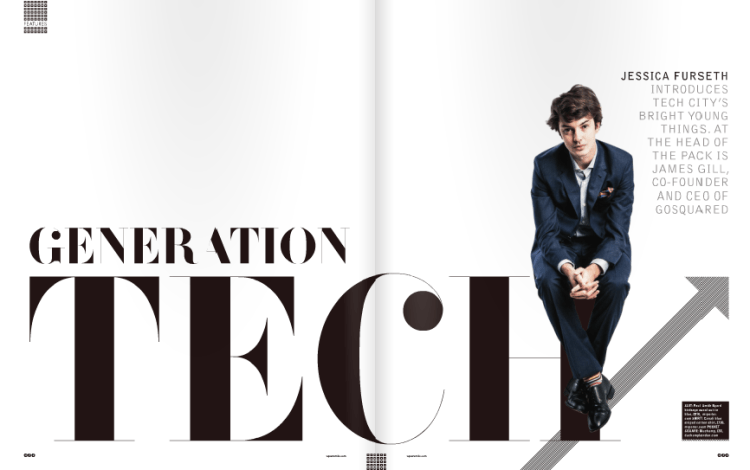
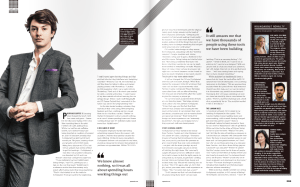
Interview with James Gill, co-founder and CEO of GoSquared

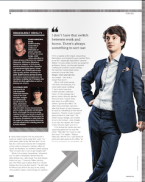
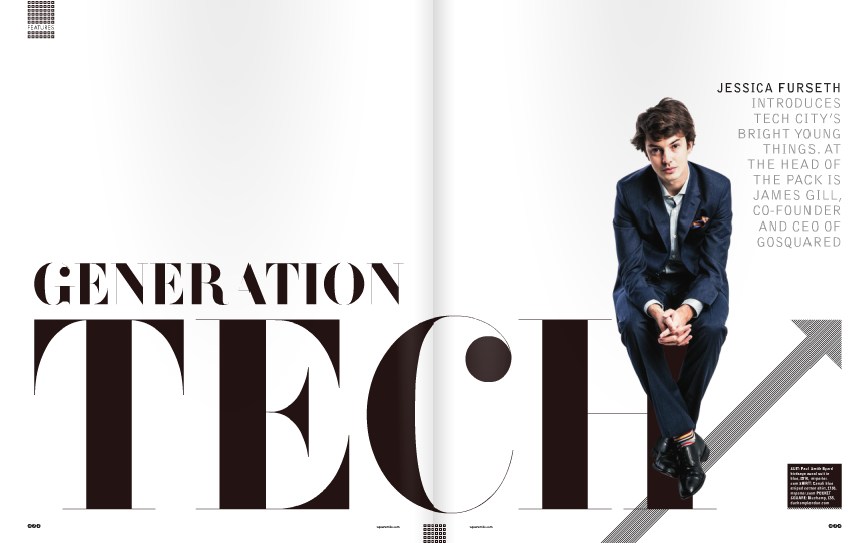
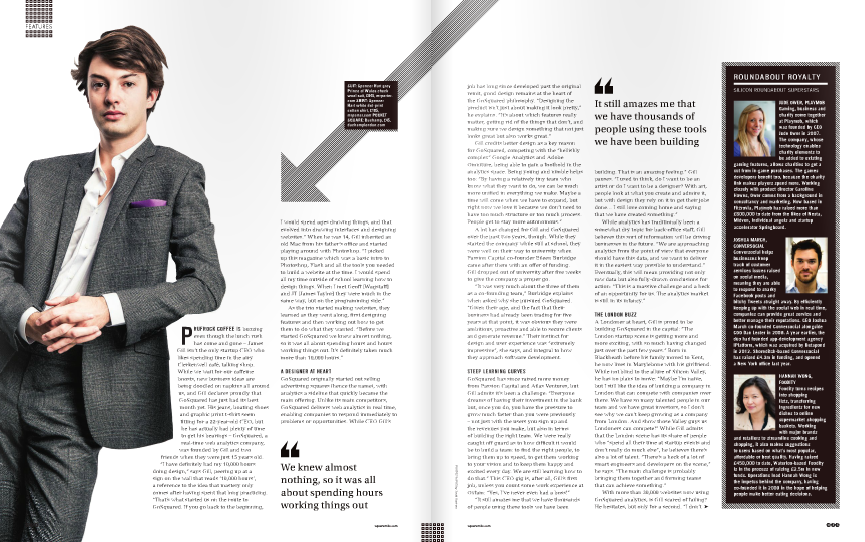
Prufrock Coffee is buzzing even though the lunch rush has come and gone, as James Gill isn’t the only startup CEO who likes hauling up in the airy Clerkenwell cafe to talk shop. While we wait for our caffeine, new business ideas are being doodled on napkins all around us, and Gill declares proudly that GoSquared has just had its best month yet. In jeans and boating shoes, his graphic print t-shirt seem fitting for a 22-year-old CEO, but Gill has actually had plenty of time to get his bearings – GoSquared, the real-time web analytics company, was founded by Gill and two friends when they were just 15 years old.

“I have definitely had my 10,000 hours doing design,” says Gill, peering up on the wall to the sign that reads ‘10,000 hours’, a reference to the idea that mastery only comes after having spent that long practicing. “That’s what started us on the route to GoSquared. If you go back to the beginning I would spend ages drawing things, and that evolved into drawing interfaces and designing websites.” When he was 14, Gill inherited an old Mac from his father’s office, and started playing around with Photoshop. “I picked up this magazine which was a basic intro to Photoshop, Flash and all the tools you needed to build a website at the time. I would spend all my time outside of school learning how to design things. When I met Geoff [Wagstaff] and JT [James Taylor] they were much in the same way, but on the programming side.” As the trio started making websites they learned as they went along, first designing features and then working out how to get them to do what they wanted. “Before we started GoSquared we knew almost nothing, so it was all about spending hours and hours working things out. It’s definitely taken more than 10,000 hours.”

GoSquared originally started out selling advertising squares (hence the name), with analytics being a sideline that quickly became the main offering. Unlike the main competitors, GoSquared delivers web analytics in real time, enabling companies to respond immediately to problems or opportunities. While CEO Gill’s job has long-since developed past the original remit, good design remains at the heart of the GoSquared philosophy: “Designing the product isn’t just about making it look pretty. It’s about which features really matter, getting rid of the things that don’t, and making sure we design something that not just looks great but also works great.”

Competing with the “hellishly complex” Google Analytics, and Adobe Omniture, Gill credits better design as a key reason GoSquared has been able to gain a foothold in the analytics space. Being young and nimble helps too: “By having a relatively tiny team who know what they want to do, we can be much more unified in everything we make. … Maybe a time will come when we have to expand, but right now we love it because we don’t need to have too much structure or too much process. People get to stay more autonomous.”

A lot has changed for Gill and GoSquared over the past two years, though. While they started the company while still in school, the trio was well on their way to university when Passion Capital co-founder Eileen Burbidge came after them with an offer of funding. Gill dropped out of university after five weeks to give the company a proper go.

“It was very much about the three of them as a co-founding team, says Burbidge when asked why she pursued GoSquared. “Given their age, and the fact that their business had already been trading for five years at that point, it was obvious they were ambitious, proactive and able to secure clients and generate revenue.” Their instinct for design and user experience was “extremely impressive”, says Burbidge, and integral to how they approach software development.

GoSquared has since raised more money from Passion Capital and Atlas Ventures, but Gill admits it’s been a challenge: “Everyone dreams of having their investment in the bank, but once you do, you have the pressure to grow much faster than you were previously. Not just with the users you sign up and the revenues you make, but also in terms of building the right team. We were really caught off guard as to how difficult it would be to build a team: to find the right people, to bring them up to speed, to get them working to your vision and to keep them happy and excited every day. We are still learning how to do that.” This CEO gig is, after all, Gill’s first job, unless you count some work experience at Oxfam: “Yes, I’ve never even had a boss!”

“It still amazes me that we have thousands of people using these tools we have been building. That is an amazing feeling.” Gill pauses. “I used to think, do I want to be an artist or do I want to be a designer? With art, people look at what you create and admire it, but with design they rely on it to get their jobs done. … I still love coming home and saying that we have created something.”

While analytics has traditionally been a somewhat dry topic for back-office staff, Gill believes this is the sort of information that will be driving businesses in the future. “We are approaching analytics from the point of view that everyone should have this data, and we want to deliver it in the easiest way possible to understand.” Eventually, this will mean providing not just raw data, but fully drawn conclusions for action: “This is a massive challenge and a heck of an opportunity for us. The analytics market is still in its infancy.”

A Londoner at heart, Gill is proud to be building GoSquared in the capital: “The London startup scene is getting more and more exciting, with so much having changed just over the past few years.” Born in Blackheath before his family moved to Kent, he now lives in the city with his girlfriend. While not blind to the allure of Silicon Valley, he has no plans of moving: “Maybe I’m naive, but I still like the idea of building a company in London that can compete with companies over there. We have so many talented people in our team and we have great investors, so I don’t see why we can’t keep growing as a company from London. And to show those Valley guys us Londoners can compete!” While Gill admits the London scene has its share of people who “spend all their time at startup events and don’t really do much else”, there’s also a lot of talent: “There’s a heck of a lot of smart engineers and developers on the scene. The main challenge is probably bringing them together and forming teams that can achieve something.”

With over 30,000 websites now using GoSquared analytics, is Gill scared of failing? He hesitates, but only for a second: “I don’t really think about it. For me there isn’t really an option but to make this work. I’ve sunk seven years of my life into this!“ To be fair, the worst case scenario for GoSquared at this point is probably a buyout, offers for which are frequent, confirms Gill: “But we really don’t want to get bought out!”

While Gill is doing “everything I physically can” to push GoSquared, there’s time for other things too, just about. For most things there’s an app: “I have my Nike+ running app. The YPlan app is great, they’re a London startup that help you find events.” He pulls out his iPhone and shows it to me, along with another couple of apps whose design he admires. Gill is a regular at the rugby to support the Harlequins, and frequently goes back to Kent to see his “amazingly supportive” parents. Before I’ve even asked he tells me about his girlfriend Emma, who has just started working for another London startup. He loves the London food scene, especially places like ‘Dirty Burger’ where they do just the one burger but what a burger it is – a well-designed concept.

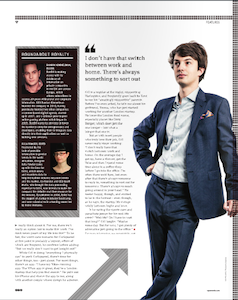
But as most people who truly love their job, Gill never really stops working: “I don’t really have that switch between work and home. On the average day I get up, have a shower, get the Tube and then I spend some time alone in a coffee shop before I go into the office. I’m often there until 8pm, but even after that there’s always someone to reply to, something to sort out for tomorrow. There’s always so much going around in your head.” He seems happy though, excited to be in the hotseat, even though as he says, the startup life swings wildly between highs and lows. Is he saving the sports cars and parachute jumps for his mid-life crisis? “Mid-life? Do I have to wait that long?” Gill laughs. “Maybe someday. But for now I get plenty of adrenaline just going to the office.”
tech1tech2tech3


***
Roundabout Royalty

Jude Ower, Playmob
Gaming, business and charity comes together at Playmob, the company founded by CEO Jude Ower in 2007. The company, whose technology enables charity elements to be added to existing gaming features, lets charities get a cut from in-game purchases. The games developers benefit too, as the charity link makes players spend more. Working closely with product director Caroline Howes, Ower comes from a background in consultancy and marketing. Now based in Fitzrovia, Playmob has raised more than $1 million to date, from the likes of Nesta, Midven, individual angels and startup accelerator Springboard.

Joshua March, Conversocial
Conversocial helps businesses keep track of customer services issues raised on social media, so they can respond right away to snarky Facebook posts and bitchy Tweets. By efficiently keeping up with the social web in real time, companies can provide great service and better manage their reputations. CEO Joshua March co-founded Conversocial alongside COO Dan Lester in 2009. A year earlier the duo had founded app-development agency iPlatform, which was acquired by Betapond in 2012. Shoreditch-based Conversocial has raised $7 million in funding, and last year opened a New York office.

Julia Fowler, Editd
Frustrated with the lack of provable information to predict trends in the world of fashion, designer Julia Fowler came up with the idea for Editd. The company mines and examines data to help the fashion industry measure trends and the market. Co-founder and CEO Geoff Watts brought the data processing expertise to Editd, and now aims to make the company the definite real-time resource for the industry. Established in 2009, Editd has the support of startup incubator Seedcamp, and later raised $1.6 million in a funding round led by Index Ventures.

Damian Kimmelman, DueDil
DueDil is making waves with its database of information on private companies in the UK and across Europe, letting subscribers access 20 years of financial and corporate information on private companies. CEO Damian Kimmelman founded the company in 2010, having previously founded two companies: a London-based digital agency in 2007, and a Chinese peer-to-peer online gaming platform in 2005. DueDil wants its services to lower the barrier to entry for entrepreneurs and developers, enabling them to integrate data directly into their applications as well as building new services.

Hannah Wong, Foodity
Foodity turns recipes into shopping lists, transferring ingredients for new dishes to online supermarket shopping baskets. Working with major brands and retailers to streamline cooking and shopping, Foodity also makes suggestions to users based on what’s most popular, affordable or best quality. Having raised £450,000 to date, the Waterloo-based company is currently in the process of raising an expected £2.5 million in new funds. Operations lead Hannah Wong is the impetus behind the company, having co-founded Foodity in 2009 in the hope of helping people make better eating decisions. She previously set up meal-planning website ‘The Resourceful Cook’.
Språket nærmest hjertet

Sør-Trøndelag, November 2013.

Språket nærmest hjertet
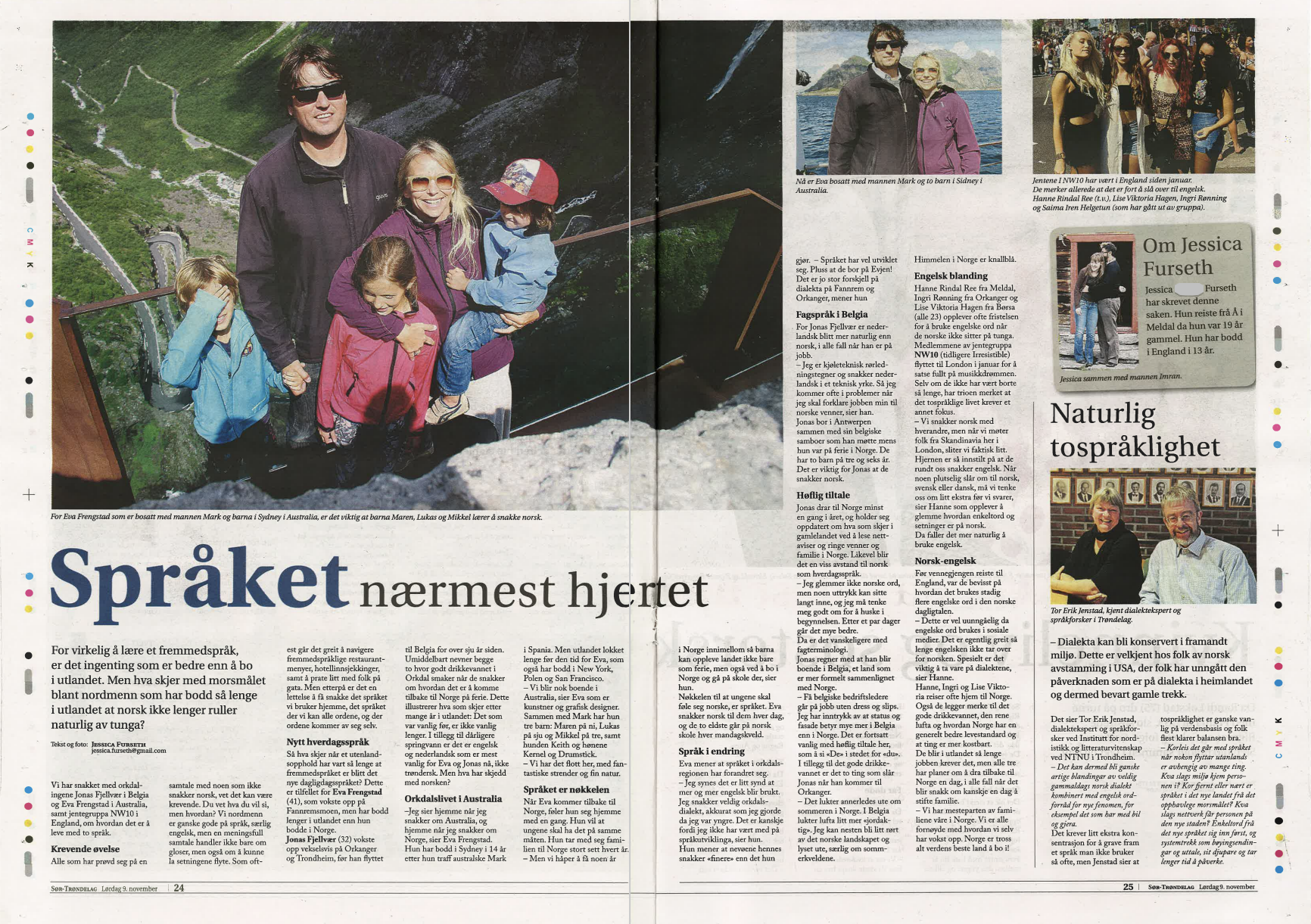
Ingenting slår å bo i utlandet for å virkelig lære et fremmedspråk. Men hva skjer med morsmålet for nordmenn som har bodd så lenge i utlandet at norsk ikke lenger ruller naturlig av tunga? Vi snakket med Orkdalingene Jonas Fjellvær i Belgia og Eva Frengstad i Australia, samt jentegruppa NW10 i England, om hvordan det er å leve på to språk.

Alle som har prøvd seg på en samtale med noen som ikke snakker norsk vet det kan være krevende. Du vet hva du vil si, men hvordan? Vi nordmenn er ganske gode på språk, særlig engelsk, men en meningsfull samtale handler ikke bare om gloser. men også om å kunne la setningene flyte. Som oftest går det greit å navigere fremmedspråklige restaurantmenyer, hotellinsjekkinger, samt å prate litt med folk på gata. Men etterpå er det en lettelse da, å få snakke det språket man bruker hjemme, det språket der man kan alle ordene og de kommer av seg selv.

Så hva skjer når et utenlandsopphold har vart så lenge at fremmedspråket har blitt det nye dagligdagsspråket? Dette er tilfelle for Eva Frengstad (41), som vokste opp på Fannremsmoen men har siden bodd i utlandet lenger enn hun bodde i Norge. Jonas Fjellvær (32) vokste opp vekselsvis på Orkanger og i Trondheim, før han flyttet til Belgia for over sju år siden. Begge to nevner med en gang hvor godt drikkevannet i Orkdal smaker når de snakker om hvordan det er å komme tilbake til Norge på ferie, noe kanskje få lokalfolk tenker like mye på. Men detaljen illustrerer hva som skjer etter mange år i utlandet: det som var vanlig før, er ikke vanlig lenger. I tillegg til dårligere springvann er det engelsk og nederlandsk som er mest vanlig for Eva og Jonas nå, ikke trønder. Så hva har skjedd med norsken?

Orkdalslivet i Australia
– Jeg sier hjemme når jeg snakker om Australia, og hjemme når jeg snakker om Norge, sier Eva. Hun har bodd i Sydney i 14 år, dit hun flyttet etter hun traff australske Mark i Spania. Men utlandet lokket lenge før den tid for Eva, som har også bodd i New York, Polen og San Francisco. – Vi blir nok boende i Australia, sier Eva, som er kunstner og grafisk designer. Sammen med Mark har hun tre barn: Maren på ni, Lukas på sju og Mikkel på tre, samt hunden Keith og hønene Kernel og Drumstick. – Vi har det flott her, med fantastiske strender og fin natur.

Eva føler seg hjemme i Norge med en gang hun kommer tilbake, og vil at ungene skal ha det på samme måten. Hun tar med seg familien til Norge stort sett hvert år. – Men vi håper å få noen år i Norge innimellom så barna kan oppleve landet ikke bare som ferie, men også å bo i Norge og gå på skole der, sier hun. At nordmenn er litt mer jordnære er en av tingene Eva har lagt merke til etter hun reiste bort, men språket er nøkkelen til at ungene skal føle seg norske. Eva snakker norsk til dem hver dag, og de to eldste går på norsk skole hver mandagskveld.

Eva har vært borte fra Norge lenge nok til at hun legger merke til å språket i Orkdalsregionen har forandret seg. – Jeg synes det litt synd at mer og mer engelsk blir brukt. Jeg snakker veldig orkdalsk, akkurat som jeg gjorde da jeg var yngre. Det er kanskje fordi jeg ikke har vært med på språkutviklinga, sier hun. – Jeg hører at nevøene mine snakker ‘finere’ enn det jeg gjør. Språket har vel utviklet seg. Pluss at de bor på Evjen! Det er jo stor forskjell på dialekta på Fannrem og Orkanger.

Fagspråk i Belgia
For Jonas har nederlandsk blitt mer naturlig enn norsk, hvertfall når han er på jobb. – Jeg er kjøleteknisk rørledningstegner og snakker nederlandsk i et teknisk yrke. Så jeg kommer ofte i problemer når jeg skal forklare jobben min til norske venner, sier han. Jonas bor nå i Antwerpen, sammen med sin belgiske partner som han møtte mens hun var på ferie i Norge. De har to barn på tre og seks år, og det er viktig for Jonas at de snakker norsk.

Jonas drar til Norge en gang for året, ofte to, og holder seg oppdatert med hva som skjer i gamlelandet med å lese nettaviser og ringe venner og familie i Norge. Men likevel blir det en viss avstand fra norsk som dagligdagsspråk. – Jeg glemmer ikke norske ord, men noen uttrykk kan sitte langt inne og jeg må tenke meg godt om for å huske i begynnelsen. Etter et par dager går det mye bedre. Vanskeligere er da hvis en har lært seg noe nytt i utlandet, slik som fagterminologi, sier Jonas. Han regner med han blir boende i Belgia, et land som er mer formelt sammenlignet med Norge. – Få belgiske bedriftsledere går på jobb uten dress og slips! Status og fasade har jeg intrykk av at betyr mye mer i Belgia enn i Norge. Det er fortsatt brukelig med høflig tiltale her, å si ‘De’ i stedet for ‘du’.

I tillegg til det gode drikkevannet er det to ting som alltid slår Jonas når han kommer til Orkanger. – Det lukter annerledes ute om sommeren der. I Belgia lukter lufta litt mer jordaktig, det er vanskelig å beskrive. Jeg kan nesten bli litt rørt av det norske landskapet og lyset ute, særlig om sommerkveldene. Himmelen i Norge er knallblå.

Naturlig tospråklighet
Selv om Eva og Jonas holder nær kontakt med Norge har det nye livet i utlandet likevel blitt det normale. Begge går aktivt inn for å bevare norsken, og særlig Eva merker at dialekta hun tok med seg til utlandet ikke er helt den samme som brukes der hun kom fra lenger.

– Dialekten kan bli konservert i framandt miljø. Dette er velkjent hos folk av norsk avstamming i USA, der folk har unngått den påverknaden som er på dialekten i heimlandet og dermed bevart gamle trekk, sier Tor Erik Jenstad, dialektekspert og språkforsker ved Institutt for nordistikk og litteraturvitskap ved NTNU i Trondheim. – Det kan dermed bli ganske artige blandingar av veldig gammaldags norsk dialekt kombinert med engelsk ordforråd for nye fenomen, for eksempel det som har med bil å gjera.

Det krever litt ekstra konsentrasjon når man skal grave fram et språk man ikke bruker så ofte, men Jenstad sier at tospråklighet er ganske vanlig på verdensbasis og folk flest klarer balansen bra. – Kor det går med språket når noen flyttar utanlands er avhengig av mange ting. Kva slags miljø kjem personen i? Kor fjernt eller nært er språket i det nye landet frå det opphavlege morsmålet? Kva slags nettverk får personen på den nye staden? Enkeltord frå det nye språket sig inn først, og systemtrekk som bøyingsendingar og uttale sit djupare og tar lenger tid å påverke.

Engelsk blanding
Fristelsen for å bruke engelske ord når de norske ikke sitter på tunga er noe Hanne Rindal Ree fra Meldal, Ingri Rønning fra Orkanger, og Lise Viktoria Hagen fra Børsa (alle 23) ofte kommer ut for. Medlemmene av jentegruppa NW10 (tidligere Irresistible) flyttet til London i januar for å satse fullt på musikkdrømmen, og selv om de ikke har vært borte så lenge har trioen lagt merke til at det tospråklige livet krever et annet fokus.

– Vi snakker jo norsk med hverandre, men når vi møter folk fra Skandinavia her i London sliter vi faktisk litt. Hjernen er så innstilt på at de rundt oss snakker engelsk, så når noen plutselig slår om til norsk, svensk eller dansk må vi tenke oss om litt ekstra før vi svarer, sier Hanne, som snakker på vegne av gruppa. – Men det er ord og setninger vi glemmer hvordan er på norsk. Da faller det mer naturlig å si det på engelsk.

Selv før vennegjengen reiste til England var de bevisst hvordan det brukes stadig flere engelske ord i den norske dagligtalen. – Dette er vel uungåelig med tanke på bruk av engelske ord i sosiale medier. Men vi synes dette er greit så lenge engelsken ikke tar over for norsken. Særlig er det viktig å ta vare på dialektene!

Hanne, Ingri og Lise Viktoria reiser hjem til Norge ofte, der også de legger merke til det gode drikkvannet, den rene lufta, og hvordan Norge har en generelt bedre levestandard og ting er mer kostbart. De blir værende i utlandet så lenge jobben krever det, men alle tre har planer om å dra tilbake til Norge en dag, i alle fall når det blir snakk om å kanskje en dag stifte familie. – Vi har mesteparten av familiene våre i Norge, og vi er alle fornøyde med hvordan vi selv har vokst opp der. Norge er jo tross alt verdens beste land å bo i.

Skrevet av Jessica Furseth, som reiste frå Å i Meldal da hun var 19 år gammel og har bodd i England i 13 år.

The new world of work

Portfolio Magazine, autumn 2013. Original article here.

portfolio

The new world of work

The way we work is in a state of flux, as a Big Bang of technology, globalisation and sociological changes is sending shock waves through every aspect of life. We are in the midst of the biggest transformation the world has ever seen, even bigger than the industrial revolution – this is how Lynda Gratton describes the information revolution.

So it is no wonder the world of work is transforming too, as we have never been more connected and the possibilities have never been greater. As Professor of Management Practice at the London Business School, Gratton’s research on the future of work has made her a leading authority on how people operate in organisations, and what we can expect from a future with seemingly infinite information at our fingertips and the opportunity to collaborate with people anywhere on the planet.

“It is not even about the future anymore, as so many of these changes are happening right now,” says Gratton, pointing to how we are speaking on the phone from our respective homes, as both of us are writing today and that is easier when we are alone. “We will see even more advanced technology coming along, making it seem as if the person on the video link is sitting right in front of us. We will see much more sophisticated ways of handling knowledge in a firm, and we are going to see changes in management perspectives.”

As technology has finally become sophisticated enough for people to connect from a distance without a stuttering internet connection getting in the way, businesses must face the challenge: how do we manage this opportunity? The ability to securely access company files from afar means employers do not necessarily have to sit in the office to get things done. Parents can take a few hours out in the afternoon to see their kids before picking up work again later, while high-definition video conferencing is increasingly embraced by international corporations looking to cut down on travel. Are we headed for a future where being in the same room as your colleagues is only for special occasions?

“It is a complex issue, because it has to do with the character of the person, the character of the work, and the character of the organisation,” says Gratton. “It is also down to how complex the work is, and how much people rely on others for knowledge transfer.” Because having a job that can be done remotely does not necessarily mean the company wants you to. Yahoo!’s new boss Marissa Mayer caused a stir when she everyone to show their faces every day because the company had lost its culture. Gratton can understand why Yahoo! made this call, as her research through the ‘Future of Work’ consortium shows there are times when only face-to-face contact will do: “When work is very complex and has a lot of interdependency, it is difficult to really get knowledge transfer going when people are not in the same place.”

In addition to ‘Future of Work’, which draws on experience from over 60 companies, Gratton also leads the ‘Inclusion & Diversity’ consortium. The culmination of her research is presented in her book ‘The Shift’, which discusses how the world of work is fundamentally changing. A common feature among companies succeeding in this new reality is a solid grasp on how to facilitate good relationships between workers who are not in the same room, Gratton has found. This is not as easy as it may sound, as humans are social creatures who thrive on the rituals of tea rounds and weather chat. So is it really possible to foster team cohesion without these niceties?

“Running a virtual team is not the same as running a face-to-face team. You have to be a lot more thoughtful about how you introduce people, the way they understand who each other are, and how they prefer to work,” says Gratton. “You have to build processes that recreate what people do naturally. There are rapid developments in this field, both in terms of technology and practices.” For those used to working face-to-face, the thought of dealing with colleagues via chat rooms may sound horrifying. But it is already happening: collaboration specialist Yammer was acquired by Microsoft last year, as the technology giant is keen to incorporate nifty interaction features such as Twitter-style @-replies, hashtags for sorting discussion topics, and Facebook-esque ‘Likes’ to signal opinions.

This is second nature for the millennials, the generation born between 1980 and 1995, who often prefer instant messaging to the telephone. Raised on the internet, the millennials are also much less willing to forego the flexibility that technology now affords, looking to employers to provide flexi-time and personal development opportunities. This was the conclusion when PwC, aided by Gratton’s team at the London Business School, presented its large generational study into what millennials want from work. While younger workers may take more naturally to this shift, Gratton disagrees that a generational change may be needed before this trend can permeate the average company:

“I do not agree with that at all. I am a baby boomer myself, and when I run a World Economic Forum team I work with academics from all over the world, half of whom I have never met. … Obviously some people resent working virtually, but at any age there is going to be some people who think it is terrible. We are certainly getting used to it.” Most people will find themselves at a lower rung on the corporate ladder though, often dealing with managers measuring productivity by how many hours your coat is hung on the back of your chair. The issue of trust goes back to the attitude of the organisation, says Gratton, acknowledging there are certainly companies where ‘presenteeism’ is the golden standard. But as anyone who has had an office job knows, being present does not necessarily mean you are working. “What we have to do is change the way we measure performance,” says Gratton. “This is more complex than face-to-face management, meaning managers have to get better. It is a more difficult task.”

While ‘presenteeism’ is starting to lose its grip on UK workplaces, it is still a major issue in other markets such as Japan. Gratton thinks change is afoot also there, as the younger generation is bringing with them a desire for more flexibility, especially as child-rearing is increasingly a task for dad as well as mum. Still, Gratton is reluctant to call one way of management better than the other: “Take investment banks, where you have to work from 8am to 10pm. I do not know if that is the right deal, but anyone who joins knows that is the deal. The consequence is that they are not always going to be attracting the most interesting people,” says Gratton.

As the PwC study shows that younger people are increasingly skeptical of the merits of letting their work be their life, Yahoo! may well lose some of their employees over the decision to cut back on flexibility. But, concludes Gratton, but only time will tell if this ‘backlash’ was the right decision: “There are no rights or wrongs, just consequences. As a leader, you need to decide what sort of corporation you want to build.”

Screen Shot 2014-02-21 at 19.12.52

The Hedge Magazine Interview

Screen Shot 2018-07-19 at 14.47.15

Interviews with alternative investment company founders, leading fund managers and industry experts, published in Hedge Magazine from 2012 to 2020. 

Screen Shot 2015-09-25 at 14.09.10

* Erik Serrano Berntsen, CEO and co-founder of Stable Asset Management. “I was looking at starting businesses, and it so happened to be hedge fund businesses. […] What excites me is finding people who want to do something new, set up something they’re proud of, make money for people but also create working environments that are rewarding.”

Screen Shot 2015-11-27 at 15.36.28

* Gemma Godfrey, founder of Moo.la. “What’s exciting is that now, with technology, you can make it cheaper to provide this service to people. If you can lower the cost of providing this service, then you can open it up to more people.”

Screen Shot 2016-05-24 at 13.08.14

* Carl Hall, partner at Alder private equity and author of The Environmental Capitalist. “In five-ten years from now, everything is going to be electric or plug-in hybrid. Those technologies are completely taking over,” asserts Hall. “Once change starts, it goes much faster than you think.”

Screen Shot 2016-02-01 at 17.21.30

* Jean-Francois Comte, co-founder and managing partner of Lutetia Capital. “This may explain why Comte is so methodical when talking about how Lutetia gets its edge: “People can come out of that environment with something of a military thinking – there’s this discipline. In M&A, at that level, there’s no margin for error. One of our staffers used to say to new recruits: ‘The difference between this and war, is that you get to go home’.”

Screen Shot 2014-10-13 at 18.19.20

Dixon Boardman, founder and CEO of Optima Fund Management. “I have befriended many of the managers we have money with. I’ve got to know them well and see them socially, and I know their children. It’s old-fashioned, but I think to know someone really, really well, to know what’s going on in their lives, means you know when they’re focused. […] But let me tell you, we don’t always get it right!” Boardman laughs. “But we get it right more often than we get it wrong.”

Screen Shot 2015-08-04 at 17.09.05

* Ramon Vega, founder and CEO of Vega Swiss Asset Management. “What you’re trying to do, as manager, is make your people feel good, and feel important. Then they are loyal to you, because you made them feel like that. Then you start to have a winning team around you.” The problem is that lots of bosses actually don’t like managing: “They want to go and fix it themselves! But I don’t know any football manager who goes onto the pitch himself if the striker doesn’t score.”

Screen Shot 2016-03-30 at 19.25.17

* Lee Freeman-Shor, portfolio manager at Old Mutual European Best Ideas fund, and author of The Art of Execution. “I’ve always had a natural interest in what’s now called behavioural finance psychology. … I suppose my natural interest in psychology led me to look in the right areas to solve that problem: how the best investors can be wrong most of the time, and still make a ton of money.”

Screen Shot 2015-04-08 at 16.16.03

* Aref Karim, CEO, CIO and founder of Quality Capital Management. “Why does QCM exist? Why are you running the business still?’ It’s because I’m very passionate about it, and more importantly it’s because there’s almost a philosophical and societal purpose behind it.””

Further interviews:

Straight to work

Businesslife, October 2013. Original article (p48-50).

BL oct13Why millennials are skipping university to go straight to the office
University is no longer the obvious choice for star candidates once their A-levels are done and the certificate is neatly framed. With soaring tuition fees and declining salary premiums after graduation, talented young people are increasingly choosing to forego life on campus. As industrious youngsters are champing at the bit to get to work, companies are finding they need to look beyond the graduate pool or risk missing out on top talent.

18-year-olds are finding increasingly more training schemes tailored especially for them, offered by future-minded companies looking to foster talent. Law, banking and accountancy are industries which have long picked up people at a young age, but as businesses are waking up to the fact that university is not the only route for the best and brightest, the trend has spread to technology, consultancy, engineering and marketing.

With tuition fees up to £9,000 per year, students who take out full loans will now emerge with a debt of at least £43,500 at the end of their degree. This is a significant burden when considering the graduate premium, traditionally cited to be £100,000 in extra earnings over a lifetime, has fallen by almost a third in the 15 years since 1993, according to research from the University of Essex. Consequently, UK university applications fell by 6.6% in 2012, and although 2013 is shaping up a bit better, this year’s UCAS figures are still below those of 2010, as prospective students are questioning whether university is worth it after all.

“It’s certainly a financial decision for students, but it’s also a lifestyle decision. Do I really want to go to university? Will I get a job in the area I want afterwards?” says Shelley Kendrick, director at recruitment specialist Kendrick Rose in Jersey. A bursary scheme, sandwich degree, or on-the-job training, may be a better bet for many. “For the organisations it’s about finding the right people for them, and a lot of that is about culture, competency, confidence, initiative and drive. Working is very different from university and a degree doesn’t give you common sense,” says Kendrick. “Communication and teamwork – those are the things employers are looking for now.”

Recruiting straight from school is a particularly important consideration for Channel Island employers, says Chris Usher, director of commerce and senior lecturer at Jersey International Business School (JIBS). “Although historically a somewhat fixed model on the island, going away to university is not necessarily right for everyone,” says Usher. JIBS offers a two-year degree in International Financial Services, awarded by the University of Buckingham, where students go to school part of the week and also get paid to work at either HSBC, RBSI, UBS or Standard Chartered.

“What the banks are getting out of this is to recruit that top quality talent. Traditionally there was a danger Jersey would lose some of the best and brightest as they go off to university to the UK and maybe not to return, or to return much later in their career,” says Usher, who plans to offer law and wealth management placements in the next year.

Usher agrees that it takes “a very committed individual” to study and work at the same time, a lifestyle that certainly leaves less time for partying. This will be a concern for a fair few 18-year-olds, meaning the trick for the companies is to identify the ones who will be worth the investment.

“Yes, they are young,” acknowledges Evelyn Brady, partner at PwC in Guernsey, “but our HeadStart programme particularly addresses people who come straight from school. We hold assessment event days, and we make sure the candidates understand what they are signing up for. If they join a firm like ours they have to commit to actually studying. We make sure they choose the right route, and that they have the right mentors to help them develop.”

Brady describes the success from PwC’s school-leaver programme as “phenomenal”, with the number of applications rising each year. Although there is always a risk that people may leave after their training, Brady says this is no more likely with the A-level students than any other age group. Hiring young candidates also mean an opportunity to raise people in the company culture, creating a degree of loyalty. Not to mention the benefit to the office of injecting some fresh blood every year: “We get people from different generations working together, contributing different insights. It’s important for us to be on top of changing dynamics in the workforce.”

Because joining a company like PwC means taking formal industry exams, Brady does not think the A-level recruits will lose out financially later in life by forgoing university: “Not if they are very, very disciplined, no. They need to do the exams, and they need to do an international rotation to show they can operate in environments beyond the Channel Islands. But if they do this, their opportunities are the same as anybody else’s.”

Events aimed at identifying talent from the school-leaver pool are run also by RBC, where promising candidates will be guided through professional exams. “Our focus is on providing robust and dynamic training to help attract, retain and develop young talent, irrespective of whether they have been to university,” says Alison Creed, joint head of RBC Corporate Employee & Executive Services in Jersey. “Many who have come through on the ‘Advance to Work’ scheme now have permanent positions at the company.”

Jackie Hankin, HR leader at EY (Ernst & Young) Channel Islands, says the company is seeing a rising number of candidates come through on the company’s school-leaver route: “There are lots of talented people out there who aren’t going to university, so if we didn’t recruit from that pool, we would miss out.” Once the Association of Certified Chartered Accountants exams are completed, the school-leavers stand at the same level of opportunity as anyone else at EY, says Hankin. “We want to build relationships for life. It’s a two-way street: the better the people who work for us, the better we are able to service our clients.”

But while opportunities abound for A-level students willing to put in the hard graft, no one interviewed for this article believes we are headed for a future where university will be obsolete.

“There will always be the gravitas and the caliber of a degree,” says Shelley Kendrick; this is true especially in certain industries or in companies where they really want to see a diploma from Oxbridge. University is also a valuable lesson in independence, and for many a necessary time to grow up a bit more before choosing a career. “You will get star graduates and run-of-the-mill graduates, and it’s the same with A-level students,” says Kendrick. “The stars will always stand out, and it’s up to organisations to recognise them.”

While agreeing that universities will remain relevant, Evelyn Brady believes companies are waking up to the fact that further education is not for everybody: “By ignoring people who don’t choose university you can certainly miss out on some top talent. At PwC we want to get the intake mix right. If we didn’t recruit school-leavers as well as graduates, we would run the risk of losing out on local talent.”

Screen Shot 2014-02-21 at 19.06.10

Layer of fog

This Recording, 2013. Original article.

TR fogLayer of fog
The text he sent me yesterday, telling me he misses me and wants to be my friend. I respond I would like that too, but I don’t know how. We sigh, as far as that’s possible to do over text, and then do nothing.

That I’m old now, meaning I know you don’t get to be friends, not right away like this. The god of break-ups owns this time, and the deity will make you sit in the waiting room flicking through the thoughts in your head, working through every little tedious thread in the tangle.

That I know why we broke up but I don’t think he does because he keeps asking me: “Did you leave because I’m so broke right now? Did you end it because I take drugs sometimes? Was it because of that guy you met, the one you keep meeting up with?” I feel the anger swell in my chest when he asks this, because it’s none of these things and yet all of these things, and so much more. But most of all it’s how he doesn’t hear me when I try and tell him. I spent the best part of a season trying to salvage things, trying to explain what the problem was, desperately sifting through all the words in my arsenal to find the ones that would show him how I felt. More than anything I wanted him to understand.

The moment when it started breaking. Of course I didn’t realise it at the time but with hindsight I can see it: a freezing day with grey fog hanging low over the city, on a bus because the train wasn’t running. He told me something about what he believed in and how he wanted to live, some dream about communal living and sharing resources and a commitment to social activism. All things I can understand and even admire, but the opposite of everything I wanted for myself, as a fickle introvert with a bad case of wanderlust. And felt an ache swell in my chest, realising in a flash that I’d put my eggs in his basket without understanding who he really was, and how could I have let that happened? I got off the bus and went home alone, deflated. We recovered, but I slowly started to retrieve my eggs, one by one, keeping them safe in my own house again because I didn’t trust him with them anymore.

Some Humpty-Dumpty metaphor.

That time he broke it off via text message while we were trying to work it out, sending me a missive while I was standing in a train station buying wine for a weekend away. I couldn’t even engage with what he was saying, blinded by the indignity of being dumped by text: “I am ending this because you no longer put our relationship first.” Or something like that; I’m not sure what it said exactly because I deleted it, too surreal a message to exist in the world. What I remember is that I laughed, then shook, and then I raged at the absurdity, the humiliation of being dumped in the manner of my mobile operator informing me I’ve exceeded my monthly data allowance. When I got back there was a wall of ice between us, which melted as he came knocking on my door late at night. We spent three days in bed, in a time capsule, but it didn’t last.

The fact that I felt relief when it finally ended. Too many repetitions of the same arguments. I’d stare at him in disbelief, across the pub table or across the stream of text messages, wondering how it was possible to have been with someone for so long and have it end in such confusion. How black and white it felt, everything he said. How he refused to allow for the fact that things could change. How I was probably equally frustrating to talk to for him but I can’t see it, because when you are breaking up, you no longer are who you are.

That I’m realising you never quite finish with someone you used to love, not really. My ex and I still possess pieces of each other, even as he lives on the other side of the city where he calls another woman girlfriend and I have someone else who answers to boyfriend. See it didn’t take long; I told you the breakdown was a relief.

The worst thing about this is realising how wrong I was about him. How it took me so long to get to really know him, blind to reality at an age when I really should know better. How it makes me look at my new boyfriend with a twinge of skepticism, wondering what’s lurking under the surface, as I’ve always thought myself to be a good judge of character but maybe not. I don’t often wish things were different, but I’d give a lot not to feel this way as my new boyfriend deserves better.

That I regret nothing about my ex. Not getting into it in the first place, nor any of the things that caused it to end because when it was good, it was fantastic. And when it started to break down, it felt natural. I can never admit this to him though, because it’s cruel. But I know what it feels like to be so broken up about a relationship that you can hardly breathe, and this isn’t it. All I know is that I toss my phone across the table in frustration at yet another text message where he completely misses the point. But even as I do it, I know it was all worth it.

The Megabuyte Interview

Screen Shot 2016-09-05 at 16.34.18

An ongoing monthly series running from 2012 to 2019, interviewing leading lights among UK technology CEOs, Chairmen, CFOs and investment professionals for Megabuyte

* Steve Vaughan, CEO of Phoenix IT. “A lot of people have 10% of the answer, cluttered up with lots of things that aren’t part of the answer.” Vaughan’s job is to be the one who can step back and put all these pieces of 10% together, and make a plan for the whole. “But how much of the plan is me thinking it up out of my own imagination? Not very much, I’m relieved to say.” Read

* Richard Law, CEO of GB Group. “But at some stage, if you’re going to disrupt things, you have to ignore what the crowd is telling you. That’s how you steal the march and make an impact.” Read

* Katie Potts, Founder of Herald Investment Management. “You just have to be prepared for things to take longer. I’m sensitive to how we are different from a lot of investors: we will regularly make investments that we expect to be dead money for a couple of years. … It takes time for real businesses to come through.” Read

* Chris Spencer, CEO Of Emis. “The secret to the company’s success, he believes, is not trying to do every system at once, and to not assume midwives, brain surgeons and psychiatric nurses all have the same needs. And to talk to the people doing the work on the ground and get them onboard, because it won’t work if the doctors don’t want it to.” Read

* John Hawkins, Executive Chairman of Vislink. “What you have to listen to most are the markets and the customers, and what you have to listen to least is middle management, because they have their own agenda. Where a lot of people fail is that they don’t execute on what they’ve seen in those first 60 days.” Read

* Alistair Lukies, CEO and founder of Monitise. “[In the UK] we are a little bit embarrassed about entrepreneurship, about risk-taking and all the things you need to create that kind of ecosystem of technology companies. Do I see my role as being a bit of a Pied Piper for UK doing more of this sort of thing? Yes, I absolutely hope Monitise is a good example.” Read

* Greg Day, Chief Security Officer of EMEA at Palo Alto Networks. “One of the reasons I love working in this industry is, no two days are the same. … Just when you think you have a handle on the cyber security industry, new technology comes out. New threats come out. It’s an amazing space that’s only limited by people’s imagination.” Read

* Lawrence Jones, CEO and founder of UKFast. “Asked how worked out how to manage 250 people after the startup days, Jones cites listening, reading and getting it wrong: “I’ve lost some brilliant people over the years by not understanding how to get them to the next level. But now, we understand. Now we have a good business that nurtures people. And if there’s no room for them to grow, you can advise them to set up another business, and then fund that.” Read

* Bob Falconer, CEO of Gamma Communications. “But to be frank, after an IPO you come back into the business and realise you must have been out of it for the best part of six months. You think you’ll have a rest, but it’s actually the opposite: I haven’t done this! I haven’t done that! There’s a huge period of catch-up.” Read

* Mike Norris, CEO of Computacenter. “Oh you have to read people. I’m a salesman, yes absolutely. I’m a B2B sales guy though, which is slightly different. If people don’t buy it from me, they’re going to buy it from somebody else. I’m not developing a need. But I’m a salesman. I love it – it’s the best part of the job.”” Read

* Andrew Lindsay, CEO of Telecom Plus. “Our view is that we’re at the vanguard of [the trend towards fairer customer treatment]. The customer who comes to us and gets treated well has lifetime value. This is much, much greater than a short-term disgruntled customer, even if you’re making a healthy margin out of them.” Read

* Mike Tobin, CEO of Telecity. “You have to grow up and you have to have luck. Every job I’ve gone for everyone said I would never get it. To be fair, I probably secretly thought I couldn’t do it! When I recruit someone, I don’t look at their CV. I assume whatever process they’ve gone through to sit in front of me means they have the minimum requirement. All I’m looking for is the chemistry. Can I trust this person?” Read

* Ian Churchill, CEO of BigHand. A high level of customer satisfaction, along with exciting new products and a stable financial base, were key reasons why Churchill opted to join BigHand last November. “You start to get a feel for the organisation as you go through an interview process, and it just felt like a really nice place to work. Five months in, I still think it’s a great place to work.” Read

* David Pollock, CEO and founder of Chess Telecom. “When you become very narrow, you become boring and you miss out on opportunities. I still don’t think, as a business, we’ve had our moment yet. There’s plenty more for us to achieve.” Read

* Christian Nellemann, CEO and founder of XLN Business Services. “One of the things Nellemann wants his business to be, is a champion for small businesses. “I’ve never worked for anybody else, I’ve always run small businesses. This one happened to morph into a big business. But my family has always been entrepreneurs. I have a very full understanding of the challenges of starting and running your own business: the priorities, the time pressures, the sacrifices.”” Read

* Lee Wade, CEO and co-founder of Exponential-e. “It’s our culture that drives the company. All these things we’ve talked about add up to this: Exponential-e 3.0. That’s been on our wall for ten years.” Well, there’s one thing that’s changed: the scope has expanded, from Europe to the world. “What I’m seeking here is about one thing, and one thing only. Recognition! Because we believe we are the best at what we do in the world.” Read

What millennials want from work

Published in Businesslife, August 2013. Original article here (p48-50).

BL Aug

What millennials want: Recruiting the next generation

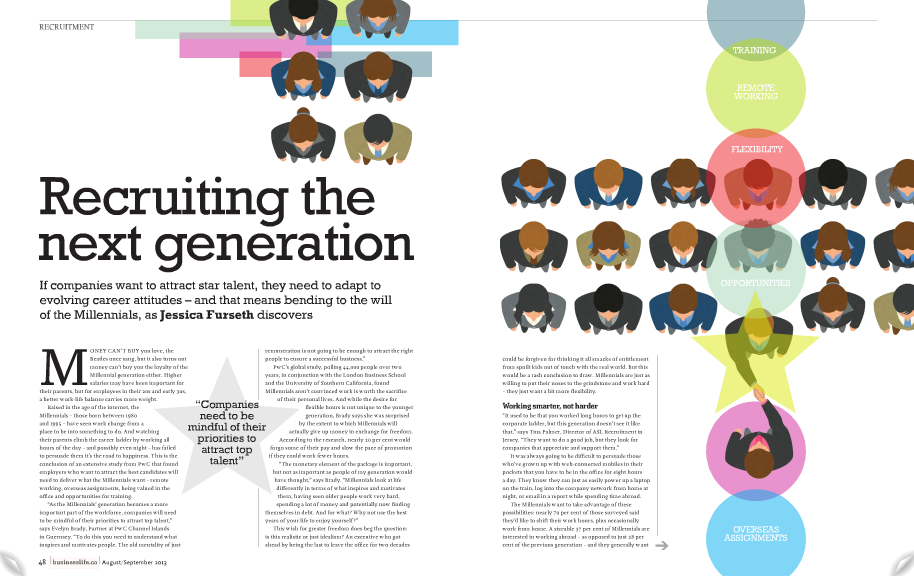
Money cannot buy you love, The Beatles once sang, but it turns out money also cannot buy you the loyalty of the millennials generation. Higher salaries may have been a key driving force for their parents, but for employees in their 20s, a better work-life balance weighs heavier on the scales.

Raised on the internet, the millennials generation – born between 1980 and 1995 – have seen work turn from a place to be, to something to do. And watching their parents climb the career ladder by working all hours of the day, and possibly even night, has failed to persuade millennials it is the road to happiness. This is the conclusion of an extensive study from PwC, which found that employers who want to continue to attract star talent will need to deliver what the millennials want: remote working, overseas consignments, being valued in the office, and opportunities for training.

“As the millennials generation becomes a more important part of the workforce, companies will need to be mindful of their priorities in order to attract top talent,” says Evelyn Brady, partner at PwC Channel Islands in Guernsey. “To attract the best candidates you need to understand what inspires and motivates people. The old mentality of just remuneration is not going to be enough to attract the right people to continue to be a successful business.”

PwC’s global study, polling 44,000 people over two years in conjunction with the London Business School and the University of Southern California, found that millennials are not convinced that work is worth the sacrifice of their personals lives. While the desire for flexible hours is not unique to the younger generation, Brady says she was surprised to what extent the millennials will actually give up money in exchange for freedom. According to the research, nearly 20% would forego some of their pay and slow the pace of promotion if they could work fewer hours.

“The monetary element of the package is important, but not as important as people of my generation would have thought.” says Brady. “Millennials look at life differently in terms of what inspires and motivates them, having seen [older] people work very hard, spending a lot of money and potentially now finding themselves in debt. And for what? Why not use the best years of your life to enjoy yourself, instead of saving for the never-never days?”

This wish for greater freedom does beg the question: is this realistic or just idealism? An executive who got ahead by being the last to leave the office for two decades be forgiven for thinking this attitude smacks of entitlement from spoilt kids out of touch with the real world. But this would be a rash conclusion. Millennials are just as willing to put their noses to the grindstone and work hard – they just want a bit more flexibility in how to go about it. “It used to be that you work really long hours to get up the corporate ladder, but this generation does not see their progression like that,” says Tina Palmer, director of ASL Recruitment in Jersey. “They want to do a good job, but they look for a company that appreciates them and supports them.”

After all, it will be difficult to persuade those who have grown up with web-connected mobiles in their pockets that it is vital to be present in the office for eight hours a day. They know they can just as easily power up a laptop on the train, log into the company network from home at night, or email in a report while spending time abroad. The millennials want to take advantage of these possibilities: nearly 70% of millennials said they would like to shift their work hours, plus occasionally work from home.

“The companies used to have all the power, telling staff: ‘If you want to get up the corporate ladder you have to be here, do this and that, and I need you in on Saturday morning’,” says Palmer. “These youngsters want to work, but they have their ethics about how they want to work, and how the company should treat them.”

This represents a significant cultural challenge for businesses, as a positive team spirit and a sense of social responsibility are all important factors for the millennials. They also want transparency around performance and compensation, and will much more easily share salary details with teammates. 37% of millennials are interested in working abroad, as opposed to just 28% of the previous generation, and they generally want to have a say in how they work rather than being told what to do.

Companies need to take these factors into account when putting together job offers for the younger generation. “People are not just looking at the money, but also at the culture of the organisation, the leadership, and what kind of working life they get. They ask, how much holiday do I get? Do I get medical? Do I get time to study? People are realising they spend a lot of time at work, and they need to be happy there,” says Palmer.

As the Channel Islands are arguably slow to adjust to new trends, a failure to attract the best millennials workers could lead to a wider skills gap, or even the islands becoming insular. While Palmer does not think Jersey companies are slow off the mark on this issue, all the sources interviewed for this article agreed that the change will take time. Evidence of adjusting attitudes are starting to be seen, however; Palmer says Channel Island staff used to job-hop, moving on every few years for the sake of a few grand: “Now people look at the packages, and often they will choose the one with better benefits, even if it is slightly lower money.”

Work-life balance is often short for getting out in time to pick up kids from school, but this is not necessarily the case for the millennials, who are still aged under 33. As 92% of those surveyed did not have children, work-life balance for them also means time for hobbies, travel, personal development, or simply wishing to meet a friend for a drink while the sun is still up.

Channel Island companies are well-positioned to respond to this desire for flexibility, because they are used to catering to working parents, says Sarah Garrood, partner at Maven Partners in Jersey: “The number of working women in the Channel Islands is very high compared to the UK. A lot of the employers here have to be flexible around the working parents situation, so Jersey seems to be very much in tune with those needs.”

Having previously spent 15 years recruiting in London, Garrood points out how Jersey and Guernsey will appeal to millennials’ sense for community and teamwork: “I have been pleasantly surprised at how much community work goes on here. It seems every day you open the local paper and read about employees engaging with the local community, be it sponsored events, sports, or companies donating staff’s time to charities.”

But while the positive examples are there, much work still needs doing before the millennials can have what they want. “We need a cultural shift in order to meet the demands of the new generation. This is happening, but it is a slow burn,” says Shelley Kendrick, managing director of Kendrick Rose in Jersey. Kendrick, who has worked closely with the Association of Graduate Recruiters, explains how the downturn has limited flexible working: “Especially since the recession, companies want a full-time headcount and there is not a great deal of job-sharing going on. Companies want people in place, by their desks, all day long.”

Having said that, Kendrick is seeing a definite change to how organisations listen to what employees want: “There is a cultural change going on among Channel Island companies, in terms of looking for people that will fit. This means looking for an attitude as opposed to just technical skills, and seeking out people who think differently and who can help the business grow.”

Especially smaller companies may find it challenging to cater to millennials’ requests for sabbaticals, volunteer assignments or year-long travel, but PwC’s Brady believes a flexible attitude and keeping an open conversation is the key: “This way it is not a surprise, so when you recruit you understand that this may be part of the career cycle. … It means thinking beyond one or two individuals in favour of a longer-term view.”

The added hassle of managing roaming staff mean corporations may initially bristle against this attitude, acknowledges Brady, but as the millennials age, they will soon make up the bulk of the workforce. In order to hire and retain top talent, companies cannot stick their head in the sand about what drives the new generation: “In order to continue to deliver positively, employees need to be able to relate to what a company is trying to achieve. There is only so much you can do with money – people will only give a certain percent of themselves that way. But if you work with them and allow them to achieve their own goals, they also allow you to achieve yours.”

After all, keeping up with a changing world is central to running a successful business: “Most corporations understand you cannot stand still.” While it will be a slow process, this is also the case for the Channel Islands, concludes Brady: “We have always had a view to the outside world. Obviously we are small islands, but most businesses here have global perspectives and deal with organisations all over the world. We need to make sure we have employees who can understand the challenges of different environments.”

Screen Shot 2014-02-21 at 19.04.27

The other mayor

Published in Square Mile Magazine, April 2013. Original article here (p78-80).

Roger GiffordInterview with the Lord Mayor of the City of London, Roger Gifford
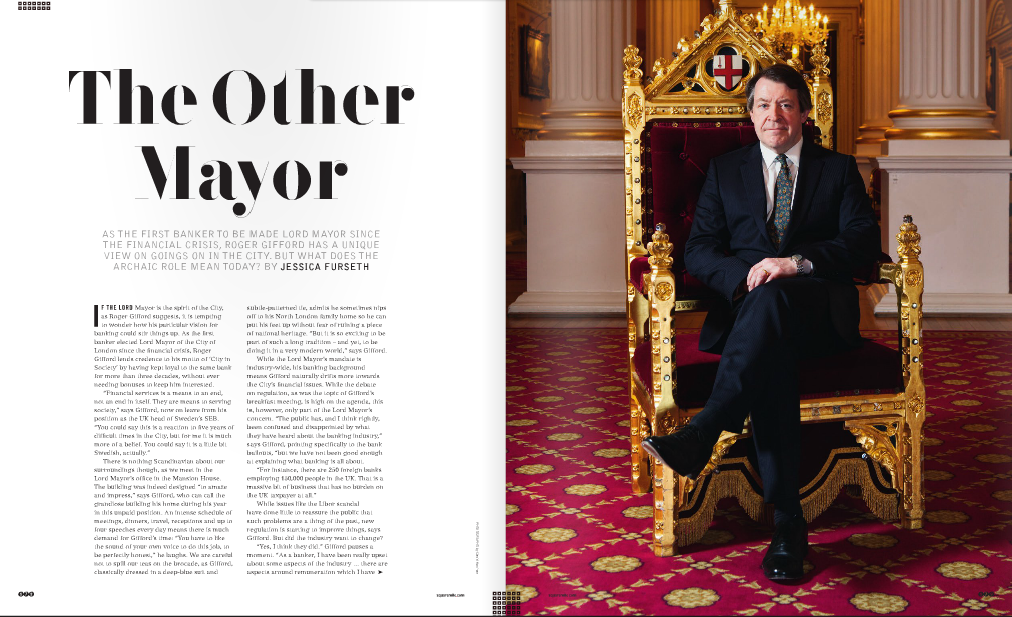
If the Lord Mayor is the spirit of the City, as Roger Gifford suggests, it is tempting to wonder how his particular brand of banking could stir things up in the City. As the first banker elected Lord Mayor of the City of London since the financial crisis, Roger Gifford lends credence to his motto of ‘City in Society’ by having kept loyal to the same bank for over three decades, without ever needing bonuses to keep him interested:

“Financial services is a means to an end, not an end in itself. They are means to serving society,” says Gifford, now on leave from his position as UK head for Sweden’s SEB. “You could say this is a reaction to five years of difficult times in the City, but for me it is much more a belief. You could say it is a little bit Swedish, actually.”

There is nothing Scandinavian about our surroundings though, as we meet in the Lord Mayor’s office in the Mansion House. The building was indeed designed “to amaze and impress”, confirms Gifford, who can call the grandiose building his home during his year in this unpaid position. An intense schedule of meetings, dinners, travel, receptions and up to four speeches every day means there is much demand for Gifford’s time: “You have to like the sound of your own voice to do this job, to be perfectly honest,” he laughs. We are careful not to spill our teas on the brocade, as Gifford, classically dressed in a deep blue suit and subtle-patterned tie, admits he sometimes nips off to his North London family home so he can put his feet up without fear of ruining a piece of national heritage. “But it is so exciting to be part of such a long tradition. And yet, to be doing it in a very modern world. It is that combination,” says Gifford.

While the Lord Mayor’s mandate is industry-wide, his banking background means Gifford naturally drifts more towards the City’s financial issues. While debates on regulation, as was the topic of Gifford’s breakfast meeting, is high on the agenda, this is however only part of the Lord Mayor’s concern. “The public has, and I think rightly, been confused and disappointed by what they have heard about the banking industry,” says Gifford, pointing specifically to the bank bail-outs, “But we have not been good enough at explaining what banking is all about. For instance, there are 250 foreign banks employing 150,000 people in the UK. That is a massive bit of business has no burden on the UK tax payer at all.”

While issues such as the Libor scandal has done little to reassure the public the problems are in the past, new regulation has already changed UK banking, says Gifford. But did the industry want change?

“Yes, I think they did.” Gifford pauses a moment. “As a banker, I have been really upset about some aspects of the industry. […] There are aspects around remuneration which I have not liked as an employer, and I am delighted they are changing.” But, notes Gifford, there is a tendency to blame procedures following a crisis, while a big part of the issue has been caused by socio-political trends of consumer over-borrowing: “You cannot really legislate for that, but people are changing regulations because of it. We have said in the City all along: we want the right regulation, not more regulation.”

Having been responsible for SEB’s UK operations for 12 years, the Scandinavian point of view has affected Gifford’s outlook on the current situation. The Swedish banking sector underwent a crisis during its deregulation 20 years ago, which means SEB now has a “more cautious, more conservative” attitude than many UK and European banks: “We have, like the Norwegian and Canadian and Australian banks, a very conservative policy on credit. We are very careful where, how much and how long we lend for. We are very careful about the derivative structured products, and we do very little of it. I have been very affected by working for a Swedish bank for 30 years.”

Gifford has previously stated how the Occupy movement sparked important discussions about what we want capitalism to be. He calls for an increased social awareness in capitalism: “We all prosper more if all parts of society are looked after. You can talk about benefit fraud, excessive social policy or taking away the will to work, but there have to be balances,” says Gifford, who credits Occupy with having made people stop and think. When asked whether this feels like a radical attitude, Gifford counters that it in fact feels very normal. But, I point out, we are sitting in this lavish building, after he as the Lord Mayor was sworn in during a silent ceremony with elaborate costumes and processions. Does the pomp and circumstance add something, or is it a distraction?

“The ceremony side of things is great fun. It is no more than 2% of the total amount of time,” asserts Gifford. “And it adds because it reminds people of the history and tradition that has developed over 800 years. There are reasons why we live the way we do, why we have the kind of government, the kind of Monarchy and the City institutions that we do. We have them because of history and they remind us of our principles, of behaviour, of activity, the direction we are going in, and they remind us that we should live for the long-term.”

There is no doubt Gifford feels is a great honour to be Lord Mayor, but, I press, does the role actually come with power? Gifford thinks for a moment. “I do not feel I have much power, but I maybe have a little bit of influence.” He pauses again. “The Lord Mayor is a representative of the City. He is the spokesman. The position is revered a bit, and that gives you responsibility to think, to behave, to discuss in a certain way. I do not think it is against the sort of person I am, but you feel the responsibility to try to influence in the right way.”

The charities, trusts and clubs where Gifford holds mandates of influence, many of which come with the job, also cross over into his personal interests: “I am really interested in what the City does on the music side. Certainly, I get very involved with the English Chamber Orchestra, the Tenebrae Choir and St Paul’s Cathedral Foundation. […] I am very interested in the power of music to change and affect people,” asserts Gifford, not to mention how these classical organisations nurture a need for tradition: “People want to belong.”

The Lord Mayor certainly knows where he belongs, having said at the beginning of our meeting he would go back to SEB after this year: “I have been 30 years with dear old SEB. I will go back to them.” But after the Mansion House experience, will his role there be enough? “I only said I would go back to SEB. I would quite like to do something a little bit else!” Gifford says, with a glint in his eye.

Screen Shot 2014-02-21 at 19.02.04

Berliner pretzel; Cornish pasty

This Recording, March 2013. Original article here.

TR pastyBerliner pretzel; Cornish pasty

The train terminal at Berlin Schönefeld Airport is just across the lawn of the terminal building. As the plane to London was set to take off in less than 25 minutes I was walking fast across the grass, but I figured there was no point in running. I mean, we were basically there, and no bears were chasing us. My boyfriend, on the other hand, was jogging up ahead, berating me for my lack of effort; he’d been stressing about the time for the entire train journey from the city. As if that would make the train move any faster, I’d muttered under my breath, as I slouched back in the train seat. I was eating the soft pretzel I’d bought from a little bakery stall after we missed the last train that would get us to the airport at a reasonable hour; it was still hot from the oven.

My boyfriend didn’t want a pretzel. What he wanted was to sit at the edge of his seat for the half-hour train ride and urge the engine forward with Jedi powers, before sprinting up to the terminal building. I caught up with him in the security line, where we scowled at each other, casting quiet blame for ending up in this predicament. It matters whose fault it was, you see, because foreign travel has cost me three relationships; four if you include the one I broke up with twice.

The first time it happened the guy wasn’t even there. I’d gone to Athens with a friend who was headed there on a business trip, which meant I often ended up on the roof after dinner, drinking beer alone while she prepared for the next day’s meetings. The night sky was black, the Acropolis was set in lights; I was bored and half-drunk and couldn’t stop thinking about some guy who wasn’t my boyfriend. Fast forward a year or so, past our resulting break-up and us geniously getting back together again, and we found ourselves going on three weekend trips together in a single month. Of course we never lived to tell the tale. Dubrovnik was the straw that broke the camel’s back; the walled city is on the World Heritage list and it was wonderfully sunny, but what I remember best is sitting outside some Renaissance church paying mobile roaming charges to call a friend, trying to put my finger of the feeling that nagged me. My parents went to Dubrovnik too later that year, and when they showed me their holiday photos I pretended I’d never been there.

Being a catalyst for a break-up doesn’t always result in negative feelings about a place though: I have pretty decent memories of Porto still. My boyfriend and I had been travelling around Portugal for two weeks by train, pulling into Porto as a couple and departing as free agents. This is a long time ago now, but I still remember a stand-off on a street corner where we wanted to go down different roads. I will refrain from making a lazy metaphor. I ended it in the airplane, up in the clouds, thinking maybe it would make it feel lighter. Somehow it worked. Something similar happened in the clouds over San Francisco, again starting in an airport, as I was headed back to London to see my boyfriend after a month apart. I was the last to board, forcing myself to keep walking down the retractable walkway while everyone else were already in their seats. Even when I think about this now, the prevailing memory is the sadness of leaving the foggy city, not the guy.

I’ve been told you’ll know everything you need about a person by how they’d behave if you got to the airport and realised you’d forgot your passport. I think about this every time I search for my passport at the security gate, because I have a sneaking suspicion that it’s not the offending boyfriends that would have failed this test. The common link here is me. I’m the one who looks over at them, the only familiar element in a sea of foreignness, and think, do we fit, even when there’s nothing else tying us together? There’s something menacing about finding yourself in an alien environment with someone, manoeuvering coded transport maps, arbitrary tipping rituals and hunger-induced fights in cultures that like to have dinner at 10pm. Not to mention the feeling of watching the person you love and adore lose their cool and stamp their feet like a five-year-old, because no one understands them when they read French words in a clunky English accent. If the cracks are already there, it culminates in one central, bleak observation: ‘We don’t belong, not here, not together.’

Or possibly something more unkind comes to mind, judging from how my boyfriend was looking at me and my pretzel during the Schönefeld scuffle. I ignored him, licking the salt off my fingers. We reached the gate with a cool ten minutes to spare, and opted to sit separately for the hour-long flight home. We made up once we reached London, hunched over Cornish pasties on a freezing train station, a scenario familiar to us and one in which the two of us made sense. We laugh about it now, as it ended well. But we’ve decided to stay put in our own city for a while, just to be safe.