Creature of habit: A story of food, marriage, and ginger beer

The Toast, November 2014. Original article

Screen Shot 2016-07-01 at 15.37.50
Creature of habit: A story of food, marriage, and ginger beer

Having no one to help carry grocery bags home, that was the worst part of breaking up with my boyfriend of nearly five years. Or should I say, that was the worst part as far as I can remember it now, an eternity later. All the other stuff about breaking up with the first person I ever loved was pretty much as you’d expect, in all the shades of hellishness. But it’s not really the sleeping alone that gets you, because you are ready for that one. It’s that second it takes to remember that you can no longer just text them when something funny happens. It’s the first time at the grocery shop, when everything’s bagged up and you realise there’s no one there to help you carry.

I got the hang of solo grocery shopping eventually: buy what you need, but never more than two bags’ worth. Or if you don’t need that much, throw in a couple of non-perishables to fill up the bags, to save having to haul that weight later. Pasta and tomato sauce featured heavily for many years. There was that period of lots of hummus with bread, preferably white crust. There was one week where I lived mostly on prawn crackers, which ended sharply after they made me sick, literally. Lots of Chinese food, later Vietnamese, then Thai. All kinds of fruit, as it requires no preparation. I rarely cooked – nothing decent anyway, as I associated food preparation with couplehood: roasted meats, creamy curries, grilled fish with spicy rice. Still, I ate something at almost every meal, and my weight stayed within an average range without much fluctuation. Occasionally I’d wrap a salmon fillet in foil with some leek, pretending for a moment I was a grown up who ate proper meals. But I couldn’t fool myself for long, as I secretly wished for that three-course-meal chewing gum that Willy Wonka gave to Violet Beauregarde. I mean, it would be so much easier.

If this sounds sad, that’s not the way it felt. I was preoccupied with other things, and just didn’t think about food very much. Ok, that week of prawn crackers was a low point, I’ll admit. But most of the time my mind was simply elsewhere as I added pesto to my pasta and ate it hurriedly, while getting ready to go out. Food was fuel, or a layer to go under the alcohol, which I only drank in moderate amounts anyway. Except for that one year when I accidentally gave up booze altogether, something I never planned for but all of a sudden I looked back and realised it had been a teetotal year.

Instead, I developed a slight addiction to Maltesers that year. That’s the chocolate with the malt honeycomb centre, which popped so pleasingly in the mouth as the chocolate melted. I’d get a small packet every day, not trusting myself with the cheaper-by-the-pound bigger pack in the house. I only managed to break the addiction by going on a three-week trip to Portugal, which turned out to be a Maltesers-free space. Something similar happened a couple of years later with Maynards winegums, the release from which I owe to a month in Australia. I am, would seem, a creature of habit.

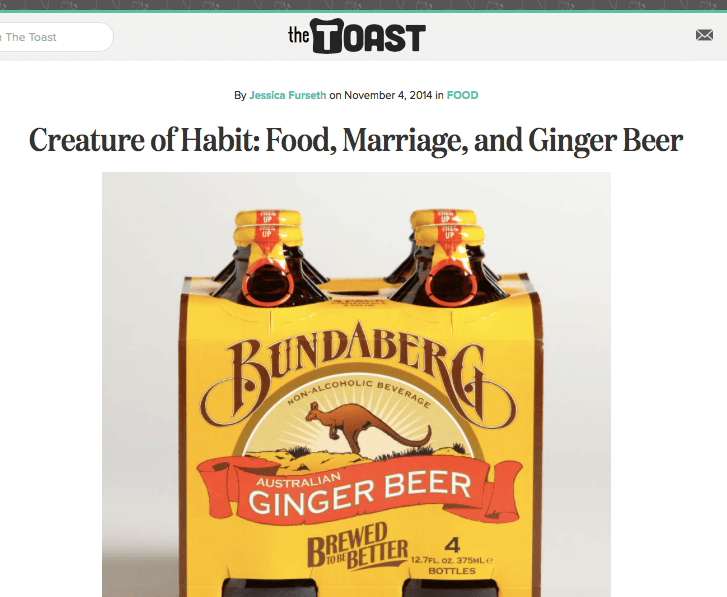
But there’s always some substance, some particular flavour or texture, that manages to slip through and take hold. My latest thing is this particular ginger beer, made by Bundaberg. The non-alcoholic drink is sold in a stubby brown bottle with a old-school pull-off cap, and while it’s not uncommon around my parts it can be tricky to find. It comes in packs of four at the big grocery shop near my house, but lately they haven’t had it in stock. I scour the aisle nervously every time I go there, hoping it will be there this time, but the ginger drought continues. Each time I check the label signalling its place on the shelf hasn’t been removed, but it seems that someone is playing a trick.

It was my birthday recently, and my husband me asked what I wanted to do. After thinking about it I realised that what I really wanted was to get in the car and go for a drive, to see if we could find some of that Bundaberg. It was sunny, as it always is on my birthday, and we drove with the windows open through back roads into leafy neighborhoods, the kinds that may appreciate a fancy bottle of ginger beer. Not that it was really about the ginger beer anymore. Still, we were rewarded with four packs; I’m drinking each bottle slowly, and once they’re gone I probably won’t buy any more. Not because they are too heavy to carry, or too hard to find, as marriage fixed those problems. Not marriage in itself, I should add, as it wouldn’t work with just anyone, but marriage to the right person, that fixed a lot.

Having a car to bring groceries home in, that’s one of the best things about getting married. Or should I say, that’s the best part out of the things I anticipated, especially as it’s so rare to meet someone who owns a car in this city. All the other stuff about getting married to someone you love more than anyone was pretty much as you’d expect, in all the shades of amazingness. Because it’s not sleeping in the same bed as someone else that gets you, as you are ready for that one. It’s the first time at the grocery shop, where you can get a trolley and not a basket, and you can get anything you want because you know that when everything’s bagged up, it’s not just you anymore. There’s someone there to cook with: tomato soups, peanut butter fudge, a whole grilled chicken. You no longer have to carry all the bags yourself.
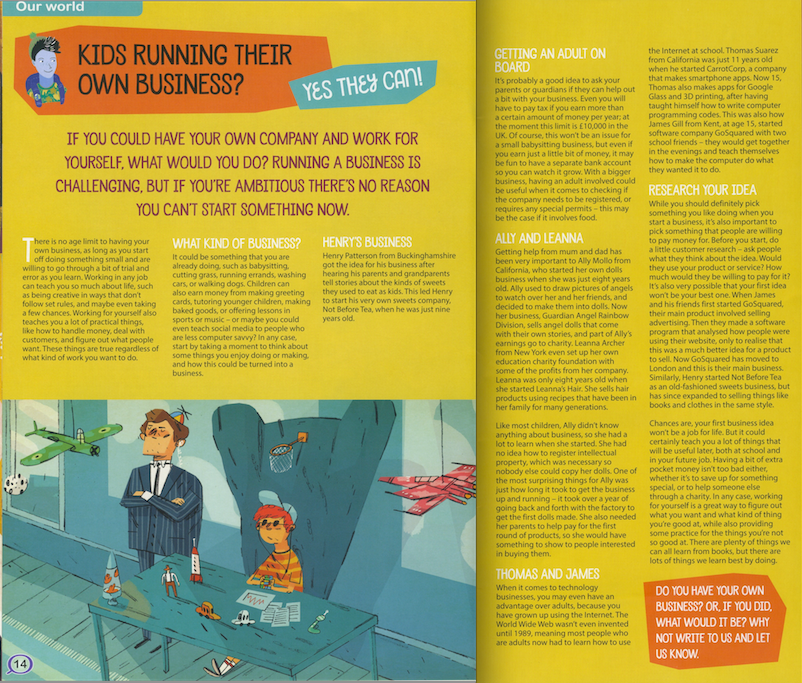
Kids running their own business? Yes they can!

Aquila kids’ magazine, October 2014.

Screen Shot 2014-09-27 at 14.20.30

Kids running their own business? Yes they can!
If you could have your own company and work for yourself, what would you do? Running a business is challenging, but if you’re ambitious there’s no reason you can’t start something now.

There is no age limit to having your own business, as long as you start small and are willing to go through a bit of trial and error as you learn. Working any job would teach you so much about life, such as being creative in ways that don’t follow set rules, and maybe even taking a few chances. Working for yourself also teaches you a lot of practical things, like how to handle money, dealing with customers, and figuring out what people want.

These things are true regardless of what kind of work you want to do – it could be babysitting, cutting grass, running errands, washing cars, or walking dogs. Kids can also earn money from make greeting cards, tutoring younger children, making baked goods, or offering lessons in sports or music – or maybe you could even teach social media to people who are less computer savvy? In any case, start by taking a moment to think about some things you enjoy doing or making, and how this could be turned into a business. Henry Patterson from Buckinghamshire got the idea for his business after hearing his parents and grandparents tell stories about the kinds of sweets they used to eat as kids. This led to Henry starting his own sweets company, “Not Before Tea”, when he was just nine years old.

It’s probably a good idea to ask your parents or guardians if they can help out a bit with your business. Even kids have to pay tax if they earn more than a certain amount of money per year: at the moment this limit is £10,000. Of course, this won’t be an issue for a small babysitting business, but even if you earn just a little bit of money, it may be fun to have a separate bank account where you can watch it grow. With a bigger business, having an adult involved could be useful when it comes to checking if the company needs to be registered or needs any special permits – this may be the case if it involves food.

Getting help from mum and dad has been very important to Ally Mollo from California, who started her own dolls business when she was just eight years old. Ally used to draw pictures of angels to watch over her and her friends, and decided to make them into dolls. Now her business, “Guardian Angel Rainbow Division”, sell angel dolls that come with their own stories. Part of Ally’s earnings go to charity, and Leanna Archer from New York even set up her own education charity foundation with some of the profits from her company. Leanna was only eight years old when she started “Leanna’s Hair”, where she sells hair products made from recipes that have been used in her family for many generations.

Like most kids, Ally didn’t know anything about business, so she had a lot to learn when she started. One thing was how to register intellectual property, which was necessary so nobody else could copy her dolls. One of the most surprising things for Ally was just how long it took to get the business up and running: it took over a year of going back and forth with the factory to get the first dolls made. She also needed her parents to help pay for the first round of products, so she would have something to show to people interested in buying them.

When it comes to technology businesses, kids may even have an advantage over adults: you grew up using the internet. The World Wide Web wasn’t even invented until 1989, meaning most people who are adults now had to learn how to use the internet, instead of it being something that’s always been around. Thomas Suarez from California was just 11 years old when he started “CarrotCorp”, a company that makes smartphone apps. Now 15, Thomas also makes apps for Google Glass and 3D printing, after having taught himself how to write computer programming code. This was also how James Gill from Kent started software company “GoSquared” at 15 with two school friends – they would get together in the evenings and teach themselves how to make the computer do what they wanted it to do.

While you should definitely pick something you like doing when you start a business, it’s also important to pick something that people are willing to pay money for. Before you start, do a little customer research: ask people what they think about the idea. Would they use your product or service? How much would they be willing to pay for it? It’s also very possible that your first idea won’t be your best one. When James and his friends first started GoSquared, their main product involved selling advertising. Then they made a software programme that analysed how people were using their website, only to realise that this was a much better idea for a product to sell. Now, as GoSquared has moved to London, this is their main business. Similarly, Henry started “Not Before Tea” as an old-fashioned sweets business, but has since expanded to selling things like books and clothes in the same style.

Chances are, your first business idea won’t be a job for life. But it could certainly teach you a lot of things that will be useful later, both at school and in your future job. Having a bit of extra pocket money isn’t too bad either, whether it’s to save up for something special, or to help someone else through a charity. In any case, working for yourself is a great way to figure out what you want, what kind of thing you’re good at, while also providing some practice for the things you’re not so good at. Because there are plenty of things we can learn from books, but there are lots of things we learn best by doing.

Scan 1

Radical Order: Geometry and the Utopian Impulse

Apollo Magazine, 2014. Original article.

Screen Shot 2016-07-03 at 15.34.26
Radical Order: Geometry and the Utopian Impulse

There’s something timeless about geometric art, with its clean lines and basic patterns appealing to an instinctive desire for order. All the works included in the Royal Academy of Arts (RA) show ‘Radical Geometry’ all date from the mid 20th century, but they still feel modern. The artists, from Brazil, Uruguay, Argentina and Venezuela, turned to this visual language, fresh and subversive at the time, to express optimism for the future. This fruitful 50-year period coincided with a turbulent and often repressive political climate, with a solid streak of radicalism running through everything. The future was close, and change felt possible.

The the overarching mood of radical optimism colours the experience of the RA show. The Uruguayan and Argentine sections starts us off with block colours, subdued towards a spectrum of dusty purple and muddy yellow, as the artists searched for an universal visual language. The boldness comes in the Brazilian section, where the colour choices turn to unapologetic black, white and red, in shapes that fit together in neatly ordered ways.

Lygia Pape is only represented with a couple of wood cuts, but her work was essential to the Brazilian artistic identity, championing art as a merging of aesthetic, ethical and the political. “Magnetised Space”, the 2012 Pape retrospective at the Serpentine Gallery, included an installation where Pape had strung gold threads from floor to ceiling; sometimes the threads seemed to disappear into nothing, but two steps to the side and they looked like rays of light. Closer inspection showed it is all perfectly logical in neat geometry, but the effect is magical.

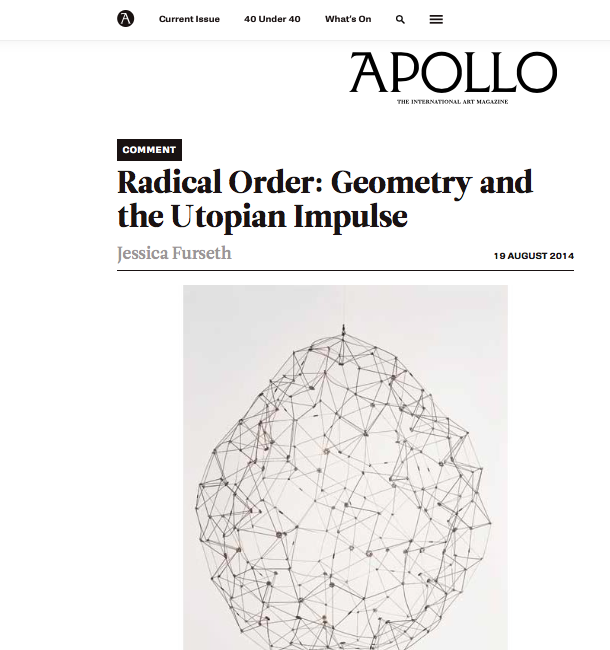
In “Radical Geometry”, the works of artist Gego (Gertrude Goldschmidt) provide a similar experience. Using wire and found objects, Gego joined her Venezuelan contemporaries in creating optical illusions, meaning the art changes depending on the viewer. “Sphere” seems to be floating in air, impossibly connected at each joint, so simple and yet so pleasing to look at. On the floor, the shadow is its own experience, unrecognisable yet inseparable from the original.

The sense of order and possibility in geometrical art comes in part from the mathematics at the core: the angles, the slots that fit. We are attracted to these shapes because they are natural to us: “Magnetised Space” showed how we have an instinct towards geometry through a still from Pape’s film, where a street performer dances in the middle of a crowd which has formed in a perfect circle around him. It is like the dancer is magnetic, attracting the crowd and repelling it at the same time, with geometry as a human impulse.

The link between radicalism and geometry was thoroughly examined in the “The Utopian Impulse”, the elegantly titled Buckminster Fuller retrospective at the San Francisco Museum of Modern Art in 2012. The futuristic designer called himself a radical idealist, dreaming up fantastic solutions to humanity’s problems. Prone to geometric designs, Fuller patented his solutions for energy-efficient housing and uniquely fuel-efficient cars, even lunar colonies, in his kooky style that left you feeling like anything was possible.

“The Utopian Impulse” included the 1969 “Earth Flag”, made by Norman La Liberte and John McConnell; it’s a grey and white planet on a blue background. Few artists today would present the idea of world unity in such a simple way as it feels distinctly nostalgic, like a throwback to simpler times. But considering how geometry, a fundamentally appealing visual language, keeps emerging in the artistic landscape, we still cannot help our impulse towards some kind of utopia. Looking at Gego’s hovering spheres, or Pape’s floating threads, we are swooning over the chance to create order in what we see.

We are islanders: Interview with Alicia Eggert

Lionheart Magazine, Home issue, 2014. Original article.

islanders1We are islanders: Interview with Alicia Eggert
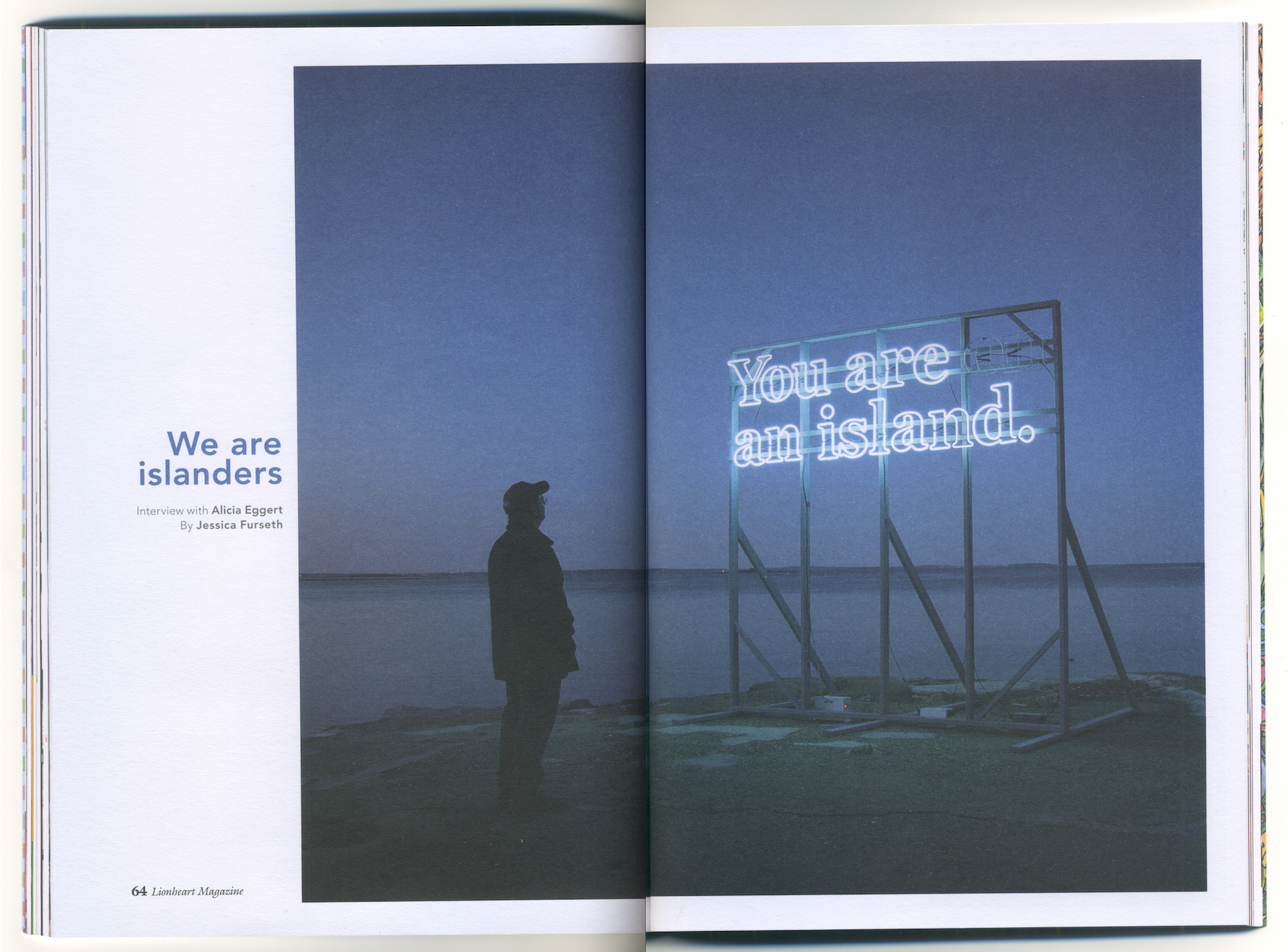
“You are on an island”, reads the sign, in bright white neon lights. Then it flashes, and suddenly the message is different: “You are an island.” It’s so simple, yet the philosophical implications are severe. And it’s not like Alicia Eggert hid this work away in some gallery. Instead she, along with co-conspirator Mike Fleming, rigged it onto a lorry and took it on tour, first in the US, then in Australia and the UK. Unsuspecting bystanders would get a dose of existentialism right in the face as the lorry drove up the High Street. Does Britain feel like an island? Or is it the the world that’s the island? The poet John Donne said it first: “No man is an island, entire of itself.” This is true, but don’t we each live alone inside our heads?

Light and language are repeating features for Alicia Eggert, who lives in Maine, USA. Time is another, as several of her works have a kinetic element: watch the rotating blocks and every so often they spell out a word: “NOW”. Then it’s gone, but it will be back. A drum is rigged to sound out the number of heartbeats of the average person, and we know the instrument will “die” when the timer runs down. A clock has 12 functioning hands, so it’s always all the time. Asign in the middle of a beautiful scenery that reads “Panorama”. All of it is so basic, on the surface. But just on the surface, though, because where do moments go once they’ve happened? Why do we forget that life isn’t a state but a motion? And what is time anyway? See, that’s what Alicia does: she gets you going.

Jessica: Your work is based on strong, clean ideas. Is it important to you that the viewer gets what you are trying to communicate?
Alicia: It has always been very important to me that my work can be understood by all people on at least some basic level. As a conceptual artist, my work always begins with an idea, and the materials I work with are chosen based on their ability to communicate a concept as clearly and concisely as possible. I think this is why text has become one of my primary sculptural materials. Words are like found objects – they are easily recognisable and accessible to anyone who speaks the same language and has the ability to read. But single words can have many definitions, so they also have the ability to possess great depth and complexity. One word can be both simple and profound. My art practice is founded on my own sense of wonder, and my personal goal is to create works of art that inspire a sense of wonder in others.

J: Time is a recurring topic for you. It feels like time passes at a different pace depending on the situation – I realise that’s impossible, but I’m not always convinced.
A: I think each one of us lives in our own little time universe. Some people live at a significantly slower or faster pace than the majority, usually without even realising it. Culture is definitely an influence, but I think it’s more individual than that. Time varies from person to person.

J: “You are (on) an island” – I love this. Do you think living on a massive continent like the US, as opposed to an island like Britain, makes people different characters? Or is being an islander a state of mind.
A: This work can be interpreted very literally when shown on geographical islands, but I think people can also live on metaphorical islands … ideological islands or political islands. I can never really know what it’s like to be an islander in the literal sense, since I was born and raised in the US. But what I love most about this sign is the way that it forces you to zoom out and consider the bigger picture. Even continents are islands on a planet whose surface is 70% water. And if you zoom out even further, our planet is an island in a vast universe. The sign highlights the sense of isolation we all sometimes feel as individuals, but it also emphasises how that feeling is something we all have in common.

J: Does working with the same ideas across several projects feel satisfying? Or is it frustrating because the questions are never fully answered.
A: It’s actually very satisfying. Because I’m not trying to answer any questions. I’m trying to figure out a better way to ask them.

http://www.aliciaeggert.com

lionheart6

A London Particular

This Recording, June 2014. Original article.

Screen Shot 2014-06-12 at 14.56.45A London Particular
I know what it’s like to live in a place where nothing ever happens, and West London is nothing like that. I know what it’s like to live in a place where you can’t choose your friends because there are only 300 souls in the village and no public transport, and this is certainly nothing like that. There’s a Tube station ten minutes up the road from my flat, and the world is just there. But it’s not East London.

The window in my old bedroom in Hackney, out East, would open onto the tiny, overgrown garden nestled in between the two rows of terrace houses. There were birds and chattering neighbours and the faraway hum of traffic; I’d lie on my bed, which was exactly the same height as the windowsill, with my head out the open window. The feeling was one of a secret patch of quiet. My current living room in Isleworth, out West, has a window wall with a door that opens out to a terrace, which would be nice if only there wasn’t so much traffic.

It takes me an hour to get to Soho now from the Isleworth flat, straight on the Piccadilly Line, crammed in with the crowds from the airport. The quickest way to get into Soho from my Hackney house was to walk down to Dalston Kingsland and get the Overground, and the city was there in half hour flat, via Highbury & Islington. My favourite route though, was to walk to the bus stop on Newington Green, which was about the same distance from the house but took you into a completely different part of the city. The leafy backroads were quiet, surrounded by houses made from that yellow brick you see all over East London. Always so much green, so many flowers.

I moved to West London for a good reason, for the only reason I’d ever have even considered it. The man I married has always lived this end of town, first for being a child here and second for working here. Before we really knew each other I expected the hour-and-a-half trek between our houses, between our London villages, to eventually become too big of an obstacle, but as it turned out, not his time. Marriage is different. Actually, let me rephrase that: marriage means that the relationship is different. It wouldn’t work with just anyone.

Because everything else about getting married has been great, but this West London thing … I thought I’d get over it, but I’m not. I’m really not, I know it’s bratty but I can’t help it. I remind myself that this really isn’t that bad, that none of the issues are actually problems, but still, I can’t shift the feeling that this is all wrong. West London is too slick; I miss the grit. This nostalgia is unusual for me, as I’ve lived in ten houses in London before this one and I’ve never felt homesick for any one of them. I even left a whole country once and never looked back: once I’ve left, that’s it. But as it turned out, not his time.

This is England, and nowhere else is this humid. It’s never more noticeable than when I get off an airplane, having spent time somewhere invariably drier; the humidity descends like a second skin the moment you step onto the jetway. The constant mugginess makes the city feel raw in the winter and sticky in the summer, exaggerating the natural direction of the temperatures. The icy fog seeps into your bones in the winter; it’s a London particular, rough and punishing. In the summer the damp heat does the same, but it’s mellow, reminding is why we love the city the way that we do.

East London is not that far away. And West London is really not that different. But home is a feeling.

The most powerful man in the City

Square Mile Magazine, April 2013. Original article (p77).

Screen Shot 2014-02-21 at 19.02.04The 100 most powerful people in the City
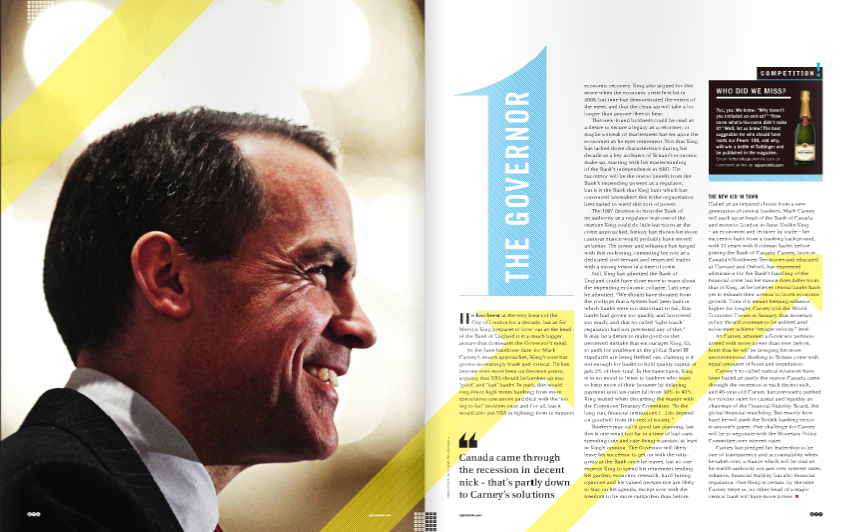
Number 1: The Governor
He is at the heart of the City of London, but as Sir Mervyn King prepares to bow out after a decade as the head of the Bank of England, it is a much bigger picture that dominates the Governor’s mind. As the June handover date for Mark Carney’s tenure approaches, King’s tone has grown increasingly frank and critical over the past few months. King is keen on decisive action, arguing that Royal Bank of Scotland should be broken up into a “good” and “bad” bank. In part this would ring-fence high-street banking from more speculative operations and deal with the ‘too big to fail’ problem once and for all, but it would also put RBS in fighting form to support economic recovery. King argued for this move also when the economic crisis first hit in 2008, but time has demonstrated the extent of the mess, and that the clean-up will take a lot longer than anyone likes to hear.

This newfound boldness could be read as a desire to secure a legacy as a reformer, or maybe a streak of fearlessness has set upon the economist as he eyes up retirement. The Bank of England was stripped of its regulatory powers in 1997, and hence could do little but scorn and tut as the crisis approached; still, King has admitted the Bank of England could have done more to warn about the impending economic collapse. Said King last year in a BBC Today Programme Lecture: “We should have shouted from the rooftops that a system had been built in which banks were too important to fail, that banks had grown too quickly and borrowed too much, and that so-called ‘light-touch’ regulation hadn’t prevented any of this.”

It may be a desire to make good on this perceived mistake that encourages King to push for prudence as the global ‘Basel III’ standards are being fleshed out, claiming it is not enough for banks to hold quality capital of at least 3% of their total. In the same spirit, King is in no mood to listen to bankers who want to keep more of their bonuses by delaying payment until tax rates fall from 50p to 45p. Stressed King when discussing the matter with the Commons Treasury Committee: “In the long run, financial institutions … do depend on goodwill from the rest of society.” Bankers may call it good tax planning, but this is one insult too far in a time of bail-outs, spending cuts and rate-fixing scandals, at least in King’s big picture.

Hailed as an inspired choice from a new generation of central bankers, Mark Carney will pack up as head of the Bank of Canada and move to London in June. King (64), born in Chesham Bois and educated at Cambridge, can look back at a career as an economist, lecturer and public servant at the Bank of England; his successor, however, hails from a banking background, with 13 years with Goldman Sachs before joining the Bank of Canada. Carney (48), born in Canada’s Northwest Territories and educated at Harvard and Oxford, has pledged his leadership to be one of transparency and accountability when he takes over the big seat at Threadneedle. While having expressed admiration for the Bank’s handling of the financial crisis, Carney’s stance does however differ from that of King as he believes central banks have yet to exhaust their arsenal to boost economic growth. Even if it means inflation stays higher, Carney told the World Economic Forum in Davos in January that monetary policy should continue to be utilised until economies achieved “escape velocity”.

Carney’s so-called radical solutions have been hailed as partly the reason Canada came through the recession in decent nick, and Carney has hinted he will be bringing his more unconventional thinking to Britain. As chairman of the Financial Stability Board, the global financial watchdog, Carney has previously pushed for stricter rules for capital and liquidity, but exactly how hard he will push the British banking sector is anyone’s guess. One challenge for Carney will be to negotiate with the Monetary Policy Committee over interest rates; in stark contrast to Britain, Canadian MPC members tend not to publicly disagree with their leader. New laws will give the Bank new authority over financial regulation, meaning that by the time Carney steps in, no other head of a major central bank will have more power.

Screen Shot 2014-06-01 at 22.36.49

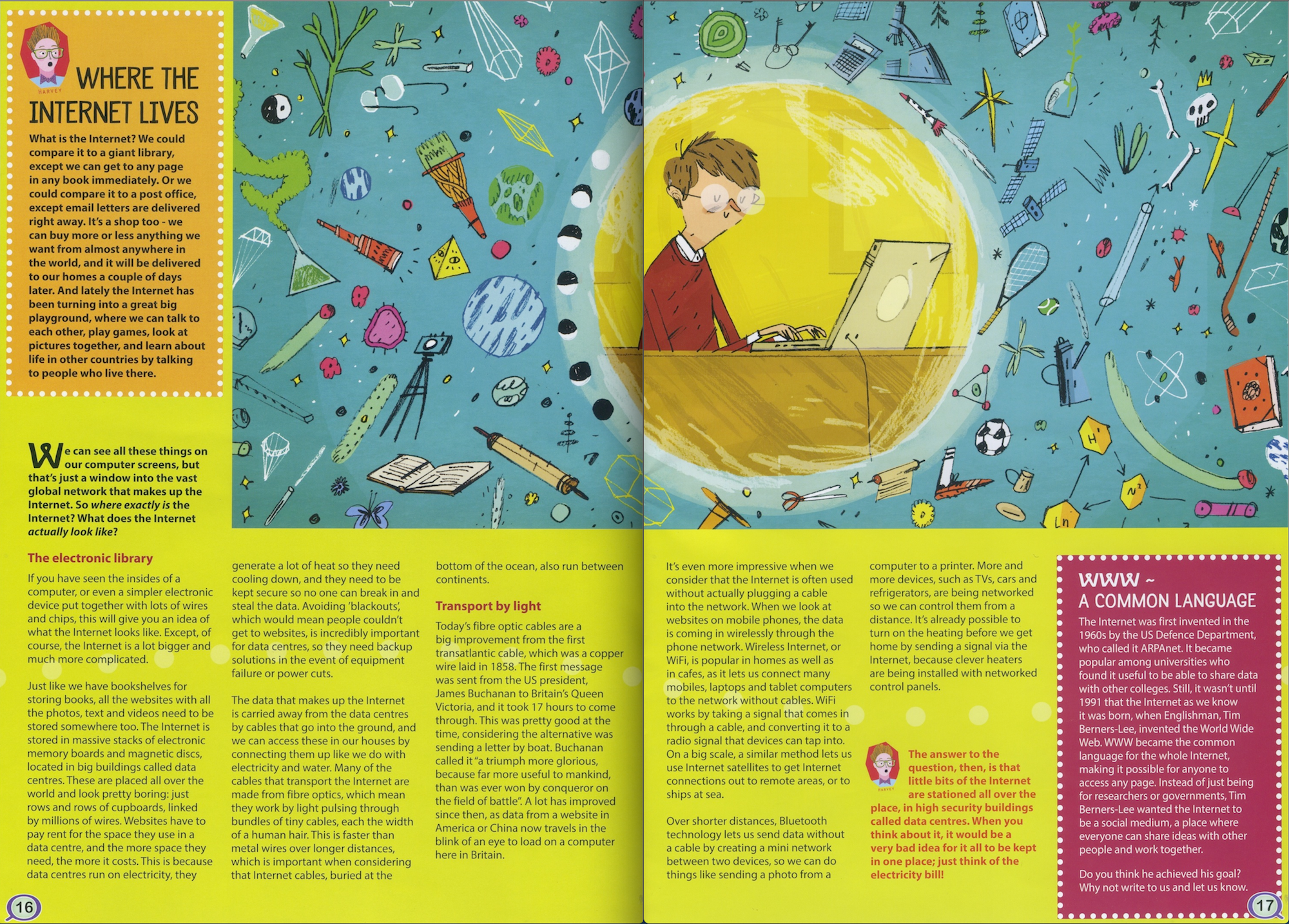
Where the internet lives

Aquila Magazine (for children aged 7-12) – June 2014. Original article.

upintheair-0614u

Where does the internet live?
What is the internet? We could compare it to a giant library, except we can get to any page in any book immediately. Or we could compare it to a post office, except letters are delivered right away. It’s a shop too – we can buy pretty much anything we want from almost anywhere in the world, and it will be delivered to our homes a couple of days later. And lately the internet has been turning into a great big playground, where we can talk to each other, play games, look at pictures together, and learn about life in other countries by talking to people who live there.

We can see all these things on our computer screens, but that’s just a window into the vast global network that makes up the internet. So where exactly is the internet? What does the internet actually look like? If you have seen the insides of a computer, or even a simpler electronic device put together with lots of wires and chips, this will give you an idea what the internet looks like. Except, of course, the internet is a lot bigger and much more complicated.

The electronic library
Just like we have bookshelves for storing books, all the websites with all the photos, text and videos need to be stored somewhere too. The internet is stored in massive stacks of electronic memory boards and magnetic discs, located in big buildings called datacentres. These are placed all over the world and look pretty boring: just rows and rows of cupboards, linked by millions of wires. Websites have to pay rent for the space they use in a datacentre, and the more space they need the more it costs. This is because datacentres run on electricity, they generate a lot of heat so they need cooling down, and they need to be kept secure so no one can break in and steal the data. Avoiding “blackouts”, which would mean people can’t get to websites, is incredibly important for datacentres, so they need backup solutions in the event of equipment failure or power cuts.

The data that makes up the internet is led away from the datacentres by cables that go into the ground, and we can access these in our houses by hooking up them like we do with electricity and water. The cables that transport the internet are made from fibre-optics, which mean they work by light pulsing through bundles of many tiny cables, each the width of a human hair. This is faster than metal wires over longer distances, which is important when considering that internet cables also run between continents, buried at the bottom of the ocean.

Transport by light
Today’s fibre-optic cables are a big improvement from the first transatlantic cable, which was a copper wire laid in 1858. The first message was sent from the US president to Britain’s Queen Victoria, and it took 17 hours to come through. This was pretty good at the time, considering the alternative was sending a letter by boat. The US president called it “a triumph more glorious, because far more useful to mankind, than was ever won by conqueror on the field of battle”. A lot has improved since then, as data from a website in America or China now travels in the blink of an eye to load on a computer here in Britain.

It’s even more impressive when we consider that the internet is often used without actually plugging a cable into the network. When we look at websites on mobile phones, the data is coming in wirelessly through the phone network. Wireless internet, or WiFi, is popular in homes as well as cafes, as it lets us connect many mobiles, laptops and tablet computers to the network without cables. WiFi works by taking a signal that comes in through a cable, and converting it to a radio signal for devices can tap into. On a big scale, a similar method lets us use internet satellites to get internet connections out to remote areas, or to ships at sea.

Over shorter distances, Bluetooth technology lets us send data without a cable by creating a mini network between two devices, so we can do things like sending a photo from a computer to a printer. More and more devices are being networked so we can control them from a distance, such as TVs, cars and refrigerators. It’s already possible to turn on the heating before we get home by sending a signal via the internet, because heaters are being installed with networked control panels.

***

WWW: A common language
The internet was first invented in the 1960s by the US Defence Department, who called it ARPAnet. It became popular among universities who found it useful to be able to share data with other schools. Still, it wasn’t until 1991 that the internet as we know it now was born, when Englishman Tim Berners-Lee invented the World Wide Web. WWW became the common language for the whole internet, making it possible for anyone to access any page. Instead of just being for researchers or governments, Tim Berners-Lee wanted the internet to be a social medium, a place where everyone can share ideas with other people and work together.

internet lives


Things I’ve lost to exes, begrudgingly.

The Toast, April 2014. Original article.

Screen Shot 2016-07-01 at 15.36.58

Things I’ve lost to exes, begrudgingly.

Take it to the sea.

Endless loaves of bread
After too many mornings of waking up at his house and finding there was absolutely nothing to eat, I started bringing my own food over. The coffee and peanut butter stayed in the cupboard where I’d left them, but the bread would disappear immediately. At one point I was buying a loaf a week for my own house, and up to three loaves for his. Then he started complaining all that bread was making him put on weight.
* Lesson: Bring a man a loaf of bread and he eats for a day.

Fancy water bottle
My ex and I had the same water bottle: a red aluminium canister of the kind that will last a decade if you look after it. I’d been looking after mine. Then at some point during the relationship the bottles got swapped, but I didn’t become aware of this until we’d gone through the only breakup I’ve ever had where things got so ugly we no longer speak. And my ex had not been looking after his bottle. I don’t want to think the swap was deliberate, as that would have been petty. But then again, he’d been known to use the Twitter account belonging to the cat he’d shared with his ex to try and make her jealous, so.
* Lesson: Trust no one.

James Bond back catalogue
My ex was really into TV, and as a result we watched what amounted to, in my opinion, endless amounts of crap. Amateur cooking shows and kitchen sink dramas, urgh. So the Bond films were an attempt at coming up with stuff we both actually wanted to watch, as we’d exhausted Star Wars and Harry Potter. So I bought the DVDs and kept them at his house, and we chuckled our way through them. I mean, those films are comedies, right?
* Lesson: Opposites attract, then opposites bicker endlessly over what to watch while eating dinner. Romance is dead.

Favourite knickers
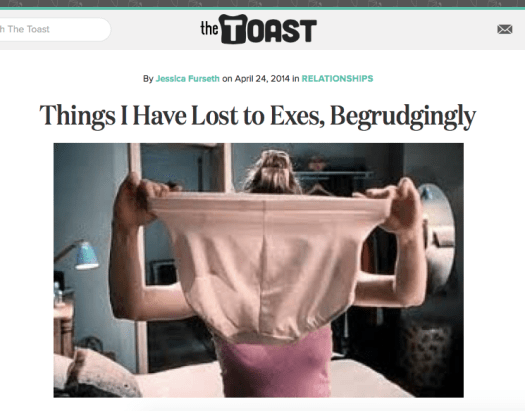
Do women actually leave used underpants at the houses of men they are dating, or is that a 1980s film cliche? In any case, these knickers were left behind in a clean state, in a moment of optimism that I’d be returning to wear them. I did not return to wear them. At the time I was too torn up about the guy to be upset about the pink lace number, but it goes without saying: I’ve never left a favourite piece of clothing at anyone’s house ever again.
* Twist in the story: About a year later I found myself back at the scene, briefly, and retrieved the lost knickers! I’ve never been able to wear them again though, so the loss stands.

Favourite yoga teacher
I once got asked out by a man who, like me, liked to do 90 minutes of Ashtanga yoga on Tuesday nights, overseen by a wonderful teacher named Kate. This man was attractive, as boys at yoga often are, but I’m fairly sure I’ve never met a person I have less in common with. Cue Mia Wallace in ‘Pulp Fiction’ making a square with her fingers. Fast forward a couple of weeks, to when his prettiness no longer compensated, and I saw no other choice: I begrudgingly gave him custody of Kate, and bought a bike instead.
* Lesson: Good men are hard to find, but not as hard to find as good yoga teachers.

Desert state

This Recording, 2014. Original article.

tumblr_n0uc8x47xs1qbeqkxo1_500

In which we sleep on crisp white sheets
Desert state


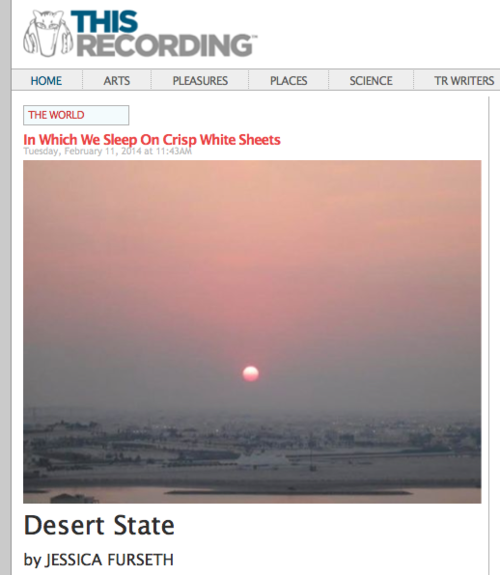
Every morning at 7am I climb over my sleeping husband, pulling the curtains open to let in a stream of dusty light. It’s pitch black until then, inside this hotel bubble without sound nor light, but I’m relieved to get up after yet another night of jetlag-ragged sleep. I tiptoe to the bathroom but nothing in this hotel makes any noise: carpet covers every surface, doors close slowly as so not to slam, furniture is heavy so it won’t topple over. The kettle takes so long to boil I have time not only to prepare the cafetiere, but also to brush my teeth for the full two minutes recommended by the dentist. I listen to the buzzing inside my head while outside, the sky is preparing for another day of pale sun in a violet sky. It’s the same as yesterday, and it will be the same tomorrow. We are in a desert state, in a brand new metropolis built on a sudden fortune, in a place where everything is shiny yet dull. It’s a city but it feels like a suburb, created from a drawing board. Every surface is kept clean yet it’s always dusty; the air is so dry that it only takes a moment.

I sit by the window drinking my coffee, inside a skyscraper hotel that’s part of a skyline that looks impressive from a distance. The bay is a few blocks away but I can see the the shore, because the buildings are just a little too far apart. I’ve never thought about that before: the distance between city buildings. But now, in this brand new environment that’s being built in front of our very eyes, it’s impossible not to look at it. In an old city, like the one I call home, the buildings push into each other, like the people on the street, and everywhere are cafes, shops, and even pavements. Here, each trip to the supermarket means manoeuvring a ledge next to a six-lane road, before scaling a sloped brick shoulder that takes you to the shopping mall parking lot. You’re not supposed to walk, is the thing, not when petrol is this cheap. Half the year it’s too hot to move around on foot anyway, with the searing sunshine leaving the outdoors just as inaccessible as if we were in a snowstorm.

In the bed, my husband has pulled the covers over his eyes, fighting against the light pouring in. He got here before me, so he’s adjusted to the local time. As much as the early mornings is a novelty for me, I envy his ability to stay up past 10pm. The sun is up and I’m awake, but my body is fighting me. I gain a little more ground every day, but I’m alarmed at how my heart pounds against my ribs, like a warning. It’s morning in the desert but my body thinks I’ve been up all night again, hankering back to in a place that’s much bolder and louder than this. I sip my coffee as I listen to the sounds trickling in, muffled through the double-glazing; the construction work has already started. For every building in this city there’s another one going up, and another road blocked to build a new lane. Inside their air-conditioned white cars, people are blasting the horns in frustration over the delays. Outside, the workers wears cloths around their heads to protect from the heat and dust.

Each day the hotel maid brings more bottled water, and provide all fresh towels even though the little card says the towels will only be changed if you put them on the floor. We may be in the desert, but there’s little concern for saving water. I wonder if they recycle all these empty water bottles. If I leave the cafetiere unwashed the maid will clean it; at first I felt I shouldn’t leave it as it’s not their job, but then I forgot a few times and now I think it’s really nice not to have to do it myself. I watch how people in restaurants ignore wait staff who bring them things, wondering how long I’d have to live here before I stopped saying thanks.

I stretch my body on the impossibly white sheets, thinking about what I’m going to do today. I have work but my head is full of cotton. I’m only here for the week anyway, having come to see my husband while he’s working. I’d never have come otherwise, as it’s not the sort of place you to visit. I was at the airport once for a stopover, just long enough to learn the name of the capital city and figure I’d probably never actually see it. But circumstances happen and now I’m here, in a padded hotel bubble, inside a not-quite-there skyline. Time feels like it’s standing still yet it’s slipping away, as before I know it it’s morning again and I’m opening the curtains, listening to the slow hiss of the kettle as the water heats up. In the desert, and in this city, there are no pavements, but people are creating sandy paths, through the construction sites. Every evening the sun sets, creating a bright spectacle in the sky, and for a moment it’s amazing before it’s gone and the sky is a dark, blank slate. Something is happening, but life is elsewhere.

My knight and I

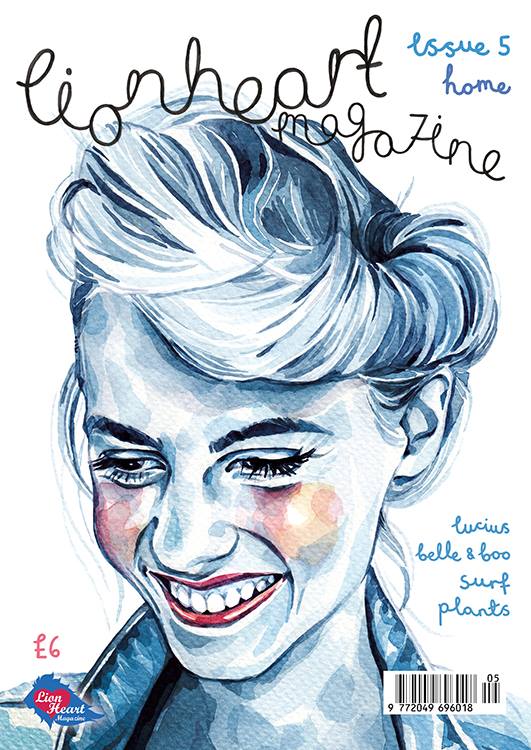
Lionheart Magazine, Shapes issue, 2013. Original article.

lionheart4My knight and I
At night I curl up in the bed and twist my arms around my legs, one hand grabbing an ankle with a knee hiked to my forehead. The city is my nightlight, slipping past the curtain to make shapes on the floor. I listen to the rustle of distant traffic with closed eyes, and within moments I’m asleep. I’m a big girl now, even tangled up in the foetal position, and I no longer have wolves at the door.

When I was a kid, monsters would come when I turned the light off to sleep. Playful cartoon creatures would grow dark and menacing at night, looming in the corners. Fairytales my grandma told me, over the smell of familiar dishes in her warm kitchen, would turn on me at night. In the stories, trolls living under bridges were pushed into the water, and wicked fairy godmothers were split in halves by brave knights. But at night they came back to life, turning my blood to ice.

During the day the imaginary monsters slept. I would walk home from school, glancing over my shoulder in case the mean boys were around. They didn’t hit me very often. Mostly they would shout, but I could barely hear a word for the thud-thud-thud of my heart pounding inside my chest. I don’t remember much anymore, but if I close my eyes I can put myself in those little shoes and let the feeling rush in all over again.

Putting one small foot in front of the other I used to walk home, locking myself in the house until my parents came home from work. They would make dinner, and the three of us would eat together at the old, wooden kitchen table. Then later they would read me stories, where knights in shining armour made sure the witches met with their deserved end. But at night the creatures roamed free. I left the bedside light on and pulled the covers over my head, and lay there stiff and scared to breathe until sleep came.

This is a very long time ago now, and I hardly ever think about it anymore. Remembering used to make me feel helpless, but as I’ve grown up the sentiment has changed. When I dive into the memory now it’s less often as the girl – instead I’m the knight, having stepped out of the fairytale to put the world right. In my armour I slay the evil goblins and toss them into the river, watching as they thrash against the rocks, whispering: ‘Who’s ugly now?’

The birthmark I’ve always had on my thigh used to be exactly in the middle, but now it’s sitting three-quarters of the way up. I’m still in the same skin, but my bones have grown. For each thing that changes, it seems, there’s something that stays the same. The skin around my eyes shows my age, but I peer down at my feet and they look exactly the same as they always did: stubby toes, puffy on top. The little girl has found her knight in shining armour, and it turns out it was me all along.

knight