Content Monetisation: Patchwork solutions (Part 2)

Megabuyte, November 2012. Original article here (£).

monetisation2The Early View
Content Monetisation: Patchwork solutions (Part 2)

It was Twitter that first alerted the world when a passenger plane landed in New York’s Hudson river back in 2009, not the mainstream news outlets. From an industry segment perspective you’d think Twitter was in competition with the likes of Facebook, but technology has blurred the edges to the extent that Twitter now competes with the general media. The best stories of the day will quickly rise to the forefront of the Twitter chatter, with people providing links to the most interesting analysis, and we each get the stories of most interest to us because we choose who to follow. What started as a place to share what we had for breakfast has (on a good day) become a sophisticated content curation engine. The money used to be in breaking news stories, but as this is no longer the case, the example of Twitter may provide an insight for publishers into what people value now: curation and analysis.

But there’s no obvious solution to content monetisation in the digital age. “There might be a 90% chance you’ll accelerate the decline if you gamble and a 10% chance you might find the new model,” one media executive said in a report by Pew Research Center’s Project for Excellence in Journalism. Industries facing disruption, such as publishing, entertainment and software, will be looking for low-hanging fruit to compensate for revenues being squeezed by an audience that increasingly expects to get things for free. In Part 1 we considered ways to make money from interesting ideas for pictures, links and advertising, while now in Part 2 we look into new variations on micropayments and freemium, plus some more unusual approaches.

Making freemium work
Paywalls and digital subscriptions are great for companies whose content is exclusive enough to make people open their wallets, however freemium is often the way to go to convince people that this is the case. Companies like Spotify (music streaming), Flickr (photo sharing), Skype (online calls) and Dropbox (cloud storage) all offer free services, making money from those who choose to upgrade to premium services. “The easiest way to get a million people to pay for a non-scarcity product may be to make 100 million people fall in love with it,” Phil Libin, CEO of Evernote, told Wired. “It’s more important that you stay than you pay. Once Evernote gets under your skin, you never want to stop using it.” The company, which provides a terrific system for saving web pages, notes, images, audio files and whatever else in online folders, has 34m users on its mobile and web platforms, of which a rapidly increasing 1.4m are paying. Libin’s method of money following love has resulted in the Silicon Valley company now planning a $1bn IPO.

The New York Times, also operating a freemium model, was rewarded by circulation revenues rising by 7% last year, mainly on the back of increasing digital subscriptions. While proving to be reasonably successful in its digital transformation, cheers are subdued as by a cost base which is looking increasingly unsuitable for the new revenue structure. As the editor of a newspaper that doesn’t charge online readers anything as all, the Guardian’s Alan Rusbridger took to Twitter last month to deny speculation that the newspaper is planning to abandon print to go exclusively online, but this idea has however taken root elsewhere. Newsweek just announced it would go exclusively online after 80 years of print. This comes two years after the magazine merged with online-born publication Daily Beast, whose founder Tina Brown has since become editor-in-chief of both publications. “This decision is not about the quality of the brand or the journalism – that is as powerful as ever. It’s about the challenging economics of print publishing and distribution,” explained Brown, who intends to support Newsweek by paid subscription in the “all-digital future”.

Online subscribers has for the first time outnumbered the print circulation at the Financial Times: in May the newspaper has 300,000 digital subscribers and a print circulation of 297,225, according to the Audit Bureau of Circulations. “It’s a big deal because it’s happening in the context of growth,” FT CEO John Ridding told MediaWeek. “Free news organisations [like the Daily Mail] can look big, but they don’t look so big when you put them up against Google or Facebook. That’s who they’re up against. It is very unlikely that advertising will support the kind of newsrooms that produce good quality journalism.”

Flattr: A solution for micropayments
Ease of payment is key to getting people to spend on freemium services; a link to PayPal is fine for a once-a-year payment but for anything more frequent we need fewer clicks. Google Wallet stores users’ card details and lets them check out from an online retailer in three clicks, while Bango last month announced it has now integrated single-click billing into Facebook’s mobile site, so users get charged via their mobile bills.

Swedish startup Flattr is an interesting solution to the micropayments problem, by allowing people to pay even the tiniest amounts with a single click. Users must first pay money into a Flattr account, and each click of a Flattr button next to content means the creator receives a portion when the user’s Flattr pot gets distributed at the end of the month. “Flattr is tackling one of the key unsolved issues of the digital world. We’ve been talking about micropayments since 2004 and still there’s no solution, so they are certainly shooting for the moon,” says Stefan Glaenzer, co-founder of Passion Capital, which contributed to Flattr’s €1.6m fundraising round earlier this year (and also founded GoSquared). “There’s a lot of innovation going on in this area, but no one is taking it to the level of Flattr. Their solution is frictionless; it’s one-click so you don’t have any mental cost of payment.”

Flattr, which takes 10% of the donations, currently has about 1m users, with the average value of a click now at $0.60-0.80. Soundcloud, Wikileaks, DailyMotion and gaming site Mimecraft are among users of Flattr, which functions like a tip jar to show appreciation for a great song, photograph, software, article or other free content. But the technology could presumably be used by content creators to charge outright; you may not want to pay £30 for a year’s subscription, but one click to pay a few pennies to access interesting content is no skin off anyone’s nose.

Playmob: The feelgood business
“Social, mobile and free-to-play gaming has absolutely exploded,” says Jude Ower, founder and CEO of Playmob, as we meet in the group’s offices in London’s Fitzrovia. “This has completely transformed a lot of gaming studios which were secure ten years ago, but have had to do complete rethinks around how they work.” As top gaming titles are feeling the squeeze from users circumventing expensive consoles, they are getting creative in offering new features for players, often through in-game shops. This is where Playmob comes in, as a means to improve monetisation via micropayments. Interestingly, Playmob does this by linking gamers with charities, meaning players can spend in the knowledge that some of their money go to good causes.

“Research suggests consumers will spend more money on an item linked to a good cause, and this is happening within gaming as well,” says Playmob product director Caroline Howes. So if a gamer wants to buy extra skills or equipment for their character, seeing these items linked to a good cause will tap into the feelgood factor, and in turn, raise the expenditure. Playmob gets 20% of the money spent, the games developer gets 30% and the charity gets 50%. Or if a developer wants to give all the money to charity, Playmob will agree a fee. The link between gaming and charity is well-established: Zynga has raised $1.5m for Haiti relief, and shooter game ‘Call of Duty’ raised $250,000 for War Child. The idea for Playmob emerged from these successes, says Ower: “We thought, if we take the back-end of that and offer it as a platform or a service for every single games developer out there, we have the opportunity of making a real impact and growing a real high-scalable business.”

Playmob has already raised $1.01m in investments, from Nesta, Midven, individual angels and accelerator Springboard. Our meeting took place just before last month’s official launch, but test campaigns had already raised over $10,000 for international charities. “We already operate on an international level, but we want to grow that reach. Following the launch it will be about getting more games into the system,” says Howes. Playmob’s technology is minimally disruptive, and the set-up takes just a couple of hours. The company is already working with a range of top games developers and will help them implement charity campaigns, but the goal is for this process to become automated so developers can log in and set up campaigns with their charities of choice.

While Playmob’s content monetisation solution is currently aimed at gamers, the technology could also be implemented more broadly. “We could potentially take what we are doing in a virtual space and apply it in a retail scenario,” says Howes, explaining how retailers often have single campaigns donating a few pennies off a product to charity. Playmob’s technology has the potential to link these free-standing campaigns – blueberries for cancer support, water bottles for drought, sandwiches for the homeless – into a single, efficient donation platform.

Be the disruption
“While these disruptions can collectively seem like a terrifying transition for incumbents, they have also created a wealth of opportunities that are waiting to be exploited by these very same organisations,” Clayton Christensen, author of ‘The Innovator’s Dilemma’, wrote in an insightful article in the Harvard University publication Nieman Reports.

One example of a company which successfully handled this kind of “terrifying” change is IBM: after starting out as a hardware and software company, declining revenues meant the group shifted its focus towards professional services and consulting. Concluded Christensen: “Faced with disruption, IBM completely redefined itself, moving away from its fading traditional businesses and leveraging the expertise of its people to capitalise on a different opportunity in the market.” The change seems to be a success: last month research house Forrester recognised IBM as a market leader in business intelligence services. In a world where Kodak went bankrupt while Instagram sold for $1bn, the message is clear: be brave, and grab the disruption by the horns.
Content Monetisation: Patchwork solutions (Part 1)

Megabuyte, November 2012. Original article here (£).

monetisation1The Early View
Content Monetisation: Patchwork solutions (Part 1)
“You may have heard something about how our industry is ‘in flux’ due to all this ‘new media’ and the ‘changing landscape’. You know, ‘the internet’.” Ann Friedman wrote this in the Columbia Journalism Review about the publishing industry, but she could have been referring to any number of sectors. “New media” is just media, Friedman goes on to say, because the internet has fundamentally changed things to the point where those refusing to adjust their business models will struggle to survive. Companies operating in early-affected areas such as publishing, entertainment and software do realise this, but what happens when the revolution has meant customers are starting to expect getting things for free?

As we consider some of the solutions for content monetisation, one thing looks certain: there is no silver bullet, and proprietors will have to get creative and employ numerous methods at once in order to replace their old revenue streams. In Part 1 of this article we will look into interesting ideas for pictures, links and advertising, before Part 2 will consider new variations on micropayments and freemium, plus some more unusual approaches.

Taggstar: Money from pictures
Two-year old London startup Taggstar has developed a technology that lets publishers monetise their online images. Already used by The Daily Telegraph, MSN, magazines from Hearst and The Independent, Taggstar works by adding little hotspots, or tags, to images, which open up additional content when tapped.

“Taggstar quickly and easily lets publishers turn images into a shopping experience,” says CEO and founder Fraser Robinson, as we ‘met’ via Skype. Publishers are given the technology free of charge, and can fill the tags with any content they want, be it videos, text, links, or most likely, things to buy. For example, a picture of Kate Moss can have a tag for each of her items of clothing, which then bring up similar items available from shops. This is where the monetisation comes in: “We have our own image search engine that crawls through merchant feeds and pulls in similar looking products. If anyone clicks through to a shop to buy, or even just to look, Taggstar gets paid, and that revenue is shared with the publisher.”

Taggstar is working on a soon-to-be-launched second revenue stream where display advertising will be enabled either inside or outside the border of images, says Robinson. Taggstar’s media sales team will connect sites with advertisers, again sharing the revenues with publishers. A third function of the technology, a bit further away, is a browser plug-in that lets anyone tag any online content: “Our core business model is to provide technology for publishers, so this bit is just nice to have. But it will let people tag content and share it in places such as Pinterest or Facebook,” says Robinson, describing it as an “everything everywhere tagging tool”. Intriguingly, this could potentially become something of a personal surface layer of content on the web amongst people who have the plug-in, letting them share tag clusters with each other, similar to how Spotify lets people share music playlists.

While newspapers have been “very excited” about Taggstar, Robinson says any size site can use the technology, down to personal blogs: “We encourage anyone to use it.” Taggstar already works on tablet computers, with a mobile version due for launch next year. Currently six-people strong, Taggstar won’t divulge financial details but Robinson says the company sees “tens of millions of image impressions every month”; this means the number of times an image loads from a tag. A key metric is the engagement rate: how often people will actually interact with a tag. This currently averages at 10%, which Robinson describes as decent for an online environment, but increasing tag interaction is a source of constant tinkering for the team.

Taggstar has raised £1.5m in funds from investors including ex-M&S Stuart Rose, Bertelsmann CEO Thomas Middelhoff, Sportal and Marquis Jets-founder Rob Hersov, and Ariadne Capital. Currently operating mainly in the UK and US, the company is planning a European roll-out, but Robinson, who was formerly managing director of commercial and media at lastminute.com, has big ambitions for the company: “I would like our technology to be part of the everyday furniture on the websites. I would like Taggstar to be as omnipresent on a page as the buttons for Reddit, Digg, Pinterest and Facebook; all the network sites that join together the internet.”

Linking together the web
While Taggstar is focusing its efforts on solving a problem for publishers, others are also operating in the field of image-interaction technology, such as ThingLink and Luminate. San Francisco-based Stipple provides a service where product-creators or shops can tag their own images to ensure product information is not lost as the pictures travel around the web. This means that even if someone saves the image on their desktop and re-uses it elsewhere, new viewers can still find their way to the original source, and potentially make a purchase. “Images are the web’s largest channel in terms of audience, but no one has had the ability to actually remain connected to and in control of their images on the open web,” Stipple CEO and co-founder Rey Flemings told AdAge. After initially raising $2m from among others Kleiner Perkins Caufield & Byers and Justin Timberlake, the group secured another $5m in May in a round led by Floodgate and Relevance Capital.

VigLink, the affiliate-links specialist provider we interviewed in San Francisco back in May, last month announced a partnership with Seattle’s GeoRiot, which deals in optimisation of links on iTunes and the App Store. This means VigLink’s users can now get better paid for linking to products on iTunes, plus referred visitors get routed to the correct country automatically. UK-based competitor Skimlinks, which also offers geotargeting, generated headlines earlier this year when customer Pinterest was criticised for using its services without declaring this to site users. Illustrating how web-based companies need to be open about how they monetise content, Pinterest abandoned their relationship with Skimlinks, and have yet to declare a revenue strategy despite being valued at $1.5bn following May’s $100m fundraising round. One possible spoke to the monetisation wheel could be a feature available from Amazon’s Zappos Labs; PinPointing recommends products on the site based on the photos pinned on Pinterest boards. The two companies are friendly but do not have a formal relationship, but the route does look ripe for monetisation of some sort: the amount of referrals generated from Pinterest has now overtaken that of Twitter. “Social shopping is a total buzzword that people throw around, but I don’t think any big brands have cracked it,” Will Young, a Zappos director, told Bloomberg. “When we talk to people and ask what they think is the best social-shopping experience, they say Pinterest, and it’s not even a retailer.”

A service perspective
While not as profitable as it once was, and increasingly threatened by the use of mobile internet devices that cut out ads, online advertising still remains a vital component of content monetisation. Google AdSense remains the leader of the pack when it comes to content-sensitive web marketing, with alternatives including AdBrite, Chitika, Infolinks and Bidvertiser, to name only a few. Also here, technology is becoming more clever, as demonstrated when a recent personal browsing history including flights to Moscow and sheets from John Lewis quickly became reflected in ads on sites such as The Guardian and Facebook.

Targeted advertising makes sense from a business perspective, and it seems people don’t even mind it: a 24-country survey by Ipsos found that 58% of social media users are in favour of targeted ads, as opposed to 42% being against. While seeing deals flash up offering flights to Russia on unrelated sites felt quite Big Brother-ish the first time it happened, this too may be one thing we can get used to if it feels like it provides a valuable service. While it’s a bit more complicated for the content provider, the new methods of monetisation may actually add some value for the customer. If we can get a hand finding the dress Kate Moss was wearing, get a link to an obscure book, or save money on a flight, we’ll soon get onboard if it makes life a little easier.

Real time data: Right here, right now

Megabuyte, November 2012. Original article here (£).

real time dataThe Early View
Real time data: Right here, right now

Quick, straightforward and in real time – that’s how we need our data in order to make optimal use of it. But as we get better at gathering information, feeding it back to those who need it becomes increasingly challenging; it’s no longer just about how much a product is selling, but also what customers are saying about it, what they’d like to see improve, which elements of the ordering process they find troublesome, and a host of other more or less vague elements which Big Data are now collecting. We met with two London startups which are making good progress in addressing the problem of how to keep track of everything as it happens. GoSquared provides real time analytics for websites so opportunities and problems can be addressed immediately, while Geckoboard’s real time dashboard collects key business indicators for easy overview.

GoSquared: Breaking down barriers
GoSquared is all about understanding your own website in real time,” says James Gill, CEO and co-founder of GoSquared. As we meet in the company’s offices in London’s Clerkenwell, Gill explains how customers get a snipped of code to put on their web pages, providing a host of information for the GoSquared servers: who is the referrer, how long do they stay on the page, what are they doing there, and so on. The information provided is similar to that from Google Analytics and Adobe Omniture, concedes Gill, except that the bigger players process the data as hourly jobs and give you it later, while GoSquared provides information on the fly.

“Often you want to see what’s happening right now. How many visitors are currently on the site? That blog post you wrote ten minutes ago, is it really popular right now or is it failing? What can you do about it? Has someone just written a negative article about you that needs addressing right away? We focus on that real-time side, rather than the historical stuff, so we can provide you with the information when you need it most.”

GoSquared’s software comes with some clever social integration tools. For instance, if a customer is moving through a website and hitting a stumbling block, such as a UK user facing a form asking for a US zip code, this can be picked up on and help can be offered via a pop-up window. “The cases where our clients have had the most success is on ecommerce checkout pages and customer support forums,” says Gill. “We’re trying to bring the site owner and the visitor closer to one another, to break down the wall between the two.”

GoSquared is now used by 20,000 sites after “fantastic” growth, says Gill, who co-founded the company with his friends James Taylor and Geoff Wagstaff when they were teenagers. Initially the company was a tool for buying “squares” of advertising, and the analytics software was conceived as a side project before its popularity turned it into the main product. The founders initially wanted to put the company to the side and go to university, but thought better of it after being approached by Passion Capital. “We weren’t looking for investment at all. We were well and truly off to university when Eileen [Burbidge] got in touch and said she wanted a chat,” laughs Gill, still just 21 years old. The company, which now employs ten people at Passion’s office space at White Bear Yard, has since raised a second round from Passion and Atlas Ventures.

GoSquared won’t divulge too much about finances, but Gill confirms they are making money: “We have decent revenues coming in; a good proportion of our 20,000 customers are paying and our revenues are going up and up every month.” The company is now focusing on moving the lower-paying customers up the chain to more revenue-yielding subscriptions. Running as a monthly pay-as-you-go model with discounts for long-term commitment, the cost depends on the number of sites a customer has.

While some experimentation is taking place, GoSquared currently doesn’t spend much on advertising. “A lot of [our core audience] has been built up through our blog, Twitter and Facebook, and through encouraging our existing users to promote us to their friends.” This kind of organic customer interaction is something GoSquared’s own product can help companies do as well; if a visitor lands on a website via a Twitter link, GoSquared won’t just name the referrer but also find the tweet so it can be responded to. “You can’t fake it on Twitter. You can’t buy your way into places like that, it has to be organic,” says Gill. “I think Twitter users are becoming more savvy when a company’s trying to sell you something versus helping you.”

Geckoboard: Eyes on the road
Like the dashboard of a car, Geckoboard presents vital business information at a single glance so users don’t have to trawl around looking for it. “It’s a living thing. The dashboard is constantly updated, meaning it’s more like a vital signs monitor on a patient, as opposed to a morgue report after the patient has died,” says Paul Joyce, CEO and co-founder of Geckoboard, as we meet in their Shoreditch office. “With Geckoboard you can see the moment your servers have gone down, the moment you get a spike in users, the moment when your sales have gone through the roof. And you can see that in real time and make decisions based on that.”

Geckoboard offers native integration of a range of well-known apps, such as Google Analytics, MailChimp, PayPal, Facebook and GoSquared, to name just a few. The system works by adding a widget to the data source, allowing Geckoboard to pull in the data. “We’re betting big on Saas. Every time we integrate with a Saas-based system we can effectively cover all the requirements of those customers,” says Joyce, adding how Geckoboard will also allow users to push their own internal data to the dash, such as Excel sheets. While there is no exchange of money taking place when external data makes its way onto Geckoboard, there is an all-around benefit due to the increased lock-in: “If someone’s looking at their web analytics data next to their sales data, for example, you get more independent on seeing that data. You can make out patterns, you can see where things go wrong or right,” says Joyce.

The product was initially aimed at SMEs, but Joyce says they are now seeing interest from government agencies and large enterprises, “so we think there’s room to explore”. The group is bringing in money but is also still burning money, says Joyce; Geckoboard has about 1400 paying customers and the number is “growing nicely”. Joyce, who founded Geckoboard alongside Rob Hudson in 2010, came up with the idea while working as an ETL developer designing data warehouses for large financial institutions: “I’ve always been interested in making that complex, drawn-out process faster so business people can see the data they need to use in a much faster way.” Joyce developed the first version of the product using his savings, before securing seed money from angel investors Christoph Janz and Alexander Bruehl, and Index Ventures and 500 Startups. A second round was completed in September.

“We’re solving a problem that’s out there faced by a lot of companies. I’d love to see hundreds of thousands of businesses using Geckoboard. I don’t see any reason why they couldn’t,” says Joyce, who sees Geckoboard as a communications company rather than an analytics group. While the group has started doing some marketing, focus is still on product development. While the temptation could be to overload the dashboard with information and features such as chat, simplicity is key to the Geckoboard experience: “You can crowd this thing really quickly […] and you could end up with something that’s hard to interpret. That would defeat the whole point of what we’re trying to do. Our job is to strip away the noise and present the core data that you can action.”

Now, and next

Getting data in real time, and for this to be relevant and manageable, is becoming increasingly vital as Big Data continues to boom. A number of companies are working on ways to tap into this need, the best known probably being New York-based Chartbeat. Founded in 2009, Chartbeat announced a Series B round of $9.5m in April to further develop its web analytics software, which aims to give publishers and websites such as the New York Times and Starbucks more accurate insights into how visitors are engaging with the content. Lebanese Woopra, founded in 2008, provides a similar service, having recently launched version 5.0 of its service and opened a San Francisco office. GoodData raised $25m earlier this year, taking total funding to $53.5m from investors including Andreessen Horowitz. The San Francisco company targets Saas providers, which integrate GoodData’s technology into its own platforms and then offer it to their customers as a tool for understanding and monetising their data.

MindMeld is an intriguing new application from Expert Labs, the US non-profit technology incubator. Star Trek fans will appreciate the nod to Spock’s information-sharing trick, but MindMeld is actually what is known as an “anticipatory computing engine”. Expected to launch by the end of the year, this Siri-on-steroids will initially be presented as a video conferencing tool, running in the background to pick up cues from the conversation in an attempt to give users the information they need before they have to ask. MindMeld then creates a display of relevant information and ranks it according to importance, drawing information from search engines, news articles, videos, social networks and documents stored locally. “[It] can actually understand what you say and find relevant information so that you have it at your fingertips,” Expect Labs co-founder Timothy Tuttle told AFP. This means that if someone in the conversation mentions a restaurant, MindMeld will pull up maps, reviews and menus from the place. “This stuff seems like science fiction, but it can happen fairly well today, and five to ten years from now it will be standard in just about every phone call or real-time communication application.”

Down the rabbit hole

Lionheart Magazine, Adventure issue, 2012. Original article.

LH3_1-COVER-211x300Down the rabbit hole
I don’t know when I changed my mind, but it happened somewhere between the park and the pub. I didn’t want to be with this guy, because I was so raw and fresh from the last one I loved; it takes so long to walk away even when you know you have to do it. Because you have to take pause when you call time on a relationship that has lasted years, a relationship that you thought, just for a moment, may be the last one you were ever going to have … Like I say to my friends when they agonise over their decisions, wringing their words in every which way in order to undo that nagging feeling: it’s not hard, it’s just painful. When we were younger it was harder to know what we wanted, but not anymore. The awareness of what I am sits with me, like a feather in my mind and a rock in my stomach. They don’t use words, those two, but it is a language that speaks in perfect resonance.

Except when it doesn’t. When I met this guy, just a couple of weeks after walking away from the last one that meant everything to me, it felt like coming home. I shrugged; I’ve been at home before. The feather and the rock are devious little tricksters, they have an agenda of chaos, of rollercoaster journeys down the rabbit hole, and this is not the time for that. I want to be on my own, I want to feel what it’s like, at long last, to not be looking. To be reliant on nobody but myself, like in a girl-power pop song. To just have fun. You can’t fake that feeling and I know that, because the last time I tried to chase it, the feeling remained at large; I’d scowl around for it while stomping home after yet another night out that left me feeling like I was the only single girl in the village. I wanted to be happy being by myself, shuffling down the pavement singing along to the music in my ears, indifferent to the comings and going of boys and just being free, happy as the sole ruler of my little castle. But instead I felt like Sleeping Beauty, stuck behind the briar growing high over my head, gnawing at my walls, closing me in. ‘Someone come save me from this,’ I’d whisper in the rare moments when I let myself feel what I was really feeling. I hated myself for it, pacing around behind the hedges, seething with resentment for failing to be strong.

That was a long time ago now, and it’s one of those stories I cringe at admitting to. So I was so excited this time, to be venturing out on my own again without this cloud hanging over me; less Briar Rose, more Lara Croft, if you will. I am in need of nothing and no one this time, and I am charmed by my flush of independence. So when this man, this annoyingly familiar, generous man with the most open face and arms I have ever come across in my life, stepped into my path, I felt my eyes narrow. ‘What the hell are you doing here,’ I said, ‘I have plans and they certainly don’t include you!’ I dismissed him with a flick of the wrist, because right away I realised a fling would be out of the question: it would be the next big thing. He didn’t agree but he understood. Some time went by. He stuck around and I kept him at arms’ length. He churned around in my head.

So, somewhere the park and the pub, in the middle of the big city on a rainy summer night. I was a little drunk, but not very. He kissed my cheek, and my forehead. I closed my eyes. He lit a match and threw it at me, and it turned out I’d been doused in petrol and now I was in flames. I swore at him, with the taste of him still on my lips, cursing him for setting me alight. He apologised and went away. I thought about him for 48 hours solidly. I picked up the phone and asked him to come over.

He is still here, and from here on the story is set in the present. I know I’ve been suckered, but I’m old enough to know that this sort of magic doesn’t come around very often. When it does, you have to climb up to the top branches and feel them sway underneath you, and trust they won’t break. I didn’t want to be up here but I am, and I’m concentrating on the moment. It’s the only thing I can do, because every other time I’ve done this, I’ve always been sent crashing to the ground.

I wear an old key on a string around my neck, it’s been with me almost every day for the past four years now. I love the idea of a key: one solution, one way, one final answer, one person. Of course, this is a crock, because there are many solutions, lots of way, a thousand answers that change as we go along, and there are lots of people. It would be easier if this wasn’t the case, but it would also be a lot more boring. Right now the feather in my mind and the rock in my stomach are weightless, spinning around each other; I’m keeping them there with steely determination but my grip on the situation won’t last. I know this because of what happens when he looks at me, with the bluest eyes I have ever seen. I can feel the branch sway underneath me, and as happy as it all makes me I am old enough to know that it’s also a threat. I squint and look closer, into his face, looking for answers, but there are no shortcuts, no tricks, no keys. He looks back at me and smiles, and I see nothing but open road and blue skies. I feel the wind rush around me and I think, maybe, just maybe.

The Moscow Metro: The People’s Ballroom

Published in Viator, 2012. Original article here.

moscowThe Moscow Metro: The People’s Ballroom
In a city as rich in monuments and history as Moscow, you may be surprised to find you have to head underground for what is arguably the best attraction of all. The metropolitan public transport system of the Russian capital is one of the busiest in the world, carrying nine million weary commuters between home and work every day. But while doing so, the Moscow metro provides an experience worthy of a Tsar, along with some interesting history lessons told from the viewpoint of a proud empire. Sculptures, frescoes and intricate mosaics might be standard in this vast metro network, but rest assured you will be amazed over and over again as you travel from one spectacular station to the next.

Novoslobodskaya
32 colourful glass panels make Novoslobodskaya quite the sight. Brass borders frame the stained glass, lit up from behind in this 1952 station. The central artwork on this Koltsevaya stop is Pavel Korin’s mosaic panel “Peace in the Whole World”; commuters are treated to gold-coloured mosaics making up the Soviet hammer and sickle, in front of which white mosaic doves are released.

Belorusskaya
The State prize of the USSR was awarded to the architects who designed Belorusskaya metro station in 1951. An elegant station with lots of subtle white details, Belorusskaya’s theme is life, culture and economics of Belarus, the Soviet subject which gained independence in 1991. Located on the Zamoskvoretskaya and Koltsevaya lines, the decor is accented by elegant light fittings amongst mostly white marble and glass, with a floor of elaborate red, white and grey ceramic tiles.

Prospekt Mira
On the Koltsevaya line, this 1965 station is themed on agriculture around the Soviet Union. The details in the reliefs are offset with gold against white, while marble and granite cover the walls and floors respectively. Like several of Moscow’s metro stations, Prospekt Mira boasts some spectacular light fittings: here chandeliers are made up by cylinders, hence bringing a classic feature up to date with the mid-century style of the day.

Taganskaya
The heroes of the Red Army surround you as you walk down the central hall of Taganskaya, built in 1950. On the Koltsevaya line, this station originally had a relief panel of Stalin surrounded by children, but even before the section was removed to create a passage, the fallen leader was replaced by imagery of a more favoured historical character: Lenin. Make sure to look up at the dome of the vestibule for the “Victory Salute” mosaic panel.

Mayakovskaya
1938-construction Mayakovskaya was the first deep-level vault metro station in the world, and arguably the crown jewel on the Moscow network. Located on the Zamoskvoretskaya line, the central hall is adorned with columns in marbled limestone and shiny stainless steel, offset by a floor in grey and pink granite and white marble. Looking up, there are mosaic panels all along the ceiling created by “People’s Artist” Alexander Deyneka, called “24 Hours in the Land of the Soviets”.

Ploshchad Revolyutsii
Located on the Arbatsko–Pokrovskaya line, Ploshchad Revolyutsii station essentially doubles as a sculpture gallery. Built in 1938, station was named after Revolution Square and has 76 bronze sculptures representing the Soviet people, glorious in past and future. Multi-coloured marble adorns the hall, which originally had a relief of Stalin before this was deemed not quite in the glorious spirit and removed.

Kievskaya
The elaborate mosaics covering the walls makes Kievskaya one of the highlights of the Moscow metro. Built in 1953, this station commemorates Russia’s union with the Ukraine, which gained independence in 1991. Located on the the Koltsevaya line, the station frescos show Ukrainians happily at work and play, surrounded by columns faced in white and grey Koelga marble.

Mendeleevskaya
Built in 1988, Mendeleevskaya is less elaborate than many of the older stations, but make the trip anyway for the spectacular light fittings along the ceiling of the central hall. The wall plaques show atomic and molecular structures; this station was named for Dmitri Mendeleev, creator of the Periodic Table of the Elements. Located on the Serpukhovsko–Timiryazevskaya line, Mendeleevskaya is technically the same station as previously mentioned Novoslobodskaya on the Koltsevaya line; the Moscow metro system will often have multiple names for interchange stations to reflect which line you are using.

Kropotkinskaya
Built in 1953, Kropotkinskaya is on the city’s oldest metro line: the Sokolnicheskaya line. Two rows of ten-sided column make up the elegant central hall, where white marble is lit by lamps hidden in the tops of the columns. More marble is found in the walls, while the floor is grey and pink granite. Kropotkinskaya won several awards when it was built, including at expositions in Paris and Brussels in 1937 and 1958 respectively, not to mention the Stalin prize of the USSR for architecture and construction in 1941.

Komsomolskaya
Komsomolskaya is where the Moscow Metro really gets its ballgown on. High, yellow-coloured ceilings are adorned with large mosaic panels, and the theme of the 1952 station is the Russians’ fight for freedom and independence. This was inspired by Stalin’s speech at the 1941 Moscow Parade, where he told dispirited World War II soldiers to remember their heroic Russian forefathers. Located on the Koltsevaya line, artist Pavel Korin chose to use mosaics after having seen in grand cathedrals how the durability of this medium meant the artwork may well last forever.

On the real hippie trail in San Francisco

Published in Viator, 2012. Original article here.

On the real hippie trail in San Francisco

“Are you looking for a restaurant?” I look around and find a little Chinese man smiling at me. You cannot stand on a San Francisco street looking uncertain for long before someone will offer their assistance (or alternatively, ask for some). The old man has found me on the kerb outside the Buddhist temple in Chinatown, my hair and clothes now pungent with the smell of incense and burning paper. Or is it holy smoke? But yes, I confirm, I am indeed looking for a place to eat. He then asks if I am alone, and nods knowingly when I confirm this: “I came here alone once too, from Hong Kong. This city gives you wings.”

We end up having lunch together, the old man and I. At home I’d have been a lot more reluctant to go off with a stranger like this, but San Francisco has a knack for making you surprise yourself. Its main attractions aren’t the bridges or the cable cars, but a feeling; maybe it’s in the water, maybe it sneaks under the door while you are sleeping. Out here on the foggy peninsula, something’s up. People actually wear flowers in their hair, as San Francisco does a surprisingly good job at living up to its substantial reputation: hippie paradise, rebel haven, magnet for idealists, non-conformists and the occasional nut-job.

Simply walking down the street will give you a decent fill of the San Francisco hippie flavour, with chatty strangers, talented street performers, wafting smells of various substances, as well as general friendliness and curiosity. But if you are serious about gaining your flower power credentials, here are ten must-see destinations.

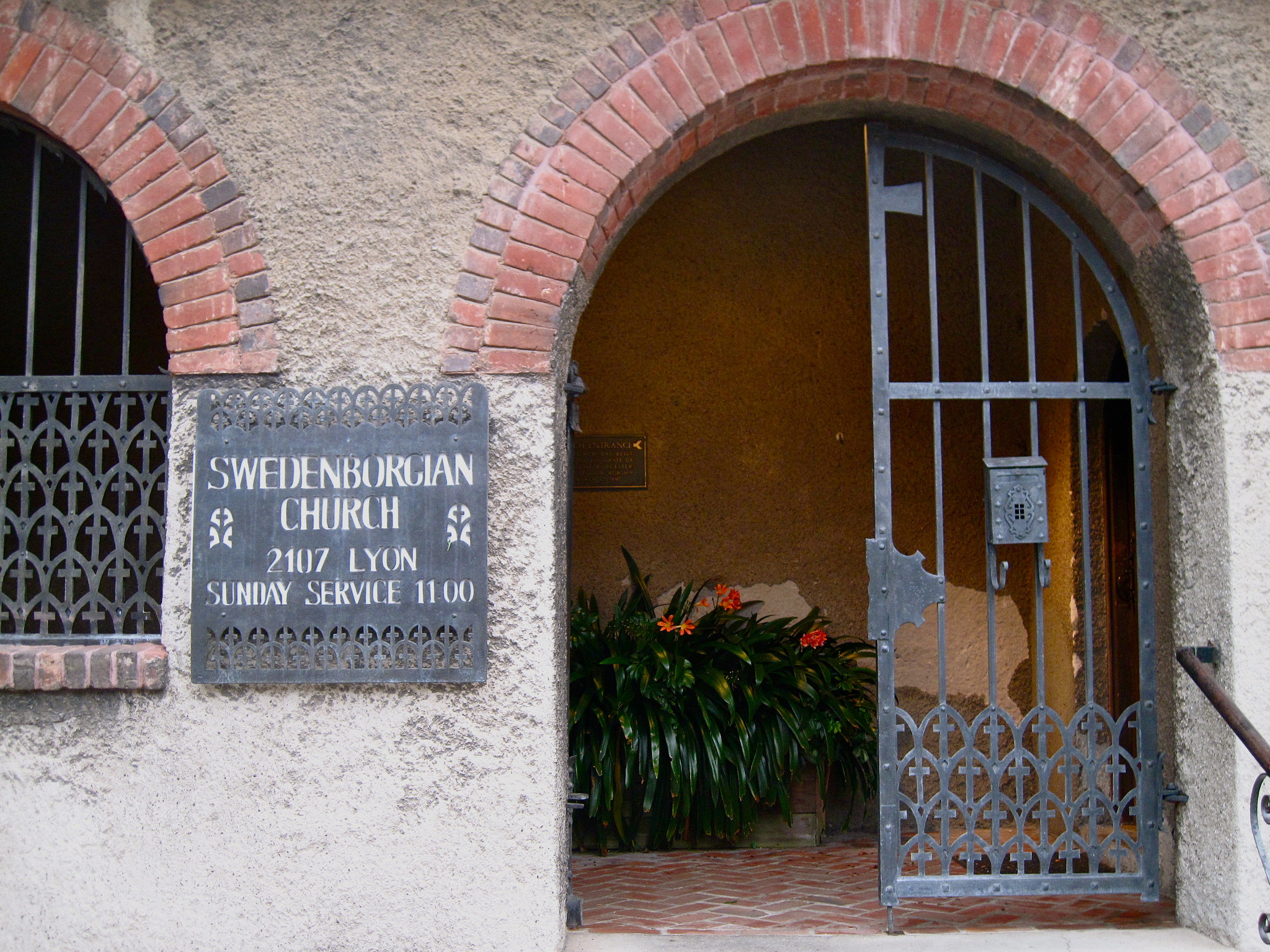
Swedenborgian Church, 2107 Lyon Street (on Washington)
Hidden out in Pacific Heights, this lumber and redbrick building from 1894 is the brainchild of Emanuel Swedenborg: theologian, scientist and receiver of divine messages. I arrived there in the early evening not expecting to find it open, but the priest, just about to lead a group in bible study, was kind enough to unlock the church for me. It’s a small, homely space: pulpit at the front, hearth at the back. Madrone tree trunks hold up the roof, and the priest pointed out how the maple chairs are made without a single nail. Swedenborgianism is founded on the belief that humans are spirits in a material world, unified by nature, love and luminous intelligence. Swedenborg called it ‘New Age’.

Yoga to the People, 2973 16th Street (on Mission)
‘This yoga is for everyone,’ is part of the guiding principle of this yoga studio. This literally means anyone, as this organisation is run on donations only. Concerned that people may become priced out of yoga, which will set you back at least three figures a month for regular practice, Yoga to the People aims to be a place where the spirit of yoga is made available to all, regardless of means. ‘All bodies rise,’ they say. Namaste.

Bound Together Anarchist Collective, 1369 Haight Street (on Masonic)
This floor-to-ceiling bookshop is chock full of books, zines, posters and pamphlets for the anarchist within. Bound Together has operated in Haight Ashbury for over 35 years now, having turned into a cultural gem in an area that still flies its hippie flag proudly. The bookshop is at the more political end of the hippie spectrum, meaning those more keen to re-live the more, let’s say, mellow elements of the Summer of Love, which happened just up the road, will find plenty of opportunity to do so on nearby Hippie Hill.

Iskcon Hare Krishna temple, 2334 Stuart Street, Berkeley (on Telegraph)
Across the Bay, another pocket of hippie history can be found in Berkeley. The Nag Champa incense lingers on Telegraph Avenue, where hoodie-clad students from the university add a freshness to the tie-dye. I was sitting in a coffee shop near the campus when a robe-clad man came up to me, asking if he could give me a booklet to the nearby Krishna temple. They can teach me how to change my karma there, he said. I have had worse offers. Lectures, chanting and vegetarian meals are also available for those looking for a more step-by-step approach.

Cathedral of Saint Mary of the Assumption, 1111 Gough Street (on O’Farrell)
Most San Francisco visitors will go to Grace Cathedral, the Episcopal house of prayer designed in the old French-Gothic style. But Saint Mary, the modern Catholic church sitting on Cathedral Hill, is by far the more unusual, and probably even more awe-inspiring. Built in 1971, the saddle roof exterior is intriguing, but it’s the inside the place that will take your breath. The concrete columns, interspersed with strips of coloured glass, sweep up to form a point high above the altar that tilts everyones heads back.

Konko Temple, 1909 Bush Street (on Laguna)
Near the windswept Japantown plaza is the Konko Temple, a small, unassuming building constructed from blond wood. In the Konko faith, heaven and earth are equally important to make a person whole, explained the reverend when I visited. I’d been sitting in the modest room for a while before he came over, patiently answering my questions and cracking the occasional joke. Kami, the Parent God, is not off in some faraway place, but here with us right now, he explained. Everything is related.

Zen Center, 300 Page Street (on Laguna)
New faces are very welcome at the modern-looking Zen Center, which holds tours for beginners so we can learn how to behave in the temple. A quiet, bright-eyed man in a robe took us around to explain what the bells mean, how to bow and how to take off our shoes in the temple. This was on a Saturday morning, just after we’d listened to a talk by the Buddhist Soto Zen reverend, a soft-spoken woman who explained It takes six months just to learned how to sit. And if you can’t … well that’s just the way it is that day. Instead, take a step back and see things for what they are.

Peoples Temple, formerly at 1859 Geary Boulevard (on Fillmore)
The Peoples Temple is a reminder there is a darker side to San Francisco’s penchant for new ways of thinking. The Symbionese Liberation Army, the radical group which kidnapped heiress Patty Hearst before she joined them to rob a bank, started in the Bay Area, and Peoples Temple founder Jim Jones decided San Francisco was the right fit for his flock. Initially, he adhered to the utopian dreams of the International Peace Mission movement, but things took a darker turn when 918 of Jones’ followers committed mass-suicide from drinking cyanide-laced Kool-Aid.

Vedanta Society, 2323 Vallejo Street (on Fillmore)
This 1905 building, with its concoction of styles, has seen better days. Still, it provides an interesting glimpse into the Vedanta Society, an order associated with monasticism and a basis in Hinduism. Just look at the building itself: each turret carries the symbol for a major religion, signalling the basic principle of ‘oneness of existence’. Vedanta teaches that the essence of all things infinite and eternal, and that all religions lead to the same goal.

Tien Hau Temple, 125 Waverly Place (on Clay)
In an alley in Chinatown, on the top floor of what looks like a residential building, is the oldest Chinese temple in the US. This, however, is not a place to sit in quiet contemplation, but a working temple. Ladies sit along the wall busily folding paper, which visitors buy to burn in the fireplace. The ceiling is covered in red and gold lanterns, with dangling messages attached, while every surface is covered in icons and incense. The smoke fills the temple before escaping out the open door, taking the prayers along with it.

Organised chaos: Keeping the start-up spirit alive

Megabuyte, October 2012. Original article here (£).

scrumThe Early View
Organised chaos: Keeping the start-up spirit alive

Valve, the Washington-based gaming company, has been proudly boss-free since its launch in 1996. Founder Gabe Newell remains in charge, but there is no evidence of this in the company literature, which boasts “no middle management, no bureaucracy, just highly motivated peers coming together to make cool stuff”. This is how most start-ups look when they first start tinkering, enabling a spirited environment where ideas matter more than job titles, but often this is lost as the organisation grows.

With 400 employees, however, Valve’s start-up days are over, but still the group is sticking to its boss-free guns. 400 people wheeling around without managers sounds chaotic, but clearly what they’re doing is working: Valve is reported to be valued at $893m in an ongoing takeover attempt from leading Korean gaming groups Nexon and NCSoft. We take a look at a few companies that are maintaining the start-up spirit as they’ve grown, and how technology provides vital tools for the task.

The Common Good
“Just like in a marketplace, everything in Valve is in flux,” explained Valve’s economist-in-residence, Yanis Varoufakis, in an insightful blog post on the company’s philosophy. Google is famous for its ‘20% Time’ policy, where staff get to spend one day a week on a project not necessarily in their job description, but at Valve this number is 100%. People’s desks actually have wheels on them, meaning staff are given the freedom to literally roam about, picking projects and forming new teams. “The idea here is that through this ever-evolving process, people’s capacities, talents and ideas are given the best chance possible to develop and produce synergies that promote the Common Good,” wrote Varoufakis. “It is as if an invisible hand guides Valve’s individual members to decisions that both unleash each person’s potential and also serve the company’s collective interest.”

Providing permission for employees to go rogue is well and good, but with hundreds of people around, a layer of technology may be necessary to help organisation, discovery and communication. While less extreme than Valve, Google, Apple and Facebook all have more or less flat organisational structures (unlike Microsoft, with its 6 to 12 layers of middle management). Mature organisations in awe of these innovators are curious about emulating their methods, in the hope of finding the source of their good fortune. Chris Robinson, CIO of business collaboration software expert Tibbr, explained at a recent company conference how tax giant KPMG is looking into changing its structure in an effort to reduce staff turnover and attract young talent:

“Organisations are turning to enterprise social networking because it breaks down silos [and hierarchy], creates a more open environment where employees can be more collaborative, think non-traditionally and share innovative ideas across the organisation with the integrity of doing what’s good for the organisation.”

Innovation at the edges
Tibbr, owned by Tibco, is among the leading providers of social collaboration tools for enterprise, according to a new report from Forrester, the others being Yammer (now part of Microsoft) and Salesforce’s Chatter. WMVare’s Socialcast and Neudesic’s Pulse are also notable contenders.

“As older companies think about how to become more innovative they are doing it in an old way: ‘We need to figure out the next innovation.’ But there is no next innovation! It is about constant innovation, and organising around letting everyone innovate,” said Yammer co-founder Adam Pisoni when we met in San Francisco earlier this year. Yammer’s collaboration software, which aims to create a productive breakdown of company boundaries, is one way to try and stave off rigidity as a company grows. It may even be possible to predict when this will be an issue: history is full of examples of how 150 is the maximum group size before the individual becomes unable to keep track of the relationships and unity is lost, if evidence from Malcolm Gladwell’s famous book ‘The Tipping Point’ is to be believed.

One way to look at Yammer’s service is how it enables staff at large organisations, where size means they can’t keep track of who does what anymore, to do what they would naturally do in a smaller environment. Software developers at PerkStreet Financial, a Boston start-up, use Yammer to facilitate its morning meetings: each member of the 37-person team posts what they did yesterday, what they’ll do today and tomorrow, and the barriers for moving forward. Members can follow the conversation using the hashtag #scrum, and chip in if they have something relevant to add, or otherwise remain uninterrupted yet reachable. Tasks can be delegated to other members using the @-reply, and keeping these conversations out in the open instead of individual inboxes means no duplications. The transparency also creates a social stigma to not pulling your weight, while at the same time it makes the group efficient by letting tasks fall to those with time and inclination to do them.

Into the Scrum
While a so-called Facebook-for-business interface will give employees the tools to organise themselves, this is not enough; a company that is serious about tapping into the innovative impulse among its staff will have to drive through what could be some big cultural changes. Before venturing into collaboration tools with Chatter, Salesforce was a red hot CRM start-up experiencing rapid growth. Seven years after its 1999 launch, however, Salesforce realised its size was starting to make it less efficient: over 200 people now worked in R&D and the department suffered from a lack of visibility, late feedback, long and unpredictable release schedules and a general decline in productivity. In response, Salesforce initiated a brisk three-month transformation to the ‘Scrum’ working methodology, the dominant technique for creating an adaptable, feedback-driven and outcome-oriented organisation with open lines of communication.

In other words, Scrum can teach companies to work like start-ups again. Also used by Amazon, key principles of Scrum include coming together to work in project cycles, during which a team runs itself, report to the customer, and management does not interfere. Another popular system is ‘Kanban’, used at Xerox and music streaming service Spotify. While similar, Kanban is arguably easier to implement successfully than Scrum, whose values go against the grain of a traditional command structure and requires goodwill from all its participants in order to work. Kanban, however, is mainly focused on openness around workflows and does not necessarily require people to throw away their job descriptions.

Satisfaction
Generation Y, accustomed to the organic nature of social media, may well prefer a flat office hierarchy because it lets them run with ideas instead of dealing with office politics. But pleasing the ‘web kids’ is not the only reason corporations may find agile working methods to be in their best interest. In the first year of changing to Scum, Salesforce released 94% more features, delivered 38% more features per developer and delivered 500% more value to their customers compared to the previous year, according to Mike Cohn’s book ‘Succeeding with Agile’.

For a large company with a strong culture and an established pecking order, it may seem daunting to throw tradition out the window and place so much trust on staff to do good. But in addition to improved output, Salesforce found employee satisfaction doubled after its adoption of Scrum, while Deloitte found a correlation between staff retention and active use of Yammer in its own organisation. People like to feel in control of their work, and to be a part of creating something that matters. If allowing people to work organically on projects they are drawn to can help a large company keep the start-up spirit alive, this may well be the secret to staying innovative in the age of constant flux.

Big Data, Big Bang: Change is the new constant

Megabuyte, September 2012. Original article here (£).

big dataThe Early View
Big Data, Big Bang: Change is the new constant

The technological Big Bang, courtesy of the coming-of-age of the internet, shows no sign of abating. For businesses, it’s proving useless to wonder where the merry-go-round of change will stop next because in all likelihood it will just keep gathering pace, and nowhere is this pace of change more prevalent than in the phenomenon that is Big Data.

“Digital innovations are transforming the economic landscape, far more profoundly than other big shifts in our economic history such as deregulation, oil shocks or mining booms,” said Deloitte’s access economics director Dr Ric Simes in a new report on digital disruption. The consultancy wrote this for the Australian market, but the lessons are global: supply chains are being scrambled and categories are being blurred, and while the timescales will vary, the disruptions apply to every single industry. Technology has leapt forward before, but how it’s different this time is that this is not a blip, it’s a new reality where ongoing change is the new permanent state.

Life in Big Data

At the core of this change is a growing realisation that the internet isn’t a virtual experience anymore, but it’s becoming an aspect of real life. The generational element to the blurring boundaries between virtual and physical experiences was eloquently summed up by Peter Czerski’s ‘We, the Web Kids’, which has become something of an internet meme: “We do not use the internet, we live on the internet and along it. […] The web is a process, happening continuously and continuously transforming before our eyes, with us and through us.”

Everything the “web kids” do comes draped in a digital layer which is starting to feel as real as anything in the physical world, explains Czerski, but what enables the internet to exist in our lives like this is the proliferation of Big Data. This includes the sheer amount of data now available for us to pick out of the ether, but equally interesting is the amount of information we ourselves put out there, via location-tagging apps, online shopping histories, Google searches, links to newspaper articles on Twitter, and updates to Facebook. In the past two years, the capacity of the internet has doubled, to 77 terabits per second, according to analysis from Telegeography. Big Data is getting obese, meaning there is a significant opportunity for start-ups that can sift through the noise and present information in an intelligent and ultimately useful manner. Here are some companies that seem to be getting the message at the core of Big Data: the internet is no longer separate from us, but it has become real life.

Visual effects
Space-Time Insight enables users to spot connections they would otherwise have missed by visualising geospatial data in map-form. The West Coast group has just raised $14m in a Series B round to further develop its technology and take it to the mainstream. The company’s funding, which totals an estimated $16m, this time came from Novus Energy Partners, EnerTech Capital and ClearSky Power & Technology Fund. The energy- and utility markets are Space-Time’s main customers at present, but the group is starting to see traction in areas such as oil and gas exploration and transportation. Space-Time enables companies with geospatially diverse assets to visualise and manage factors beyond user data to also include factors ranging from weather to social media.

Another geospatial startup freshly injected with cash is SpaceCurve in Seattle, whose second round of funding brought in $3.5m from Triage Ventures, Reed Elsevier and Divergent Ventures. Total funding is now $5.2 million. SpaceCurve doesn’t actually launch its product until next year and the descriptions of what they do are a bit vague: “The technology will tie people or entities to a precise point in time and space, immediately discover the social and semantic relationships between them, and deliver this real-time intelligence instantly to identify new opportunities, and support better decisions and more profitable actions.” A lot remains to be seen regarding SpaceCurve, but there is no shortage of potential and the backers seem to be pretty excited.

Security and mobility
Sqrrl recently raised $2m in seed money, from Atlas Ventures and Matrix Partners, to aid in their mission to make Big Data applications more secure. This will hopefully make Big Data utilisation more palpable for customers in sensitive industries such as financial services and healthcare. Massachusetts-based Sqrrl’s mission is aided by co-founder and CEO Oren Falkowitz’s roots of working with Big Data questions at the US National Security Agency. The CEO explained Sqrrls methods to GigaOm: “An electronic health record might have a hundred or a thousand components and if any one of those requires an extra control, like the patient’s social security number, the current method is to control that entire record. We have fine-grained access model so you can assign different security to the patient name, to allergies, to medications, to doctors names – they can all be individually controlled.”

Palo Alto’s Factual has spent the summer launching a couple of interesting applications for mobile. As providers scramble to make better location-specific offerings, Factual’s Geopulse API provides everything the Big Data group has on file about a specific location, mined from its constantly growing databanks. In Texas, Datafiniti is only one year old but comes with a compelling mission: to become a search engine for data. The hope of founder-CEO Shion Deysarkar, formerly of data crawler 80legs, is that Datafiniti will make finding relevant data as easy as finding relevant web sites through Google.

World Wide Kaggle
On the subject of mind-boggling Big Data ventures, it’s hard not to be excited by Kaggle. The San Francisco-based start-up has a unique solution for how Big Data can be used to predict future behaviour, by linking scientists to companies sitting on mountains of scrambled data. Kaggle’s method is to offer cash prizes to the global PhD community, asking them to find the best solution to the problem on behalf of clients such as NASA and Ford. At the moment, insurer AllState is offering money via Kaggle to scientists who can come up with the algorithm that best predicts which customers are going to renew their car-insurance policies when there is six months left. Boffins worldwide can take a crack at this using historic data from 2008 to 2011 work out a predictive model, and similar methods are being used to solve problems for music companies wanting to know which songs will be most popular, and banks wondering which customers will be most likely to default on a loan.

Kaggle’s founder is Australian native Anthony Goldbloom, whose previous employment was macroeconomic modeling for the Reserve Bank of Australia. Speaking to Silicon Valley news outlet PandoDaily, Goldbloom told of how he taught himself to code after learning about Big Data and becoming fascinated with what it would mean if the right information was linked to the right people. Goldbloom launched the first version of Kaggle in 2010, and last November the group raised $11m in a Series A round led by Index Ventures, Khosla Ventures and PayPal co-founder Max Levchin. Kaggle claims its unorthodox approach means its competitions have always yielded a solution that outperforms in-house efforts, and often the best models will come from unpredictable candidates which may not have been hired for the job in a traditional setting. There is something wonderfully egalitarian about a system that promotes solutions purely based on talent instead of people’s backgrounds, but Kaggle proves this counter-intuitive system also makes the best business sense. Dreamt up by a “web kid” born in 1983, Kaggle’s audacious concept shows just how intriguing the results can be when Big Data is put to work on big problems in a world where the distinctions between “digital” and “real” life are becoming increasingly irrelevant.

Letters from the start-up frontier

mb logo

*** The Early View from London ***

My series on the UK technology start-up community, written for Megabuyte in 2012-13. This followed on from my series about start-up life and tech trends in Silicon Valley (below).

* Real time data: Right here, right now. Interviews with GoSquared and Geckoboard – read

* When ‘new media’ is just media: Content monetisation. With interviews with Taggstar and Playmob read part 1 / read part 2

* Big Data, big bang: Change as the new constant read

* Scrum, and keeping the start-up spirit aliveread

* Let’s fill this town with start-ups! Interview with Seedrs – read

* Land of plenty: Angel investors and the London opportunity. Interviews with Seedcamp and Passion Capital – read

* The fundraising experience for London startups. Interviews with company founders – read

* Is London the hottest place in the world to be a startup? Interview with Julie Meyer of Ariadne Capital – read

*** Letters from the West Coast ***

My series about start-up life and tech trends in Silicon Valley and San Francisco, published in Megabuyte in 2012.

* The magic in the Valley. What is it about Silicon Valley that makes it such a dynamic place to start a business? – read

* The social revolution. Interview with Yammer, plus how social tools are changing how businesses collaborate and create – read

* The mobile internet takes shape. Interview with HotelTonight, with notes on internet evolution from Spirent – read

* The dark art of content monetisation. Interview with VigLink, with notes on mobile advertising from Blinkx – read

* The innovation cycle: The agony and the ecstasy. The trouble with innovation and keeping the start-up spirit alive – read

* The view to Britain: How is Britain’s technology scene viewed from the West Coast? – read

Let’s fill this town with startups!

Megabuyte, September 2012. Original article here (£).

seedrsThe Early View
Let’s fill this town with startups!

The experience of raising money for Seedrs, the startup crowdfunding company, was exactly the kind of hard slog that Jeff Lynn’s company wants to provide relief from. “We struggled desperately to raise our first seed capital. We kept joking: If only we existed!” I sat down with the co-founder and CEO at a coffee shop overlooking London’s Old Street roundabout, the epitome of the hotbed of activity that is Tech City, also known as Silicon Roundabout. Lynn is on his way to look at his new and improved offices just up the road; there’s money around for this now, following a £1m fundraising round secured in May with contributions from DFJ Espirit, Digital Prophets and angel investors. This takes the total raised to £1.3m.

“As we’re a startup, we started our fundraising process by going to the angels. But what we didn’t understand was that none of them really got financial services. The moment they heard the word ‘FSA’ they didn’t want to touch us,” says Lynn. Seedrs got FSA regulatory approval in March, meaning the company can position itself as a serious investment vehicle. The funding came primarily from the financial sector in the end, says Lynn, which turned out to be a perfect fit because although they may not get tech, they do understand finance. “For companies, raising capital is generally a very inefficient process. A lot of it is based on personal introductions, […] there’s a lot of needle in the haystack because you have to find the person who’s looking for exactly your kind of company,” says Lynn, recalling running around London to attend numerous meetings while trying to secure funding. Seedrs wants to remedy this by creating a portal to bring investors and companies together.

While Seedrs has only been up and running for two months following its July launch, it took three years of preparation to reach this point. “The tricky part was the legals. This is a brand new type of financial services, and getting regulatory approval was the hard part,” says Lynn, whose experience as a corporate lawyer at Sullivan & Cromwell in London and New York meant the young company could manoeuvre the regulatory challenges without going broke on legal fees. “I think a lot of people, over a long period of time, looked at this area and thought it couldn’t be done, or they thought it would take too much time and money to do it. We saw it as a challenge.”

The initial comparison for what Seedrs does is often Kickstarter and IndieGoGo, the popular crowdfunding platforms. While Lynn is a fan of Kickstarter, he is quick to point out that this is mostly for creative projects; it provides no real financial upside and it’s not a platform approached with the mindset of an investor. Seedrs, on the other hand, is for companies looking for their first round of funding, up to £150,000. This means potential investors will benefit from the Government’s SEIS (Seed Enterprise Investment Scheme) initiative, which provides 50% income tax relief on investments and exemption from capital gains tax upon exit. Seedrs takes 7.5% of the funds raised, and if the company proves profitable, Seedrs also takes 7.5% of investors’ profit. Seedrs will structure the transaction, including carrying out legal due diligence and executing subscription agreements, plus holding and managing the shares on behalf of investors; “That last one is critical, and one of the points often misunderstood in this space,” says Lynn, explaining how having a few hundred people supporting you is great for providing capital, support and early adopters, but having this number of people on the shareholder register is a bit of a nightmare. Seedrs’ role will therefore make it easier for the entrepreneur to expand later by making sure it doesn’t have to reach 300 people to get consent to waive a particular provision or agreement. Seedrs will also vote on behalf of investors, and while they don’t sit on the board, they take on a “guardian” role to protect investors against effects of dilution or other “nasty things” that can happen to investors of private companies. Concludes Lynn: “We don’t think the role as mass-funded startups would work at all without some central party doing the management. The crowds can make great investment decisions, but crowd management doesn’t tend to work very well.”

On that note, Seedrs will not have an opinion on the companies it helps to raise money, as that’s for the market to decide. What they will do, however, is filter for operations that may be illegal, unethical or generally not what they say on the tin. Potential investors will need to fill in a short questionnaire, designed to prevent money laundering but also to make sure people understand the risks of startup investing. Lynn certainly doesn’t mince his words on this point: “It’s vital people understand that in any given investment they will most likely lose their money. As part of a portfolio they can make a good return, but they need to be prepared to lose their money on any single investment.” Lynn reckons you need as many as 100 startups in your portfolio to ensure sufficient diversification to get the rewards. Consequently, Seedrs sees itself as an attractive option for high-net-worth investment angels keen for a more efficient way to access new companies, as well as smaller investors previously unable to access the sector for being too complicated or requiring too big a cash pile.

So far, Seedrs has successfully channelled funding for four companies: two web tech, one financial tech and one games group. While the “Shoreditch crowd” was first to clue on to Seedrs, Lynn wants to attract a broad array of companies, including services, restaurants, niche manufacturing and so on: “We want everyone. We’re limited to pre-revenue companies seeking £150,000 or less, so as long as you’re starting out, and that amount of money is properly useful to you, we want you.”

At the moment, Seedrs employs four people in London, soon to be six, while co-founder and COO Carlos Silva runs a seven-strong development team in Lisbon. Lynn, who is also Chairman of the government’s Coalition for a Digital Economy group, wants Seedrs to ultimately be the go-to place for UK startups seeking their first cash. Having said that, Lynn readily admits the sky’s the limit: “We want to be a global player. We are very keen to expand to Europe, and we’re also looking at other markets.” The legalities means this has to be done on a jurisdiction-by-jurisdiction basis, so bigger countries such as Brazil, India, Japan and China are key geographic ambitions. And then there’s Lynn’s native US, where next year’s likely implementation of the American Jobs Act will make business crowdfunding legal: “There are already dozens of platforms lining up to do this for the US market. […] So while these platforms fight it out for the American market, we want to go around and build up the rest of the world. Entrepreneurship exists everywhere.”