Mark Bradford

Published in Whitehot Magazine, 2012. Original article here.
bradfordMark Bradford at San Francisco Museum of Modern Art
San Francisco, California

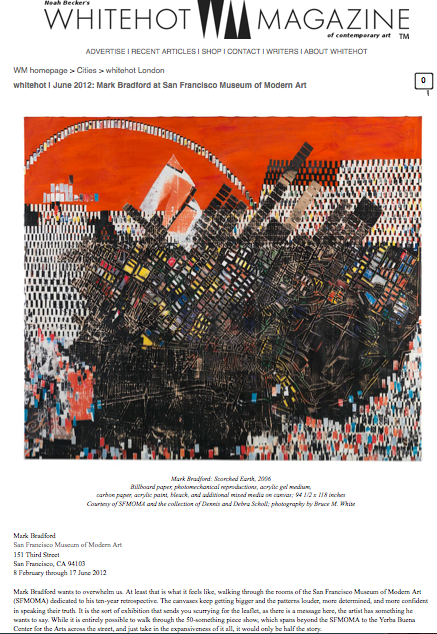
Mark Bradford wants to overwhelm us. At least that is what it feels like, walking through the rooms of the San Francisco Museum of Modern Art (SFMOMA) dedicated to his ten-year retrospective. The canvases keep getting bigger and the patterns louder, more determined, and more confident in speaking their truth. It is the sort of exhibition that sends you scurrying for the leaflet, as there is a message here, the artist has something he wants to say. While it is entirely possible to walk through the 50-something piece show, which spans beyond the SFMOMA to the Yerba Buena Center for the Arts across the street, and just take in the expansiveness of it all, it would only be half the story.

Los Angeles-based Bradford brings a lot of his environment into his art. Working extensively with found objects, such as posters, billboards, maps, fliers, comics and magazines, the grit of the street translates excellently into the clean gallery space. Displayed chronologically, the first works are made from curling papers from his mother’s hair salon in South Central Los Angeles, resulting in beautifully textured and monochrome-ish canvases deeply rooted in what was going on around the young artist at the time. The style has since changed, but the connection to the surrounding world been maintained.

It is strangely difficult to describe Bradford’s work, though. ‘Juice’ from 2003 is made from mostly white squares, interspersed with black; ‘Strawberry’ from 2002 has white squares scattered over cheerful orange. But this tells you nothing about the works unless you see them, and unless you take your time in doing so, even that may not be enough. Sitting in front of one of Bradford’s pieces, especially the largest ones, gives you an idea of the work that has gone into it, with the pasting, scraping and painting, the sticky substances coating the artist’s hands at the end of the day. There is intensive labour behind these efforts to translate a world onto canvas. More than anything, Bradford’s works look like maps: of places, of feelings, of the troubles with the human condition. The effect is overwhelming, especially as the colours turn rich and dark, as the patterns grow harder to trace towards an intensity just on the right side of painful.

The massive ‘Black Venus’ from 2005 is compiled by smaller fragments in black and blue, cut into strips; there is an order to the chaos but it slips away from you. ‘Potable Water’ from 2005 is fraying, buckling off the wall. The blue streaks presumably represents water, and a look at the label reveals the work is a comment on California’s water issues throughout history. Several of the works carries references to social and political issues, along with a rich vein of pop culture. ‘Mississippi Gottam’ from 2007 concerns the destruction of New Orleans by Hurricane Katrina: silvery white, clay-like colours, patterned, etched, light playing on the surface like light on rippling water. “I am always looking for ways to activate a new kind of reality,” Bradford has said. “It is a very physical thing for me, more than an intellectual pursuit.” This comes across perhaps more than ever with ‘Mithra’, the life-size ark made from plywood and pasted papers, which Bradford displayed in New Orleans in a reference of the biblical levels of flooding and the government’s failure to protect the city’s inhabitants. The section on display is only a fraction of the whole, but gives an impression of how staggering the piece must have been in its entirety.

The exhibition includes a few of Bradford’s sound and video works as well, including ‘Pinocchio is on Fire’, where visitors are invited to lie down on bean bags in a room full of patterns and music. The experience is powerful, both visually and audibly, but Bradford does not need multimedia to do this; he manages just fine with just his canvases. Take ‘You’re nobody (til somebody kills you)’, where the cacophony comes together to a perfect hum, sort of like magic, as you sit still in front of the sprawling canvas. I kept tracing the patterns with my eyes, completely unable to describe what I was seeing, but something was happening. Almost like a 3D picture where you have to look at it before something pops out at you, the image felt alive; it seemed to hint at something bigger, like when you are looking a map of a city you know well. There is an energy in Bradford’s works, something that transcends the sum of their parts. I found myself reluctant to leave.

Fire in the heart

Published in Oh Comely, May 2012.

Screen Shot 2014-02-21 at 18.43.53

Fire in the heart

‘Junkhearts’ director Tinge Krishnan talks about writing stories in the playground, leaving medicine, and moving through darkness into light.

She is a believer in transformation and redemption, Tinge Krishnan. It is there in her own story, from her start as a medical doctor to becoming a film director, and it is the central theme in Junkhearts, her first feature film. The brief connection between Lynette, the young homeless girl, and Frank, the wrung-out soldier, triggers significant changes, but still the overarching feeling in Junkhearts is one of bleakness. At least that is what I say to Krishnan as we wait for our tea to arrive.

“It wasn’t intended to be bleak, does it feel bleak?” says Krishnan. This is awkward. The director has just told me how she’s always worried about letting the film down by saying silly things in interviews. And here I am, having possibly misread its intentions completely. But Krishnan seems genuinely interested in my interpretation of the film, asking several questions about which specific scenes I’m referring to. When Frank and Lynette meet they give something to each other, but then it all threatens to fall apart, I say to her. The film almost shows you that you shouldn’t trust people. Krishnan thinks about it for a moment.

“That does exist in Frank. His worldview is that people are not to be trusted, so he’s almost waiting for it to happen. All the little decisions he makes contribute to it. That is a pattern Frank has to shift, and in the end it’s proved, it was right to trust,” says Krishnan. “Frank couldn’t have continued to live the way he lived when he met Lynette. He had to go through a lot of pain, but there was a lot that shifted in that pain and it opened him up.”

Frank suffers from post-traumatic stress disorder (PTSD) from being a soldier in Northern Ireland, and this was a key point of connection for Krishnan. Krishnan was in Thailand during the 2004 tsunami, and being a doctor she helped in the aftermath of the crisis. This led to her developing PTSD.

“It was a very powerful experience,” says Krishnan, who received counselling after returning to the UK. “I wanted to make a piece that’s about that healing process. As a filmmaker I could find a way to creatively express those experiences in a way that could touch an audience and help them understand. I think it’s hard to understand PTSD when you haven’t experienced it yourself.”

Before becoming a filmmaker, Krishnan worked as an A&E doctor – not exactly a typical route for budding creative types. Krishnan can trace the idea of a ‘detour’ back to school: “All the way through school I’d write plays and stories, reading them out in the playground. I assumed I was going to become a writer, but my English teacher said I should go do and do something different first.”

While the path to filmmaking wasn’t a conscious choice, Krishnan has no regrets about hanging up her white coat: “That’s fine, because I learned so much from it, it’s amazing.” She pauses. “Aspects of being a doctor that I miss are relating that intimately with people, and finding solutions. That was always very interesting.”

It must have been great to have a job where you got to help people, I suggest, but Krishnan shakes her head: “Medicine isn’t all running around saving lives, sometimes it feels like its mainly banging your head against a bureaucratic wall!” She laughs. “I’m not sure to what degree doctors actually feel they’re making a difference.“

And as a filmmaker, does she feel like she’s making a difference now? Krishnan thinks about it for a moment: “I would hope so. It is my intention. Maybe not? I don’t know. All I can do is try.”

Krishnan spent a lot of time researching the themes of the film, talking to servicemen suffering from PTSD and alcohol problems, and spending time in drug rehab centres talking to former crack users. But when asked about which elements drew her to Junkhearts, the first thing she brings up is the father-daughter relationships; an intertwined storyline is that of Christine, the daughter Frank abandoned. “At the core it really is a relationship film. It’s about that funny relationship between daughters and fathers, or father figures. The interface between feminine and masculine energy can be quite tempestuous.”

The power of the feminine is emerging as a theme for Krishnan’s work, alongside redemption, tenderness and transformation of darkness into light. While also looking after her new baby, the director is currently busy working on her new script, for a thriller centred on a female anti-hero.

Krishnan still has dreams where she’s a doctor, but her heart belongs to film now. “It’s about that moment when we’re on set, and the actors are releasing powerful, in-the-moment performances. I can see it in the monitor and I can hear it in the headset and I can feel that electricity that means we’re getting something powerful. That’s the best feeling.” Krishnan pauses, she seems to have drifted off somewhere. “When making a film there will be a moment when there’s a commitment, you feel it coming from the crew and the cast when everyone knows they are working on something exciting. You really feel the moment when people start to walk through the fire.”

Cool kid Chloë

Lionheart Magazine, Warmth issue, 2012. Original article.

Cool kid Chloë
Swagger, talent and a thirst for exploration through acting is why Chloë Moretz is a star in the making. Jessica Furseth talks to the Hollywood actress about ambition, confidence and listening to your mother.

She has a lot of sass for a 14-year-old, that Chloë Moretz. She rocks up with buckets of smiles, a cocky-cute “how you doing” and she’s just so cool – there’s no other word for it. I meet the teenage actress in London during the promotions for Martin Scorsese’s film ‘Hugo’, where Chloë plays sheltered Paris girl Isabelle as she embarks on a much-longed-for adventure. But the Chloë sitting in front of me in the flash hotel suite looks much more grown up than the beret-wearing child on screen. An elegant hair bun is paired with dark-checked trousers and a grey blouse, with her silver nail polish perfectly offset against chunky heels in the same colour. She speaks with a broad American twang; earlier that day Martin Scorsese praised her for being a joy to direct, with an English accent so spot on he thought she was a native. The verdict is in: not just a pretty face, but good at her job too.

“It’s such an honour to have worked with Marty, he’s a living legend,” says Chloë, kicking back in her chair. She’s conscious of not seeming ungrateful for the chance to work with Scorsese, but then again, why wouldn’t she be chosen? After all, she’s good. “In acting there are so many people telling you ‘no’, but I look at them and think, well you say ‘no’ now, but next year I promise you are going to want me for your movie. And almost every time I’ve done that it’s come true: they have come back wanted me!”

Chloë laughs easily, drawing you in with the occasional geeky grimace. Listening to her describe Scorsese makes it clear she sees him more like an uncle than a hero: “He’s an amazing guy, he’s so funny! He makes everyone feel comfortable, everyone’s on the same playing field. I think that’s why he gets such a good vibe in his movies.” The role of Isabelle is probably the closest Chloë has come to playing a girl like herself, after previous experiences of playing a vampire in ‘Let Me In’ and a potty-mouthed superhero in ‘Kickass’. Tim Burton’s ‘Dark Shadows’ is due shortly, where Chloë plays a girl with a “dark secret”: “I look for something where I really connect with the character. If I can’t put down the script, if all I can think about for the next few days is how I want to play that character, that’s the kind of movie I’ll do.”

Chloë lives with her mother and four older brothers, and it’s clear that little sister’s career is a family project: “My brother Trevor and my mother read all the scripts that come in, and if they like them they send them to me. The we make a group decision on what’s not only the best decision for my career, but also for me as an actress.”

It’s easy to forget the young woman sitting in front of me is only 14 years old. Not that she tries to appear older, in fact she seems very aware of her youth. “I’ve seen [Scorsese’s] ‘Raging Bull’ and ‘Gangs of New York’ but my mum still keeps me from seeing ‘Taxi Driver’. Even though the others are also 18-rated, that’s over my head in a different way. It deals with things I can’t exactly grasp at 14. Which I don’t like to admit but I have to.”

Chloë has worked as an actress for half her life now, starting out by reciting monologues in the playground. “My mom would get calls from school asking, why is your daughter talking about killing someone?” She laughs. “That’s how I got into acting, and I begged my mom to let me do it. Of course I didn’t know what acting really was, just that it was fun.”

And it’s still fun: “I think the day it starts to feel like work is the day I will stop, but I’m nowhere near that. I still have an amazing time acting, when it’s huge and fantastical and I get to see through the eyes of the character. […] I love roles where I’m not like myself, because I’m Chloë every day. I’m happy with my life, so I like playing characters that aren’t so happy.” She pauses. “Those are the roles I can really space out in, you know, where I can really get into those dark crevices of the psyche. I love those weird and dark places you have to go to for those characters.”

Chloë is quick to concede she’s not exactly a regular 14-year-old, but her responses usually draw examples from her family, not from working with famous directors or going to Hollywood parties. Like when I ask if she feels older than she is: “My mom is the kind of mom where if you want a bowl of cereal, she’ll tell you to go get it yourself. She didn’t baby us to the point where we didn’t know what to do by the time we were 14. My family is … it’s sort of a sophisticated atmosphere, maybe. And also pretty crazy. But my mom’s always raised me to be a smart kid.”

It’s a bold statement, but Chloë definitely is a smart kid: “I think there’s a difference in acting older and feeling older, knowing older. When I was 13 I thought I was older, but now I’m 14 I realise I was a baby then. So when I’m 16 I’ll think I‘m a baby now.” She laughs. “And when I’m my mom’s age I’ll really think I was a baby!”

But make no mistake: Chloë has buckets of confidence. “Yes I do. But in any profession you have to be confident. I’m very competitive. I’ve always wanted to be the best.“ She shrugs, cocking her head to the side. “One of the first films I saw was ‘Breakfast at Tiffany’s’ and I fell in love with Audrey Hepburn. She makes you smile, you know? And that was one of the reasons I wanted to act, the way she makes you smile and transports you to that place, that’s what I want to do for people. I want to transport people to another place.”

And then our time is up, as the PR sweeps in and hustles Chloë out of her seat. She flashes a grin and thanks me for the chat before she’s off to charm someone else. In this she will succeed, I have no doubt.

Lucian Freud: Portraits

Published in Whitehot Magazine, 2012. Original article here.

FREUDLucian Freud: Portraits
National Portrait Gallery, London

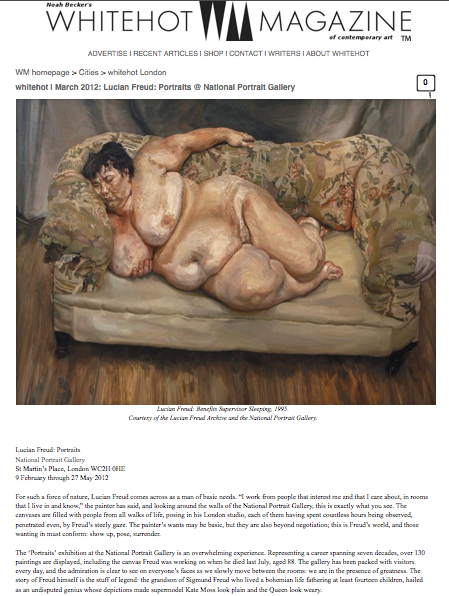
For such a force of nature, Lucian Freud comes across as a man of basic needs. “I work from people that interest me and that I care about, in rooms that I live in and know,” the painter has said, and looking around the walls of the National Portrait Gallery, this is exactly what you see. The canvases are filled with people from all walks of life, posing in his London studio, each of them having spent countless hours being observed, penetrated even, by Freud’s steely gaze. Because the painter’s wants may be basic, but they are also beyond negotiation; this is Freud’s world, and those wanting in must conform: show up, pose, surrender.

The ‘Portraits’ exhibition at the National Portrait Gallery is an overwhelming experience. Representing a career spanning seven decades, over 130 paintings are displayed, including the canvas Freud was working on when he died last July, aged 88. The gallery has been packed with visitors every day, and the admiration is clear to see on everyone’s faces as we slowly move between the rooms: we are in the presence of greatness. The story of Freud himself is the stuff of legend: the grandson of Sigmund Freud who lived a bohemian life fathering at least fourteen children, hailed as an undisputed genius whose depictions made supermodel Kate Moss look plain and the Queen look weary.

At least that is what it may seem like at first. The faces and the often-naked bodies are scrutinised down to their most extreme detail, exaggerating every imperfection, but look at the paintings long enough and the raggedness is transcended. Freud would labour intensively over each brush stroke, requesting the sitter to arrive daily over several months; with that amount of time spent watching someone it is no wonder the surface becomes just the beginning. The result will “astonish, disturb, seduce, convince”, just as Freud wanted.

Take ‘Lying by the rags’, where a naked woman looks like she has rolled down off the bed along with the crumpled sheets. Her skin becomes kaleidoscopic in detail, but there is a sunlit patch of floor in front of her, lovingly rendered with as much care as the main subject. ‘And the bridegroom’ depicts a naked couple sleeping, limbs gratuitously sprawled across the large canvas. But in Freud’s world an appendage is the same whether it is a breast or the tail of a mouse; the process of observing goes far beyond simple titillation.

Freud’s earliest works are different from the style he is famous for, but still there are common threads. ‘Girl in a dark jacket’ shows a woman with striking eyes, where meticulous attention has been paid to her irises and frizzy strands of hair. The nudes from the same period are shockingly smooth in comparison to the laboured, mottled skin of the latter works; sure it is pleasant to look at, but is it as interesting? In ‘Pregnant girl’, painted during the 1960s mid-period, Freud has started using more texture, with blue veins poking through the skin and deep shadows cast from the collarbone. It may be more classically beautiful than what comes later, but aesthetics is not the goal: this is a process of discovery.

The final section of the exhibition focuses on Freud’s last 20 years, and contains arguably some of his finest work. There’s no sign of slowing down, quite the opposite, this is an artist in his prime. The ‘Benefits supervisor’ series is fascinating, where Freud has pained a large, nude woman in a celebration of abundant flesh. The pictures of Freud’s assistant David and Eli the whippet  show a strong, confident style and two subjects clearly at ease. In ‘Eli and David’ from 2005-6, David does the unusual thing for a Freud portrait and smiles, while Eli sleeps serenely. The result is a tender image, slightly softer in the brush strokes. Adding to the poignancy, these were also the subjects of the canvas sitting on Freud’s easel the day he died.

The departing feeling from the Lucian Freud exhibition is one of saturation, exhaustion and exhilaration. On the steps I overhear a fellow visitor’s comment to her friend that Freud seemed to care more for dogs than for people, and this is certainly possible. Take 2001’s ‘Naked portrait’, where the woman’s feet are cut off while careful attention has been given to the imprint left by her feet inside the shoes on the floor. It is all the same to Freud, he painted what he saw and that meant sometimes a hard-boiled egg or the back of a chair got centre stage. But every one of his canvases contain a person, who got to be observed by a genius with a single-minded obsession. I catch myself feeling more than a little envious of those who were chosen.

The mythology of Sir Ben Kingsley

Published in Idol Magazine, 2012. Original article here.

kingsleyThe mythology of Sir Ben Kingsley
Sir Ben Kingsley discovered a rich mythology in ‘Hugo’, Martin Scorsese’s playful 3D adventure. The veteran actor took us to the heart of the story, while Martin Scorsese dazzled us with us his passion for 3D as the next step in cinema history.

While ‘Hugo’ tells the dreamt-up story of a boy living in the clock tower of a Paris train station, the role played by Sir Ben Kingsley is plucked from reality. It is the life story of Georges Méliès which fascinates Kingsley, far more than the excitement over the film’s 3D format. As one of the world’s first filmmakers, Méliès made over 500 films, before a lack of money forced him into a life as a cranky toymaker at Gare Montparnasse.

“For an actor, to explore the light of Méliès in his glass studio, and then to experience the dark of the toyshop, the exile … to be Méliès at his most empowered, in order to appreciate that terrible loss when he can no longer function as a creative artist,” says Kingsley, as he fixes his eyes on you and pulls you into his narrative. “It was terrific to occupy the full sweep, the arc of the character. This was one of the greatest arcs I’ve ever been privileged to scale. Beautiful, perfect! The balance of it is perfect.”

Kingsley paints pictures with his words. The veteran actor is calm and focused as we meet in grand settings at London’s Dorchester Hotel. Dressed in a dark blazer and neat jeans, Kingsley speaks with consideration, whispering a bit here and there for emphasis. Sir Ben, as he is called by everyone around him, is 67 years old, but there is nothing to suggest the ‘Gandhi’-star is looking for any less demanding roles now that he is eligible for his free bus pass. For what would be the fun in that?

“I fear there is a desperate immaturity in me that means I will be stuck being a child for a long, long time,” laughs Kingsley.

Childish inspiration
Kingsley shares the spotlight in ‘Hugo’ with 14-year-olds Asa Butterfield and Chloë Moretz, playing the parts of Hugo and his friend Isabelle. While the film, based on Brian Selznick’s book ’The Invention of Hugo Cabret’, is suitable for children, it contains a wealth of detail which means it appeals also to a mature audience.

“There are many subtle metaphors in the film, like the heart with a key to unlock it,” says Kingsley; Hugo is trying to repair an automaton given to him by his father, but he is missing a heart-shaped key. “Méliès’ heart is closed, and the key to unlock is the most innocent of children. Also, Hugo has to recreate himself because of the loss of his parents. He is very brave living in the train station, winding the clocks, being the time keeper of the world.”

Kingsley is full of admiration for his young colleagues, to the extent that he claims they pushed him to do better job himself. “Asa and Chloë both bring to their work a purity. Their acting is unimpeded, it is uninterrupted by theory, it comes from the heart,” says Kingsley. “This then demands in me the same level of purity. It raises my game, which is for me very exciting.”

Classical myths

Children’s ability to inspire is a topic that Kingsley returns to several times during our meeting, both in terms of how it affects him as an actor, but also how it is the kids in ‘Hugo’ who inspire a change in filmmaker Méliès after he has given up.

“It is one of the ancient classic myths: the exiled man is drawn back into life by the hand of a child. I always look for the six-seven classical stories in the scripts that I am offered. If there’s a central myth that acts as a map to unlock a script and fill it with genuine life and feeling, that’s the script I will choose. I recognised that early on in Marty’s script: there it is, there’s the exiled man and the child! It’s perfect, perfect.”

His background from the Royal Shakespeare Company means Kingsley is more familiar with the classical myths than most. This influence remains clear even now: Kingsley’s words are akin to performance, uttered with a perfect grammatical structure usually found only on stage.

3D controversy
‘Hugo’ is the first 3D experience for both Kingsley and Martin Scorsese, and the format remains controversial. But the man who gave cinematic classics such as us ‘Taxi Driver’ and ‘Goodfellas’ has buckets of enthusiasm for the new frontier:

“I’ve always wanted to do something in 3D. Over the years I’ve been obsessed with it: the blue and red glasses, black and white 3D, I’m a fanatical about it all but I never thought we would be able to do it,” says Scorsese.

The technology has now caught up with the director’s inspiration, but the 3D experience in ‘Hugo’ is less gimmicky than we are used to. Still, the Hollywood legend does not necessarily agree that 3D has to add something to the story. “Everybody says 3D has to enhance the story, but you have to think of what that really means. Does colour enhance every damn film that’s ever made? No!” Scorsese becomes animated. “Does colour enhance the room right now? It is in colour! Guess what, it’s in 3D too!”

Constant reinvention
Listening to Scorsese is fascinating: he charges forward, he stops mid-sentence and jumps back and forth as he makes his point. But all the actors in ‘Hugo’ say the same thing: Scorsese is highly observant, and he makes everyone around him feel at ease.

“He doesn’t miss a thing, I’m not exaggerating,” says Kingsley. “Whenever you’re with Marty, in his lovely big glasses, you see that he’s always taking in everything: the world, the person with whom he’s speaking. And it’s that extraordinary appetite for life that allows him to entirely reinvent himself, and to be completely with the person in front of the camera.”

While Kingsley was not a fan of 3D before making ‘Hugo’, it seems the experience may have changed the Shakespearean’s view of the format. “You are asking me about 3D in the wake of a beautiful experience,” says Kingsley. “My first time with 3D was this little View-Master where you turned a disc to see things in 3D. As a child I loved it, I was inside another world. Until I saw Marty’s film I had never had a 3D experience with the same effect. Marty allows you to see things through your child’s eyes, and that’s an amazing achievement,” says Kingsley. “It’s a miracle, really.”

Sir Ben Kingsleys mytologi

Dagbladet, mars 2012.

Sir Ben Kingsleys mytologi
Martin Scorseses nye 3D-eventyr ’Hugo’ er en familiefilm, men Sir Ben Kingsley oppdaget en rik mytologi sin rolle som filmpioneeren Georges Méliès. Vi traff Kingsley i anledning London-premieren av ’Hugo’.

Martin Scorseses ’Hugo’ forteller en oppdiktet historie om en gutt som bor i klokketårnet på Montparnasse-stasjonen i Paris. Men rollen til Sir Ben Kingley (67) er tatt fra virkeligheten, og det er livsreisen til Georges Méliès som fascinerer Kingsley, mye mer enn all ståheien rundt 3D. Som en av verdens første filmskapere lagde Méliès over 500 filmer, før pengemangel drev han til et liv som gretten leketøysmaker på Gare Montparnasse.

”For en skuespiller, å kunne reise mellom lyset, der Méliès lager filmer i glasstudioet sitt, til mørket i lekebutikken der han er i eksil … å kunne være Méliès i sin storhetstid, og så prøve å forstå hvordan det er å miste det som han mistet, og ikke kunne være en kunstner lenger. Det var fantastisk å kunne dra på denne reisen, det en av de flotteste livsreisene innen en rolle jeg har fått være med på. Nydelig. Perfekt. Balansen er perfekt.”

Han maler bilder med ord, Kingsley. Veteranskuespilleren er rolig og avbalansert når vi treffer han i en overdådig hotellobby i London, han har full kontroll over situasjonen der han setter de skarpe øynene i deg og tar drar deg inn i det han forteller. Kledt i mørk dressjakke og jeans, Kingsley snakker med omtanke, han hvisker litt innimellom når han vil understreke det han vil si. Sir Ben, som alle kaller han, er 67 år gammel, men det er ingenting som tyder på at storhetstiden for den eminente skuespilleren er forbi. Heller ser det ikke ut til at Kingsley, som er best kjent for å ha spilt Gandhi, er interessert i å velge mindre krevende roller nå i pensjonistårene. For hvor er jo moroa med det? ”Jeg er redd det er en desperat umodenhet i meg som betyr at jeg vil bli værende et barn i lang tid ennå,” ler Kingsley.

Unge medskuespillere
Kingsley deler rampelyset i ’Hugo’ med Asa Butterfield (14) i tittelrollen, samt Chloë Moretz (14) som spiller ungjenta Isabelle. I tillegg til å være en varm og innlevende familiefilm er ’Hugo’ også rik på detaljer som betyr at et eldre publikum kan også sette pris på den.

”Det er mange små metaforer i filmen, slik som hjertet som trenger en nøkkel,” sier Kingley; Hugo forsøker å reparere en mekanisk figur som faren gav ham, men han mangler en hjerteformet nøkkel. ”Hjertet til Georges Méliès er lukket, og nøkkelen til å åpne det igjen er disse barna. Hugo har måtte skape sitt eget liv etter å ha mistet foreldrene, han er veldig modig som bor i togstasjonen der han trekker opp klokkene. Han er tidspåpasseren, han har et enormt ansvar.”

Kingsley har stor respekt for sine unge medskuespillere, til den grad at han mener de bidro til at han gjorde en bedre jobb selv – ikke et dårlig kompliment fra den erfarne skuespilleren.

”Det er en renhet i måten Asa og Chloë arbeider på. De har ingen strategi, de er bare ute etter å fortelle sannheten. Deres ytelser kommer fra hjertet, ikke fra teori eller livserfaring,” sier Kingsley. ”Å spille mot den slags renhet krever at jeg gjør ting på samme måte. Jeg må opp på det samme høye nivået, og det gjør opplevelsen så mye mer spennende.”

Klassiske myter
Barns evne til å inspirere er et tema Kingsley kommer tilbake til flere ganger under samtalen, både hvordan han selv som skuespiller påvirkes, men også hvordan det er barna i ’Hugo’ som varmer hjertet til Georges Méliès etter at han har gitt opp alt håp.

”Det er en av de klassiske mytene: mannen i eksil som med hjelp fra et barn kommer tilbake til verden. Å finne denne historien i Martys film var fantastisk. Det er alltid så spennende å kjenne igjen de samme seks-sju klassiske historiene i nye filmer, og jeg ser alltid etter dem når jeg leser manuskript. Det er perfekt, perfekt.” sier Kingsley. Å ha startet sin skuespillerkarriere i Royal Shakespeare Company betyr at Kingsley har god kjennskap til klassikerne, og denne innflytelsen er tydelig også i dag; Kingsley snakker med en perfekt grammatisk struktur det er sjelden å høre utenfor teateret.

’Hugo’ er den første 3D-opplevelsen for Kingsley, og det ser ut til at erfaringen har endret klassikerens syn på formatet. ”Du spør meg hva jeg synes om 3D etter en nydelig opplevelse,” sier Kingsley. ”Min første opplevelse med 3D var de lekene du holder foran øynene og ser bilder i. Jeg hadde en slik da jeg var gutt, jeg var fascinert av den. Filmen til Marty er den eneste 3D filmen jeg har sett som har hatt samme virkning på meg. Martys 3D film drar deg inn i en ny verden, og han får deg til å oppleve den på samme som om du var et barn,” sier Kingsley. ”Bare det er jo et mirakel.”

Martin Scorsese: 3D er neste trinn i filmevolusjonen

Dagbladet, mars 2012.  

Martin Scorsese: 3D er neste trinn i filmevolusjonen
Martin Scorsese er storbegeistret over 3D-film formatet, og syntes det var spennende å teste nye teknologiske grenser med familiefilmen Hugo. Nå sier filmregissøren kritikerne må slappe litt av og gi nyvinningen en sjanse.

Hugo er Martin Scorseses første film i 3D, et format som er kontroversielt innen filmkretser. Men mannen som gav oss ’Taxi Driver’ og ’Goodfellas’ er full av entusiasme for det som er nytt:

”Jeg har alltid hatt lyst til å lage film i 3D. Jeg har alltid vært fascinert av det: blågrønne briller, svart-hvitt 3D, alt det der,” sier Scorsese, som også har sagt ja til å regissere Jo Nesbø-boka ’Snømannen’. Beslutningen om å filme Hugo i 3D var delvis drevet av teknologiske framskritt, sier Scorsese, som også var glad for å kunne lage en film som appellerer til sin unge datter.

At Hugo handler om en av filmkunstens pionerer er treffende: ”Med en gang da de første filmskaperne fikk bilder som bevegde seg ville de ha farger, de ville ha lyd, og de ville ha dybde. Vi har fått de to første,” sier Scorsese.

3D-opplevelsen i Hugo er ikke så gimmick-drevet som vi har blitt vant til, men Hollywood-legenden er ikke så villig til å gå med på at 3D må nødvendigvis bidra til historien.

”Alle sier at 3D må bidra noe til filmen, men hva betyr nå det? Vil du si at farger forbedrer hver forbaskede film som noen gang er laget? Nei!” Scorsese blir animert; øyenbrynene danser bak brillene og armene fyker utover. ”Men vi filmer i farger likevel. Er dette rommet bedre fordi det er i farger? Det er i 3D også, vet du!”

Scorsese har hørt alle argumentene mot 3D og synes at kritikerne må slappe litt av. ”Jeg synes kritikerne er sneversynte. De må se filmen, svaret mitt ligger der,” sier han, litt resignert. Han har hatt denne samtalen mange ganger. Kritikerne har jo et par poeng da, legger han til, med de upraktiske brillene og det kommersielle aspektet, men teknologien er fortsatt i utvikling; dette er jo bare begynnelsen.

”Tenk deg tilbake til for hundre år siden, da folk satt og pratet om denne nye greien som het film, som de viste fram i kafeer. Eller på de som gikk inn på museum i Paris og ble konfrontert med impresjonismen. Hva i alle dager har de gjort med penselen!” Scorsese ler. ”Jeg sier ikke at jeg er en impresjonist, men kan vi ikke ha en åpen dialog? Ikke legg lenker på den neste generasjonen rundt 3D. Ikke gjør det!”

Det er fascinerende å snakke med Scorcese. Han prater fort og innlevende, han stopper midt i setninger og hopper fram og tilbake i fortellingene – her er det ingen pusterom. Men alle skuespillerne i filmen sier det samme: Scorsese går ikke glipp av noen ting. Han har en enestående evne til å skape god stemning rundt seg og han har en suveren nysgjerrighet.

”Jeg overdriver ikke, han får med seg alt,” sier Ben Kingsley, som spiller filmskaperen Georges Méliès i Hugo. ”Marty, bak de store brillene, han slutter aldri å observere verden rundt seg. Han konsentrerer seg fullt om den personen han snakker med. Han fokuserer fullt på skuespilleren som står foran kameraet.”

– – –

CV: Martin Scorsese
Den legendariske filmregissøren Martin Scorsese (69) er mannen bak klassiske filmer som ”Taxi Driver”, ”Goodfellas” og ”Raging Bull”. Født inn i en arbeiderklassefamilie i Little Italy i New York, Scorseses filmer takler ofte tema som den Italiensk-Amerikanske identiteten, katolisisme, moderne kriminalitet og vold. Regissøren har mottatt en rekke priser for arbeidet sitt, deriblant Gullpalmen, Golden Globe-prisen og en Oscar for beste regissør for ”The Departed”. Nyere titler inkluderer ”Gangs of New York”, ”The Aviator” og ”Shutter Island”. ”Hugo”, Scorseses første 3D-film, vant fem Oskar-statuetter i februar, deriblant for beste kinematografi og visuelle effekter.

FAKTA: Hugo
12 år gamle Hugo (Asa Butterfield) bor alene i klokketårnet i en togstasjon i 1930-årenes Paris, der han forsøker å reparere en mekanisk figur som faren gav ham før han døde. Det ensomme livet til Hugo tar en ny vending når han treffer Isabelle (Chloë Moretz), guddatteren til den gretne leketøysmakeren Georges Méliès (Sir Ben Kingsley). Når Hugo og Isabelle begynner å finne ut av mysteriet med figuren, viser den seg å være nøkkelen til et liv Méliès har prøvd å glemme. Filmen, som er basert på Brian Selznicks bok ”The Invention of Hugo Cabret”, har opptredener fra Christopher Lee, Sacha Baron Cohen og Jude Law. Den fantastiske historien er også en hyllest til Georges Méliès, en av filmkunstens grunnleggere. ’Hugo’ har norgespremiere 16 mars.

Lygia Pape: Magnetized Space

Published in Whitehot Magazine, 2012. Original article here.

PAPELygia Pape: Magnetized Space
Serpentine Gallery, London

Lygia Pape’s work, with all its geometry, should not feel this sensual. Maybe it is because of the music, the soft bossa nova strumming through the rooms of the Serpentine Gallery, or it could be the radical undercurrent that does it. The political message is there as a subtle nudge in the work, much of which was created under a stifling Brazilian government, but Pape is also radical in terms of her playfulness.

The experimentation pops to the surface in the series of woodcuts on Japanese paper. The visible wood grain in the prints gives the work an earthy feel, further encouraged by the slight yellowing of the paper. These prints were made in the 1950s, but Pape’s choices are timeless: triangles, circles, squares. The shapes follow each other, first in sync before colliding to create something new. It is very satisfying to look at, as if the mind enjoys tracing the lines, following them to their conclusion as they create illusions of depth. Maybe there is a mathematical formula at the bottom of it; it is possible Pape has created a secret language we do not realise that we understand.

“I want to discover new things. Because, to me, art is a way of knowing the world… to see how the world is… of getting to know the world,” said Pape. The influential Brazilian artist (1927-2004) was a founding member of the Neo-Concrete movement, which sought to include art into everyday life. Pape did this by fusing ideas of aesthetics, ethics and politics into her work, before her late works centred in on emotion and sensation.

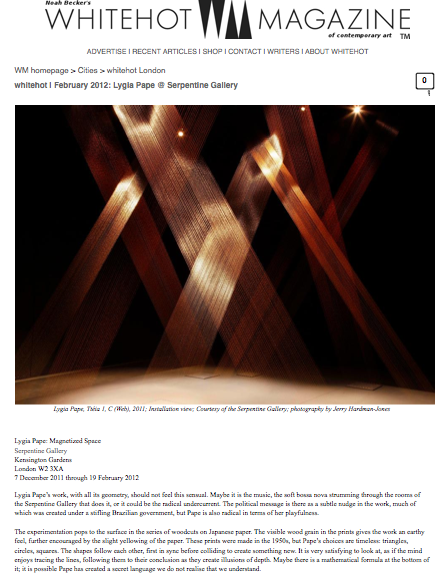
The most aesthetically striking work in the show is ‘Web’: gold threads are strung from floor to ceiling in a subtly lit room. From some angles the threads seem to drift into nothingness, while two steps later they look like rays of light. Study reveals it is all perfectly logical, but the effect is magical. Some of the strands weave in with each other before veering off again, sort of like Pape’s work itself. “My concern is always invention,” said Pape, and because of this penchant for experimentation, this retrospective consists of many seemingly unrelated elements. In addition to sculpture and prints there are video works rescued from scratchy old tape, each of them boldly sensual and subtly political. The common thread is there: it is magnetic, it inspires reaction.

The intriguing ‘Book of Time’ consists of 365 blocks lined up neatly on the wall. Each is the same yet completely different from the other: blue, red or yellow, with stripes, cuts or patterns. They represent days, each one repeated, each one unique. Time often feels more like a river, meaning there is something refreshing about Pape’s attempt to tame it: break it down into segments, describe each one, keep a list. We do not remember each day, but this approach gives us a map. It may seem impossible, but with the right prompts we could recall almost anything, even when our days run into the thousands.

The Viking compass

Lionheart Magazine, Bravery issue, 2011. Original article.

lionheart1The Viking compass
We’re moving, my bike and I, the traffic around us is menacing but today it creates the perfect hum. My wheels are a butch girl called Lola, I’m a scrawny girl in woollen layers. I’ve got music in my left ear and the rush of the city in my right, I know what I’m doing here, moving through roundabouts, edging up to be first in line at the big crossings. Casual but cocky in my element, I stretch my back out as I wait for the light to turn green. This city, this country, it’s my home, I feel it in my bones, it’s there in the buzz on my skin.

I’ve lived in England for almost 12 years now, a third of my life. I was raised Viking, in Norway where it’s dark for an hour in the summer and you pay for that with blood in the winter. I was a kid then, an awkward teenager who left in a huff the first chance she had. Norway and I have since forgiven each other, but the feeling of detachment remains. There’s space between the houses up north, in the country that provided me with pale skin and fawn-coloured hair, there’s space between the people. There’s a stillness, a quiet understanding of what we are, that we are all the same. Everywhere are tall pines, wide valleys, and whitewater rivers, subdued by eight months of winter. If I never see snow again that will be fine with me.

People ask me about Norway, about the food, music and culture, but I don’t know the answers to the questions anymore. A decade changes things – I know this, because the few days a year I spend there are enough to show me, again and again, how they’ve moved on without me. There’s an irony at work here: I left because the world is such a big place, and what happened was I ensconced myself on this small, crowded island, squinting backwards with increasingly foreign eyes. When I visit them up north I drive my mother’s car to the shop and panic at the sight of another vehicle, because everyone’s driving on the wrong side of the road. The reprogramming is happening.

It took a while, but I’ve figured out how to live in England now. I have learned what clothes to wear when the weather is muggy and shifty, the art of banter and the fact that “how do you do” isn’t actually a question. I go back to where I came from and people expect me to be the same, or should I say, they expect me to have kept up with the changes, but instead the years pass and I stumble at Norwegian words. My language is rusting. I don’t recognise the people in the paper, I balk at the price of peppers in the shop, I carry my umbrella everywhere even though up north it doesn’t really rain. The air feels cold inside your nostrils, you can hear the gravel crunch underneath your shoes and life feels so slow.

The funny thing is, I never felt Scandinavian until I left. It’s only now I understand how much of me is shaped by the place I come from. How pragmatism is a national trait, not a personal one. How things so often aren’t about common sense, they are about culture. England isn’t a big leap in global terms, but it’s big enough to trigger an awareness about how the customs of the people around us shape our choices. Even now, after a decade in England, the culture around me isn’t really mine, meaning I get to choose. But every year that passes I understand a little more about this country, one discovery leads to the next, like peeling an onion. In England, the air is damp even when the sun shines, it feels different than anywhere else in the world: the constant crowds, the cracks in the pavements, the roasted foods and a language that rolls in the mouth. Everything has rounder edges, everything is patched together by people from all corners of the world, adding their stories to the tapestry that makes up this small island.

At night I pull my woolly cardigan around me, the stars are the same ones I’ve always looked at but here they’re positioned differently in the sky. I was just a kid when I got here, suitcase full of tinned fish, looking not for England but simply for something different. I’m a grown up now, and I realise the passage of time would have changed me even if I’d stayed put. There’s still a lot of Scandinavian in me – the skin that burns in the sun, the pragmatic core that borders on rudeness. Norway may have brought me up but it’s England that raised me, it’s where I’ve made my bed. I feel it every time I return, when my plane lands and the wheels jump against the runway. I know I am home, it’s the feel of you when you’re around me.

Nordmannskap i ein havregraut

Sør Trøndelag, mars 2000.

Nordmannskap i ein havregraut
Sjølv om innbyggjartalet på Å ikkje når 400, betyr ikkje det at dei ikkje kan fylle eit samfunnshus. For på fredag laut dei opne opp glasa allereie før underhaldninga byrja.

Meldal Historielag sto for arrangementet av kulturkvelden, som vart opna med det kjende spelet ’Grauten på Grut’. Tidsbiletet var tilrettelagt av Ola Uvøyen, som òg hadde rolla som forteljar. ’Gammelkarainn’ sto for dei musikalske innslaga.

Det var eit besøk på garden Nordstuggu og Grut som har vorte historie som del av Aasmund Olavson Vinje si bok ’Ferdaminne frå sommaren 1860’. Lars Jordet gjorde ein staut figur som Vinje, som kjem gangande frå Rennebu ein dag i onnetida. Han er trøtt og svolten, og får høyre at på Grut er det råd for begge deler.

Gardskjerringa Inber, i Magni Ree Furseths skikkelse, tykkjer det er synd å by framandkaren på dugurdsmat, men Vinje vil ikkje være kleinare enn att han et havregrauten: ”Lat meg berre få god mjølk åt denne dugurdsgrauten, du!”

Seinare fortel han ein bonde han treff, spela av Ole Hoel, om opplevinga: ”Det var som det skar i meg av all nytinga! Eg forsto ikkje all denne nordmannskapen før et åt grauten på Grut.”

Dugurdskost vart òg servert til heile samfunnshuset. Johanna Rikstad, Astrid Fossmo og Berit Hoel hadde teke på seg oppdrage å koke grauten, 85 liter til saman. ”Grauten er slik som han var på Grut, laga av havremjøl, vatn og salt,” seier Berit.

Denne grauten var nok betre enn han som vart servert på Grut, for det var ikkje store fatet att til slutt. For enkelte av publikum var det fyrste gongen dei fekk servert slik kost, og formannen i historielaget, Erik Steien, vart overraska: ”Eg trudde ikkje han skulle vere så god, nei!”