Knit, purl, catharsis

Flamingo Magazine, Future Craft issue, March 2013.

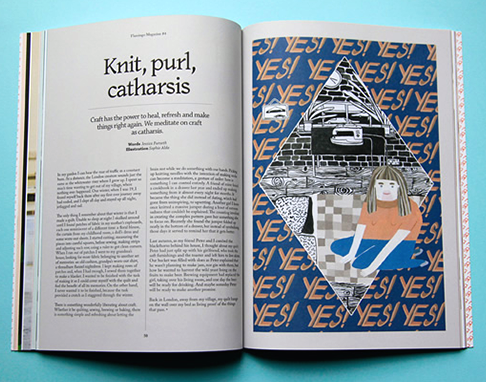
knitpurlKnit, purl, catharsis
In my garden I can hear the distant sounds of traffic, night and day like a constant hum. This is London, where only a few stars are still visible in the light-polluted sky, hanging over a metropolis of grit and push. I feel it surrounding me, like a promise that it’s all within reach.

At a distance, the London creature sounds just the same as the whitewater river where I grew up. I spent so much time wanting to get out of that place, to leave the village where everyone was the same and nothing ever happened. One winter, when I was 19, I found myself back there after my first ever journey outward had come to an end, and I slept all day and stayed up all night in jetlagged sadness. My heart was still out there, across the ocean, where life was happening and where I still wanted to be, but instead I had to come back to the village where the river now slept under a sheet of ice and snow. I wondered if any of it had ever happened, that brief moment of life in the city, and I was terrified that maybe I’d dreamed it up.

I don’t remember much from that winter except for one thing: I made a quilt. Unable to sleep at night I skulked around until I found pieces of fabric in my mother’s cupboards, each reminiscent of a different time: a floral blouse, my childhood curtain, a doll’s dress, some worn-out sheets. I started cutting, measuring the pieces into careful squares, before I started sewing, making strips, adjusting each row using a ruler to get clean corners. When I ran out of patches I went to my grandma’s house, looking for more fabric with another set of memories: an old cushion, grandpa’s worn-out shirt, a threadbare flannel nightdress. I kept making rows of patches and when I had enough, I sewed them together into a blanket. I wanted it to be finished so I could cover myself in these feelings, these stories from a time when I was small enough for the village to be big enough for me. And I never wanted it to be finished because I needed this task; it was my crutch as I staggered through the winter, bewildered by clocks and maps and no longer believing my own memories.

Now that craft has changed from a chore to a hobby, there is something quite liberating about this activity. Whether it be quilting, sewing, brewing or baking, there is amazingly simple and refreshing about letting the brain rest while doing something with our hands. Picking up the knitting needles to make my own socks to go inside my winter boots becomes a meditation, a gesture of order because here is something I can control entirely. A friend found a cookbook in a drawer last year and ended up making something from it almost every night for months, deciphering hand-scrawled recipes of boiled puddings and obscure cuts of meat. It became the thing she did instead of dating, which had gone from uninspiring to upsetting fast. Another friend once knitted a massive jumper during a bout of extreme sadness that couldn’t be explained by life just being a bit rubbish anymore. The counting of the complex pattern created something else to focus on, something other to do than wonder where her life had gone. She found the jumper again recently, folded up neatly in the bottom of a drawer, but instead of it being a symbol of her illness it seemed to carry a promise that it gets better.

I thought about my quilt earlier this autumn, when I went with my friend Peter up to the blackthorns that grown along the brook behind his house. Peter had just split up with his girlfriend, who’d taken the toaster and the soft furnishings and left the man to live with a bare-walled flat and a nagging question about the point of committing, if this is all it’s worth. Our bucket filled with sloes as Peter explained how he wasn’t planning to make jam, nor gin, with them, but how he wanted to harvest the wild yeast living on the fruits to make beer. Brewing equipment had taken over his living room, replacing the girl, and one day the beer will be ready for drinking. And someday, maybe a little later, Peter will be ready to make another promise.

In my London garden, the soft rustle of traffic sounds just like the whitewater river I grew up by, but only if I close my eyes. I came to the city because this is where I want to be. Inside, on the wall over my bed, my quilt hangs as proof of the things that pass.

flamingo1

Is London the hottest place in the world to be a start-up?

Megabuyte, February 2013. Original article here (£).

london hottestThe Early View
Is London the hottest place in the world to be a start-up?
There is a distinct buzz of optimism surrounding the London start-up scene. Yes, we could do with more money to create more opportunities, but everyone we’ve spoken to agree that London has come a really long way in being a nurturing hub for innovation. As the Valley is arguably approaching maturation, the London location is the hot newcomer that’s just now becoming established enough to be a real force to be reckoned with. We met with Julie Meyer, founder and CEO of Ariadne Capital, to talk about why London may well be the most exciting place in the world to be a start-up.

The network king
“You can say what you want about the Empire, but the United Kingdom understands networking, says Julie Meyer, who grew up in Silicon Valley but opted for London as the base for her entrepreneur financing group. “London is absolutely conducive to start-ups and venture capitalists, and to the people who want to build the future. Absolutely. That is why I choose to be here. This is London! As far as I am concerned, this is the center of the universe.” Meyer laughs, but she’s also being serious. We’re chatting across the conference table in her offices near Trafalgar Square, from which Meyer runs the Ariadne Capital Entrepreneurs Fund. BeatThatQuote, Espotting, Monitise, SpinVox and Zopa are among the finds of the woman who founded the First Tuesday entrepreneur network and sold it, in 2000, for $50m.

While home to plenty of companies with international success, the UK technology industry tends to quietly get on with it while leaving it to its US cousins to brag about changing the world. But Meyer believes there are distinct advantages to the British way of doing things: “I have seen it be a tremendous advantage, for instance in terms of culture and team. It’s less about the one superstar player and more about the team going over the wall together. […] Another advantage is the network: I think the United Kingdom should focus on trading through the Anglosphere network, which it created. The Eurozone is just one of the spheres of influence for the UK, the others being the Commonwealth and North America. What other country has three spheres of influence like the United Kingdom?”

The British way
“What I like about British entrepreneurs is they are more about the talent, less the ego,” says Meyer, who doesn’t thinks the British are becoming more ‘American’ in their approach to business. “The British way has its disadvantages, but let’s face it: it’s a lot less off-putting! When people go around talking about themselves it gets rather annoying, doesn’t it? But that’s the way the Americans are raised.” On the subject of companies succeeding internationally with a British approach, Meyer is a big fan of Monitise, the mobile banking group which has been advised by Ariadne Capital since 2004. “[CEO and co-founder] Alistair Lukies is an amazing entrepreneur. He has just acquired his biggest American rival [Clairmail], and this is the way we should be doing it. Why just sell to them, why not buy them?”

UK software groups have the potential be as big as US ones, is Meyer’s message, which is a refreshing point of view so shortly after UK software leader Autonomy went American, to HP. However, last year’s in-depth industry study from Startup Genome found that Silicon Valley has 30% more founders that want to change the world than London or New York, while London has twice as many founders wanting to make a quick sale compared to the other two. Having said that, our interviews with London startups found that most founders wanted to build instead of sell, seeing no reason why they couldn’t carve out a niche in the new internet-augmented world alongside their Valley peers.

“I want to build the company and be in charge of what we’re doing. The idea of selling to a big company or work for Google doesn’t really do it for me,” said James Gill, CEO and co-founder of London start-up GoSquared, when we met in the autumn. “I love the idea of us being a big UK tech company, and I’m seeing more and more London companies having that attitude. […] We has more than ever going for us; sure, we don’t quite have the capital going into London companies, but it’s never been a better time for us to start aiming to build a company that could one day go public.”

The David and Goliath dance
While the young entrepreneurs may be less interested in working for Google, the trend suggests they are likely to find themselves in some sort of collaboration with the mature players. Today’s startups, the so-called Davids, should no longer hope to slay the Goliaths of their industries, says Meyer, but instead the pair must dance: “Today’s entrepreneurs know venture capitalists will not give them $50m to go build a Tesco,” she says, after pointing out how Ocado made life a lot harder than it needed be, by opting to create its own distribution network instead of hooking into an existing one. “You can tell Ocado is of a previous era because the venture capitalists gave them a lot of money to build distribution. Today what you would do is say, ‘Hey Julie, I have an insight into consumer behavior online. Can I have £250,000 to demonstrate this?’ Then we could do a deal with a Goliath with a distribution base, and build the company having raised maybe around £2m.”

This collaborative approach is not just for the benefit of the startups, but also for the established players grappling to stay innovative. The solution for the incumbents isn’t necessarily to buy younger companies, says Meyer, who runs workshops putting old and new companies together in an informal setting where a fresh conversation and experimentation can take place. “Where we see the opportunity is around business model, not tech. We are not investing in disruptive technologies, we are investing in disruptive economics,” says Meyer, pointing to Monitise as a good example of a David and Goliath collaboration: the group reached out to big banks offering them a cut of mobile commerce revenues instead of struggling to create a system from scratch. “A lot of corporates will say, ‘show us some disruptive technology’. But it shouldn’t be too disruptive, it should be pretty basic.”

London startups: The fundraising experience

Published in Megabuyte, January 2013. Original article here (£).

fundraising experienceThe Early View
London startups: The fundraising experience

London is rapidly emerging as one of the best places in the world to be a startup. Even if opinions differ on the details, most people in the community seem to agree on this fact. “I think London is at just the right inflection point, where after a number of years there is finally real support of entrepreneurship across the country,” says Jeff Lynn, CEO and co-founder of fundraising platform Seedrs. More activity from angels and government initiatives such as the Enterprise Investment Scheme is one thing, but Lynn also emphasises the improved acceptance towards risk: “If you talk to people in their 50s or 60s they tend to say, ‘Oh failure will ruin your career’. In the past that was true, but the consequences of failure are not as substantial as they once were.”

If you try and you fail, and the reason you failed is not that you were lazy, stupid or corrupt, said Paul Graham of Y-Combinator, then you will benefit from it. Until recently this has been an attitude confined to the Valley, where six decades of startup history means company founders can pitch to investors who once stood in their place and know what it’s like. But London is now starting to wake up to how innovators should be nurtured, and there’s something to be said for being an entrepreneur seeking funding in a young, dynamic area undergoing rapid growth. London provides a real opportunity for startups to stand out, with pressures (and valuations) remaining more down to earth. Following our interviews with London startup investors, we take a look at the issue of fundraising from the point of view of company founders.

Money via networking
Geckoboard, the real-time application monitor, recently completed its second round of fundraising, following its seed investment in December 2010. “I had the idea in March 2010, and the following July was when we had an alpha version of the product. In startup speak it was a minimally viable product, just to solicit feedback, and by August we’d got some traction,” says Paul Joyce, CEO and co-founder. This was also the point at which Joyce quit his day job, to give his full attention (and savings) to Geckoboard. The investors followed shortly after, in a chain of events not dissimilar to how networking has secured funds for several UK startups: “[Investor] Christoph Janz got in contact way back in July 2010 saying that he liked our product. Then when he found one of his portfolio companies to be using Geckoboard it was brought to his attention again. At that stage I as looking at maybe raising a small amount of money, so I spoke to Christoph and he was interested. It happened very quickly.”

But Joyce won’t describe the fundraising process as easy. Being a three-person team at first, it was demanding to take one person away from running the company to go to meeting after meeting to look for money. “It’s not something that falls in your lap. A lot of thought goes into it. How much are we going to raise? What sort of venture is going to add value? How much equity are we going to give away?”

Not to mention how getting funding is not an end-point for a startup, but an opportunity to keep developing the product to hopefully become a long-term value business. Following the second round of fundraising earlier this year, Joyce says the key challenge is to demonstrate traction and show the people are responding to what you are trying to do. And of course, you have to make sure people know who you are: “We put ourselves on Angel List, which is a fantastic resource for seed funding. I think we’re still the most followed European start-up on Angel List actually; we had a lot of meetings and we were over-subscribed.”

Beyond the bootstrap
Fintech software upstart FundApps, which caters to hedge funds, managed to get up and running without resorting to outside funding at all. Even as the company expands, CEO and founder Andrew White says he doesn’t expect to raise any money.

“We bootstrapped the company at first, and within a couple of months we had a beta product we could show,” says White, who then reached out to some former clients in the process of setting up their own company. FundApps differentiates itself by providing a lower cost Cloud service for hedgies to keep on top of regulation in different jurisdictions. As the first sale was secured within four months, the group was profitable almost right away. The aim for FundApps now is to expand the client base, which currently numbers only three but one of which is “one of the biggest banks in the world”. But even as the group plans to sell the software internationally, White doesn’t foresee the need to reach out for funding: “There’s no real scaling issues with the company, except for sales. The software is written, and if we want to go into China we will use sales and operations people on the ground. […] This was one of my aims for the company: to create something that could scale pretty much infinitely without having to put lots of people in. This should also keep us nimble and innovative.”

Bootstrapping was also the plan for James Gill, CEO and co-founder of real-time web analytics outfit GoSquared, until Eileen Burbidge from Passion Capital got in touch. The company has since raised a second round, with Passion and Atlas Ventures.

“Initially I never really planned to raise money. I hoped to get enough money from our paying customers to fund what we were doing, and maybe that could help us get through university,” says Gill. The plan may initially have been to use GoSquared to pay for school, but Gill and his young co-founders now have bigger ambitions for their company: “I’m really glad the opportunity came around. It’s enabled us to take what we’ve done way above what we imagined.”

Still the web, but different

While the UK will continue to take a backseat to the Valley simply because there’s a lot less money sloshing around, the general attitude seems to be that this is improving, slowly but surely. While the companies emanating out of London tend to span the full spectrum of industries, the entrepreneurs succeeding in raising money in London do tend to have a distinct second-generation feel about them. A good example of this is the contrast between dot-com success Lastminute.com and Taggstar, the web content monetisation group set up by a former director of the travel site.

“What was different when Brent [Hoberman] and Martha [Lane Fox] started Lastminute.com in 1998 was how there was a fresh open marketplace, with real first-mover advantage in sectors like travel, clothes or online shopping in general. While there’s huge opportunities also now, it’s harder to break ground in existing verticals,” says Taggstar CEO and founder Fraser Robinson, who was managing director of Commercial & Media at Lastminute.com and around for the “growing pains and exit pains”.

“Had Taggstar been a business looking to sell something or attract an audience to a website it would have been a lot harder to raise money,” says Robinson, who secured £1.6m for the group in 2010. “Instead we are a tech provider, offering third party solutions to other websites in a very scaleable manner. These are the sorts of businesses where it seems a lot of new investment is going now: company that make existing sites better, more efficient or profitable, rather than trying to be a destination site.”

Literary pubs of London: A beer-soaked history

Published in Viator (here), 2013. 

london pubs

Literary pubs of London: A beer-soaked history
The two thousand year old city that is London is a living, breathing history book. While Samuel Johnson was right: “There is in London all that life can afford”, often what we locals like doing most is to haul up in the pub. Luckily, we need not choose between comfort and culture when looking for a watering hole around London town, because so many pubs are rich in historical and literary connotations. So get your pint and find a seat by the fire, underneath low beams on crooked floors, and get merry in the knowledge Dickens may well have sat in the very same spot.

Ye Olde Cheshire Cheese, 145 Fleet Street, in the City
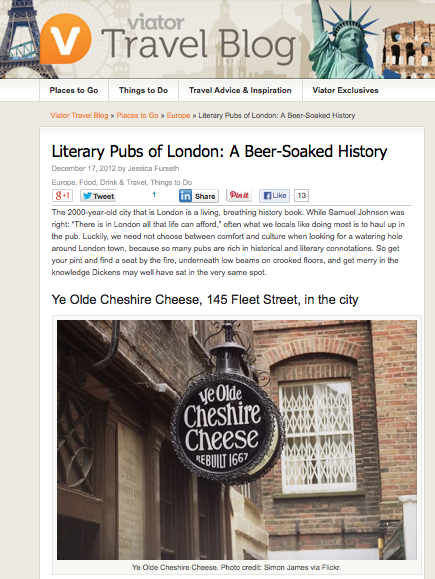
One of many London pubs with a Charles Dickens connection, it’s easy to see the author penning some of his gloomier stories at Ye Olde Cheshire Cheese. The atmosphere comes from the lack of windows, but take this as is part of the charm as you crawl through the many little rooms inside. There’s been a pub in this spot since 1538, but the one there today was re-built after the Great Fire of London. Dickens’ novel ‘A Tale of Two Cities’ makes a reference to this pub, when the characters make their way along Fleet Street “up a covered way, into a tavern … where Charles Darnay was soon recruiting his strength with a good plain dinner and good wine”.

The Prospect of Whitby, 57 Wapping Wall, in Wapping
Whether it’s true that this pub sits at the site of the city’s oldest riverside tavern is not certain, but this is still a great place to have pint by the Thames. Legendary diarist Samuel Pepys drank here, but the pub also features in newer works of fiction: Vercors’ 1952 novel Les Animaux dénaturés, and the famous English comic book series ‘The League of Extraordinary Gentlemen’.

The Fitzroy Tavern, 16 Charlotte Street, in Fitzrovia
This classic London pub was once the epicentre of the city’s literary bohemians, drawing custom from the likes of Dylan Thomas, George Orwell and Augustus John. Originally a coffee house when it was built in 1883, it became a pub only a few years later and has stayed true to these roots ever since. Fame or infamy depends on who is asked, but between the 1920s and 1950s it was a popular after-work hangout for Orwell and Thomas who worked at the nearby BBC. Today it hosts the weekly gatherings for the alternative student magazine at University College London.

The Anchor, 34 Southwark Bridge Road, at Bankside by London Bridge
This is where Samuel Pepys sat when he watched the Great Fire of London in 1666, taking refuge in “a little alehouse on bankside … and there watched the fire grow”. The building standing in this spot today has gone through several modifications, not all of them for the better, meaning the best spot to sit and soak in the atmosphere today is probably the large seating area overlooking the Thames. Regardless, this is the only remaining pub in an area once popular for riverside inns around the time of Shakespeare. The site of his original Globe theatre is only a block away (the new building by the river is a replica), meaning there’s a good chance the playwright would have drank at The Anchor.

The Pillars of Hercules, 7 Greek Street, in Soho
“Who would want to hang out around the Pillars of Hercules? Only those bent by this passion for writing books. We were absolutely determined to become writers. We didn’t use words like ‘passion’, but we acted them out. Writing was the only important thing,” Ian McEwan recently said in an interview with The Guardian. The author would spend time in this Soho establishment with his literary friends Martin Amis, Julian Barnes and Christopher Hitchens. The pub itself stems back to 1733, with ties also to Casanova, Thomas De Quincey and Charles Dickens.

The Spaniards Inn, Spaniards Road, in Hampstead

A literary classic, The Spaniards Inn remains a gem of a pub with beautiful oak panels and a great beer garden, where you can find such a rarity as a panoramic view of London. Dickens mentions the Spaniards in his novel ‘The Pickwick Papers’, Bram Stoker names it in ‘Dracula’, and Keats allegedly wrote ‘Ode to a Nightingale’ in the garden. The Spaniards remains a great end point after a walk across Hampstead Heath, with a live fire and brews on tap to get the warmth back in your body on a chilly day.

Land of plenty: London for startup investors

Megabuyte, November 2012. Original article here (£).
london investorsThe Early View
Land of plenty: London for startup investors
The London startup ecosystem now constitutes at least 3,000 tech-focused companies, but possibly as many as 5,000, according to research by Charles Armstrong, the ethnographer and business innovator. Armstrong runs Trampoline Systems in Shoreditch, an award-winning social analytics software specialist, which maps companies’ internal and external relationships. But even he has been surprised at the speed and intensity of growth in the tech cluster around what is admittedly one of London’s grimmest roundabouts. As the London startup hunting ground is getting increasingly rewarding for investors, we spoke to Seedcamp and Passion Capital about what they are looking for, and what kind of opportunity they see in the London scene.

Seedcamp: Network is king
“At the moment we are calling ourselves a global early stage seed investor with a mentoring programme, ” says Kirsten Campbell, general manager of Seedcamp, as we meet in their offices at Google Campus in Shoreditch. The terminology needs work, she laughs: “But we are more than a seed investor. I wouldn’t necessarily classify us as an incubator, as those typically tend to have companies in a co-working space. We don’t like to use the word accelerator either, although there’s a lot of value when that happens.”

Regardless of what Seedcamp will end up calling itself, the fact remains that a host of hot startups can be traced back to the five-year-old programme. These include fashion data expert Editd, peer-to-peer currency exchange group Transferwise, and Playmob, the charity and gaming link-up specialist. Seedcamp’s standard investment is €50 000 for a 8-10% stake, alongside a year-long support programme with access to leading events and mentors. Similar initiatives include Springboard in Europe and Y-Combinator, 500 Startups and TechStars in the US, which support early-stage companies for a limited time while preparing them to raise their next round of funding.

Seedcamp is usually a company’s first cash injection outside friends and family, says Campbell: “This means there’s also a learning curve, as quite often when we send companies a term sheet they have never seen one before.” On that note, Carlos Eduardo Espinal, Seedcamp partner alongside Reshma Sohoni, has set up seedsummit.org, where anyone can look at legal documents for startup funding as agreed as standard by over 30 of the bigger investors [including Passion Capital]. “So even if you have nothing to do with Seedcamp, you can look up what a standard term sheet looks like. That gives you grounds for negotiating if you get something that’s way off.”

This may seem very neighbourly of Seedcamp, but these are actually a very choosy bunch. Operating exclusively on an events- and applications basis, last year Seedcamp got 2000 letters, from which they selected 200 for personal meetings before choosing 20 for investment. “So that gives you an idea of our process, but if you’re talking about quality, we could probably invest in more. There are certainly companies that have applied to Seedcamp and not been picked that have gone on to raise money elsewhere,” says Campbell, pointing out how Christian Thaler-Wolski, Wellington Partners principal and Seedcamp mentor, kept track of a company he met at Seedcamp Berlin last year. Bonusbox, a Facebook-based shopping portal, didn’t get into the Seedcamp programme, but Thaler-Wolski ended up contributing to their funding.

But with companies like Seedcamp being quite exclusive, is there enough money going around in London to fund the good startups? Campbell thinks for a moment: “I guess it depends on how well networked you are, and what investors think of your capabilities. But if you have a strong team in London, Berlin or another hub, I don’t think companies struggle too much to get investment. There seems to be a boost at the moment, there are so many angel networks pitching events.” Right now, Seedcamp is present at ‘How to Web’ in Bucharest, ‘LeWeb’ is coming up next week in Paris, and last week there was an event in Vienna. And investors do go to these events, says Campbell, as well as big corporates such as Microsoft and Facebook, ever keen to see what’s happening on the ground. She points out how co-working community TechHub held an event at Campus earlier in the week; it was meant to be a casual night for founders to test their demos, but investors still managed to sneak in.

For startups, Campbell recommends researching which investor is most suitable to your specific situation and target that shortlist. “Look at the size of deals they typically do to make sure they can give you the amount you are looking for. Look at which sectors they like: for instance Notion Capital likes to invest in B2B software, and Anthemis likes fintech.” Campbell is also a fan of AngelList, the San Francisco-based online network for connecting startups with angel investors. A similar initiative is London-based Seedrs [who we met in September], where companies can reach out not just to angels but anyone else who’d like to invest. There are nearly 18,000 business angels out there in the UK, most being registered by The British Business Angel Association.

When choosing their investments, Campbell says Seedcamp primarily consider the team and the market size, but also the general impression of the people involved. “Some of the teams are really early stage, so all you can get is a gut feel whether these founders will be able to achieve something.” Campbell reckons about half of the applicants to Seedcamp have a previous venture of some kind behind them: “We invested in Cashpadder last year and in March they sold to AirBnB. The founder, Stephen Rapoport, is now doing his second startup [YourGrind, a custom coffee bean delivery service], so even in a short space of time we are seeing experience building up.”

Passion Capital: A room full of opportunity
White Bear Yard, Passion Capital’s open and friendly co-working space in London’s Clerkenwell, is the sort of buzzy space that gives the impression of the next generation of tech being created right under your nose. Luke Johnson, head of Risk Capital Partners and chairman of StartUp Britain, described it thus in the FT: “This method of building new companies at warp speed is fascinating. […] I like the sense of urgency, the work ethic, the high-pressure environment that helps drive rapid progress, and the incredible opportunities to network and cross-fertilise.”

The $60m Passion fund has only been around since April 2011, but founders Stefan Glaenzer, Eileen Burbidge and Robert Dighero have been busy. Out of 1500 possible investments in the first year they ended up with 20, including real-time analytics group GoSquared, direct debit innovator GoCardless, social micropayments outfit Flattr, and Pusher, a programming interface for adding scalable functionality to apps in real time.

“There is a hell of a lot of deal flow in London and Europe right now,” says Stefan Glaenzer. The Passion team look for three Ts when choosing their investments, he explains: team, traction, technology: “Team is the most important once. We first look for passion and willingness in the entrepreneur. It doesn’t necessarily have to be passion for the product, but are these these passionate people? Then there’s the execution and the ability of the founders. And last, do they have the entrepreneurial oomph?” This is where the gut feeling comes in, says Glaenzer: “Some have the oomph and some just don’t.”

Glaenzer thinks the quality as well as the quantity of startups in London, and Europe overall, has increased, and a lot of this can be traced back to the growth in the overall scene: “The ecosystem is getting better. Go back 6-7 years there were 3-4 digital companies around the roundabout. Now there’s over 3000 in 1.5 square miles.” Of course not all the startups are good, adds Glaenzer, but the increasing mass improves the networking and funding opportunities.

Being involved in companies at the earliest stages is where the fun’s at for Glaenzer, who co-founded auction site Ricardo.de and was the first to invest in Last.fm: “I love it. That’s why we do early stage: being involved from the moment of the idea or prototype, then you see a service or product become loved, and then you enter a growth phase … nothing beats it.” Having said that, the backers at Passion will either take a close or remote role with its companies, depending on what they prefer: “We provide them with some funding, resources and a network, and some grey hair magic. But in the end it’s the entrepreneurs who make or break it.”

Passion’s seed rounds last either six, nine or 12 months, during which time the companies need to find an external lead for the next round and Passion will participate pro rata. If they can’t, for a great entrepreneur this may not mean the end, but a signal to go back to the drawing board, says Glaenzer: “It took me five companies to hit on a good one. It doesn’t have to be the first one that makes it. I experienced this myself: you don’t get it right every time.”

The entrepreneur resource
London is the world’s seventh most influential startup ecosystem, according to an interesting new report from Telefonica Digital and Startup Genome, after Silicon Valley, Tel Aviv, Los Angeles, Seattle, New York and Boston. The ‘Startup Ecosystem Report 2012’ surveyed over 50,000 entrepreneurs in an effort to understand how their locations played a hand in their progress. Diverse talent, good support networks, lack of red tape around company creation, and supportive capital structures has made London the biggest hub in Europe, but it still has 70% less “risk capital” available for early-stage startups than the Valley.

While accelerators, angels and investment funds may look like the gatekeepers from the point of view of companies, Glaenzer points out it’s actually the great entrepreneur that is the scarce resource and money that’s the commodity. “For the exceptional entrepreneurs it’s not that hard to raise money. […] But then there is this bracket of entrepreneurs, especially first timers, where the potential might be good but there’s no proven track record.” This is the segment that may find it harder to get funding, but having said that, Glaenzer thinks London and Europe has come a long way in providing opportunities for also this group: “But I’d like to see five times the funds we have now [in the region] become available over the next five to ten years. With the increasing density of the startup ecosystem, I think we could make use of that amount of money.”
Content Monetisation: Patchwork solutions (Part 2)

Megabuyte, November 2012. Original article here (£).

monetisation2The Early View
Content Monetisation: Patchwork solutions (Part 2)

It was Twitter that first alerted the world when a passenger plane landed in New York’s Hudson river back in 2009, not the mainstream news outlets. From an industry segment perspective you’d think Twitter was in competition with the likes of Facebook, but technology has blurred the edges to the extent that Twitter now competes with the general media. The best stories of the day will quickly rise to the forefront of the Twitter chatter, with people providing links to the most interesting analysis, and we each get the stories of most interest to us because we choose who to follow. What started as a place to share what we had for breakfast has (on a good day) become a sophisticated content curation engine. The money used to be in breaking news stories, but as this is no longer the case, the example of Twitter may provide an insight for publishers into what people value now: curation and analysis.

But there’s no obvious solution to content monetisation in the digital age. “There might be a 90% chance you’ll accelerate the decline if you gamble and a 10% chance you might find the new model,” one media executive said in a report by Pew Research Center’s Project for Excellence in Journalism. Industries facing disruption, such as publishing, entertainment and software, will be looking for low-hanging fruit to compensate for revenues being squeezed by an audience that increasingly expects to get things for free. In Part 1 we considered ways to make money from interesting ideas for pictures, links and advertising, while now in Part 2 we look into new variations on micropayments and freemium, plus some more unusual approaches.

Making freemium work
Paywalls and digital subscriptions are great for companies whose content is exclusive enough to make people open their wallets, however freemium is often the way to go to convince people that this is the case. Companies like Spotify (music streaming), Flickr (photo sharing), Skype (online calls) and Dropbox (cloud storage) all offer free services, making money from those who choose to upgrade to premium services. “The easiest way to get a million people to pay for a non-scarcity product may be to make 100 million people fall in love with it,” Phil Libin, CEO of Evernote, told Wired. “It’s more important that you stay than you pay. Once Evernote gets under your skin, you never want to stop using it.” The company, which provides a terrific system for saving web pages, notes, images, audio files and whatever else in online folders, has 34m users on its mobile and web platforms, of which a rapidly increasing 1.4m are paying. Libin’s method of money following love has resulted in the Silicon Valley company now planning a $1bn IPO.

The New York Times, also operating a freemium model, was rewarded by circulation revenues rising by 7% last year, mainly on the back of increasing digital subscriptions. While proving to be reasonably successful in its digital transformation, cheers are subdued as by a cost base which is looking increasingly unsuitable for the new revenue structure. As the editor of a newspaper that doesn’t charge online readers anything as all, the Guardian’s Alan Rusbridger took to Twitter last month to deny speculation that the newspaper is planning to abandon print to go exclusively online, but this idea has however taken root elsewhere. Newsweek just announced it would go exclusively online after 80 years of print. This comes two years after the magazine merged with online-born publication Daily Beast, whose founder Tina Brown has since become editor-in-chief of both publications. “This decision is not about the quality of the brand or the journalism – that is as powerful as ever. It’s about the challenging economics of print publishing and distribution,” explained Brown, who intends to support Newsweek by paid subscription in the “all-digital future”.

Online subscribers has for the first time outnumbered the print circulation at the Financial Times: in May the newspaper has 300,000 digital subscribers and a print circulation of 297,225, according to the Audit Bureau of Circulations. “It’s a big deal because it’s happening in the context of growth,” FT CEO John Ridding told MediaWeek. “Free news organisations [like the Daily Mail] can look big, but they don’t look so big when you put them up against Google or Facebook. That’s who they’re up against. It is very unlikely that advertising will support the kind of newsrooms that produce good quality journalism.”

Flattr: A solution for micropayments
Ease of payment is key to getting people to spend on freemium services; a link to PayPal is fine for a once-a-year payment but for anything more frequent we need fewer clicks. Google Wallet stores users’ card details and lets them check out from an online retailer in three clicks, while Bango last month announced it has now integrated single-click billing into Facebook’s mobile site, so users get charged via their mobile bills.

Swedish startup Flattr is an interesting solution to the micropayments problem, by allowing people to pay even the tiniest amounts with a single click. Users must first pay money into a Flattr account, and each click of a Flattr button next to content means the creator receives a portion when the user’s Flattr pot gets distributed at the end of the month. “Flattr is tackling one of the key unsolved issues of the digital world. We’ve been talking about micropayments since 2004 and still there’s no solution, so they are certainly shooting for the moon,” says Stefan Glaenzer, co-founder of Passion Capital, which contributed to Flattr’s €1.6m fundraising round earlier this year (and also founded GoSquared). “There’s a lot of innovation going on in this area, but no one is taking it to the level of Flattr. Their solution is frictionless; it’s one-click so you don’t have any mental cost of payment.”

Flattr, which takes 10% of the donations, currently has about 1m users, with the average value of a click now at $0.60-0.80. Soundcloud, Wikileaks, DailyMotion and gaming site Mimecraft are among users of Flattr, which functions like a tip jar to show appreciation for a great song, photograph, software, article or other free content. But the technology could presumably be used by content creators to charge outright; you may not want to pay £30 for a year’s subscription, but one click to pay a few pennies to access interesting content is no skin off anyone’s nose.

Playmob: The feelgood business
“Social, mobile and free-to-play gaming has absolutely exploded,” says Jude Ower, founder and CEO of Playmob, as we meet in the group’s offices in London’s Fitzrovia. “This has completely transformed a lot of gaming studios which were secure ten years ago, but have had to do complete rethinks around how they work.” As top gaming titles are feeling the squeeze from users circumventing expensive consoles, they are getting creative in offering new features for players, often through in-game shops. This is where Playmob comes in, as a means to improve monetisation via micropayments. Interestingly, Playmob does this by linking gamers with charities, meaning players can spend in the knowledge that some of their money go to good causes.

“Research suggests consumers will spend more money on an item linked to a good cause, and this is happening within gaming as well,” says Playmob product director Caroline Howes. So if a gamer wants to buy extra skills or equipment for their character, seeing these items linked to a good cause will tap into the feelgood factor, and in turn, raise the expenditure. Playmob gets 20% of the money spent, the games developer gets 30% and the charity gets 50%. Or if a developer wants to give all the money to charity, Playmob will agree a fee. The link between gaming and charity is well-established: Zynga has raised $1.5m for Haiti relief, and shooter game ‘Call of Duty’ raised $250,000 for War Child. The idea for Playmob emerged from these successes, says Ower: “We thought, if we take the back-end of that and offer it as a platform or a service for every single games developer out there, we have the opportunity of making a real impact and growing a real high-scalable business.”

Playmob has already raised $1.01m in investments, from Nesta, Midven, individual angels and accelerator Springboard. Our meeting took place just before last month’s official launch, but test campaigns had already raised over $10,000 for international charities. “We already operate on an international level, but we want to grow that reach. Following the launch it will be about getting more games into the system,” says Howes. Playmob’s technology is minimally disruptive, and the set-up takes just a couple of hours. The company is already working with a range of top games developers and will help them implement charity campaigns, but the goal is for this process to become automated so developers can log in and set up campaigns with their charities of choice.

While Playmob’s content monetisation solution is currently aimed at gamers, the technology could also be implemented more broadly. “We could potentially take what we are doing in a virtual space and apply it in a retail scenario,” says Howes, explaining how retailers often have single campaigns donating a few pennies off a product to charity. Playmob’s technology has the potential to link these free-standing campaigns – blueberries for cancer support, water bottles for drought, sandwiches for the homeless – into a single, efficient donation platform.

Be the disruption
“While these disruptions can collectively seem like a terrifying transition for incumbents, they have also created a wealth of opportunities that are waiting to be exploited by these very same organisations,” Clayton Christensen, author of ‘The Innovator’s Dilemma’, wrote in an insightful article in the Harvard University publication Nieman Reports.

One example of a company which successfully handled this kind of “terrifying” change is IBM: after starting out as a hardware and software company, declining revenues meant the group shifted its focus towards professional services and consulting. Concluded Christensen: “Faced with disruption, IBM completely redefined itself, moving away from its fading traditional businesses and leveraging the expertise of its people to capitalise on a different opportunity in the market.” The change seems to be a success: last month research house Forrester recognised IBM as a market leader in business intelligence services. In a world where Kodak went bankrupt while Instagram sold for $1bn, the message is clear: be brave, and grab the disruption by the horns.

Content Monetisation: Patchwork solutions (Part 1)

Megabuyte, November 2012. Original article here (£).

monetisation1The Early View
Content Monetisation: Patchwork solutions (Part 1)
“You may have heard something about how our industry is ‘in flux’ due to all this ‘new media’ and the ‘changing landscape’. You know, ‘the internet’.” Ann Friedman wrote this in the Columbia Journalism Review about the publishing industry, but she could have been referring to any number of sectors. “New media” is just media, Friedman goes on to say, because the internet has fundamentally changed things to the point where those refusing to adjust their business models will struggle to survive. Companies operating in early-affected areas such as publishing, entertainment and software do realise this, but what happens when the revolution has meant customers are starting to expect getting things for free?

As we consider some of the solutions for content monetisation, one thing looks certain: there is no silver bullet, and proprietors will have to get creative and employ numerous methods at once in order to replace their old revenue streams. In Part 1 of this article we will look into interesting ideas for pictures, links and advertising, before Part 2 will consider new variations on micropayments and freemium, plus some more unusual approaches.

Taggstar: Money from pictures
Two-year old London startup Taggstar has developed a technology that lets publishers monetise their online images. Already used by The Daily Telegraph, MSN, magazines from Hearst and The Independent, Taggstar works by adding little hotspots, or tags, to images, which open up additional content when tapped.

“Taggstar quickly and easily lets publishers turn images into a shopping experience,” says CEO and founder Fraser Robinson, as we ‘met’ via Skype. Publishers are given the technology free of charge, and can fill the tags with any content they want, be it videos, text, links, or most likely, things to buy. For example, a picture of Kate Moss can have a tag for each of her items of clothing, which then bring up similar items available from shops. This is where the monetisation comes in: “We have our own image search engine that crawls through merchant feeds and pulls in similar looking products. If anyone clicks through to a shop to buy, or even just to look, Taggstar gets paid, and that revenue is shared with the publisher.”

Taggstar is working on a soon-to-be-launched second revenue stream where display advertising will be enabled either inside or outside the border of images, says Robinson. Taggstar’s media sales team will connect sites with advertisers, again sharing the revenues with publishers. A third function of the technology, a bit further away, is a browser plug-in that lets anyone tag any online content: “Our core business model is to provide technology for publishers, so this bit is just nice to have. But it will let people tag content and share it in places such as Pinterest or Facebook,” says Robinson, describing it as an “everything everywhere tagging tool”. Intriguingly, this could potentially become something of a personal surface layer of content on the web amongst people who have the plug-in, letting them share tag clusters with each other, similar to how Spotify lets people share music playlists.

While newspapers have been “very excited” about Taggstar, Robinson says any size site can use the technology, down to personal blogs: “We encourage anyone to use it.” Taggstar already works on tablet computers, with a mobile version due for launch next year. Currently six-people strong, Taggstar won’t divulge financial details but Robinson says the company sees “tens of millions of image impressions every month”; this means the number of times an image loads from a tag. A key metric is the engagement rate: how often people will actually interact with a tag. This currently averages at 10%, which Robinson describes as decent for an online environment, but increasing tag interaction is a source of constant tinkering for the team.

Taggstar has raised £1.5m in funds from investors including ex-M&S Stuart Rose, Bertelsmann CEO Thomas Middelhoff, Sportal and Marquis Jets-founder Rob Hersov, and Ariadne Capital. Currently operating mainly in the UK and US, the company is planning a European roll-out, but Robinson, who was formerly managing director of commercial and media at lastminute.com, has big ambitions for the company: “I would like our technology to be part of the everyday furniture on the websites. I would like Taggstar to be as omnipresent on a page as the buttons for Reddit, Digg, Pinterest and Facebook; all the network sites that join together the internet.”

Linking together the web
While Taggstar is focusing its efforts on solving a problem for publishers, others are also operating in the field of image-interaction technology, such as ThingLink and Luminate. San Francisco-based Stipple provides a service where product-creators or shops can tag their own images to ensure product information is not lost as the pictures travel around the web. This means that even if someone saves the image on their desktop and re-uses it elsewhere, new viewers can still find their way to the original source, and potentially make a purchase. “Images are the web’s largest channel in terms of audience, but no one has had the ability to actually remain connected to and in control of their images on the open web,” Stipple CEO and co-founder Rey Flemings told AdAge. After initially raising $2m from among others Kleiner Perkins Caufield & Byers and Justin Timberlake, the group secured another $5m in May in a round led by Floodgate and Relevance Capital.

VigLink, the affiliate-links specialist provider we interviewed in San Francisco back in May, last month announced a partnership with Seattle’s GeoRiot, which deals in optimisation of links on iTunes and the App Store. This means VigLink’s users can now get better paid for linking to products on iTunes, plus referred visitors get routed to the correct country automatically. UK-based competitor Skimlinks, which also offers geotargeting, generated headlines earlier this year when customer Pinterest was criticised for using its services without declaring this to site users. Illustrating how web-based companies need to be open about how they monetise content, Pinterest abandoned their relationship with Skimlinks, and have yet to declare a revenue strategy despite being valued at $1.5bn following May’s $100m fundraising round. One possible spoke to the monetisation wheel could be a feature available from Amazon’s Zappos Labs; PinPointing recommends products on the site based on the photos pinned on Pinterest boards. The two companies are friendly but do not have a formal relationship, but the route does look ripe for monetisation of some sort: the amount of referrals generated from Pinterest has now overtaken that of Twitter. “Social shopping is a total buzzword that people throw around, but I don’t think any big brands have cracked it,” Will Young, a Zappos director, told Bloomberg. “When we talk to people and ask what they think is the best social-shopping experience, they say Pinterest, and it’s not even a retailer.”

A service perspective
While not as profitable as it once was, and increasingly threatened by the use of mobile internet devices that cut out ads, online advertising still remains a vital component of content monetisation. Google AdSense remains the leader of the pack when it comes to content-sensitive web marketing, with alternatives including AdBrite, Chitika, Infolinks and Bidvertiser, to name only a few. Also here, technology is becoming more clever, as demonstrated when a recent personal browsing history including flights to Moscow and sheets from John Lewis quickly became reflected in ads on sites such as The Guardian and Facebook.

Targeted advertising makes sense from a business perspective, and it seems people don’t even mind it: a 24-country survey by Ipsos found that 58% of social media users are in favour of targeted ads, as opposed to 42% being against. While seeing deals flash up offering flights to Russia on unrelated sites felt quite Big Brother-ish the first time it happened, this too may be one thing we can get used to if it feels like it provides a valuable service. While it’s a bit more complicated for the content provider, the new methods of monetisation may actually add some value for the customer. If we can get a hand finding the dress Kate Moss was wearing, get a link to an obscure book, or save money on a flight, we’ll soon get onboard if it makes life a little easier.

Real time data: Right here, right now

Megabuyte, November 2012. Original article here (£).

real time dataThe Early View
Real time data: Right here, right now

Quick, straightforward and in real time – that’s how we need our data in order to make optimal use of it. But as we get better at gathering information, feeding it back to those who need it becomes increasingly challenging; it’s no longer just about how much a product is selling, but also what customers are saying about it, what they’d like to see improve, which elements of the ordering process they find troublesome, and a host of other more or less vague elements which Big Data are now collecting. We met with two London startups which are making good progress in addressing the problem of how to keep track of everything as it happens. GoSquared provides real time analytics for websites so opportunities and problems can be addressed immediately, while Geckoboard’s real time dashboard collects key business indicators for easy overview.

GoSquared: Breaking down barriers
GoSquared is all about understanding your own website in real time,” says James Gill, CEO and co-founder of GoSquared. As we meet in the company’s offices in London’s Clerkenwell, Gill explains how customers get a snipped of code to put on their web pages, providing a host of information for the GoSquared servers: who is the referrer, how long do they stay on the page, what are they doing there, and so on. The information provided is similar to that from Google Analytics and Adobe Omniture, concedes Gill, except that the bigger players process the data as hourly jobs and give you it later, while GoSquared provides information on the fly.

“Often you want to see what’s happening right now. How many visitors are currently on the site? That blog post you wrote ten minutes ago, is it really popular right now or is it failing? What can you do about it? Has someone just written a negative article about you that needs addressing right away? We focus on that real-time side, rather than the historical stuff, so we can provide you with the information when you need it most.”

GoSquared’s software comes with some clever social integration tools. For instance, if a customer is moving through a website and hitting a stumbling block, such as a UK user facing a form asking for a US zip code, this can be picked up on and help can be offered via a pop-up window. “The cases where our clients have had the most success is on ecommerce checkout pages and customer support forums,” says Gill. “We’re trying to bring the site owner and the visitor closer to one another, to break down the wall between the two.”

GoSquared is now used by 20,000 sites after “fantastic” growth, says Gill, who co-founded the company with his friends James Taylor and Geoff Wagstaff when they were teenagers. Initially the company was a tool for buying “squares” of advertising, and the analytics software was conceived as a side project before its popularity turned it into the main product. The founders initially wanted to put the company to the side and go to university, but thought better of it after being approached by Passion Capital. “We weren’t looking for investment at all. We were well and truly off to university when Eileen [Burbidge] got in touch and said she wanted a chat,” laughs Gill, still just 21 years old. The company, which now employs ten people at Passion’s office space at White Bear Yard, has since raised a second round from Passion and Atlas Ventures.

GoSquared won’t divulge too much about finances, but Gill confirms they are making money: “We have decent revenues coming in; a good proportion of our 20,000 customers are paying and our revenues are going up and up every month.” The company is now focusing on moving the lower-paying customers up the chain to more revenue-yielding subscriptions. Running as a monthly pay-as-you-go model with discounts for long-term commitment, the cost depends on the number of sites a customer has.

While some experimentation is taking place, GoSquared currently doesn’t spend much on advertising. “A lot of [our core audience] has been built up through our blog, Twitter and Facebook, and through encouraging our existing users to promote us to their friends.” This kind of organic customer interaction is something GoSquared’s own product can help companies do as well; if a visitor lands on a website via a Twitter link, GoSquared won’t just name the referrer but also find the tweet so it can be responded to. “You can’t fake it on Twitter. You can’t buy your way into places like that, it has to be organic,” says Gill. “I think Twitter users are becoming more savvy when a company’s trying to sell you something versus helping you.”

Geckoboard: Eyes on the road
Like the dashboard of a car, Geckoboard presents vital business information at a single glance so users don’t have to trawl around looking for it. “It’s a living thing. The dashboard is constantly updated, meaning it’s more like a vital signs monitor on a patient, as opposed to a morgue report after the patient has died,” says Paul Joyce, CEO and co-founder of Geckoboard, as we meet in their Shoreditch office. “With Geckoboard you can see the moment your servers have gone down, the moment you get a spike in users, the moment when your sales have gone through the roof. And you can see that in real time and make decisions based on that.”

Geckoboard offers native integration of a range of well-known apps, such as Google Analytics, MailChimp, PayPal, Facebook and GoSquared, to name just a few. The system works by adding a widget to the data source, allowing Geckoboard to pull in the data. “We’re betting big on Saas. Every time we integrate with a Saas-based system we can effectively cover all the requirements of those customers,” says Joyce, adding how Geckoboard will also allow users to push their own internal data to the dash, such as Excel sheets. While there is no exchange of money taking place when external data makes its way onto Geckoboard, there is an all-around benefit due to the increased lock-in: “If someone’s looking at their web analytics data next to their sales data, for example, you get more independent on seeing that data. You can make out patterns, you can see where things go wrong or right,” says Joyce.

The product was initially aimed at SMEs, but Joyce says they are now seeing interest from government agencies and large enterprises, “so we think there’s room to explore”. The group is bringing in money but is also still burning money, says Joyce; Geckoboard has about 1400 paying customers and the number is “growing nicely”. Joyce, who founded Geckoboard alongside Rob Hudson in 2010, came up with the idea while working as an ETL developer designing data warehouses for large financial institutions: “I’ve always been interested in making that complex, drawn-out process faster so business people can see the data they need to use in a much faster way.” Joyce developed the first version of the product using his savings, before securing seed money from angel investors Christoph Janz and Alexander Bruehl, and Index Ventures and 500 Startups. A second round was completed in September.

“We’re solving a problem that’s out there faced by a lot of companies. I’d love to see hundreds of thousands of businesses using Geckoboard. I don’t see any reason why they couldn’t,” says Joyce, who sees Geckoboard as a communications company rather than an analytics group. While the group has started doing some marketing, focus is still on product development. While the temptation could be to overload the dashboard with information and features such as chat, simplicity is key to the Geckoboard experience: “You can crowd this thing really quickly […] and you could end up with something that’s hard to interpret. That would defeat the whole point of what we’re trying to do. Our job is to strip away the noise and present the core data that you can action.”

Now, and next

Getting data in real time, and for this to be relevant and manageable, is becoming increasingly vital as Big Data continues to boom. A number of companies are working on ways to tap into this need, the best known probably being New York-based Chartbeat. Founded in 2009, Chartbeat announced a Series B round of $9.5m in April to further develop its web analytics software, which aims to give publishers and websites such as the New York Times and Starbucks more accurate insights into how visitors are engaging with the content. Lebanese Woopra, founded in 2008, provides a similar service, having recently launched version 5.0 of its service and opened a San Francisco office. GoodData raised $25m earlier this year, taking total funding to $53.5m from investors including Andreessen Horowitz. The San Francisco company targets Saas providers, which integrate GoodData’s technology into its own platforms and then offer it to their customers as a tool for understanding and monetising their data.

MindMeld is an intriguing new application from Expert Labs, the US non-profit technology incubator. Star Trek fans will appreciate the nod to Spock’s information-sharing trick, but MindMeld is actually what is known as an “anticipatory computing engine”. Expected to launch by the end of the year, this Siri-on-steroids will initially be presented as a video conferencing tool, running in the background to pick up cues from the conversation in an attempt to give users the information they need before they have to ask. MindMeld then creates a display of relevant information and ranks it according to importance, drawing information from search engines, news articles, videos, social networks and documents stored locally. “[It] can actually understand what you say and find relevant information so that you have it at your fingertips,” Expect Labs co-founder Timothy Tuttle told AFP. This means that if someone in the conversation mentions a restaurant, MindMeld will pull up maps, reviews and menus from the place. “This stuff seems like science fiction, but it can happen fairly well today, and five to ten years from now it will be standard in just about every phone call or real-time communication application.”

Down the rabbit hole

Lionheart Magazine, Adventure issue, 2012. Original article.

LH3_1-COVER-211x300Down the rabbit hole
I don’t know when I changed my mind, but it happened somewhere between the park and the pub. I didn’t want to be with this guy, because I was so raw and fresh from the last one I loved; it takes so long to walk away even when you know you have to do it. Because you have to take pause when you call time on a relationship that has lasted years, a relationship that you thought, just for a moment, may be the last one you were ever going to have … Like I say to my friends when they agonise over their decisions, wringing their words in every which way in order to undo that nagging feeling: it’s not hard, it’s just painful. When we were younger it was harder to know what we wanted, but not anymore. The awareness of what I am sits with me, like a feather in my mind and a rock in my stomach. They don’t use words, those two, but it is a language that speaks in perfect resonance.

Except when it doesn’t. When I met this guy, just a couple of weeks after walking away from the last one that meant everything to me, it felt like coming home. I shrugged; I’ve been at home before. The feather and the rock are devious little tricksters, they have an agenda of chaos, of rollercoaster journeys down the rabbit hole, and this is not the time for that. I want to be on my own, I want to feel what it’s like, at long last, to not be looking. To be reliant on nobody but myself, like in a girl-power pop song. To just have fun. You can’t fake that feeling and I know that, because the last time I tried to chase it, the feeling remained at large; I’d scowl around for it while stomping home after yet another night out that left me feeling like I was the only single girl in the village. I wanted to be happy being by myself, shuffling down the pavement singing along to the music in my ears, indifferent to the comings and going of boys and just being free, happy as the sole ruler of my little castle. But instead I felt like Sleeping Beauty, stuck behind the briar growing high over my head, gnawing at my walls, closing me in. ‘Someone come save me from this,’ I’d whisper in the rare moments when I let myself feel what I was really feeling. I hated myself for it, pacing around behind the hedges, seething with resentment for failing to be strong.

That was a long time ago now, and it’s one of those stories I cringe at admitting to. So I was so excited this time, to be venturing out on my own again without this cloud hanging over me; less Briar Rose, more Lara Croft, if you will. I am in need of nothing and no one this time, and I am charmed by my flush of independence. So when this man, this annoyingly familiar, generous man with the most open face and arms I have ever come across in my life, stepped into my path, I felt my eyes narrow. ‘What the hell are you doing here,’ I said, ‘I have plans and they certainly don’t include you!’ I dismissed him with a flick of the wrist, because right away I realised a fling would be out of the question: it would be the next big thing. He didn’t agree but he understood. Some time went by. He stuck around and I kept him at arms’ length. He churned around in my head.

So, somewhere the park and the pub, in the middle of the big city on a rainy summer night. I was a little drunk, but not very. He kissed my cheek, and my forehead. I closed my eyes. He lit a match and threw it at me, and it turned out I’d been doused in petrol and now I was in flames. I swore at him, with the taste of him still on my lips, cursing him for setting me alight. He apologised and went away. I thought about him for 48 hours solidly. I picked up the phone and asked him to come over.

He is still here, and from here on the story is set in the present. I know I’ve been suckered, but I’m old enough to know that this sort of magic doesn’t come around very often. When it does, you have to climb up to the top branches and feel them sway underneath you, and trust they won’t break. I didn’t want to be up here but I am, and I’m concentrating on the moment. It’s the only thing I can do, because every other time I’ve done this, I’ve always been sent crashing to the ground.

I wear an old key on a string around my neck, it’s been with me almost every day for the past four years now. I love the idea of a key: one solution, one way, one final answer, one person. Of course, this is a crock, because there are many solutions, lots of way, a thousand answers that change as we go along, and there are lots of people. It would be easier if this wasn’t the case, but it would also be a lot more boring. Right now the feather in my mind and the rock in my stomach are weightless, spinning around each other; I’m keeping them there with steely determination but my grip on the situation won’t last. I know this because of what happens when he looks at me, with the bluest eyes I have ever seen. I can feel the branch sway underneath me, and as happy as it all makes me I am old enough to know that it’s also a threat. I squint and look closer, into his face, looking for answers, but there are no shortcuts, no tricks, no keys. He looks back at me and smiles, and I see nothing but open road and blue skies. I feel the wind rush around me and I think, maybe, just maybe.

The Moscow Metro: The People’s Ballroom

Published in Viator, 2012. Original article here.

moscowThe Moscow Metro: The People’s Ballroom
In a city as rich in monuments and history as Moscow, you may be surprised to find you have to head underground for what is arguably the best attraction of all. The metropolitan public transport system of the Russian capital is one of the busiest in the world, carrying nine million weary commuters between home and work every day. But while doing so, the Moscow metro provides an experience worthy of a Tsar, along with some interesting history lessons told from the viewpoint of a proud empire. Sculptures, frescoes and intricate mosaics might be standard in this vast metro network, but rest assured you will be amazed over and over again as you travel from one spectacular station to the next.

Novoslobodskaya
32 colourful glass panels make Novoslobodskaya quite the sight. Brass borders frame the stained glass, lit up from behind in this 1952 station. The central artwork on this Koltsevaya stop is Pavel Korin’s mosaic panel “Peace in the Whole World”; commuters are treated to gold-coloured mosaics making up the Soviet hammer and sickle, in front of which white mosaic doves are released.

Belorusskaya
The State prize of the USSR was awarded to the architects who designed Belorusskaya metro station in 1951. An elegant station with lots of subtle white details, Belorusskaya’s theme is life, culture and economics of Belarus, the Soviet subject which gained independence in 1991. Located on the Zamoskvoretskaya and Koltsevaya lines, the decor is accented by elegant light fittings amongst mostly white marble and glass, with a floor of elaborate red, white and grey ceramic tiles.

Prospekt Mira
On the Koltsevaya line, this 1965 station is themed on agriculture around the Soviet Union. The details in the reliefs are offset with gold against white, while marble and granite cover the walls and floors respectively. Like several of Moscow’s metro stations, Prospekt Mira boasts some spectacular light fittings: here chandeliers are made up by cylinders, hence bringing a classic feature up to date with the mid-century style of the day.

Taganskaya
The heroes of the Red Army surround you as you walk down the central hall of Taganskaya, built in 1950. On the Koltsevaya line, this station originally had a relief panel of Stalin surrounded by children, but even before the section was removed to create a passage, the fallen leader was replaced by imagery of a more favoured historical character: Lenin. Make sure to look up at the dome of the vestibule for the “Victory Salute” mosaic panel.

Mayakovskaya
1938-construction Mayakovskaya was the first deep-level vault metro station in the world, and arguably the crown jewel on the Moscow network. Located on the Zamoskvoretskaya line, the central hall is adorned with columns in marbled limestone and shiny stainless steel, offset by a floor in grey and pink granite and white marble. Looking up, there are mosaic panels all along the ceiling created by “People’s Artist” Alexander Deyneka, called “24 Hours in the Land of the Soviets”.

Ploshchad Revolyutsii
Located on the Arbatsko–Pokrovskaya line, Ploshchad Revolyutsii station essentially doubles as a sculpture gallery. Built in 1938, station was named after Revolution Square and has 76 bronze sculptures representing the Soviet people, glorious in past and future. Multi-coloured marble adorns the hall, which originally had a relief of Stalin before this was deemed not quite in the glorious spirit and removed.

Kievskaya
The elaborate mosaics covering the walls makes Kievskaya one of the highlights of the Moscow metro. Built in 1953, this station commemorates Russia’s union with the Ukraine, which gained independence in 1991. Located on the the Koltsevaya line, the station frescos show Ukrainians happily at work and play, surrounded by columns faced in white and grey Koelga marble.

Mendeleevskaya
Built in 1988, Mendeleevskaya is less elaborate than many of the older stations, but make the trip anyway for the spectacular light fittings along the ceiling of the central hall. The wall plaques show atomic and molecular structures; this station was named for Dmitri Mendeleev, creator of the Periodic Table of the Elements. Located on the Serpukhovsko–Timiryazevskaya line, Mendeleevskaya is technically the same station as previously mentioned Novoslobodskaya on the Koltsevaya line; the Moscow metro system will often have multiple names for interchange stations to reflect which line you are using.

Kropotkinskaya
Built in 1953, Kropotkinskaya is on the city’s oldest metro line: the Sokolnicheskaya line. Two rows of ten-sided column make up the elegant central hall, where white marble is lit by lamps hidden in the tops of the columns. More marble is found in the walls, while the floor is grey and pink granite. Kropotkinskaya won several awards when it was built, including at expositions in Paris and Brussels in 1937 and 1958 respectively, not to mention the Stalin prize of the USSR for architecture and construction in 1941.

Komsomolskaya
Komsomolskaya is where the Moscow Metro really gets its ballgown on. High, yellow-coloured ceilings are adorned with large mosaic panels, and the theme of the 1952 station is the Russians’ fight for freedom and independence. This was inspired by Stalin’s speech at the 1941 Moscow Parade, where he told dispirited World War II soldiers to remember their heroic Russian forefathers. Located on the Koltsevaya line, artist Pavel Korin chose to use mosaics after having seen in grand cathedrals how the durability of this medium meant the artwork may well last forever.