The case for making a digital will

Published in BL Magazine, July 2019 (original article p58-61).

The case for making a digital will

When writing a will that determines who gets the house and who gets the good china, take a moment to also consider what should happen also to your digital assets after the final curtain.

We all know you can’t take it with you – but for a lot of our digital assets, there’s no set procedure for how to pass it on to someone else. While the law has provisions for what to do with money even if there’s no will, chances are that your digital assets will be left to languish if you don’t leave instructions.

When we say “digital assets” we’re not talking about things like online bank accounts, as those funds can be inherited like any other financial assets. We’re talking about things like a library of digital photos that reside behind a computer password, sitting in a data centre owned by Google or Microsoft. It’s a music collection worth thousands of pounds on Apple’s iTunes. It’s a library of books on an Amazon Kindle, a gambling account, a Bitcoin wallet, frequent flier miles, a personal website, an Instagram account which makes money from advertising, or a Facebook account that’s just for friends and family. 

Only 13% of us have made plans for their social media accounts after death, according to the Digital Legacy Association, and only 2.3% have made plans for our purchased digital assets. But the technology companies that often hold our digital assets won’t just pass on the data to a spouse or parent without clear instruction – to them, user privacy is paramount. Earlier this year, Rachel Thompson successfully requested that a UK court compel Apple to give her access to her late husband’s iPhone, so that she could download his 2,000 family photos for the sake of their young daughter Matilda. Tech companies have usually complied with court orders like this, but as a digitally minded population starts to age, this will become an increasingly common problem and we can’t all go to court. 

*

A tangible asset can be passed down in a will under the law regardless of whether it has value. People assume the same will be true for digital assets, but it’s not. “This is an emerging area of law,” says Gary Rycroft, Partner at Joseph A Jones & Co in Lancaster and Chair of the digital assets working group at the Law Society. Commenting on the Thompson case, Rycroft says: “The point Apple is making is that they’re [holding] data for someone who they have a contractual arrangement with. They don’t want to breach that contract without having either express permission of the person, or a court order.”

Rycroft doesn’t think we’ll all end up in court over this, as long as we catch on to the fact that we need to leave instructions: “Making a will is key. Make it clear what you want, and then Apple or whoever will know that they have your blessing to pass on your digital assets to [your nominated person],” says Rycroft. Several digital services now have procedures to formalise this process: Google’s Inactive Account Manager and Facebook’s Legacy Settings page both let you nominate a trusted contact to handle the account should you pass away.

But the nature of ownership is changing. While one photo storage service will let users rent storage space and retain ownership, others will not – anything you upload to Facebook becomes theirs, for example. And anything that you buy on iTunes isn’t actually yours, but just something you have the right to access – and that right dies with you. 

Donna Withers, Head of Probate and Wills at Bedell Cristin in Jersey, says that the matter of digital assets is so new that clients who come to see her don’t often have a good grasp on it. “It’s something that we bring up with people whenever they’re making their ordinary wills. We will ask them what [online] accounts they have,” says Withers. Like most modern day will and probate lawyers, Withers finds herself having to tell people about what is and isn’t possible to cover in a standard will. The fate of people’s digital assets will come down to the terms and conditions of the service in question, and it can vary widely: air miles or flight status will vanish when the user dies, for example. Instagram will memorialise or close down an account upon receipt of a death certificate, while Twitter only offers the option to delete. With Bitcoin, there’s only one password and if that is lost, the money is too – that’s what happened earlier this year when $190 million in cryptocurrency was permanently lost following the death of the person who held the key. 

A simple solution to all this is to write down all your online accounts and passwords, alongside instructions for what you want to happen to your email account or Facebook. “But that goes against digital advice that you should never write down your password. Not to mention that you could be in breach of the terms of your contract,” says Withers. As a lawyer she cannot recommend this course of action, but she says it’s common for people to leave sealed envelopes alongside their wills to be handed over after death. 

*

There will be as many as 2 billion dead Facebook accounts by the end of the century, according to the Oxford Internet Institute. Some people like the idea of living on in digital form, whereas others find it distasteful – leaving behind instructions will likely be reassuring both for you and your family. But a will governing the fate of digital assets may not be legally binding, as people are ultimately bound by the individual user contracts with the companies that issued the service. The Digital Legacy Association has templates for a “social media will”, noting that this is a “statement of preferences” and not something that can be enforceable in court. 

Elisabeth Ferrara, a Legal Assistant who specialises in wills and probate at Viberts on Jersey, recommends always printing wills and adding physical signatures and two witnesses, even for assets that exist in digital form – the law has yet to recognise a digital signature. 

Ferrara also points out there’s a difference between digital assets and digital presence, and you can only leave provisions in your will for the former. While you can argue that a social media account has value, the problem is that the user is probably still bound by the provider’s terms and conditions.  “In Jersey we have [two] types of assets: immovable estate is property and land, […] and movable assets which tends to be pretty much everything that isn’t land.” This broad definition is helpful, as a social media account which earns advertising, for example, could count as a movable asset under the law. “The nature of assets is changing with the growth of electronic assets,” says Ferrara, pointing to how we’re actually renting a lot of the things we may think we own. But if the law changes to bring that ownership back into our hands, Ferrara says that the broad definition of movable assets under Jersey law means the jurisdiction should be reasonably well set up to respond to it. “But [currently], it is it is very much up to the company to decide what’s going to happen [to your data] after death.” 

Just like you’re not supposed to log into an online service as someone else, writing down your online passwords and putting them somewhere safe is technically not allowed. But that may not be something that most people consider to be very fair – if you’ve paid for the music, shouldn’t it be yours to do with as you please? And if you give your spouse your computer password, is that really a crime? Gary Rycroft expects the law might change to reflect the fact that people don’t find this fair: “In the States there’s been much more activity in terms of law reform, [arguing] we should be able to pass these [assets] on.” Rycroft thinks the UK will follow suit: “There’s increasing awareness by consumers and there [will be] a backlash eventually.” 

Until then, the service providers will in likelihood become better at dealing with the fact that customers die – and hopefully start prompting us to fill in the legacy information rather than hiding the form deep down in the settings. And while it’s technically not allowed, many of us will ultimately be leaving a list of passwords somewhere safe, with instructions to our loved ones to download our assets or close up accounts, without needing to go through the formalities.

When women aren’t given pain relief for invasive gynae procedures

An extended version of the story published in Broadly by Vice on 16th January 2019.

hysteroscopy

If your doctor told you to take two paracetamol before coming in for a small medical procedure, what would you expect? As I went in for my first hysteroscopy—a procedure that examines the inside of the uterus with a small camera to explore heavy or unexpected bleeding, pelvic pain, fibroids, polyps, fertility issues, or diagnoses uterine cancer—I figured it might be like a smear test, or maybe an IUD fitting. The hospital leaflet I was given prior to the procedure told me to expect period-like cramping. I took some paracetamol with codeine to be safe, and laid back with my feet in stirrups.

As the doctor inserted the scope through my cervix I felt my uterus fill with cold water. I thought, this feels strange, but ok. But then the pain started and it was no longer ok. I hyperventilated as I clamped down on the nurse’s hand. Soon I was unable to keep quiet, moaning in pain, and as the biopsy was taken I felt a stabbing electric pain spread from my insides and across my entire body. I shouted out, “Fucking hell!” Afterwards, as I was panting and sweating, the nurse asked me pointedly: “Did you forget to take any paracetamol?”

The nurse’s reaction left me thinking maybe I was unusual. Was I being a wimp? It’s hard to feel bold with water running down your legs as they hand you a sanitary towel the size of your shoe. But in the days and months that followed I couldn’t shake the feeling that something was off. Why wasn’t I given pain relief? But what happened to me is not unusual, and in fact, many women’s experience of hysteroscopy is far worse than mine.

“I was hit with this indescribable pain, like a nerve pain but twenty times over. It took my breath away. I wasn’t able to talk, I couldn’t shout out. My legs were twitching, I started to feel sick and I felt hot all over,” says Lorraine (66) from Leicester, who prefers not to give her surname as she might pursue legal action. “I told the doctor afterwards that if childbirth was a 10 on the pain scale, but that was a 15 to 20. He did not seem at all concerned or bothered.” Lorraine’s counsellor has since diagnosed her with PTSD from her experience: “I’m having nightmares, and actually seeing things in the day. I keep seeing this man,” she says, referring to the doctor.

Pain, it seems, is a routine part of hysteroscopy. The dentist will give you a shot before starting to drill—pain relief is available and common. So why does the NHS continue to send women to have their wombs poked and prodded on paracetamol? And why, when women are in obvious pain, do doctors ignore them?

*

NHS guidelines state that the pain levels accompanying hysteroscopies vary: some women feel “no or only mild pain,” but for others it can be “severe”. In a case like Lorraine’s, the guidelines say the procedure should be stopped and options for pain relief discussed, with options including gas and air, stronger pain medication, conscious sedation, or a up to and including a general anaesthetic.

The current guidelines from the British Society for Gynaecological Endoscopy’s (BSGE), the body overseeing hysteroscopy, does acknowledge that it “can be associated with significant pain.” Consultant Gynaecologist Justin Clark, Vice President of the BSGE, told me that hysteroscopies used to be done under general anaesthesia until the early part of this century, when technological advances meant the scope had become small enough to avoid needing to dilate the cervix. “But [the move to outpatient hysteroscopy] has also been driven by patients—by expectations of immediacy of care and getting a timely diagnosis,” says Clark. For women who find the procedure tolerable, this may well be a better choice: “People recognise that admission to hospital can have disadvantages, such as hospital-acquired infections and the risk of anaesthesia.”

Asked about the lack of concern women report about their pain, Clark is not unsympathetic: “A minority will have a very unpleasant experience, and if we could identify those women in advance that would be advantageous [so they can be given general anesthesia right away].” Revised guidelines from the BSGE are due in 2020, but a patient leaflet that addresses pain in a far more realistic way was issued on 19th December. The Campaign Against Painful Hysteroscopy, which has collected a well of women’s stories, has created a community via their Facebook page and it’s in no small part thanks to their work, supported by sympathetic voices within the BSGE and MPs, that more attention now seems to be paid to pain management.

Clark stressed to me that patient comfort is of the utmost concern for the BSGE, and their newest leaflet is certainly an improvement in ensuring women are fully informed. But the problem is that this information around pain management, and advice on how to mitigate it, is often not communicated to patients by their treating physicians, or mentioned in the leaflet that accompanies their appointment letter. While the option of a general anaesthetic is sometimes mentioned, the leaflets are individual to each hospital and often do not reflect the nuanced guidelines of the BSGE. Most women will simply be given a given a leaflet that makes light of any potential pain and go in trusting that two paracetamol and a stiff upper lip is all that’s required. Clark acknowledges this variation may mean not all women get the full picture: “It’s incumbent on hospitals to make sure their information leaflet is valid, and that they speak to the patient in a clear way.” Most women will trust that their doctors are telling them what they need to know, and not go looking for horror stories on the internet.  

Even women who ask directly about the pain ahead of time report that it’s underplayed by doctors, who tell them that most people “tolerate” the procedure well. “When I asked it if would be painful, the doctor and the assistants smiled at each other and told me women get this done all the time,” says Valentina (34) from London, who prefers not to give her last name as she still needs to go back to complete the procedure after it was too painful to endure without sedation. “I wasn’t given the option to make an informed decision.” This attitude from doctors seems typical: “I was told there would be minimal pain like having a smear, and as I’d had children it wouldn’t be a problem. [The doctor said] a local anaesthetic injection into the neck of the womb would be more painful than the procedure, and would prolong the appointment. I decided to grit my teeth and get on with it,” says Liz Vining (65) from Swansea. She describes her experience as barbaric: “I couldn’t believe what had happened to me in the 21st century. 18 months on I still get tearful remembering it.”

The number of women who report their hysteroscopy to be very painful varies, but a is around 20-30 percent. A 2014 study, whose findings are in line with similar studies, found that 20 percent of women described the pain as “intolerable”, 46 percent said “moderate” and 34 percent said “mild”. The pain is usually worse for women who’ve not given vaginal birth, or who’ve gone through menopause. Clark at the BSGE told me that a study of 1,600 outpatient hysteroscopy patients, soon to be published in the British Medical Journal, found that most women tolerate the procedure well: “The acceptability rates are high, over 90 percent. The pain scores [out of ten] are in the region of three to four.”

But it is important to note that this study was just for diagnostic hysteroscopy—entering the uterus with a camera and looking around—and did not include any biopsies or polyp removals. While talking to Clark I realised that the “looking around” part of my hysteroscopy was indeed a three or a four out of ten, but spiked to a nine only during the biopsy. This distinction during clinical research may explain why so many doctors tell patients that hysteroscopy is “tolerable”, but when I was in the stirrups I experienced it as a single event. Consequently, I felt like the doctors had not been truthful about the prospect of pain. Clark conceded this point: “I agree the biopsy is far more uncomfortable that a well-conducted hysteroscopy.”

Consultant Gynaecologist Edward Morris, Vice President of Clinical Quality for BSGE’s umbrella organisation Royal College Obstetricians and Gynaecologists (RCOG), told me that it’s been important to them to listen to women’s experiences ahead of the new guidelines in 2020: “We are aware of some women reporting that they did not feel well informed about the procedure and their options.” Morris told me that women should discuss concerns about pain with their doctors, as an outpatient procedure (without proper pain relief) isn’t right for everyone: “[For example] if she faints during periods because of pain, if she has experienced severe pain during previous vaginal examinations, if she has previous traumatic experience, or if she prefers not to have this examination while awake”. A 2014 study also found that pain may be worse for women who’ve not given vaginal birth or who’ve gone through menopause.

A chilling fact is that hospitals have actually been financially incentivised to perform outpatient hysteroscopies on women. In 2013, the NHS doubled the rates that hospitals would be paid to perform hysteroscopies as an outpatient procedure, and lowered the rates paid for anaesthetised hysteroscopies. The procedure used to be commonly performed under general anaesthetic, until a shift around 2001 in part due to the influence of NHS’s National Clinical Director for Cancer Sean Duffy. In 2001, in response to comments about outpatient hysteroscopy research, Duffy wrote in the British Medical Journal that while a “small proportion of patients do, undeniably, experience considerable pain”, he concluded that for most patients the “minimal discomfort” is worth the convenience of having an outpatient procedure. “Too much emphasis is put on the issue of pain surrounding outpatient hysteroscopy,” wrote Duffy. “A small proportion of patients do, undeniably, experience considerable pain, but most patients do not, and they trade off the minimal discomfort they experience with the convenience and interaction of outpatient hysteroscopy.”

When MP Lyn Brown spoke in Parliament on 11th December she said the NHS’s Best Practice Tariff system encourages quick-and-easy hysteroscopies in a way that prioritises savings over women’s dignity and humanity. Brown said: “The national target is for the risky outpatient hysteroscopies to increase to 70 percent of the total, up from 59 percent. The Department for Health is not working to reduce pain and trauma for women—it is incentivising hysteroscopies without effective pain relief and is taking our choices away.”

*

Historically, women’s pain is taken less seriously by doctors. One 2001 study found that some doctors believe women have a “natural capacity to endure pain” due to the stresses of childbirth. Deb Drinkwater (56) from Salford says her hysteroscopy took away her dignity, as it left her screaming, crying, and losing consciousness. Drinkwater had previously had a bowel screening, a similar exploration of the back passage where patients are routinely offered sedation (Clark at the BSGE said that colonoscopies and gastrointestinal endoscopies, where the scope goes down the throat, are sedated because the tube goes further into the body and “around bends”). Based on her experiences with both procedures, Drinkwater says she can’t help but wonder if there’s a gender bias: “Colonoscopy is something that both men and women do.”

Drinkwater says she’s really not a wuss: “I know what pain is. I’m not an anxious patient.” But after her hysteroscopy, as she was struggling to stand, she made a nervous joke to the student nurse: “I said, I hope I hadn’t put her off nursing by being in such a state. She said to me, no lie: ‘Don’t worry about it, the woman before you screamed the whole way through it.’”

NHS England performed almost 39,000 “unspecified diagnostic” hysteroscopies last year, and the number is set to rise. 75 percent of women do find having a hysteroscopy bearable, but for the remaining 25 percent who don’t, their experience would be vastly improved if everyone knew in advance they could ask for sedation. If nothing else, being met with understanding when they experience painand an awareness that they’re not weak nor even unusual if they require pain medicationwould go a long way. Katy Wheatley (46) from Leicester initially felt shame and blamed herself for not being able to get through her hysteroscopy, even when the pain sent her into clinical shock. “But when I look back at it—they must have seen it so many times. No one in the room reacted when I went into shock. You could tell it was routine for them—that in this room, this is what happens to women.”

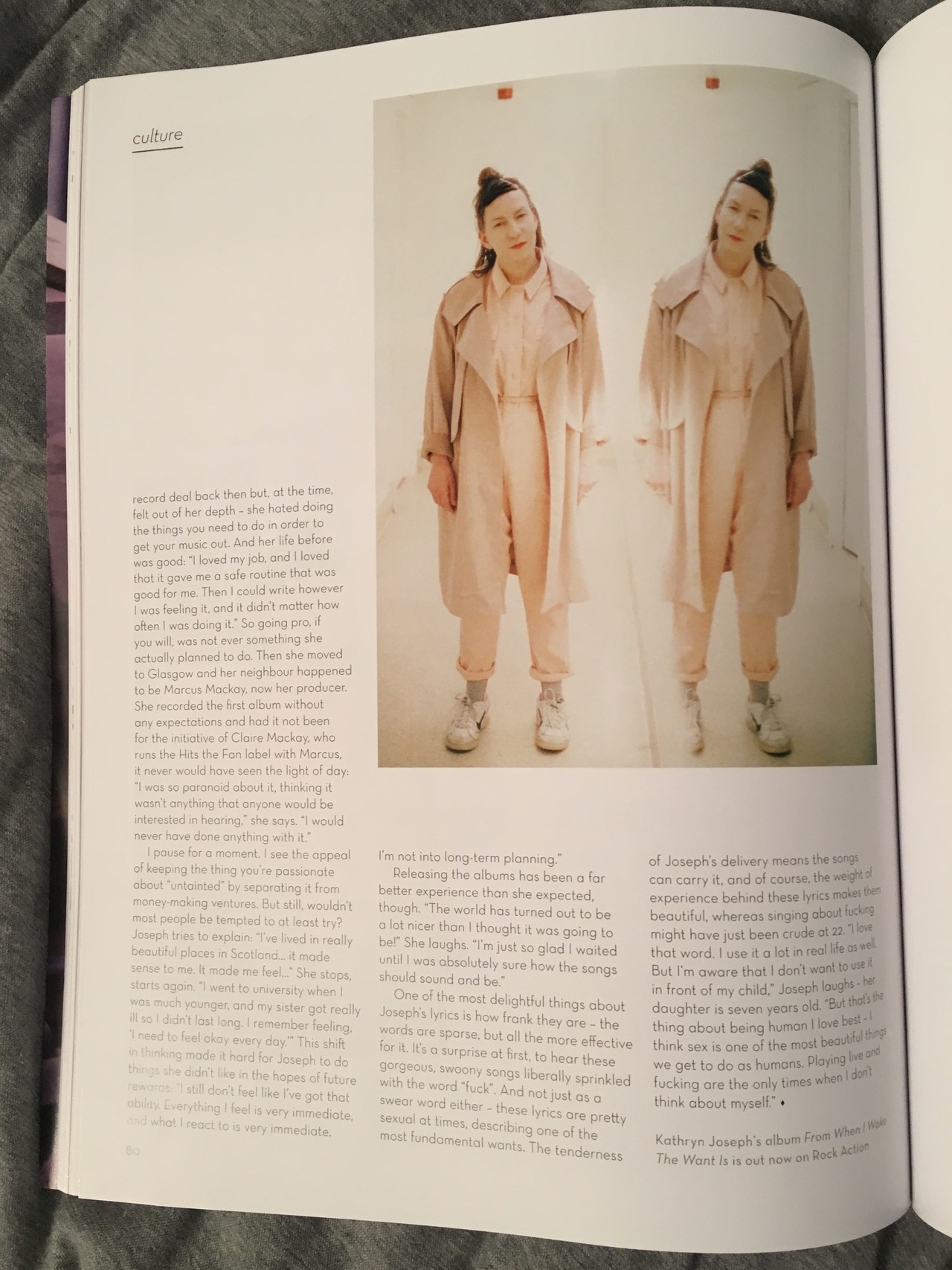
Everything and its opposite // Interview with Kathryn Joseph

Published in Oh Comely magazine, February 2019. 

Everything and its opposite

There’s so much want in Kathryn Joseph’s music. It’s right there in the title of her new album, “From when I wake the want is” – that feeling that sits there, under the eyes, under the tongue, and there’s nothing you can do except watch as the ache turns into a pleasure. At least that’s how sensations float together in Joseph’s music: “I think you need that sore part to make anything that’s beautiful.”

This is a heartbreak album, but unless I knew that Joseph wrote it in response to lost love I don’t think I would have been able to tell. Joseph leaves such a wide open space in her soundscapes that it could be about anything, as long as you’re willing to meet here there. The title reminds me of that quote by Poe: “Sometimes, I’m terrified of my heart, of its constant hunger for whatever it is it wants; the way it stops and starts.” I’m fascinated by the idea that there’s you and then there’s your heart, or your want – and that your want isn’t necessarily looking out for your best interests.

Joseph’s music seems to come from a place outside of her control: “Songs start off as noises, then I fit the words into it. I don’t really understand it.” The music swells behind the sparse yet sharp lyrics, delivered in Joseph’s sometimes brittle, sometimes cottony, voice. But there’s no self-pity there, as she sings it almost matter-of-factly: “How do I get rid of all this fucking love?” The song soars, creating a sense of floating as the soreness transcends into something almost comforting. You know when you’re experiencing something so intense that it flips over into its opposite? Like when you eat something so extremely sweet that it starts to taste acidic?

I’d been thinking about this for a while, long before I heard Joseph’s song – “From when I wake the want is” was released in August 2018. When I call Joseph at home in Glasgow, a few days after she opened for Neko Case in London, I don’t expect her to necessarily understand what I’m on about, but of course she does: “I am obsessed with the feeling that I am everything and its opposite at all times. It’s what I find almost disturbing about myself. I think my songs are that too.”

The new album follows on from Joseph’s 2015 debut, which won the prestigious Scottish SAY Award. But nothing about her story suggests she was expecting this success, or even really courting it. At 43, you could call Joseph a late bloomer, except that she’s always been making music – just, you know, for herself. “I’d been a waitress since my twenties,” Joseph tells me, describing her new life of making a living from music as something she just didn’t think she’d ever reach. She hated doing the things you need to do in order to get your music out, as it made her feel out of control. And her life before was good: “I loved my job, and I loved that it gave me a safe routine that was good for me. Then I could write however I was feeling it, and it didn’t matter how often I was doing it.” So going pro, if you will, was not ever something she actually planned to do, but then she moved to Glasgow and her neighbour happened to be Marcus Mackay, now her producer. Still, everything about Joseph’s journey has been a hide and seek experience – she recorded the first album without any expectations, and had it not been for the initiative of Claire Mackay, who runs the Hits the Fan label with Marcus, it never would have seen the light of day: “I was so paranoid about it, thinking it wasn’t anything that anyone would be interested in hearing,” she says. “I would never have done anything with it.”

I pause for a moment. I can see the appeal of keeping the thing you’re passionate about “untainted” by keeping it separate from any money-making ventures. But still, most people would be tempted to at least try? Joseph thinks about it. She loved her previous job and the people she was working with – she really liked her life, you know? She tries to explain: “I’ve lived in really beautiful places in Scotland … it made sense to me. It made me feel…” She stops, starts again. “I went to university when I was much younger, and my sister got really ill so I didn’t last long. I remember feeling, ‘I need to feel okay every day.’” This shift in thinking made it hard for Joseph to do things she didn’t like in the hopes of future rewards: “I still don’t feel like I’ve got that ability. Everything I feel is very immediate, and what I react to is very immediate. I’m not into long-term planning.”

Releasing the albums has been a far better experience than she expected, though. “The world has turned out to be a lot nicer than I thought it was going to be!” She laughs. “I love that this is my job now. I love getting to do it.” And it came at the right moment too – Joseph was actually offered a record deal when she was in her 20s, but felt very much out of her depth at the time: “I’m just so glad I waited until I was absolutely sure how the songs should sound and be.”

One of the most delightful things about Joseph’s lyrics is how frank they are – the words are sparse, but all the more effective for it. It’s a surprise at first, to hear these gorgeous, swoony songs liberally sprinkled with the word “fuck”. And not just as a swear word either – these lyrics are pretty sexual at times, describing one of the most fundamental wants. The tenderness of Joseph’s delivery means the songs can carry it, and of course, the weight of age and experience behind these lyrics makes them beautiful, whereas singing about fucking might have just been crude at 22. “I love that word. I use it a lot in real life as well. But I’m aware that I don’t want to use it in front of my child.” Joseph laughs – her daughter is seven years old. “But that’s the thing about being human I love best – I think sex is one of the most beautiful things we get to do as humans. Playing live and fucking are the only times when I don’t think about myself.”

Kathryn Joseph’s album “From when I wake the want is” is out now on Rock Action.


The case for the four-day workweek

BL Magazine, January 2019. Original article p54-57.

Sharing the spoils: The case for the four-day workweek

Automation leads to improved efficiency – but who benefits? Until now, the spoils of technological advancement has gone straight to the business bottom line, as staff keep working the same hours no matter how much time is “saved” by technology.

We were supposed to be working 15 hours a week by now, predicted the economist John Maynard Keynes – in 1930 he anticipated that technological advancements in “progressive countries” would mean we’d be enjoying more leisure. But it hasn’t happen, even as data is now automatically input, documents effortlessly shared across devices, reports instantly assembled, and hardware spontaneously alerts us when it needs attention. In spite of warnings that automation will put people out work, Britons put in some of the longest hours in Europe – we rack up £32 billion worth of unpaid overtime, according to a Trades Union Congress (TUC) survey from September.

And people resent working so much. 81% want to work less, the TUC found, and out of those, about half would love to have a four-day workweek. The TUC has thrown its weight behind this idea, calling it a way to ensure productivity gains are distributed fairly. “Bosses and shareholders must not be allowed to hoover up all the gains from new tech for themselves. Working people deserve their fair share,” TUC General Secretary Frances O’Grady said in a statement. “If productivity gains from new technology are even half as good as promised, then the country can afford to make working lives better.”

But working four days per week – while being paid the same as before – would it actually work?

screen shot 2019-01-10 at 15.43.41Initial reports suggest a four-day week may lead to improved productivity, even with fewer hours in the office. When researchers at Auckland University of Technology tracked a four-day workweek initiative at a 240-people-strong trust and estates company, they found that staff were less stressed and reported more motivation and commitment to their work, which in turn resulted in better performance. This makes sense: 12.5 million UK work days were lost last year because of work-related stress, depression or anxiety, according to the Health and Safety Executive, and the single biggest cause was workload.

The four-day workweek isn’t just some futuristic pipe dream. The fact that this idea has been floated at this point in time is no coincidence: we are finally at a point in technological advancement where it might actually be possible. There are already several businesses in the UK who’ve implemented a four-day workweek. The companies BL spoke did have the altruistic goal of sharing the spoils of technological advancement, but they also genuinely believed it serves the business financially.  

For NautoGuide, a digital mapping company in Swindon with five employees, the decision to move to a four-day week in September was motivated out of a desire to have more time to work on strategic goals. “We had a project that we really wanted to deliver long term as an investment, but we never got round to it because we were always firefighting,” says Dave Barter, CEO and Founder of NautoGuide. The company realised the answer wasn’t to have more resources or to be more efficient, but to have more time to think. “When you’re all in the office you never [take that thinking time], because the phone rings, email comes in, and people want things. The only way we could see to achieve that was by taking ourselves out the office.”

The staff at NautoGuide now work regular hours Monday to Thursday, and Barter thinks it’s fostered an appreciation that this is a place where you get rewarded for your good work right now, rather than maybe someday. “I think there’s also a benefit to being seen as having an open and forward-thinking culture, as [clients] see that and understand it will translate to our work too,” says Barter.

Rich Leigh is the Director and Founder of Radioactive PR, a dozen-people-strong public relations company in Gloucester. “I’ve got incredibly happy staff,” says Leigh, who started the four-day workweek initiative six months ago. The company is making more money than ever before, although the initiative has made a difference to the margins as Leigh has had to hire sooner than he probably would have otherwise needed as he doesn’t want to “squeeze five days into four”. The initiative has made the company an attractive place to work, Leigh says: “We get so many CVs. Inevitably we’ll be finding the very best people.”

Becky Simms, CEO and Founder of Reflect Digital, a marketing agency in Kent with a staff of 55, has also found that business has been good since moving to a four-day workweek in October: “We’ve closed the most business and had the most revenue.” The initiative was inspired by a desire for staff to be their best in the office, says Simms – agency work is high pressure: “You’re really worn out by the time you reach the weekend. [The four-day week] was inspired by that buzz you get after three day weekend. Now we can have that time to relax, but still really work hard while we’re in the office.”

*

While these early day experimentations with the four-day workweek are promising, it is very early days – it is hard to say for sure just how this change will affect companies’ bottom line. But while people on the Channel Islands put in just as many long hours, corporations in finance, professional services, and tourism industries may be less inclined to opt for less time in the office as a means of passing on the benefits of automation, at least for now.

The Channel Islands are “not as advanced as the UK in terms of digital transformation, says Pierre Jehan, Client Services Director of Resolution IT, an IT outsourcing specialist in Guernsey. Pointing to the 2,000 vacancies in the Guernsey finance sector alone, Jehan says it’s clear that automation has a role to play in closing this gap: “But with the shortages that they have, employers may be reluctant to offer a day per week off.”

But employees on the Channel Islands are still seeing other benefits of automation and digital transformation passed on to them, with opportunities for remote working and flexible hours: “Automation can also make workers’ lives more enjoyable by taking mundane tasks away and making them more efficient, and letting them concentrate on the nicer things in their jobs.” Jehan strongly believes in rewarding the people who create the savings – if a department comes up with new methods for saving hours, they should directly benefit from it. “Companies, in whatever sector, should empower staff to use these technologies in order to become more efficient and innovative through digital transformation. And in the same breath, they should reward their staff for doing so.”

While agreeing that Channel Island companies should be looking to robotic process automation or AI to help fill the worker shortages, Justin Bellinger, Chief Digital Officer of Channel Islands telecommunications supplier Sure thinks there are fundamental issues that needs addressing before the four-day workweek will make it onto the agenda. This will include tutoring and retraining: “We need to work out what machines can do that will benefit our businesses. What do I want my people doing it instead of manual input? The answer will be more interpersonal skills and emotional intelligence – things that will add value beyond the basic grind.”

This has already started happening on the Channel Islands, says Bellinger, pointing to the fund insurance and trust sectors: “As we come under ever-increasing regulatory scrutiny in the financial services sector, I firmly believe that regulators will start to automate compliance. … We’ve already started to see that in the gaming industry.”

The proponents of the four day workweek have an uphill battle ahead to convince business leaders that more time away from the desk could actually mean better overall job performance. “But how long that person has spent at their desk is a false way of looking at productivity. We’re not working at cotton mills anymore,” says Bellinger. Most people can only focus for five or six hours per day before fatigue sets in and quality starts to decline; when a Swedish retirement home ran a six-hour workday experiment in 2016, they found that nurses were less stressed, got sick less often, and had more energy to spend on quality interactions with their patients. It’s a fallacy to think that keeping people at work automatically means getting more out of them.” Research backs this up – most people can only focus for five or six hours per day before fatigue sets in, so it’s a fallacy to think that keeping people in the office automatically means getting more out of them.

For Rich Leigh, the change to a four-day workweek has had the benefit of positioning his company as forward-looking and innovative. “We’ve had clients come to us as a direct result of this, saying they we like the fact that we don’t just talk the talk, but walk the walk too.” Ultimately, Leigh cares about ensuring his staff are happy: “These are people you spend the majority of your life with. Why wouldn’t you want to give them the best time that you can?”

Hotel

Published in Lionheart Magazine, the ‘Bright’ issue, in November 2018. 

Hotel

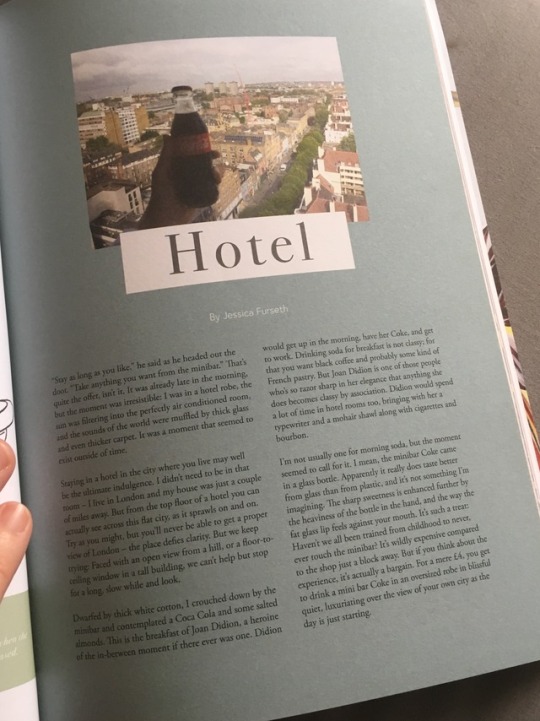
“Stay as long as you like,” he said as he headed out the door. “Take anything you want from the minibar.” That’s quite the offer, isn’t it. It was already late in the morning, but the moment was irresistible: I was in a hotel robe, the sun was filtering into the perfectly air conditioned room, and the sounds of the world were muffled by thick glass and even thicker carpet. It was a moment that seemed to exist outside of time.

Staying in a hotel in the city where you live may well be the ultimate indulgence. I didn’t need to be in that room – I live in London and my house was just a couple of miles away. But from the top floor of a hotel you can actually see across this flat city, as it sprawls on and on. Try as you might, but you’ll never be able to get a proper view of London – the place defies clarity. But we keep trying: Faced with an open view from a hill, or a floor-to-ceiling window in a tall building, we can’t help but stop for a long, slow while and look.

Dwarfed by thick white cotton, I crouched down by the minibar and contemplated a Coca Cola and some salted almonds. This is the breakfast of Joan Didion, a heroine of the in-between moment if there ever was one. Didion would get up in the morning, have her Coke, and get to work. Drinking soda for breakfast is not classy – for that you want black coffee and probably some kind of French pastry. But Joan Didion is one of those people who’s so razor sharp in her elegance that anything she does becomes classy by association. Didion would spend a lot of time in hotel rooms too, bringing with her a typewriter and a mohair shawl along with cigarettes and bourbon.  

I’m not usually one for morning soda, but the moment seemed to call for it. I mean, the minibar Coke came in a glass bottle. Apparently it really does taste better from glass than from plastic, and it’s not something I’m imagining. The sharp sweetness is enhanced further by the heaviness of the bottle in the hand, and the way the fat glass lip feels against your mouth. It’s such a treat: Haven’t we all been trained from childhood to never, ever touch the minibar? It’s wildly expensive compared to the shop just a block away. But if you think about the experience, it’s actually a bargain. For a mere £4, you get to drink a mini bar Coke in a oversized robe in blissful quiet, luxuriating over the view of your own city as the day is just starting.

A trip too far?

BL Magazine, Sept-Oct 2018. Original article p44-46

On the health impact of business trips, and how employers need to take more responsibility

To have the life of a business hotshot, putting in a couple of hours for meetings before lounging at the pool for the rest of the day – nice work if you can get it, right? But of course you can’t, because this version of business travel doesn’t exist anymore, if it ever actually did. Any lingering luxuries afforded to work travel disappeared with the 2008 credit crunch, and economy flights and tight turnarounds have been the norm ever since. “The guys here take the mickey out of me when I’m going to Dubai, asking if I’m going to the swim-up bar,” says Trevor Norman, Director of Funds and Islamic Finance at VG in Jersey. “But it’s not all fun – business trips are work.”

Seven million business trips are taken every year by UK residents, according to the Office of National Statistics, a number that’s typically risen by 2.8% per year since 1980. A survey by Bristol Airport found that those who travel with their jobs typically head out eight times a year. But frequent business travel can have serious negative effects on health – mental as well as physical. Because there’s a lot going on when you’re travelling for work: you have to get to the airport on time and pass through security, and maybe the plane is late. Trying to sleep in an economy seat is never fun, and you land late at night and maybe there’s only junk food available. You have a few drinks – it’s been a long day – and you skip the gym before crashing into bed for some restless sleep while fighting your body clock. Tomorrow is a day of back-to-back meetings.

There’s a proven link between a high number of days spent on the road and a risk of long-term health issues like heart attacks and strokes. But a study published last December in the Journal of Occupational and Environmental Medicine suggests it may be causing some more immediate problems too. People who travel a lot for work are more likely to see their mental health suffering, by having trouble sleeping, being sedentary, smoking, and drinking more alcohol. Anxiety and depression also spiked for those who found themselves frequently on the road.

While most of us probably travel less than 14 times per month – the frequency which the study identified as being particularly harmful – the negative effects can be felt at more moderate levels too. A World Bank study found that the business travellers among its staff were three times as likely to file psychological insurance claims. Health risk appraisal surveys at large corporations routinely show that international business travel is associated not just with poor health, but that it also makes it harder to keep up with the pace of work. This means it’s not just an individual’s problem, but a corporate concern.

“The opportunity to travel is often touted by companies as a benefit in their recruitment of talent, but the accumulating evidence linking extensive business travel to chronic disease health risks needs to be factored into the cost-benefit analysis of the practice,” Dr Andrew Rundle, lead study author and Associate Professor of Epidemiology at Columbia University in New York, wrote in the Harvard Business Review. “Employees simply need to be aware that business travel can predispose them to making poorer health decisions.”

*

Dr Bob Gallagher, who heads up occupational health at Queens Road Medical Practice in Guernsey, says that companies are getting better at taking responsibility for their employees’ well-being while on the road. The issue should be considered as part of a company’s risk assessment: “Work travel can cause problems that can make people unwell, or it can make pre-existing mental or physical health conditions worse – or both, as these things are often linked,” says Gallagher. At his practice, Gallagher meets people who travel “an awful lot”, sometimes for weeks at a time. “It’s rare to meet someone who travels often for work who says it’s something they enjoy doing,” says Gallagher – for most people it’s something they have to do for the job and it can be a source of stress.

Common ill effects of work travel include heartburn, acid indigestion, digestion problems, and trouble sleeping, says Gallagher. “If you are below par because you haven’t slept, you’re a bit hungover, you’ve eaten too much food, you haven’t exercised, are you performing at your best? Probably not.” While some of this is down to the individual, companies are starting to realise that it’s their responsibility too. “Organisations need to look at this. They shouldn’t cram the day full of meetings so people can’t have some rest. Make sure people have a bit more time,” says Gallagher.

Ensuring employees don’t return from a mad-dash business trip too tired to drive home from the airport is also a matter for companies’ duty of care, says Andrew Perolls, Director of Business Travel Direct, a travel management company. “Companies have to be more careful about how they look after staff.” This also means ensuring staff aren’t staying in hotels in unsafe parts of town, considering things like access to medical facilities, and also, ensuring the company knows exactly where everyone is in case of a natural or political event.

While Perolls can testify to the fact that the life of the work traveller has sped up – going on a one-day business trip to the US is not unheard of – he also thinks this might be improving. “What people are prepared to put up with is changing,” says Perolls, adding that staff are increasingly bristling at being told to fly budget airlines at the crack of dawn. Especially the millennial generation, who’re now in their 30s, are more attuned to work-life balance: “We know that in specialist professions, they may even look at the travel policy before deciding to join a company if the job involves a lot of travel.”  

*

Letting employees choose where to stay (within a budget) is one way to keep people happy – that way they can pick a hotel with a gym, or something in walking distance of good food options. Allowing people to fly out the night before will also prevent stress, as well as ensuring there’s downtime between meetings. Giving people a leisure day or two at the end of their trip is a good way to ensure the trip is a positive event, says Perolls: “It’s a shame going all the way to Bangkok only to see the airport.”

Ensuring you don’t have to run through airport security is always a great start to any trip, but ultimately, travel is an exercise in unpredictability. “Stress can be defined as a perceived lack of control, which is common when travelling,” says David Brudö, co-founder and CEO of Remente, a mental health app that aims to promote wellbeing through planning. Brudö explains how he recently used Remente to plan a trip to Japan, from booking flights and choosing restaurants to scheduling in his meditation sessions on the plane. “When you’re travelling you’re a bit disconnected from the outside world, but this means you actually have some time to take care of yourself. A plane is a great place to just sit and meditate, read a book, and invest in yourself,” says Brudö. Remente also works with businesses looking to improve employee wellbeing: “We see that the more balanced people are, the more productive they are. That’s something businesses are increasingly realising.”

It’s hard to get around the need for business travel – video conferencing is constantly improving, but it’s not a substitute for a handshake. But a stressed organisation is not a smart organisation, and it’s clear that companies are realising that taking care of people is ultimately a sound business decision; Deloitte found that 88% of UK businesses are working towards improving work-life balance for staff. That also means helping people stay healthy on the road, by booking the hotel with the nice gym, or providing resources for meditation or cognitive behavioural therapy. Ultimately, it also means picking the people who enjoy travel to go on trips, while letting those who’d rather not stay home.

*

The lifetime flier

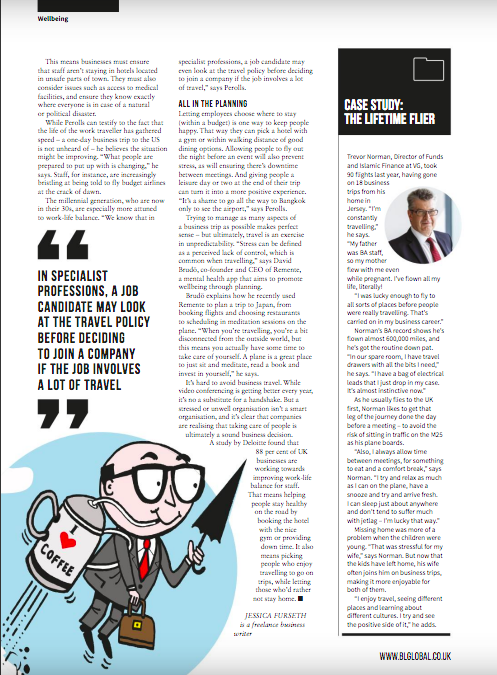
Trevor Norman took 90 flights last year, having gone on 18 business trips from his home in Jersey. “I’m constantly travelling,” says Norman, Director of Funds and Islamic Finance at VG, a Jersey-based independent provider of fiduciary and administrative solutions. “My father was BA staff so my mother flew with me even while pregnant. I’ve flown all my life, literally!” He laughs. “I was lucky enough to fly to all sorts of places before people were really travelling. That’s carried on in my business career.”

Norman’s BA record shows he’s flown almost 600,000 miles. He’s got the routine down pat: “In our spare room I have travel drawers with all the bits I need. I have a bag of electrical leads that I just drop in my case. It’s almost instinctive by now.” As he usually flies to the UK first, Normal likes to get that leg done the day before, as he’s done with risking still sitting in traffic on the M25 as his plane boards. “Also, I always allow time between meetings, for something to eat and a comfort break. … I try and relax as much as I can no the plane, have a snooze and try and arrive fresh. I can sleep just about anywhere and don’t tend to suffer much with jetlag – I’m lucky that way.”

Missing home used to be more of a problem when the children were young. “That was stressful for my wife,” says Norman. Although now that the kids have left home, his wife often comes with him on trips, which makes for a lovely time for them both. “I enjoy the travel to see different places and learn about different cultures. I try and see the positive side of it.”

Down the line: How Crossrail is changing London’s neighbourhoods

OnOffice Magazine cover story, August 2018. Original article (PDF).

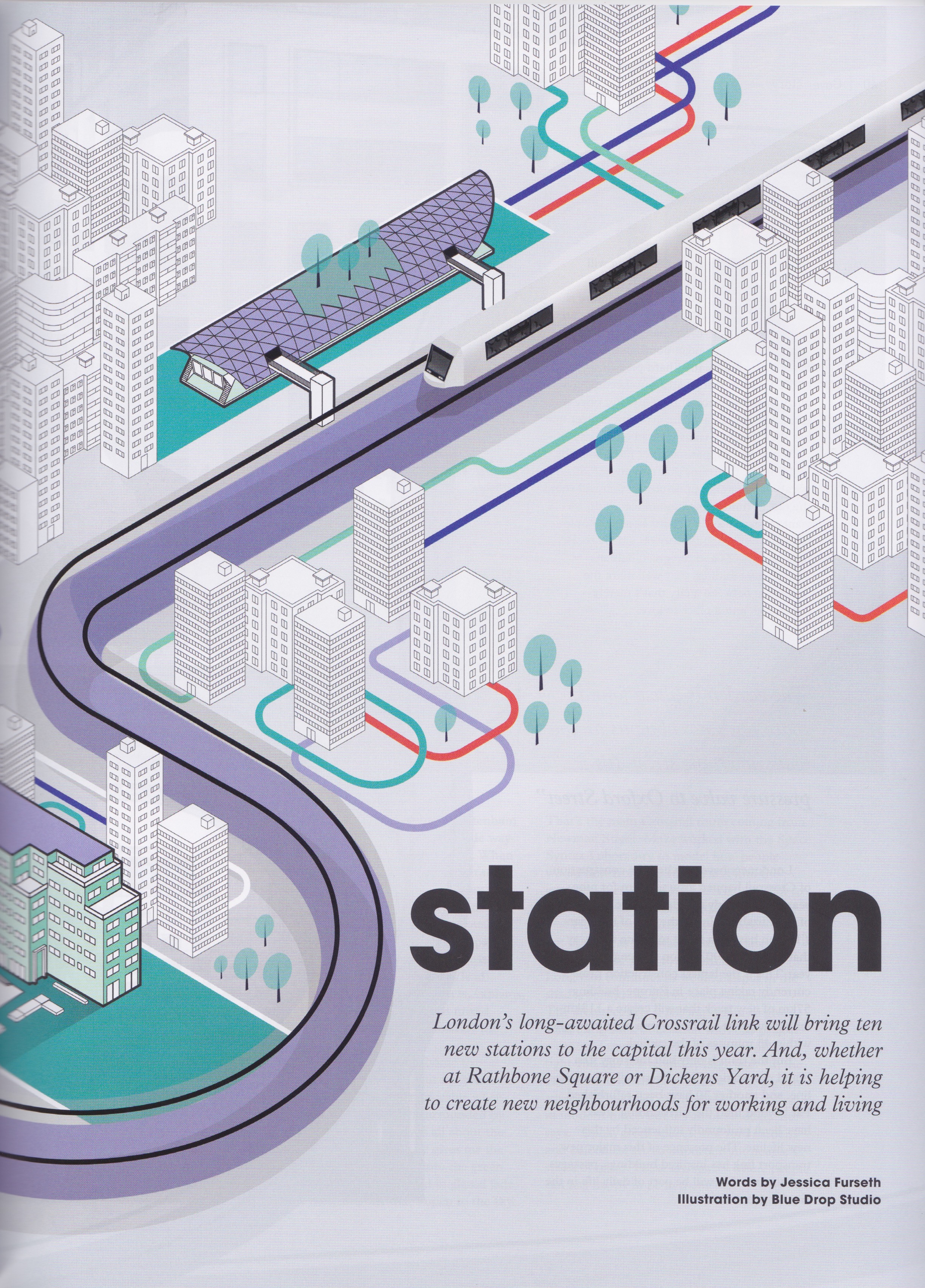
Station to Station: How Crossrail is changing London’s neighbourhoods

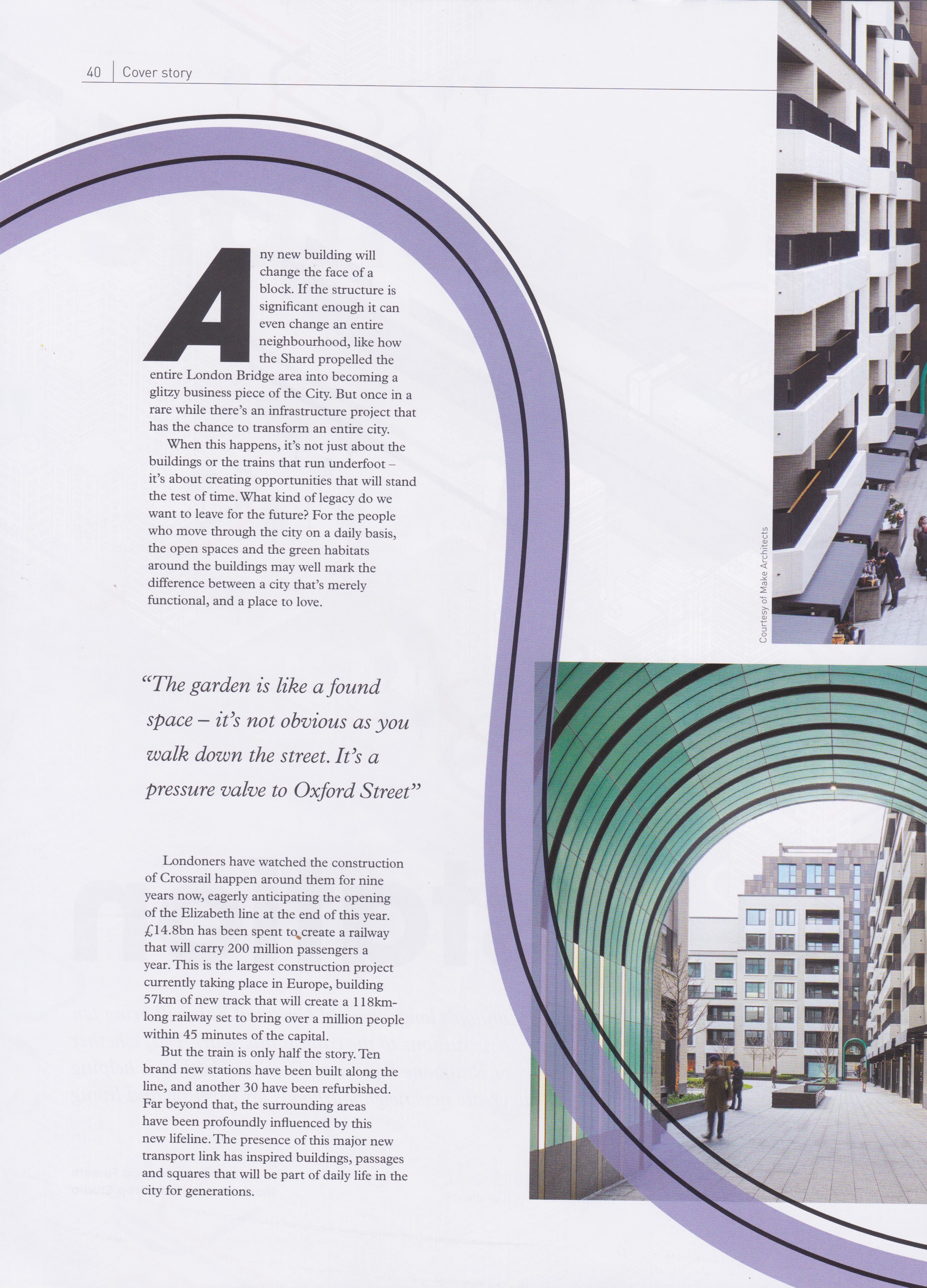
Any new building will change the face of a block. If the structure is significant enough it can even change an entire neighbourhood, like how the Shard propelled the entire London Bridge area into becoming a glitzy business piece of the City. But once in a rare while there’s an infrastructure project that has the chance to transform an entire city.

When this happens, it’s not just about the buildings or the trains that run underfoot – it’s about creating opportunities that will stand the test of time. What kind of legacy do we want to leave for the future? For the people who move through the city on a daily basis, the open spaces and the green habitats around the buildings may well mark the difference between a city that’s merely functional, and a place to love.

Londoners have watched the construction of Crossrail happen around them for nine years now, eagerly anticipating the opening of the Elizabeth line at the end of this year. £14.8 billion has been spent to create a railway that will carry 200 million passengers a year. This is the largest construction project currently taking place in Europe, building 57 kilometres of new track to create a 118 kilometre-long railway set to bring 1.5 million people within 45 minutes of the capital.  

But the train is only half the story. Ten brand new stations have been built along the line, and another 30 have been refurbished. Far beyond that – the surrounding areas have been profoundly influenced by this new lifeline. The presence of this major new transport link has inspired buildings, passages, and squares that will be part of daily life in the city for generations.

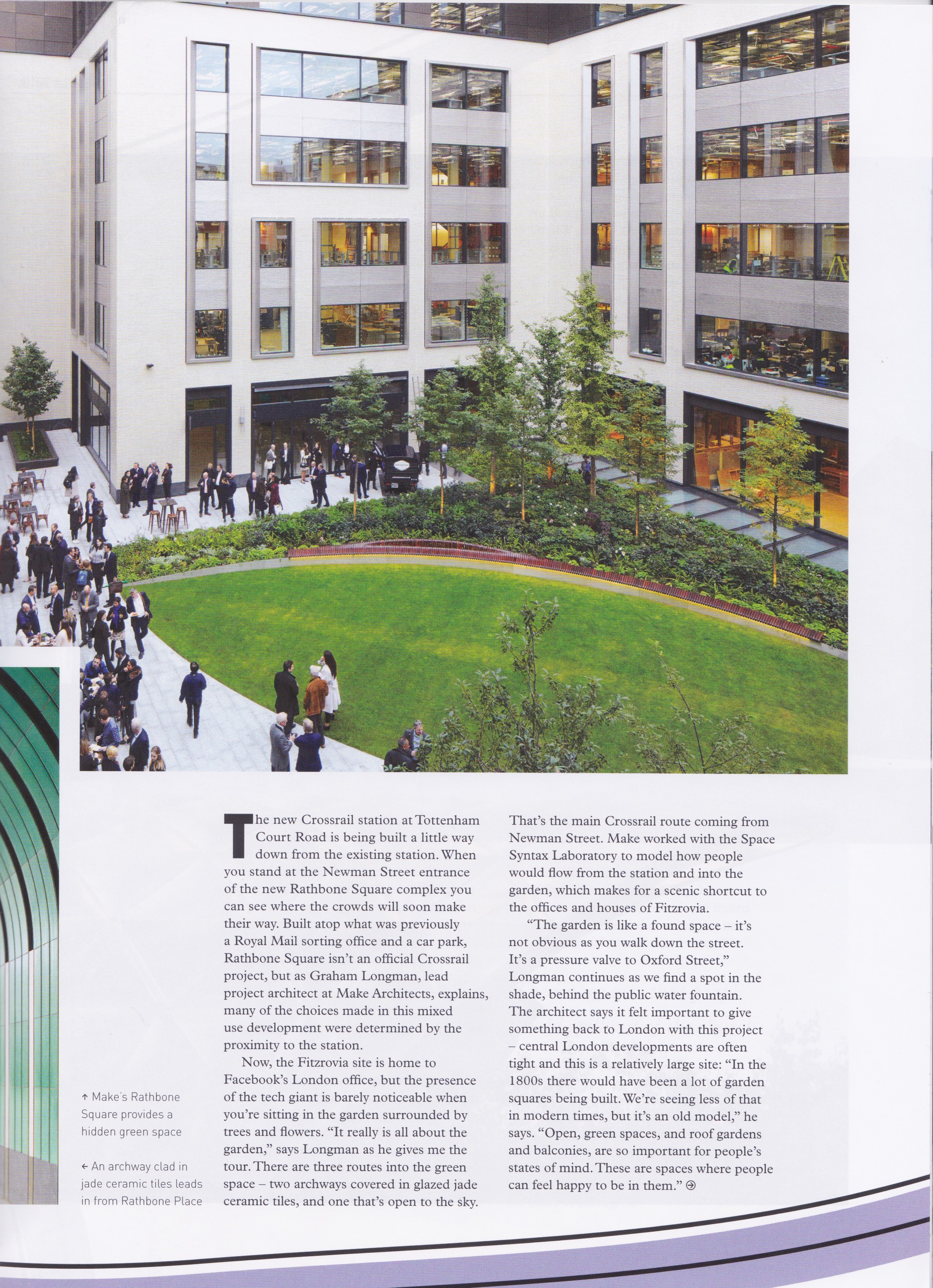
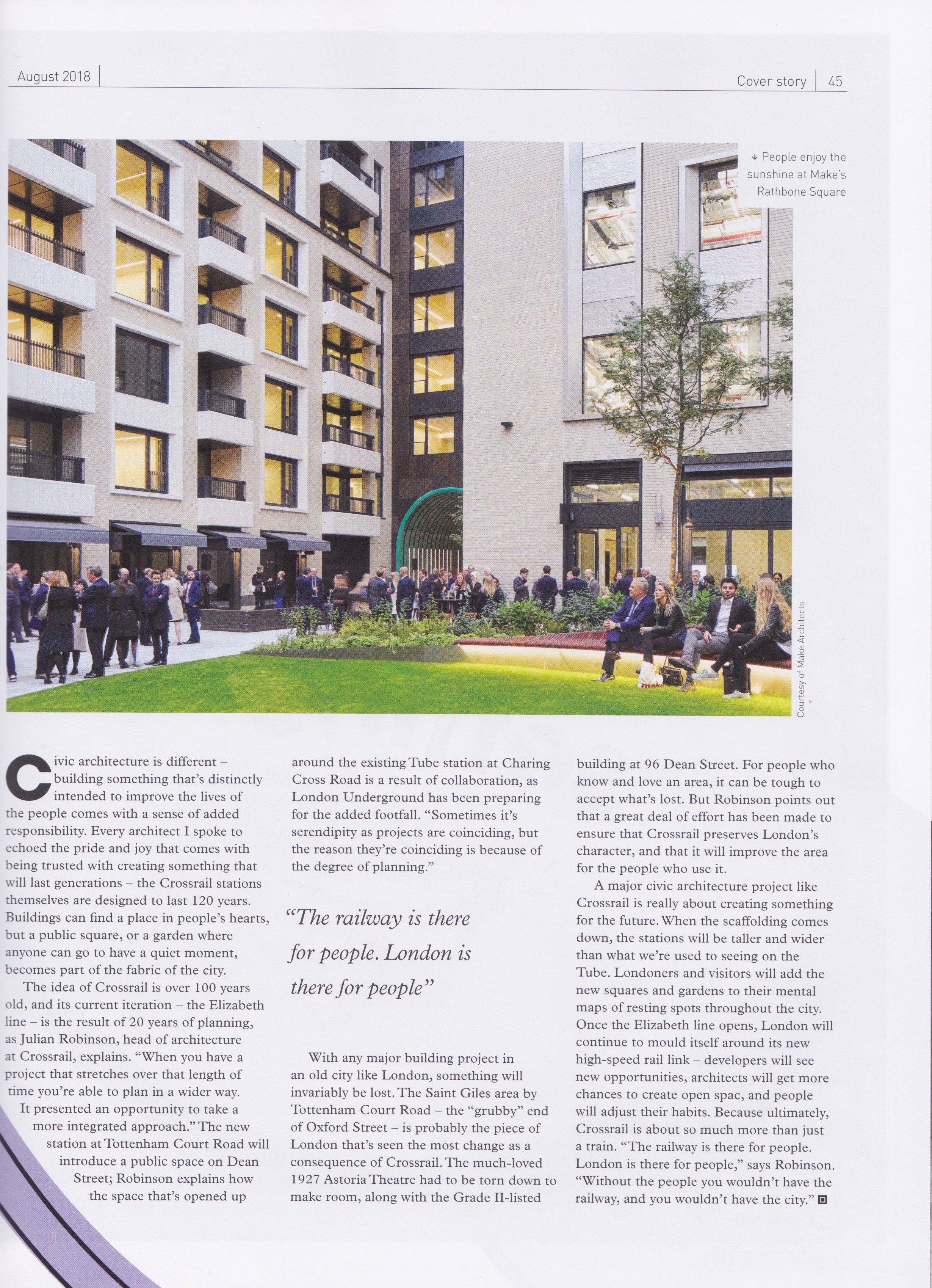
At Tottenham Court Road, the new Crossrail station is being built a little way down from the existing station.When you stand at the Newman Street entrance of the new Rathbone Place complex you can see where the crowds will soon make their way. Built atop what was previously a Royal Mail sorting office and a car park, Rathbone Place isn’t an official Crossrail project, but as Graham Longman, Lead Project Architect at Make Architects explains, many of the choices made in this mixed use development were determined by the proximity to the station.

Now, the Fitzrovia site is home to Facebook’s London office, but the presence of the tech giant is barely noticeable when you’re sitting in the garden surrounded by trees and flowers. “It really is all about the garden,” says Longman as he gives me the tour. There are three routes into the green space – two archways covered in glazed jade ceramic tiles, and one that’s open to the sky. That’s the main Crossrail route coming from Newman Street. Make worked with the Space Syntax Laboratory to model how people would flow from the station and into the garden, which makes for a scenic shortcut to the offices and houses of Fitzrovia.

“The garden is like a found space – it’s not obvious as you walk down the street. It’s a pressure valve to Oxford Street,” Longman continues as we find a spot in the shade, behind the public water fountain. The architect says it felt important to give something back to London with this project – central London developments are often tight and this is a relatively large site: “In the 1800s there would have been a lot of garden squares being built. We’re seeing less of that in modern times, but it’s an old model,” he says. “Open, green spaces, and roof gardens and balconies, are so important for people’s states of mind. These are spaces where people can feel happy to be in them.”

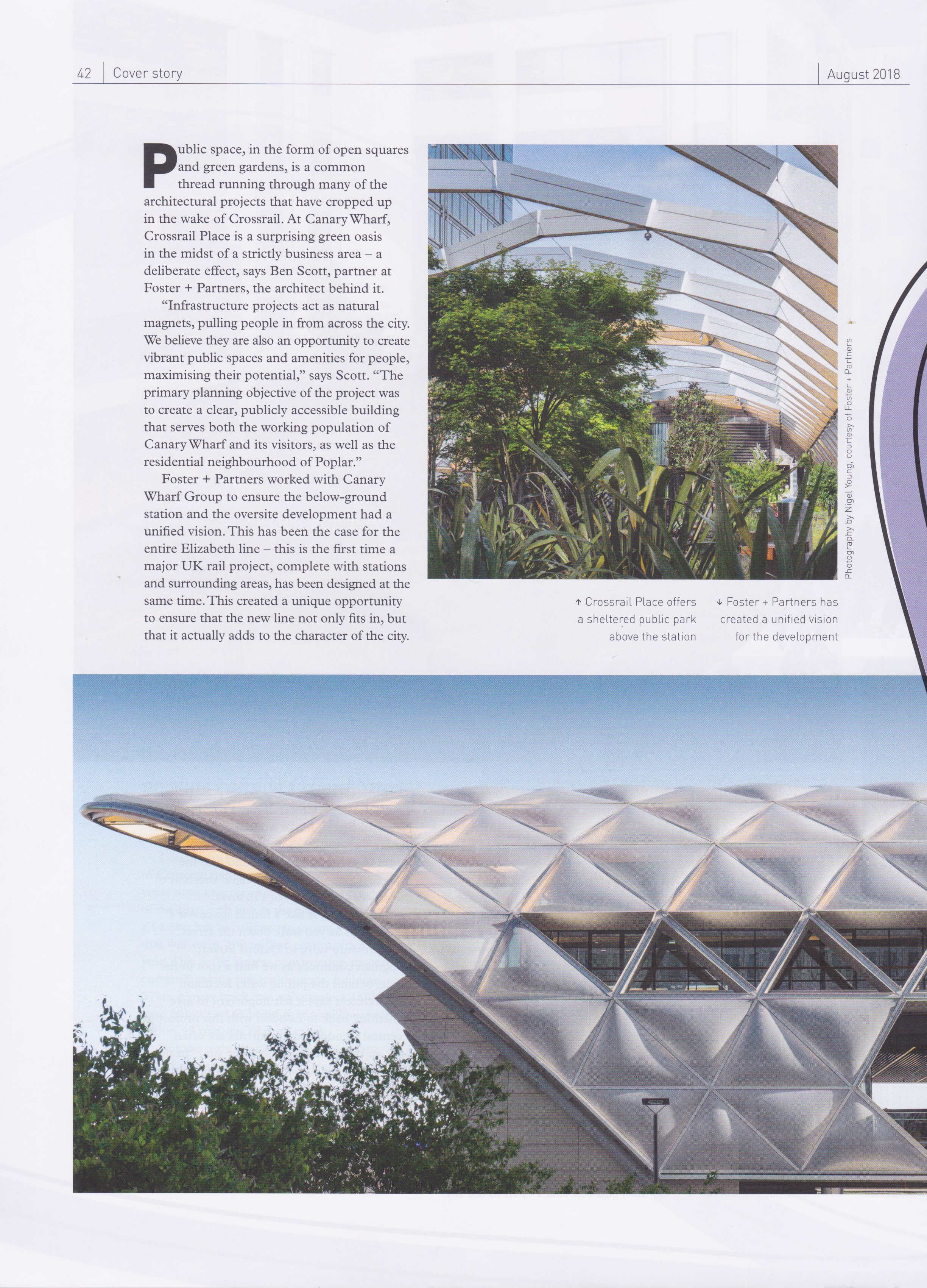
Public space, in the form of open squares and green gardens, are a red thread running through many of the architectural projects that have cropped up in the wake of Crossrail. At Canary Wharf, Crossrail Place is a surprising green oasis in the midst of a strictly business area – a deliberate effect, according to Ben Scott, Partner at Foster + Partners, the architecture studio behind Crossrail Place.

“Infrastructure projects act as natural magnets, pulling people in from across the city. We believe they are also an opportunity to create vibrant public spaces and amenities for people, maximising their potential,” says Scott. “The primary planning objective of the project was to create a clear, publicly accessible building that serves both the working population of Canary Wharf and its visitors, as well as the residential neighbourhood of Poplar.”

Foster + Partners worked with Canary Wharf Group to ensure the below-ground Crossrail station and the oversite development had a unified vision. This has been the case for the entire Elizabeth line – in fact, this is the first time that a major UK rail project, complete with stations and surrounding areas, has been designed at the same time. This created a unique opportunity to ensure that the new line not only fits in, but that it actually adds to the character of the city.

For several Crossrail-related architecture projects along the line, public life sits at the centre of new developments. When placemaking practice JTP was tasked with the Dickens Yard development in Ealing in West London, there was no doubt: this was an opportunity to create a new centre for Ealing. “It lacked a town square – it has Haven Green to the north but it didn’t really have a civic open space in the centre of town,” says Ian Fenn, Partner at JTP. Dickens Yard is not directly linked to Crossrail, but a large part of the appeal for the mixed use development is the increased footfall expected from the new trainline.

Dickens Yard sits on top of a former car park, but the square at the heart faces a number of listed buildings, including Christ the Saviour church, Ealing Town Hall, and Ealing Fire Station. “A key driver for the design was to create a series of linked spaces that embraced the context of the surrounding buildings,” says Fenn. “We created a new town square that [opened up] the main entrance of the church. The image was that people would spill out of the church on wedding days and into this new realm in the heart of Ealing.”

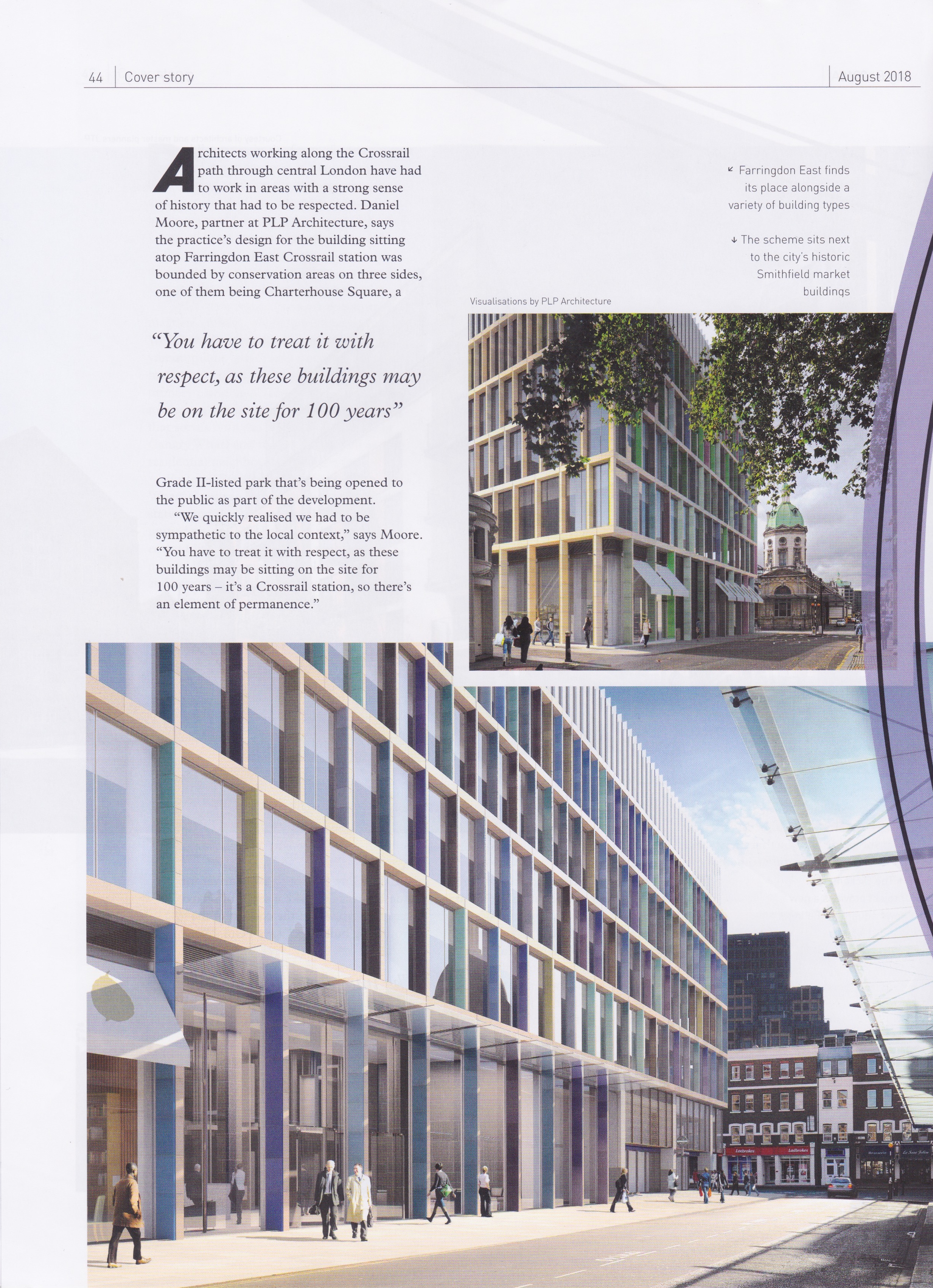
Architects working along the Crossrail path through central London have had to work in areas with a strong sense of history that had to be respected. Daniel Moore, Partner at PLP Architecture, says their design for the building sitting atop Farringdon East Crossrail station was bounded by conservation areas on three sides, one of them being Charterhouse Square, a Grade II-listed park that’s being opened to the public as part of the development. “We quickly realised we had to be sympathetic to the local context,” says Moore. “You have to treat it with respect, as these buildings may be sitting on the site for a hundred years – it’s a Crossrail station, so there’s an element of permanence.”

Civic architecture is different – building something that’s distinctly intended to improve the lives of the people comes with a sense of added responsibility. Every architect I spoke to echoed the pride and joy that comes with being trusted with creating something that will last generations – the Crossrail stations themselves are designed to last 120 years. Buildings can find a place in people’s hearts, but a public square, or a garden where anyone can go to have a quiet moment, becomes part of the fabric of the city.

The idea of Crossrail is over 100 years old, and its current iteration – the Elizabeth line – is the result of 20 years of planning, as Head of Architecture at Crossrail, Julian Robinson explains. “When you have a project that stretches over that length of time you’re able to plan in a wider way. It presented an opportunity to take a more integrated approach.” The new station at Tottenham Court Road will introduce a public space on Dean Street; Robinson explains how the space that’s opened up around around the existing Tube station at Charing Cross Road is a result of collaboration, as London Underground has been preparing for the added footfall. “Sometimes it’s serendipity as projects are coinciding, but the reason they’re coinciding is because of the degree of planning.”   

With any major building project in an old city like London, something will invariably be lost. The Saint Giles area by Tottenham Court Road – the “grubby” end of Oxford Street – is probably the piece of London that’s seen the most change as a consequence of Crossrail. The much-loved 1927 Astoria Theatre  had to be torn down to make room, along with the Grade II-listed building at 96 Dean Street. For people who know and love an area, it can be tough to accept what’s lost. But Robinson points out that a great deal of effort has been made to ensure that Crossrail preserves London’s character, and that it will improve the area for the people who use it.

A major civic architecture project like Crossrail is really about creating something for the future. When the scaffolding comes down, the stations will be taller and wider than what we’re used to seeing on the Tube. Londoners and visitors will add the new squares and gardens to their mental maps of resting spots throughout the city. Once the Elizabeth line opens, London will continue to mould itself around its new high-speed rail link – developers will see new opportunities, architects will get more opportunities to create open air, and people will adjust their habits. Because ultimately, Crossrail is about so much more than just a train. “The railway is there for people. London is there for people,” says Robinson. “Without the people you wouldn’t have the railway, and you wouldn’t have the city.”


Strange birds

Published in Lionheart Magazine (Issue 9: Land, Water and Air) in April 2018

Strange birds

Wild parrots don’t belong in London but still, they are everywhere. I always find it a little jarring to see one – the shocking green and red typical of a parakeet is starkly out of place. It’s like we instinctively know that English birds should be brown and grey, with a hint of colour on the chest at most. The parakeets are striking outliers: they are characters of a brighter, sunnier place that’s clearly very far away from here.

I suppose your attitude to happening upon a flock of wild parrots in London will depend on who you are – will you respond to this uncanny encounter with awe, or with scepticism? They sure are adorable, darting between the trees, but seeming a wild parrot in an English park also feels like someone messed up and put the wrong bird down on the island.

I feel a bit like that myself in West London – a strange bird in a wrong place. I moved here from East London, my home of nearly a decade, for reasons that were good but ultimately not my ideal choice. I was pretty sour about it at first, but I’ve had some time to think about it and I’ve come to take a more philosophical approach to the matter: what makes a home?

The parrots made England their home by being big and bold. Now, wild parrots are actually one of the most common birds found in London, and their numbers are growing at a rapid pace as winters are getting milder. There’s more of them out West, but they’ve been spotted in all 32 boroughs. In Kensington Gardens there’s a group that’s apparently so tame they will eat out of your hand. Peckham, Brixton and Greenwich also have them living in the local parks. There’s lots of different types: Alexandrine parakeets have been seen in Lewisham, while Bromley has blue-crowned parakeets, and Amazonian orange-winged parakeets have made a home in Weybridge.

No one quite knows how London came to have wild parrots. Maybe they escaped from a film set, or from a hanger at Heathrow Airport, or were set loose when aviaries were damaged during the 1987 storms? The best story is that Jimi Hendrix once released a breeding pair of parrots on Carnaby Street in the 1960s, but like is often the case with myths like that, the truth is probably far less remarkable.

There’s a flock of feral parakeets living not far from my house, and I often see them in the trees in my garden. I enjoy their company a lot. I’ve never seen any wild parrots in East London, so the first time I spotted one out West it felt like it meant something – maybe this place would have its own charm too? London is so big, made up of all these little villages, meaning that wherever you are there will be things that you can’t find anywhere else. One of my favourite things is when someone says something smart to me that I hadn’t thought of. When that happens, it’s like my brain cracks open for a second, with the sheer thrill of it. Sometimes, places are a lot like that too.

On synchronicity

Published in Lionheart Magazine #8, the Pattern & Colour issue, September 2017.

On synchronicity

Reality has one advantage over fiction: real life events can be wildly improbable. When you’re making things up they have to be believable, but reality makes no such promises: anything can happen.

It was the author John Irving who said this, I think – I seem to remember reading it in a preface to one of my favourite novels, “The World According to Garp”. This is a book where magical things happen to ordinary people. Or more likely, where perfectly realistic things happen, because reality is full of wild coincidences.

Like this one. I met my friend Johanna in San Francisco 18 years ago, and while we’ve kept in touch we hadn’t seen each other in the past decade. But the other week we’d agreed to meet – and three days before we were supposed to see each other for the first time in all that time, we ran into each other on the street. It was around the corner from my house in London, although she didn’t know I lived there, and she lives in Vienna now. I was headed into a café, so had she walked up just a moment later we’d have missed each other.

I ran into my partner at Waterloo station a few days later. He was on his way home and I was on my way into Soho when our paths crossed by the ticket barriers. This is less freaky as we both go through that station all time time, but Waterloo is the busiest rail station in all of Britain and the place was rammed with people. I wasn’t supposed to be on that train but I’d missed the last one, and I wasn’t supposed to take a left at the gates but did it anyway as it was so crowded. And suddenly Luke was there, I saw him first and reached out to touch his arm, interrupting the flow of people to steal a moment out of time.

Coincidences come with a feeling that something has slipped through a crack somewhere, interrupting the normal workings of time and space. A person shows up in a place they’re not supposed to be in; a name or number repeats; two people have had the same experience; a song plays at the perfect moment. These are some of the most common coincidences, and they happen to all of us, all the time.

But it feels so profound when it happens, and a number of coincidences in a row can create a sense of luck. Maybe it feels like you’re being carried forward by an invisible force, or that things are being nudged along to make sure they’re going your way. Like when you’re travelling through traffic and all the lights turn green just as you approach, or you get what you need in an unexpected way, just at the right time. The psychologist Carl Jung called this “synchronicity” – meaningful coincidences. This relates to Jung’s idea of the “unus mundus” – the idea of “one world” with an underlying order and structure where everyone and everything is connected.

It’s a quick jump from the idea of a connected world to superstition. As pattern-seeking animals, it can be hard for us to experience coincidences and not be tempted to read any deeper meaning into them, especially if the experience feels like it borders on the supernatural. But there are seven billion people on the planet, and with such large numbers, outrageous coincidences actually start to become likely. It may feel unlikely to meet someone who shares your birthday, but mathematically, you only need 23 people in a room before there’s a 50/50 chance two of them will be born on the same day.

Still, none of this explains how it’s possible to be thinking about someone – maybe a friend you don’t speak to every week – and the moment you do, your phone buzzes with a text from them. This happens to me all the time. Once my partner used “oak” as a metaphor, and we rounded the corner to find the ground suddenly covered in oak leaves. I was in a taxi on my way to something I was dreading, and “Don’t bring me down” came on the radio – and the same song played again in the taxi on the way back. I start thinking I want to get some Birkenstocks and suddenly I see them on a million people every day. But this isn’t the universe speaking to us – this is what linguistics professor Arnold Zwicky calls the “frequency illusion”: you think about something and your brain becomes primed to focus on it. It’s not that these things are suddenly happening more often, it’s just that now, you’re paying attention.

If it makes you sad to think that coincidences are just a toss of a coin, don’t be. Just because there’s nothing magical about magic, it doesn’t make our experience of it any less meaningful to us. Although Carl Jung didn’t like the idea of reading coincidences as random: “This would result in a chaotic collection of curiosities, rather like those old natural-history cabinets where one finds, cheek by jowl with fossils and anatomical monsters in bottles, the horn of a unicorn, a mandragora manikin, and a dried mermaid.” He says this as if it’s a bad thing, but it sounds pretty great to me.

It’s such a big world, and it can feel so overwhelming. How amazing is it that we find the things that we end up loving: our people, our places, our songs, our random detours that become memories that stick in our brains for the rest of our lives? I’m sure my partner and I have passed each other at Waterloo station without seeing each other a dozen times, and I believe it was luck that we saw each other that day. But that didn’t make it any less wonderful. A face that I love appeared in the crowd, purely as a surprise, and we shared a moment that shouldn’t quite be happening.

London’s challenger banks are the envy of New York fintech

FusionWire, 2016. 

London’s challenger banks are the envy of New York fintech

New York has no shortage of impressive fintech startups, but when it comes to challenger banks, everyone is looking to London.  

New York fintech holds its own against any other startup scene, no doubt about it – but even New Yorkers will admit that London is ahead when it comes to challenger banks. During a recent reporting trip to New York, the consensus was clear: there’s great admiration for up-and-coming UK banks like Mondo and Starling. These are the next-generation banks that are offering a full retail banking service, rather than just a front-end built on top of existing infrastructure. “This is what I want [to see] more of the US. I want new online banks built from the ground up. I want to see somebody do it,” said Joe Ziemer, head of communications and policy initiatives at Betterment, when we met in May.   

Starling and Mondo both secured UK banking licences this summer, joining the dozen-plus new banks that have received licences since 2013; that was when UK regulators changed the rules in an effort to encourage innovation in the retail banking sector. Goals are lofty and ambitious and there’s money available to pursue them: Starling raised $70m in January, while Mondo was valued at £30m following its £6m fundraising in February. In May, new name Tandem raised £1m on crowdfunding platform Seedrs in less than 20 minutes.

In New York, leading US robo adviser Betterment is an example of a fintech startup that provides a full service, rather than just repackaging products from traditional financial groups. There are two key benefits to this approach, says Ziemer: “One is the user experience. If you open a Betterment account you will open the entire thing in two minutes – the advisory relationship and the brokerage relationship. … If you fund your account tonight you’ll be fully invested tomorrow morning.” This is possible because Betterment handles everything in-house, and no outsourcing means no delays, no profit-sharing, and overall full control.

Building from scratch – like Betterment is doing as a US robo adviser, and Mondo is doing as a UK challenger bank – has drawbacks. For one, it takes much longer. It also requires more funding up front, as years can go by before the product can be launched and even then, it can take years to make money. But if successful, the payoff will be a company that’s central to the customer, rather than a nice-to-have. An example of this is how we may use a service like PayPal, but this is useless without a bank account: our central relationship is still with the bank. The overall goal of Betterment gets to the heart of this, says Ziemer: “We want to get to a place where we are the client’s central financial relationship.” For UK challenger banks, the goal is the same – this is what’s caught the admiration of the New York fintech scene.  

The regulation advantage

So if New York can nurture a full-service financial advisory startup like Betterment, why the dearth of groundbreaking challenger banks? Put simply, it’s the lack of supportive infrastructure or permissive regulation. “There’s certainly a number of connecting data points around challenger banks being more prominent in Europe and Asia rather than the States. It may have to do with the regulatory scheme here in the US: you don’t often see them popping as much,” said Jesse Podell, Managing Director of Startupbootcamp Fintech New York, when we spoke in May. “[In London] you have some proven leaders, like Mondo. Whereas here, it may feel a bit stalled.”

Podell says London has done a remarkable job at boosting its fintech scene, which unlike in the US, benefits from being focused primarily in one place. But the UK still lags behind when it comes to funding. In North America, VC-backed fintech companies raised $1.8 billion across 128 deals in the first quarter of 2016, according to KPMG and CB Insights, which concluded fintech deal activity in the region is on track to reach a new high this year. In Europe, funding numbers for the period came in at $0.3 billion, and half of this went to WorldRemit and LendInvest. “Fintech investment in Europe has certainly been less overheated than in other markets,” CB Insights CEO Anand Sanwal said when the numbers were published, adding that this has resulted in increasing interest from US and Asian investors. These number do however pre-date Brexit, which has created uncertainty; London’s ability to hire people from all over Europe has been a significant asset when it comes to competing with the US.

London benefits from having more fintech accelerators compared to New York, and Podell is impressed by the quality of the infrastructure set up to support fintech startups in London. “What I do really appreciate and like about London is the regulatory scheme. It seems to be more adept at working and experimenting with startups. It’s seen as quite adversarial here in the States.” Podell, who’s just overseen the first round of companies completing the Startupbootcamp Fintech New York accelerator programme, says this is something he would like to work towards improving in the US: “[In London] you have a regulatory sandbox that startups have enjoyed. That could be a big part of the reason why the UK has done well.”