On his 30th birthday, Luke Abrams received 30 pounds of Red Robin-brand bacon—”Applewood smoked!”—from a friend who was a cook at the chain. “Red Robin is famous for their bacon. It’s like crack,” Luke explained. “I don’t know what sorcery they perform, but it always comes out perfect. It’s not brittle, so it snaps; it’s not floppy and undercooked; it’s not pale pink but this nice rust color. It’s thick and smoky and ah!” As you can’t buy Red Robin bacon wholesale, the perfect bacon experience was not one Luke could hope to replicate at home—until that fateful birthday.
Is there such a thing as too much bacon? At the time, Luke Abrams didn’t think so. So the Saturday after his birthday, he woke up with a mission to make the perfect bacon, no matter how much consumption that took.
Normally, Luke would cook bacon on an oven tray, but even with the good stuff he still couldn’t replicate the restaurant experience—part of the secret was clearly in the cooking. “My dad told me than when he was growing up, his mom kept a big Folgers coffee can on top of the stove, filled with bacon grease,” Luke explained.
Grandma Eva, who was healthy long into her 80s, would use it for cooking, digging in with a wooden spoon to get a solid dollop. This, said Luke’s dad, was the superior way to cook bacon: a cast iron pan filled with an inch of fat. “The bacon grease acts as a heat transfer medium,” says Luke, who’s an engineer. A frying pan results in uneven cooking, and you avoid this by submerging the meat—not to mention how it means more fat stays within the rasher.
So Luke started cooking bacon while preserving the grease—the first few batches weren’t Grandma Eva bacon, or Red Robin-esque bacon, but, you know, there wasn’t anything wrong with it either, so he ate it.
“By batch seven I had my inch of bacon grease, and I’m like, oh my god. I think I’m onto something. This is the best bacon I’ve ever had.” Luke’s eyes light up at the memory. As he put on the tenth batch he was red and sweating, the kitchen was smoky and the stove was a puddle of grease. But Luke ate the last batch too, taking the total bacon tally to 100 strips.
The next morning, Luke stepped out of bed and immediately fell over. “I couldn’t stand. I put a foot on the floor and this sharp pain rocketed all the way up my right leg. … I was wracking my brain. Did I stub my toe? How can you get injured in your sleep!” Luke hobbled around all day, confused and miserable. The same thing happened Monday morning, when he had to go to work but couldn’t drive. “I realized, I’m going to have to go to the doctor!”
At that point, Luke hadn’t been to the doctor since he broke his collarbone when he was 17. The check-up took place on Tuesday, and the pain went away on Wednesday, 72 hours after it started. Finally, he heard back from the doctor: amazingly, Luke was in the 99th percentile for health. His diagnosis: acute gout.
Too much bacon can certainly cause an attack of gout, says Caroline West Passerrello, a spokesperson for the Academy of Nutrition and Dietetics. “Bacon is high in purine. The body converts purine to uric acid. If uric acid builds too quickly and can’t be eliminated, it deposits as crystals in the tissues. That’s what cause the intense joint pain, swelling, redness, and possible temporary immobility.”
In the Middle Ages, gout was associated with the nobility, as only the wealthy could afford to eat the rich diet that might cause gout. You’re still more likely to get gout if you’re a man or if you’re overweight. “But gout could happen to anyone,” says West Passerrello. Everyone’s purine tolerance differs, so there’s no way of knowing what amount of bacon is safe for you unless you’re willing to test it out.
Luke still loves bacon, but he’s no longer so cavalier with portion sizes. Because yes, says Luke, there’s definitely such a thing as too much bacon: “I call it the Gout Line. I don’t know where my Gout Line is, and I’m unwilling to do the studies to find it. I’d say that for me, it’s somewhere between 20 and 100 strips of bacon.”
The permanently closed Lord Napier pub in Hackney is a never-ending piece of community art, but how long can it stay that way?
I first saw the Lord Napier in Hackney Wick ten years ago, walking down White Post Lane when I happened upon this closed-down, derelict East London pub. In the picture my friend Matt took of me I’m standing in front of an orange, yellow and pink splash of graffiti, which is how the building looked that day. But the Lord Napier is a living piece of street art, and chances are it will look different on any given day.
On Google Street View, the default image shows the Lord Napier as of March 2018, covered head to toe in bold color. But if you click on the little clock in the top left corner you’ll find all the previous Street View photos of that spot captured through time, back to 2008 when Street View was launched. A decade later, this technology has become a surprising treasure trove: the time shifting feature lets us open up the history of a place with a simple slide of the finger.
The decorated Lord Napier has become a symbol of Hackney Wick and Fish Island, once an unappealing patch of inner London where artists moved in at the start of the millennium, attracted by warehouses and cheap rent. But the run-up to the 2012 London Olympics changed everything, as the event was held right on the Wick’s doorstep. The Olympics triggered a rapid and aggressive gentrification that continues to price out artists and other locals in this run-down urban area, threatening the very survival of what was once Europe’s densest arts hub.
Cities are constantly evolving, but gentrification has hit East London hard in the past two decades and Hackney Wick could soon be beyond recognition. But in Street View, the city exists in all states at once. The archival pictures of the Lord Napier show a relatively modest level of graffiti at the front of the building in the early years of Street View, spreading out to the side facing Hepscott Road. After 2012 is when things start to get really interesting, as street artists start taking to the Lord Napier as a canvas to display their craft – not just on a corner, but covering the whole damn thing. In 2014, Street View captures the Lord Napier washed in a pastel rain, the work of an artist by the name of HRS. In 2015, it’s covered in three giant black and white faces looking down from the wall as if in horror, painted by street artist Nemos.
The Street View photos of the Lord Napier reveal not just the changing graffiti on the building itself, but also the evolving cityscape around it: the old factory buildings are torn down one by one, replaced with flats that few of the locals can afford to live in. And yet the Lord Napier remains, increasingly as a symbol of what Hackney Wick used to be: a fantastic explosion of mad, noisy creativity built by misfits and underdogs. The Lord Napier, like the WIck, is grotty, insistent, and glorious – the phrase written across the top of the building puts it perfectly: [From] Shithouse to Penthouse.
The most recent Street View picture is a year old, but it’s reasonably similar to what the Lord Napier looks like today. A lot of the art, especially the top section of the building, is from a project that took place in July 2016, the last time the pub received a major artistic overhaul. This was when local artist Aida Wilde curated a 48-hour art takeover, inviting local street artists whose work was known across East London if not also even further afield, including Sweet Toof, Mighty Mo, Mobstr, Dscreet, Malarky, Donk, Static, Teddy Baden, Sony, Xenz, Charice, Stik and Done.
“It was like a last blowout before for the party fizzled out,” Wilde tells me over the phone. “After that, about 70% of the people who’d worked on the pub were gone within the year.” ‘Save Yourselves’ was a true community effort, with local organizations providing paint and equipment: “The experience was so intense!” Wilde laughs. The phrase across the top – Shithouse to Penthouse – was the first thing they did: “That’s Edwin – I think he’d done it a year or so prior on another wall in the area. We started with that because we thought, if anyone stops us before we’re finished, at least that’s done.”
*
The Lord Napier has become a symbol of Hackney Wick – something that the locals who resent the changes can look to for reassurance that some things still remain the same. The first record of the Lord Napier pub is from 1863, and by all accounts it was a standard English pub serving area factory workers. Graffiti appeared not long after the pub closed in 1995, but it’s prime real estate now – how much longer will it stay the same?
When I first discovered that plans were underway to refurbish the pub, I assumed the worst: more unaffordable flats. But that was before I’d met Stewart Schwartz, the owner of the Lord Napier and the man who decides what happens next. “We’re just going to clean it up and refurbish it, to its original style,” Schwartz tells me as we sit down for coffee at the White Post Café. It’s going to become a pub again! “It’s an iconic building, and hopefully it will be a central hub.”
Born in Hackney, Schwartz started a printing business in the Wick in 1984 before expanding into property. He owns several buildings in the area and is landlord to many artist studios, and no, he asserts, he doesn’t want to build any flats. Schwartz bought the Lord Napier about 14 years ago. “At first we didn’t do much with it. There were a few raves in there, and as time went on it got into a worse state,” says Schwartz. His initial plans to extend the building into an artist complex fell apart due to planning issues, and when the Wick became a Conservation Area the pub was listed as a “heritage asset”. So now, Schwartz has decided to restore the 1920s exterior with the two-tone green glazed tiles, and he’ll be adding an upstairs fine dining room as well as a also roof garden.
But what about the street art? “It’s a bit Vivienne Westwood, isn’t it. A bit Malcolm McLaren!” Schwartz laughs. Aida Wilde sought permission in 2016, but most of the time, artists have taken matters into their own hands. “People have come along and done graffiti – they just do it. What can you say? If it becomes a feature, fine. Let’s get on the bandwagon, lets ride with it.”
While Schwartz doesn’t seem too concerned about whether or not the refurbished Lord Napier has a street art element, the heritage statement from ZCD Architects says the graffiti represent “an important part of the pub’s history” and that it should indeed be represented “in some form” in the next iteration of the Lord Napier. In the planning statement, the architects suggest that maybe local graffiti artists could be invited to create custom work on the brickwork of the pub: “We propose to repeat this process annually in order that the facade retain a freshness, as well as allowing the pub to become a ‘living artwork’.”
These are the last days of organic, spontaneous graffiti on the Lord Napier – the building work has just started. For those who see the pub as a symbol of resistance in Hackney Wick, it’s a strange feeling: it won’t be the same, but the next iteration of the Lord Napier will hopefully be a place where the people can gather and admire local street art. Even if it’s a lot cleaner, it’s a nod to what was once here. “People need to know what kind of creative artists lived here,” says Aida Wilde. “I really don’t think anywhere else exists like Hackney Wick.”
The curse of the British pub refurbishment The Disappearing City
It’s the end of an era for Norman’s Coach & Horses on Greek Street in Soho. By the end of June, Fuller’s, the brewery that owns the freehold of this crown jewel of old Soho, will step in to run it as a spruced-up managed estate. To quote Alastair Choat, who took over the Coach from “London’s rudest landlord” Norman Balon 12 years ago: “What the fuck?”
The Coach & Horses is more than a pub – it’s a deeply loved London institution. Nearly 12,000 people have signed the petition to stop Fuller’s from taking over. If you’ve been there, with its blond wood and red light, you’ll understand why: the place is full of people talking and sharing stories over drinks, and while it’s busy there’s somehow always a seat. The Coach has a feeling of community that’s rare to find in central London.
I first met Choat last December, when I was researching a hunch I had about Greek Street being the last great, shit street in Soho. I’d fallen in love with the Coach – the beating heart of Greek Street – years before, one night when I wandered in during one of their piano singalongs. The landlord invited me for a pint, where he told me about the moment that he himself was charmed by the venue, just before he took over the leasehold: “We walked in the double doors on Greek Street, through the pub, and out the doors on Romilly Street. I just went, ‘That’s the pub we want to buy. That’s the one.’” Choat assured me that day he had no plans to change anything at the Coach, which has been there since 1847: “It’s rough around the edges, but I like it as it is.”
I’d asked Choat that question because so many fantastic pubs succumb to the scourge that is “refurbishment”. Last year another Soho landmark, the Pillars of Hercules, was transformed from an old and sticky (but great) pub to a cocktail bar. Sure, there are times when a refurb is needed, and sometimes you need to change the carpets to keep things sanitary. But for a good old boozer, more often than not a refurbishment will rip out the heart of the place.
Fuller’s have said they will be restoring The Coach to its “former glory and retaining all of the features that have made it such a famous pub”. But the glory days of the Coach was Balon telling everyone to fuck off, and one of those fantastic “features” is that Choat (allegedly) lets people smoke inside the Coach on Christmas Eve – it’s one of those weird and wonderful Soho moments you can’t put in a spreadsheet. The appeal of the Coach has little to do with the decor, and everything to do with the spirit that Balon infused into the place over six decades (which Choat has preserved). But soon, the Coach’s sweary smoking days are over.
So what do you do when a Soho institution is dying? As devastating as it’s been, Choat and his daughter Hollie have put up a hell of a fight. And they’ve given their patrons one last Coach & Horses moment that will be talked about for years to come: a special production of “Jeffrey Bernard is unwell”, the West End play chronicling Jeffrey Bernard – writer, alcoholic, 4x divorcee – who once got locked in at the Coach overnight after falling asleep in the bogs.
The pub was packed on press night, with Balon in the audience and Stephen Fry at the bar, as Robert Bathurst paced the length of the room as he delivered his one-man show. It was as funny as expected but it was surprisingly bittersweet too, as Bernard spoke so fondly about the Coach, and of Soho. “Soho’s always waiting with open arms and legs,” said Bernard, who was already writing about the “dying Soho” in his Low Life magazine column in the 1970s. But as Bernard concludes: “Life does go on, whatever proof there might be to the contrary.”
*
A favourite pub is a place where nothing changes – it’s a constant in an uncertain world. So to walk up to a beloved boozer and see the doors closed with that word – “refurbishment” – stapled to the wall, is a kick in the teeth. This is what happened at another one of my favourite Soho boozers, the Blue Posts in Chinatown. Run by Michael Cowell and his partner A Yamashita, it was a pocket of realness in a touristy area. The Blue Posts had a worn-down brown feel and a chill atmosphere, and the place was much loved by locals. When I’d give people the address to meet me there (stressing it’s the one on Rupert Street, not the namesake in Berwick Street), more often than not they’d call me from across the street telling me they couldn’t find it – it was a strangely invisible pub. But one day the doors were shut, and when it opened again, in December 2017, it looked completely different.
Years later, I can see that the new Blue Posts, with its dark-painted wood and brass details, is an objectively beautiful pub. But it took me years to be able to actually go and have a drink there again, spinning on my heels the first time and walking straight back out because it just wasn’t the same. Layo Paskin, the new owner of the Blue Posts, is sympathetic: “There are people who walk in and say, ‘Oh, it’s not like it was.’ But slowly, over a few years, they may start to drift back and have a bit more softness about our approach. I understand it, but change isn’t always bad.”
Paskin, who with his sister Zoë also runs the Palomar restaurant a few doors up, was born in London and spent time in Soho growing up – he was familiar with the Blue Posts before taking it over. He describes its former state as a “dilapidated shell”, and his first port of call was to find out what the 1739-born pub was once like: “We worked with the shape of building to recreate it. We put in Georgian windows and used the flooring that was left to re-do the first floor so it’s all original,” says Paskin.
It takes time to make a local – Paskin says they’ve had the same team working in the Blue Posts since reopening: “It’s miles better now than when we opened, and it will be miles better in another year. You have to build your community – people coming in, feeling it, knowing who runs it. It takes a lot of care and patience.”
The Fallen Heroes, a jazz band who have played the Blue Posts on Sundays for over 12 years, is still part of the scenery, says Paskin, who has a 15-year lease on the Blue Posts and views himself as a custodian: “We’re aware that this pub will be around long after we’ve gone. All we’re here to do is make our period of running the pub really good in its own way. That really is the truth.”
*
There’s a good and a bad way to do a pub refurbishment, and the annual Pub Design Awards from Camra (Campaign for Real Ale) has a category to recognise this. “What we want to see is that people have looked at the building carefully, identified the best features and what’s important about the building, and played to those strengths,” says Andrew Davison, Camra’s Pub Design Awards coordinator. Camra most recently celebrated the Sekforde, a Clerkenwell pub from 1829, and previous refurbishment winners included the Fitzroy Tavern in Fitzrovia, and The Scottish Stores, the former strip pub on Caledonian Road in King’s Cross – all old London pubs restored to original features.
The Camra judges see a lot of exposed brick these days: “An awful lot of refurbishments are very formulaic.” But Davison points out that pubs need to keep evolving – Camra saw more applications in its conversion category this year, as existing buildings (like a slaughterhouse or a pavillion) are converted into pubs. Britain has lost 25 per cent of its pubs in the past 20 years, with one closing every 12 hours. The industry is under extreme pressure, and Davidson says it’s not fair to say you can never change anything.
“People’s idea of what they want from a pub have changed, and a pub is going to evolve to serve its customers,” he says. People nowadays want food and clean toilets, for example, neither of which was standard in pubs back in the day. “What you want is to hang on to the best of the old while allowing things to evolve to meet changing circumstances. If nothing ever changed, I think we’d be losing a lot more pubs.”
*
A good pub is a community. A refurb really needs to be well thought through because unless it’s brilliant, any change will be bad. But Louise Sutherland, a director at pub refurbishment specialist Fairland Contractors, tells me there’s a lot of renovation activity in London these days, across traditional as well as modern pubs. “There’s a lot of small breweries that want to do a really good refurbishment,” she says. “The bigger breweries are also doing a fair bit.”
Fairland has just finished refurb on the Star of the East in Bethnal Green, and the company also worked on the Marquis of Cornwallis in Bethnal Green, The Victoria in Paddington (owned by Fuller’s, who Sutherland describes as a “sympathetic restorer”), and the Crowne Plaza bar in Blackfriars. The current trends are all about outside seating and living walls, wallpapers with strong patterns, ornate features such as monkey lamps, softer seating (getting more women into pubs is a goal), and stuff that looks good on Instagram. Sutherland acknowledges that being too trendy can make spaces look dated: “But pubs get a lot of wear and tear. When your basics are good you can always do an update.”
Sutherland says a simple do-up isn’t rocket science: paint the walls, get rid of the wires, put up some decent pictures and maybe some bric-a-brac, get the lighting right – and don’t rush it. “But the one thing that absolutely makes a great refurb is a good designer. You can tell a mile off if there’s been a designer or if people have done it themselves,” she says. If not, the risk is that it can look tatty: “More often than not, you need someone to come in and help you. You [want] a designer who’s sympathetic to the pub’s history.”
*
The saving grace of the new Blue Posts is that it’s been respectfully renovated with a view to bringing back its original features, a fact that also means it’s sufficiently different to not really remind you of the previous one. This isn’t always the case: when the Nellie Dean on Dean Street reopened after a more or less gentle refurb it had the most ridiculously harsh lighting which made it impossible to be there (for the record, this has since improved). The Market Porter by Borough Market is original dark wood in the front where time stands still, but the back has been refurbished and it’s all clean and bright. While I can understand the need to expand the small space, the dark back corner of the Porter was perfect when I and my fellow night shift workers would roll in at 7am for an after-work drink, looking for a place the sun didn’t reach.
There are still a lot of great little boozers around London where nothing has changed for decades, and for me, all this change is a reminder to visit them while they’re still there. The other Blue Posts (the one on Berwick Street) is still going strong, and so are several other Soho favourites like the French House, the Lyric, and the Cross Keys in Covent Garden.
For pubs that are centuries old, what’s original to you will depend on when you first walked in the door. The old Blue Posts that I loved was probably done up some time around the 1970s, so it’s not like it was “original” – and in fairness, the same is true for the Coach & Horses. I understand that a refurb that to me is a dreaded change, may well become the foundation of someone else’s beloved local in the future. But being a custodian of a London mainstay requires being very, very respectful to what came before.
I still miss the old Blue Posts in Chinatown, but I have to admit that the new external window seats are a brilliant addition. I’m going to be spending some time there this summer, as the alley is a great spot to hang out before going for dim sum – and maybe it’s time to move on. I’m still livid about losing the Coach & Horses, but let’s give Norman Balon the last word – as he said when he retired from the Coach in 2006: “Yesterday is dead. Live for today, and look forward to tomorrow.”
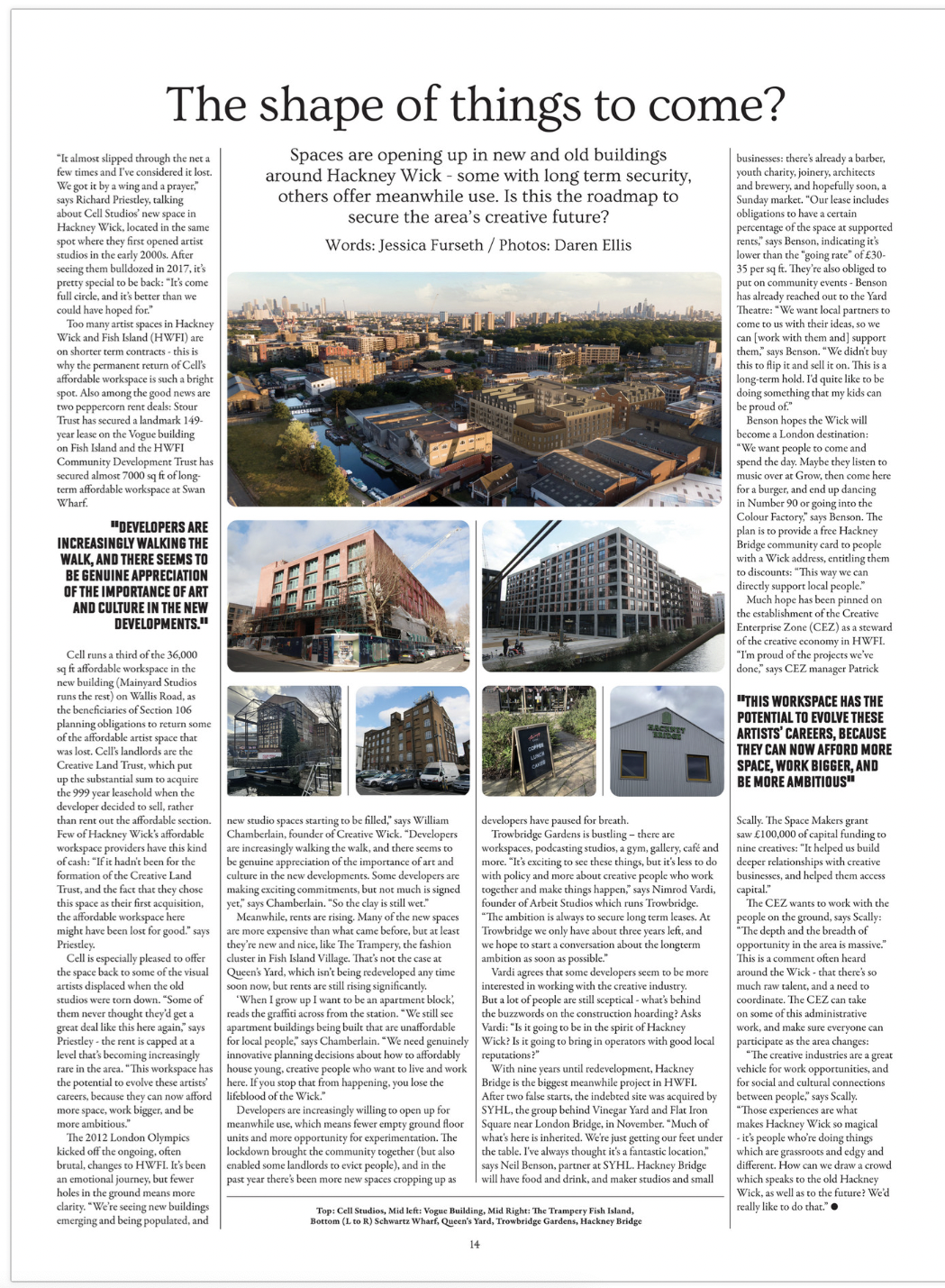
Spaces are opening up in new and old buildings around Hackney Wick – some with longterm security, others as meanwhile use. Is this the roadmap to secure the area’s creative future?
“It almost slipped through the net a few times and I’ve considered it lost. We got it by a wing and a prayer,” says Richard Priestley, talking about Cell Studios’ new space in Hackney Wick, located in the same spot where they first opened artist studios in the early 2000s. After seeing them bulldozed in 2017, it’s pretty special to be back: “It’s come full circle, and it’s better than we could have hoped for.”
Too many artist spaces in Hackney Wick and Fish Island (HWFI) are on shorter term contracts – this is why the permanent return of Cell’s affordable workspace is such a bright spot. Also among the good news are two peppercorn rent deals: Stour has secured a landmark 149-year lease on the Vogue building on Fish Island, the HWFI Community Development Trust has secured almost 7000 sq ft of long-term affordable workspace space at Swan Wharf.
Cell runs a third of the 36,000 sq ft affordable workspace in the new building (Mainyard Studios runs the rest) on Wallis Road, as the beneficiaries of Section 106 planning obligations to return some of the affordable artist space that was lost. Cell’s landlords are the Creative Land Trust, which put up the substantial sum to acquire the 999 year leasehold when the developer decided to sell, rather than rent out the affordable section. Few of Hackney Wick’s affordable workspace providers have this kind of cash: “If it hadn’t been for the formation of the Creative Land Trust, and the fact that they chose this space as their first acquisition, the affordable workspace here might have been lost for good.” says Priestley.
Cell is especially pleased to offer the space back to some of the visual artists displaced when the old studios were torn down. “Some of them never thought they’d get a great deal like this here again,” says Priestley – the rent is capped at a level that’s becoming increasingly rare in the area. “This workspace has the potential to evolve these artists’ careers, because they can now afford more space, work bigger, and be more ambitious.”
*
The 2012 London Olympics kicked off the ongoing, often brutal, changes to HWFI. It’s been an emotional journey, but fewer holes in the ground means more clarity. “We’re seeing new buildings emerging and being populated, and new studio spaces starting to be filled,” says Will Chamberlain, founder of Creative Wick. “Developers are increasingly walking the walk, and there seems to be genuine appreciation of the importance of art and culture in the new developments. Some developers are making commitments, but not much is signed yet,” says Chamberlain. “The clay is still wet.”
Meanwhile, rents are rising. Many of the new spaces are more expensive than what came before, but at least they’re new and nice, like The Trampery, the fashion cluster in Fish Island Village. That’s not the case at Queen’s Yard, which isn’t being redeveloped any time soon now, but rents are still rising significantly.
When I grow up I want to be an apartment block, reads the graffiti across from the station. “We still see apartment buildings being built that are unaffordable for local people,” says Chamberlain. “We need genuinely innovative planning decisions about how to affordably house young, creative people who want to live and work here. If you stop that from happening, you lose the lifeblood of the Wick.”
*
Developers are increasingly willing to open up for meanwhile use, which means fewer empty ground floor units and more opportunity for experimentation. The lockdown brought the community together (but also enabled some landlords to evict people), and in the past year there’s been more new spaces cropping up as developers have paused for breath.
Trowbridge Gardens is bustling – there’s workspaces, podcasting studios, a gym, gallery, café and more. “It’s exciting to see these things, but it’s less to do with policy and more about creative people who together and make things happen,” says Nimrod Vardi, founder of Arbeit Studios which runs Trowbridge. “The ambition is always to secure long term leases. At Trowbridge we only have about three years left, and we hope to start a conversation about the longterm ambition as soon as possible.”
Vardi agrees that some developers seem to be more interested in working with the creative industry. But a lot of people are still sceptical – what’s behind the buzzwords on the construction hoarding? Asks Vardi: “Is it going to be in the spirit of Hackney Wick? Is it going to bring in operators with good local reputations?”
With nine years until development, Hackney Bridge is the biggest meanwhile project in HWFI. After two false starts, the indebted site was acquired by SYHL, the group behind Vinegar Yard and Flat Iron Square near London Bridge, in November. “Much of what’s here is inherited. We’re just getting our feet under the table. I’ve always thought it’s a fantastic location,” says Neil Benson, partner at SYHL. Hackney Bridge will have food and drink, and maker studios and small businesses: there’s already a barber, youth charity, joinery, architects and brewery, and hopefully soon, a Sunday market. “Our lease includes obligations to have a certain percentage of the space at supported rents,” says Benson, indicating it’s lower than the “going rate” of £30-35 per sq ft. They’re also obliged to put on community events – Benson has already reached out to the Yard Theatre: “We want local partners to come to us with their ideas, so we can [work with them and] support them,” says Benson. “We didn’t buy this to flip it and sell it on. This is a long term hold. I’d quite like to be doing something that my kids can be proud of.”
Benson hopes the Wick will become a London destination: “We want people to come and spend the day. Maybe they listen to music over at Grow, then come here for a burger, and end up dancing in Number 90 or going into the Colour Factory,” says Benson. The plan is to provide a free Hackney Bridge community card to people with a Wick address, entitling them to discounts: “This way we can directly support local people.”
*
Much hope has been pinned on the establishment of a Creative Enterprise Zone (CEZ) as a steward of the creative economy in HWFI. “I’m proud of the projects we’ve done,” says CEZ manager Patrick Scally (who’s also this issue’s guest editor). The Space Makers grant saw £100,000 of capital funding to nine creatives: “It helped us build deeper relationships with creative businesses, and helped them access capital.”
The CEZ wants to work with the people on the ground, says Scally: “The depth and the breadth of opportunity in the area is massive.” This is a comment often heard around the Wick – that there’s so much raw talent, and a need to coordinate. The CEZ can take on some of this administrative work, and make sure everyone can participate as the area changes:
“The creative industries are a great vehicle for work opportunities, and for social and cultural connections between people,” says Scally. “Those experiences are what makes Hackney Wick so magical – it’s people who’re doing things which is grassroot and edgy and different. How can we draw a crowd which speaks to the old Hackney Wick, as well as to the future? We’d really like to try to do that.”
Lionheart Magazine #14, the Joy issue, published May 2022.
In the water, in my body
I started swimming by chance. It was a warm day in early summer by the seaside, and I was charmed by an inviting tidal pool and decided to go for a swim for the first time in many years. The water was shockingly cold and rich with salt, and when I was in it, just so much all at once! I left with sand everywhere, and walked around for hours before having an early dinner of chips and oysters and a single cocktail, before going to sleep for ten dreamless hours.
Something had happened in that water. Intrigued, I looked up where I could swim outdoors in London, and found that the city I know pretty well has so much water in it. And you can just get in! So that’s what I did all summer, in the lidos, ponds, reservoirs, docks and the river. It had been a rough year and I knew that I needed something to get back to myself – I literally needed a cold splash of water to the face.
Many people who are into so-called wild swimming have a story like this. You come to the water because you need something, because you’ve lost something or because you are yourself lost, in pain or distress. If we come to the water feeling disconnected we leave as part of things again, and we keep going because it’s easy – to be in water, it’s such a simple pleasure.
At least that’s how I felt when I started in the summer. I knew people swam outside all year round, but as the temperature started to creep downwards I was sceptical about continuing – why take on the pain? As the autumn leaves dropped into the pond, I didn’t keep going as much as I just … didn’t stop. On Halloween it was 12 degrees and it had frankly become a bit miserable, but I wanted to make it to single digits – I’d come this far, right? And then, on a sunny and freezing late November day at the lido, I swam in nine degree water for the first time. Suddenly, I felt the euphoria that those wide-eyed cold swimmers had told me about but had eluded me so far. In the frigid water, my skin was on fire and my mind was empty but for the sensation, and I laughed out loud, amazed. After two laps I got out, freezing and flustered and exhilarated. The revelation had taken its sweet time, but when it came it was instant and transformative.
*
“The key is cut by the lock. You will code then decode your mind. You will save yourself. You cannot help it,” Molly Brodak wrote. I think about this a lot when I think about swimming. In the beginning I kept going to the water because it felt good and I trusted that feeling – I needed to move towards things that felt good because I needed to trust myself again. Swimming felt good in a gentle way back in the summer when the water was warm, and I would go to the Hampstead Heath ponds in a skirt with a bikini underneath and just dry off on the grass afterwards. This feels like a long time ago now, as I’ve been hauling neoprene swim socks and gloves for months, along with a full set of thermals and a hot thermos to combat the cold from within. I’ve tried going to heated outdoor pools in winter and while it’s lovely, it just doesn’t have the same effect. I’ll swim back and forth in the warm water, so pretty with the steam coming off the surface, but it’s too sweet. It’s not a victory – it’s not a kick in the face, and when it’s cold and dark in a way that creeps under the skin, only a hard-won thrill will do.
There’s always a second when I walk towards the single-digit temperature water where I don’t want to do it, because I know that for the first few seconds I will feel like I’m dying. But I do it anyway because I know this is the thing to do – I trust myself again. And also, I know that the process of repeatedly going from fear to composure in the water is helping me be more like that on dry land as well. Not that I think about any of that when I’m in the water – there’s not a thought in my mind other than to swim and to breathe. At the far end I’ll flip over on my back to float, watching the trees and the sky and all the good fortune that’s around me. In a minute I’ll have to move so that I don’t freeze, but right then I’m out here, in the water, in my body, out of my mind. In that moment it doesn’t feel like it’s going to be okay – it feels like it already is.
Published in Lionheart Magazine issue 13, the “Magic” edition, August 2021.
Normally I’d say that I rarely get bored – only boring people are bored! – but the pandemic really knocked me down a peg. I was bored like only a five year old can be, lolling around and moping about it. I’ve forgot a lot of the details of lockdown now, because that’s how memory works: when nothing happens it will feel unending in the moment, but the brain glosses over in retrospect because why bother keeping a record of something so unremarkable?
The lockdown experience reminded me of childhood in more ways than one: you’re told when you can do things, who you can see, and when TV has lost its allure you’re left going on aimless walks around your neighbourhood. Fortunately for me, I’d learned how to handle boredom as a child so I was prepared – I knew that you go from whining about how dull it all is until you get sick of yourself and go do something. It’s like a spark going off inside of your mind, and you needed that dullness to get there, right? When I talk about magic, this is what I mean – the incredible ability of our own minds to find connections and create something wonderful.
When it worked it was great. I took long wanders along the riverbank, taking note of the tidal markers and the wildflowers – it was peaceful and lovely. But I couldn’t make it last: I’m not a child anymore, and I need my world to be bigger than this. I want to stress that I know I was very lucky to be so bored by a pandemic where people died, but that’s also part of the problem: I kept expecting some kind of clarity of mind in the middle of it all – some kind of appreciation or insight triggered by the severity of the situation – but it never came. In my rational mind I knew I was fortunate, but deep inside I was still the same brat I’ve always been.
Except sometimes. In the first lockdown, when absolutely everything was closed, I got the train to Southbank one day and walked across the river up to Chinatown, through Soho and up to King’s Cross – it was as if someone had hit the pause button on the city. During that time the Tube was mostly empty, with each platform plastered not with the usual rainbow of advertisements but in posters encouraging us to wash our hands, wear our masks, and take our vitamins. The only thing breaking it up was the occasional “Poems on the Underground” poster:
“I open the window to let you in, rain, and your forceful breath startles the curtain, smelling of moss, forming droplets on my lips.” [Julia Fiedorczuk]
When I read this it had been a year of masking and social distancing, and the idea of letting someone close enough to feel their breath felt impossible. My brain had started to adjust to this new, fearful reality, but once I was reminded of the past, the thought of brushing up against a stranger on the way to the bar left me breathless. It was right there, like it was preserved under glass in a frame, waiting for me to pick it up again. The same was true about the oil painting I used to do as a teenager, which I got back into again during that third and most crushing lockdown. I discovered that my abilities were exactly where I’d left them – no better, no worse, just like a time capsule within myself. Now that the world is opening again I think about this a lot: I wonder which memories I’ll stumble across as I see little things that remind me of our funny year spent inside our houses, inside our minds.
The city came back again eventually, and we stumbled out of our houses squinting at the light, all a bit worse for wear. Part of me wants to forget this ever happened, but I know that’s not how it works. What I do know is that this pandemic pushed us all to the edges of our resilience – our worlds shrunk and we had to retreat into our minds, because outside there was nothing to do but wait, try really hard to be grateful, and take yet another walk.
Getting that vaccine was one of the best moments of my life – it was the key to getting the world back, and if that’s not magic then I don’t know anything. I keep having these moments where I’m sitting in my favourite restaurants and I realise that for a moment, I’d actually forgot all about this year. Then I’m absolutely bowled over by the miracle of getting to do these normal things again. Can you believe it! How wonderful and how ordinary, all at the same time. See, there is nothing magic about magic.
You must remember this: How to make better memories
A rush of memories can overwhelm you, but you have more control over how and what you remember than you might think. Because the brain is constantly changing our memories, your recollections are constantly up for renegotiation.
Some memories seem to live outside of ourselves, waiting for us to stumble upon them. For me, the smell of tar brings back my late grandfather, clear as day in his blue mechanic overalls. A little thing can trigger a memory, causing it to come flooding back: go and put on a song you loved at 17 and wait for the flood of teen feelings – it’s as if all those memories were holed up in that song.
Every autumn, you might get an urge to buy new stationery, all thanks to years of going back to school at this time of year. This is because reminders, like the leaves turning, cue us to remember everything else associated with that memory: “When we’re forming a memory, we’re incorporating where we are, who we’re with and how we’re feeling,” says Chris Bird, professor of cognitive neuroscience at University of Sussex.
Memories are often tied to places and people. It seems I keep many of my memories of the year I was 26 stored with my friend Ben, who was around a lot that year so when I see him, it all comes back. There’s a specific bench on the canal in East London where I’m forever breaking up with someone I loved, one of a million moments that seem to live out in the city, waiting for me to stumble across them.
“We think of memories as an event made up of lots of different parts. Any one of those parts can trigger the reconstruction of that whole memory,” says Jack Mellor, professor of neuroscience at the University of Bristol. “The brain is wonderfully flexible, and it allows you to adapt your memories to your current environment,” says Mellor – so passing a restaurant may remind you of the last meal you had there, or if you’re in a different mood, you could recall the fight you had afterwards.
A memory is stored in nerve cells in the brain, or in the connections between several nerve cells – these cells are then linked to thousands of others. “The way those connections occur, and strengthen and weaken, will determine how you [link] a particular group of experiences together into a memory,” says Mellor. It’s a flexible process: “The brain can change the connections between these components of our memories.”
This process isn’t as random as it might seem: you can actually make a decision to remember things. “One way to do this is to rehearse the memory by going back over what happened today,” says Bird. But laying down the memory is only half the job – you have to get it out again: “Often, unless something happens to trigger a memory, we won’t remember it.” If I never go to that park where I scaled the fence to look at the stars with a boy I had a crush on, I might never think of it again.
We will never remember everything. The brain really likes variety and tends to gloss over monotony – this is why you don’t remember last month’s breakfast, last year’s commute, or most of lockdown: “If nothing much is happening, at the time it feels like time is moving incredibly slowly,” says Bird. “But looking back, it seems like it went very quickly because there was nothing really to hang onto.” This is also why we might remember a week of holiday better than an entire year: it was full of novelty. So next time you have a slow Sunday, go and do something new because it will be more likely to leave an impression for later.
We remember what’s important to us. “But often, we don’t realise what exactly is important to us,” says Mellor – chances are you have a strong memory associated with a childhood snack, toy or holiday destination, because it was a big deal at the time. “We may have repressed a memory for many years, and [we might come across] a little trail that brings us back to that memory. This tells us that it actually is really important to us [after all].” This little revelation can be a nice cue to start exploring some of those memories and associated feelings, as it might help us understand our past a bit better and shed some light on why we are the way we are.
But our memories aren’t as accurate as we think they are. This is good news if you’re feeling tormented by a years-old slight that keeps circling in your mind – it may not actually be entirely correct. But if you think of your memories as a beautiful archive of your life, forever there to relive in perfect accuracy, our brain’s disregard for cold hard facts might be a bit upsetting.
Asked why this happens – wouldn’t it be better if we remember things correctly? – Mellor laughs: “But it’s not correct anymore, is it?” We’re now at the edge of what memory research can tell us, but this essentially goes back to why we remember anything at all: to help us predict the future. We will notice when a building on our high street has changed, but over time the brain might simply gloss over the past versions – it doesn’t matter anymore. “The brain is basically trying to predict what’s going to happen next so that you can make the best decisions possible,” says Mellor. Keeping a perfect record of the past is often simply not very important.
The same might actually be true for emotional memories too: when we review our memories we might be changing them a little in the process, as we reconsider to make better sense of things. This plasticity is what helps us move on, and it’s a central component to cognitive behavioural therapy and PTSD treatment. The fact that the connections between the nerves in your brain aren’t set in stone means you can re-associate in a way that serves you better: “This process allows you to think about things in a different way in future,” says Mellor.
When I went to the pub again for the first time after lockdown, feeling ecstatic at being able to do something so nice and normal after so long, it was at a location I’d primarily associated with having drinks the day I got married. Will my plastic brain update this memory now? “It depends on how much effort you put into continuing to associate that pub with your wedding, or with lockdown ending,” says Bird – it’s in part up to me. “Certainly if you carried on going to the pub regularly it would lose its former association and just become a place you go.”
While my memories are constantly being updated, I’m not a computer – I’ll still remember things from the past, even as things change those old memories aren’t as important to my daily life anymore. But reassuringly, we’re not doomed to forever watch our past on a cinema reel in our minds. Bird told me that we tend to recall things that are consistent with our moods, so if I’m happy I tend to recall uplifting memories, and vice versa. Knowing that our memories aren’t neutral, but in fact are coloured by our moods, is a powerful tool: next time you’re spiralling into a memory well, remember it’s not necessarily accurate. You’re just jumping between nerve cells in the brain, so if you don’t like the journey, take a step back. There’s always a chance to take another look at the past and try for a better outcome.
*** How to make good memories ***
Deborah Smith, positive psychologist and author of Grow Your Own Happiness, has some tips for how to make good memories, not just in the moment but also in retrospect.
Take pictures, but not too many. Being in the moment and enjoying it makes better memories than trying to hold onto it so tightly.
Looking at pictures is a powerful way to retrieve memories, but it can also influence you by over-simplifying things. If you’re looking at a photo of a childhood birthday where you’re sitting alone, it could make you feel like you didn’t have friends. Remain open to other possibilities and call someone who was there, and your perception might well change.
Consider a gratitude journal – simply writing down nice things occasionally will slowly start to shift how you think and what you notice.
Rose-tinted glasses are a thing, but so are grey-tinted ones – neither perception is correct. To improve a bad day, remind yourself that your feelings aren’t facts, but something you can negotiate: call a friend, dance it out, make a nice dinner and maybe you can turn it around.
Sometimes you should do something just for the memory! If you’re scared, think about how this will be a great story, and you’ll laugh about it in the years to come.
“I can’t order at the bar! They say it’s table service only!” My friend Ben is an experienced pub-goer, but the government’s new coronavirus rules, which had gotten stricter back in September, had him shook. We found ourselves a table and faced the strange at The Kings Arms, a proper boozer just behind Waterloo Station in South London. The bell for last call was jarring when it rang at 9:30 pm, but there’s a pandemic and we must all do our bit. Honestly, I was just happy to be out—every single bar and restaurant in England was shut for 104 brutal days this spring. “Cheers!” I said to Ben. “Some pub is better than no pub!”
The next time I met up with Ben, only people from the same household could sit inside, leaving us huddled around a patio heater—let’s just say you have to really want it to do that in London in November. The rules have changed so many times this year I’ve lost track, but I’ll never forget that first weekend of freedom after the spring lockdown. The relief was palpable in the streets of Soho—we would get a summer after all! The bars and restaurants flooded the newly pedestrianized streets with tables to serve us at a safe distance, and it felt like a celebration. I ordered two glasses of wine at the bar at The Lyric, my favourite Soho pub, dropping a quid into a glass labelled “Boris says stay alert and tip us.” Sitting down at a freshly sanitized table I had a feeling that this reprieve wouldn’t last, but hey, let’s ride it like we stole it.
During this magical summer I visited my favourite pubs as often as I could. Who knew who’d survive? In November, pubs could only do takeaway, and now, in December, the rules are only slightly looser. The coronavirus doesn’t care how much we miss idling away a Sunday afternoon in the pub, and by the time this is over many of them will be gone. The pub industry was under plenty of pressure before the pandemic (running a pub is long hours for not much money, and 25 percent of UK pubs have shut since 2001) and the Campaign for Real Ale (CAMRA) didn’t mince words: this year will “make or break” the pub industry.
“For many pubs, it’s not really viable to be open. They’re not making any profit. But they are doing it anyway, because they want to,” says Nik Antona, National Chairman of CAMRA, over the phone from Staffordshire. “The local pub is where people meet, where they have a chat, where they put the world to right.” Rent and bills are still due, but pubs haven’t received any insurance money because insurers are refusing. The government’s furlough scheme has been helpful, but many London pubs found their business rates were too high to qualify for support grants. “It’s been quite a harrowing time for the industry,” says Antona, who estimates about 2 to 5 percent of pubs didn’t open after the first lockdown. “If we hadn’t gone into any other restrictions, many would probably have opened up eventually.” Now it depends how long the restrictive rules will last and what happens next in terms of formal support. Resources are stretching thin: “If pubs can’t reopen [after the November lockdown], we may see more casualties.”
The Queen’s Head, a charming Victorian pub near King’s Cross in Central London, has been closed since the first lockdown. “Every time we plan to reopen, [new rules] come up,” says landlord Nigel Owen over Zoom. He’s hoping to reopen in January. “But right now, the area is a ghost town. A big part of our footfall is local office workers, tourists, and people travelling in and out of King’s Cross station,” says Owen. The locals are still there, but the pandemic could have a lasting effect on the way people work and travel.
Owen has run The Queen’s Head for more than ten years. “It’s a proper pub,” he says, telling me about first going to see it: it was closed down and the etched windows were covered in newspaper, and he peered through the letterbox to be amazed by the big bar and mirrors. The Queen’s Head is a conservation site and can only ever be a pub, which is helpful; Owen has been negotiating with the property owner for rent relief because paying the full amount for the year is impossible. Asked about insurance, Owen shakes his head: “It’s a mafia. You pay all this money for insurance, but you’re not insured for anything!” Owen knows pub landlords who’ve handed back their keys—it’s been a rough year. “But one of the benefits that could come out of all this is people realising we need to support local businesses. Without support, they just aren’t going to be there.”
Heath Ball, landlord at The Red Lion & Sun in Highgate Village in North London, credits local support with keeping the pub afloat this year. Ball never closed the classic Edwardian pub, keeping it open as far as regulations would let him: “I’ve still got staff to look after. I can’t sit still. It’s about survival of the business.” Ball gives me a cup of mulled wine as we sit down outside the pub—the winter warmer is selling well to people who go for walks on nearby Hampstead Heath. The Red Lion & Sun is part of the community: “We’ve got a lot of elderly customers who we deliver food to. David, next door, he’s in his 90s, he likes a pint of bitter. We put it on a tray with his dinner and leave it outside his door,” says Ball. When regulation for a time dictated orders must be made by phone, Ball rigged up a handset on the pavement, and people collected from a marvelous shed out front.
Ball, who’s run The Red Lion & Sun for more than 13 years, says they’re holding their own and no one’s lost their job, even though they didn’t qualify for support grants. They are tied to the Greene King pub company which discounted the rent: “Greene King have been really supportive. I think they want to keep their tenants in place—this is a good business here.” Stark figures from the British Beer & Pub Association suggest 72 percent of pubs and restaurants could be unviable by next year, unless they’re either able to be open or receive support to be closed. I ask Ball, how much longer can he keep this up? “This second lockdown is a lot harder financially. The summer was [busier], but the novelty has worn off,” Ball sighs. “Who can survive this? Where are we going to end up?”
I leave The Red Lion & Sun with a takeaway, taking the long way back to the Tube so I could finish it before putting a mask on. I realize how much I’d missed it, being at the pub and getting the train home, half-cut and relaxed after putting the world to rights. Most of my favorite pubs are still hanging on, but a lot of people’s favorites won’t make it till the end of this pandemic. Cities change constantly but it’s usually slow, and it’s a very strange feeling to watch your city transform like this. Any time could be the last time.