Meet Kash, the most exciting payment startup in town

FusionWire, January 2016.

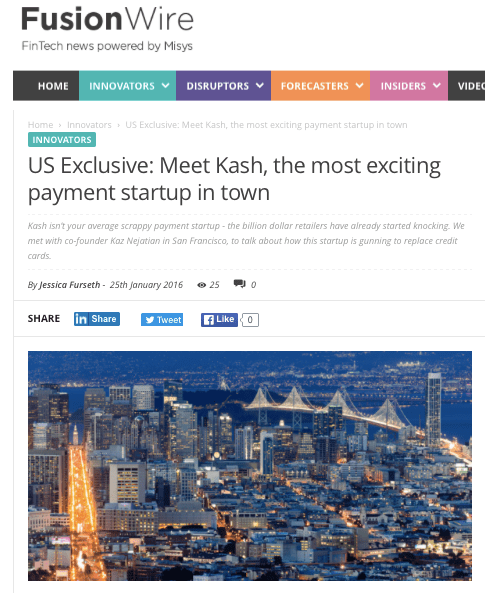
kash wpMeet Kash, the most exciting payment startup in town

Kash isn’t your average scrappy payment startup – the billion dollar retailers have already started knocking. We met with co-founder Kaz Nejatian in San Francisco, to talk about how this startup is gunning to replace credit cards.

At first glance, Kash could be mistaken for just another payment technology startup, although one with a particularly bold goal: to become the retail payment method of choice. Nothing about Kash’s offices in San Francisco’s SoMa district pegs the company as remarkable; as is the case for many of the City’s early startups, searching for Kash’s offices leaves you concerned you’re about to walk into someone’s flat. But no, this is the right place, says CEO and co-founder Kaz Nejatian as he lets me in, explaining how there are six Bitcoin companies in the building, which neighbours Pinterest and AirBnB.

In his hoodie and ‘Toronto Law’ t-shirt, Nejatian brings out water in mason jars as he explains how four people work for Kash in SF and three more in Canada – this count should double this year. But this is by no means a bootstrapped operation. Kash’s ambitious plan to become the retail payment method of choice has some big-name backers: first Y Combinator, then investors including Tim Draper and Green Visor Capital – and in September, former Visa CEO Joe Saunders joined the Kash board, alongside Square founding member Sam Wen. In other words: the Kash plan may be bold, but the talent pool is deep. Nejatian tells a compelling story, and after an hour in his company it’s hard not to get onboard with the excitement.

The quick and cheap alternative
The key to what Kash does, is letting people pay for things using direct debit: “We’re the only direct debit company in the US,” says Nejatian. “In the US, there’s no instant payment system that’s affordable.” The alternatives are the credit card networks, which are quick but expensive – or the Automated Clearing House network, which is cheap but takes several days. Kash adds an API on top of the banking network, which then allows people to log into their bank accounts and pay directly, at low cost. It’s all done and dusted in about two seconds.

This all sounds great, but still – getting people to change a behaviour as fundamental as credit and debit card payments is a tall order. It’s not like Kash is the first to have tried? Nejatian nods, eager to explain. First of all it’s easy: the payment is done within the browser, with no app required, and the technology is available to 93% of US consumers. The low rates are a key issue for merchants choosing Kash: instead of paying the usual 4-5% transaction fee to clear card payments, e-commerce merchants pay 0.5% with Kash. This enables them to either pocket the difference, or pass this saving on to their customers.

“We do incredibly well everywhere we’re deployed. We’ve just deployed across a major e-commerce retailer – our e-commerce product came out less than five weeks ago! On this e-commerce route, we do over 25% of transactions. In the first week there, we beat every brand of cards.” Right now, about 400 companies use Kash, with several more in the pipeline. In about three months, a “multi-billion dollar company” with physical outlets in fifty states will join this number – Kash can be used both online and in-store.

The reception from the established banking industry has been positive, says Nejatian: “There are banks that really like us, and we have big and small partner banks. But credit card transactions are the single largest source of revenue for American banks, so there are obviously banks that are nervous about that revenue going away.” Nejatian hopes to partner with more banks, but accepts it will take time. “The regulators here take a much dimmer view towards innovation [than in the UK]. It’s not as easy for banks here to say they want to have a fintech innovation hub that lets startups do whatever they want.” Nejatian shrugs; the Canadian national was previously a banking lawyer in New York, making it easier for Kash to navigate this issue.

The anti-fraud guarantee
Another appealing feature of Kash is how merchants are protected from chargebacks, which in the US can be significant. Then there’s how the technology boasts being highly resistant to fraud. Kash will cover fraudulent transactions up to $100k, says Nejatian: “But we haven’t had a single case of fraud.” Asked to explain how they’ve managed to create a system that makes this possible, Nejatian compares standard card payments to a game of Chinese Whispers: you swipe your card and it starts a chain: to the gateway, the bank, the network, and many more steps beyond:

“Instead, we have an algorithm that clears transactions, determined fraud, and moves money around. We use literally hundreds of factors to determine fraud, credibility, and creditworthiness. None of those factors we use are used by credit card companies.” Nejatian asks if I have a $5 note on me. “If I have the serial number that’s on your bill, I couldn’t spend that $5, right?” I look at the note in my hand. “But if I knew the 16 digits on your credit card, I could buy myself a Louis Vuitton purse tomorrow.” He laughs. “If you were to design a payment system today, you wouldn’t say, ‘Let’s clear money using 20 random digits!’ Because that doesn’t make any sense.”

Most of the security features in the Kash algorithm are kept secret – Nejatian will go as far as saying one of them is your IP address, but there are several dozen more. “We know information about you that your bank doesn’t know, and doesn’t want to know. … When we know those things, we don’t have to rely on numbers.”

A passion project
Having a catalogue of big name supporters to point to has been good for Kash as it pushes ahead with its ambitious goal. “But I think what makes us impressive to our merchants is when they see results. 80% reduction in transaction fees – that’s real to people.” Nejatian pauses. “I come from a long line of retailers. We moved from Iran to Canada when I was 12, and we had a corner store. I would go through our bank statements and look at credit card fees, and every month the credit card companies were making more money from my mom’s store than my mom was. Every single month. That’s true for most merchants in the US and Canada.” Nejatian was 14 years old when he decided he wanted to do something about this. “I’ve been thinking about this for a really long time! It’s nice to have a plug that a lot of people are using, and like. It’s having a real impact in the world.”

While getting small retailers onboard is Nejatian’s hobby, he knows full well it’s the billion-dollar chains that are going to make Kash a success. Progress has also been aided by the US’s recent migration to chip and PIN cards, which changed the landscape for card fraud by driving it online. “We honestly didn’t expect e-commerce [takeup] to grow as fast as it has,” says Nejatian. The company started in 2012, but the first few years were spent building the tech from scratch – the actual product is less than a year old. Even more amazingly, this growth has happened without a sales team, as it’s all been word of mouth. “But we’re building a payment company – it will take a while! I’ve waited twenty years to start the company. I can wait twenty more years for it to become a big company.”

The goal is to take Kash global: “The payment system is broken virtually everywhere. It’s bad in the US, but it’s terrible in Africa and Asia. … Moving money should be frictionless. Ideally moving money shouldn’t cost you. We have a long way to go.” Nejatian describes Kash as his mission in life, and considering his enthusiasm it’s hard to doubt his sincerity as he explains he didn’t start Kash to run his own company, but to make payments more affordable for people. “I want this to exist. I think we’ll be the ones to do it. But even if we’re not, I’d want this to exist.”

How to fix a leak in your bathroom

The Billfold, January 2016. Original article.

bathroom wp

How to fix a leak in your bathroom

1. Move into your new flat and marvel at the fact that you own this place. Before you’ve finished unpacking, receive notice that they’ve examined every one of the building’s 27 flats to find the source of a leak — it’s your bathroom! You’re on the hook for the repair costs, as the building insurance only covers the cost of repairing the damage resulting from said leak. This doesn’t make any sense, but okay. You chase the insurance company for three months to get them to send their repair crew. This, you realise later, is what they call “foreshadowing”.

Week one.

2. A repairman is set to arrive at 8am on Monday. He won’t know how long the job will take until he’s had a look, but he estimates three days, maybe five at the most. On Monday he texts to say he’ll start on Tuesday, but he’s confident he’ll be done by the weekend. Tuesday: repeat.

3. Pete the repairman shows up on Wednesday, deems the bathroom floor to be damaged and pulls up the tiles. Now he just has to put down new tiles. Easy! Then Pete calls you from the tile shop: do you want different tiles? The insurance covers like-for-like replacement, but if you want something different you can just pay the excess. Oh! Pete needs to know right away, but that’s fine — this is the moment design-Instagram has prepared you for. You know exactly what you want, and feel like you’ve really got a great deal here.

4. Friday morning, Pete calls: the tile delivery was delayed and he’s only just got his hands on it now. The job will run into Monday, not including the grouting and finishes of course. Fine, whatever. You spend the weekend tiptoeing around on a concrete bathroom floor, but the final result is going to look great!

Week two.

5. Brian the tiler arrives, deems a section of wall to have water damage too and pulls down the tiles in question. They are standard white tiles so he’s just going to swap them out. Easy. A few hours later, a bewildered Brian calls: your old wall tiles were not standard! The replacements are no good! Since this discovery only came after the old tiles were knocked down, it means replacing every single wall tile. Work stops for 24 hours as the insurance company ponders the issue.

6. To everybody’s surprise, the insurer decides to to cover like-for-like replacement of the wall tiles. So, says Pete, do you want different tiles? You know the drill — you’re practically a design blogger by now! Pete spends the rest of the week removing the old tile and preparing the walls, leaving your entire flat covered in a fine layer of plaster dust. It gets everywhere, including inside the kitchen cupboards.

7. On Saturday morning, you get up early as Pete has arranged for a weekend tiler — let’s get this done! — he says. You feel encouraged until Pete calls: the tiler isn’t coming because broke his ankle last night. You attempt to feel sorry for him. A second weekend is spent tiptoeing around on a chipboard bathroom floor. You have to crouch down in the tub as you wash, as not to splash the bare walls.

Week three.

8. Brian is back — your bathroom has now become a nuisance for him as he has places to be. No one expected it to last this long, Brian informs you, while you make him a cup of tea after checking the mug for plaster dust. The feeling of getting a bargain has well and truly evaporated, but both Pete and Brian seem confident it will be done by Friday.

9. On Tuesday morning, Brian calls in a fluster: there’s a leak! It seems all the jostling around has cause the original leak — the one that triggered all this, remember? — to reemerge. Or maybe it wasn’t fixed properly in the first place, Pete suggests, but you care little for his excuses. All that’s certain is that a plumber is needed before they can proceed, and also, a section of drywall needs replacing. Work stops for 48 hours as the insurance company considers who will pay for all this.

10. Thursday rolls around, and you tell Pete to go ahead — you’re ready to throw money at the problem. Pete says he understands. He finds someone to fix the leak and repair the wall — they’ll be over Sunday morning! Great. You spend your third weekend in a stripped down bathroom, crouching down to shower still, now with the added challenge of trying to flush the toilet at little as possible as not to aggravate the water damage. You travel the London Underground, where each station is covered in colourful, sprawling tiles, and you feel like they’re mocking you.

Week four.

11. Alan the plumber was a little too gleeful when he told you that having a repair last four weeks is nothing — sometimes these jobs go on for months and months because they just can’t locate the source of a leak. Imagine! Mere hours later, you realise there’s still the tiniest leak, and now, the toilet doesn’t flush properly. Someone will be round to fix it and finish the job, tiling and all, says Pete — bright and early on Wednesday. This is a low, you think to yourself as you spend the next three days with what can reasonably be called substandard plumbing. Your place has slowly turned into a tip and there’s building dust everywhere, but there’s no point cleaning until the work is done. You consider checking into a hotel, but you can’t chance it — you have no idea how much all this will cost you.

12. On Wednesday, a fellow named John arrives and says he’s going to stay until the job is done, which means he’ll be working the weekend. You nod feebly — you’re starting to accept this situation as your life now. You no longer have any feelings about any of it: not about your bathroom, the now-lost weekend, the mess that is your flat, or indeed the certainty that the arrow of time only moves in one direction. But John fixes the toilet flush, and tiles the shower so you can wash without worrying about damaging the walls for the first time in weeks. In spite of yourself you feel a spark of hope, but only for a moment: John can’t make it on Friday due to a veterinary emergency. You make sympathetic noises, but it’s all an act.

13. Good old Pete comes to fix that tiny leak. He can’t work out exactly what the problem is so you authorise a full replacement — it’s not cheap, but the thought that money could save you from this is sweet relief. John returns the next day and claims he’ll be done by Sunday night, but you know better than to believe a word of it.

Week five.

14. John is back bright and early Monday morning — of course he is. Yesterday he told you that whenever builders say five days you have to allow seven, which is not your idea of good expectation-management. But the tiles are in place! Pete has arranged for someone to come and finish up the last bits, including shortening your bathroom door, which apparently is a thing that needs doing. That’s not happening until Thursday though. Deflated, you go to pour yourself a drink, only to discover that John has finished your good booze.

15. Some guy called Sam calls you on Thursday morning: can we push this final bit to Monday? Oh we most certainly cannot, you inform him, you need to move on with your life. Sam rocks up at 5pm and informs you it’s really not a big job! But there’s too much left to finish it all today of course, and he’ll have to come back on Monday. Your mind goes to that Seinfeld episode where Elaine tells her phone line engineer: “You know, I could’ve killed you, and no one would have known.”

Week six.

16. Sam, who’s still alive, returns on Monday as promised and everything is miraculously done. You’ve never been so happy for a chance to clean in your life. The bathroom looks so good! And, you think to yourself, maybe the kitchen could do with some tile too? This time you’d do it yourself though — hell is other people. And you’re determined! In that respect, Pete, Brian, Alan, John and Sam have nothing on you.

The curious link between smell and memory

Aquila Magazine for children, December 2015. 

aquila dec15

The curious link between smell and memory

Why is smell such a strong trigger for bringing back memories? And what happens in our brains when a memory comes flooding back?

Smells have a funny way of bringing back memories you hadn’t thought about in a long time – maybe even things you’d forgot all about. If you’re not sure what we mean, just go and take a whiff from a bottle of sunscreen. It may be winter right now, but it will bring you right back to the beach, or the park, or wherever you were the last time it was hot enough to need to put on suntan lotion. But even if it’s snowing outside, chances are the smell will trigger memories and feelings of summer, and they’ll come flooding into your head, far more intensely than they would by just talking about it.

memory1

This little memory trick works with all sorts of scents we have an emotional connection to. Think about how the smell in the air changes when summer turns to autumn, and it can only mean one thing: school’s back. Or if you’re in a car or train on the way to the sea, and you can smell the saltwater long before you can see it. Many of the smells we experience in childhood will act as doorways to memories when we’re grow up, waiting to be rediscovered if we smell something just like it again. Say if your grandfather is a woodworker and you like spending time in his workshop, the smell of wood shavings will probably remind you of this for the rest of your life. Sometimes the special smell can be really subtle, like the smell inside a toy chest or a wall clock, meaning you may not even realise it has meaning to you. But one day in the future you could find yourself smelling it again, and the effect can be striking: suddenly you will be right back to the place, and maybe even the time, where you were the first time you experienced that smell.

But how is it possible for smells to do this?

Out of the five senses – smell, sight, touch, hearing, taste – neuroscientists have discovered that smell is the oldest. What they mean by this is that in the history of evolution, creatures were early to develop the ability to “smell” chemicals in the air and water around them. Because of this, we can say that even bacteria have a sense of smell. But while we’re good at describing how things look or taste, we’re actually pretty bad at describing how something smell. While we describe tastes as sour or sweet, we usually resort to comparing smells to something else – like fresh bread, a meadow, or dog poop. Or as you might say if a smell triggers a memory: “This cake smells like my grandma’s kitchen.”

Let’s take a look at how we process scents inside our brains. The part of the brain responsible for handling smells is called the olfactory bulb: it starts inside the nose before running up into the brain. The olfactory bulb has connections to two other parts of the brain: the amygdala, which deals with emotion, and the hippocampus, which is very important for creating memories. Most other senses don’t touch on these areas as they travel into the brain, meaning they’re not as likely to bring back memories of the same intensity. Maybe that’s why hearing the word “rose” isn’t as effective for remembering as smelling a rose?

memory2

Another unique thing about smell is that it moves very quickly to reach deep inside the brain, unlike the other senses which travel along a less direct pathway. Take vision – it starts in the eyes of course, before moving on to a relay station inside the brain called the thalamus, and only then moving further into the brain. Hearing does the same thing. Smell, however, skips the extra step and goes straight for the olfactory bulb. We don’t quite know why this happens, but having a straighter route with fewer pit stops may account for some of the reason that smells can hit us so hard. Researchers have actually discovered that using words to describe things can make the memories less intense, because when we talk about something that’s happened, we start to think of it like a story that we’re shaping, instead of just experiencing raw emotions.

But why can smells bring back memories so faint we thought we’d lost them? We’re not completely sure why this happens, but there’s a few clues in the brain’s memory centre, the hippocampus. Here’s one way to think about it: if a person were to suffer brain damage that affected their hippocampus, they would struggle to remember things after they had happened. But they could still learn new things. So for example, if that person with brain damage were to learn how to ride a bicycle, they wouldn’t remember learning it – but if given a bike, they would be able to ride it. This is because the memory of learning, and the ability to ride a bike, is saved in different places in the brain. That makes it possible to forget the smell of fresh snow at Christmas, but smelling it again years later could still trigger the experience of snow, and we’d feel something. So even if we have lost the memory, the experience could still be kept safe inside our brains, waiting for the right smell to bring it back.

FinTech City

Square Mile Magazine, November 2015. Original article p76-79.

Screen Shot 2015-10-13 at 13.05.53

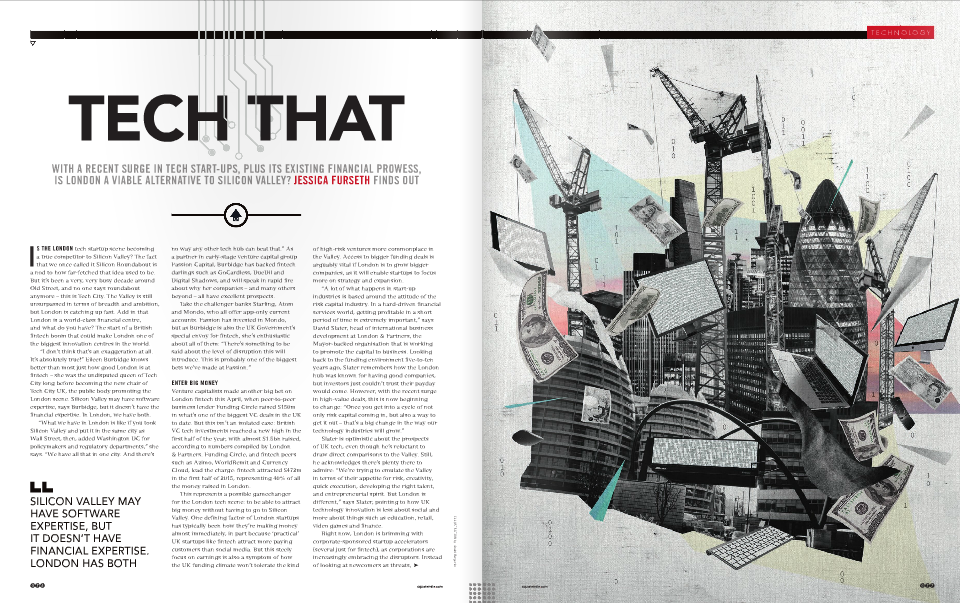
FINTECH CITY
The hottest thing in the tech startup scene right now is finance. Because no one is better at fintech than London – not even Silicon Valley.

Is the London tech startup scene becoming a true competitor to Silicon Valley? The fact that we once called it Silicon Roundabout is a nod to how far-fetched that idea used to be. But it’s been a very, very busy decade around Old Street, and no one says roundabout anymore – this is Tech City. The Valley is still unsurpassed in terms of breadth and whitehot ambition, but London is catching up fast. Add that to the fact that London is a world class financial centre, and what do you have? The start of a British fintech boom that could make London one of the biggest innovation centres in the world.

“I don’t think that’s an exaggeration at all. It’s absolutely true!” Eileen Burbidge knows better than most just how good London is at fintech – she was the undisputed queen of Tech City long before becoming the new chair of Tech City UK, the public body promoting the London scene. Silicon Valley may have software expertise, says Burbidge, but it doesn’t have the financial expertise. In London, we have both: “What we have in London, is if you took Silicon Valley and put it in the same city as Wall Street. Then, add Washington DC for policymakers and regulatory departments. In London, we have that all in one city. And there’s no way any other tech hub can beat that.”

As a partner in early-stage venture capital group Passion Capital, Burbidge has backed fintech darlings such as GoCardless, DueDil, and Digital Shadows, and will speak in rapid fire about why her companies – and others beyond – have excellent prospects. Take the challenger banks Starling, Atom and Mondo, offering app-only current accounts. Passion has invested in Mondo, but as Burbidge is also the UK Government’s special envoy for fintech, she’s enthusiastic about them all: “There’s something to be said about the level of disruption this will introduce. … This is probably one of the biggest bets we’ve made at Passion.”

Screen Shot 2015-10-13 at 13.05.57Enter big money
Venture capitalists made another big bet on London fintech this April, when peer-to-peer business lender Funding Circle raised $150 million in what’s one of the biggest VC deals in the UK to date. But this isn’t an isolated case: British VC tech investments reached a new high in the first half of the year, with almost $1.5 billion raised, according to numbers compiled by London & Partners. Funding Circle, and fintech peers such as Azimo, WorldRemit and Currency Cloud, lead the charge: fintech attracted $472 million in the first half of 2015, representing 40% of all the money raised in London.

This represents a possible gamechanger for the London tech scene: to be able to attract big money without having to go to Silicon Valley. One defining factor of London startups has typically been how they’re making money almost immediately, in part because “practical” UK startups like fintech attracts more paying customers than social media. But this steely focus on earnings is also a symptom of how the UK funding climate won’t tolerate the kind of high-risk ventures more commonplace in the Valley. Access to bigger funding deals is arguably vital if London is to grow bigger companies, as it will enable startups to focus more on strategy and expansion.

“A lot of what happens in start-up industries is based around the attitude of the risk capital industry. In a hard-driven financial services world, getting profitable in a short period of time is extremely important,” says David Slater, head of international business development at London & Partners, the Mayor-backed organisation working to promote the capital to business. Looking back to the funding environment five-ten years ago, Slater remembers how the London hub was known for having good companies, but investors just couldn’t trust their payday would come. With the recent surge in high-value deals, this is now starting to change: “Once you get into a cycle of not only risk capital coming in, but also there’s a way to get it out – that’s a big step change in the way our technology industries will grow.”

Slater is optimistic about the prospects of UK tech, even though he’s reluctant to draw direct comparisons to the Valley. Still, he acknowledges there’s plenty there to admire: “We’re trying to emulate the Valley in terms of their appetite for risk, creativity, quick execution, developing the right talent, and entrepreneurial spirit. But London is different,” says Slater, pointing to how UK technology innovation is less about social and more about things like education, retail, video games, and finance.

Right now, London is brimming with corporate-sponsored startup accelerators (several just for fintech), as corporations are increasingly embracing the disruptors. Instead of looking at newcomers as threats, incumbents are supporting them with cash and mentoring, keen to tap into fresh ideas. This is one of the reasons why Slater thinks London is the perfect test bed for tech innovation: “We have all sorts of well-established industry there. It’s ready, and even accepting of the fact they’re going to be disrupted.”

The deep finance bench
The fact that the government values fresh thinking in the financial sector is a vital factor behind the fintech boom. Gemma Godfrey, who’s currently setting up fintech venture Moo.la after previously heading up investment strategy at Brooks Macdonald, highlights how recent regulatory advances have driven change. “We have a very supportive regulator. We have new pension freedoms, and the Retail Distribution Review has provided transparency over the way people pay fees,” says Godfrey. She points to how the rise of the “DIY investor” has paved the way for online-only companies like Nutmeg to offer wealth management and pensions.

Still, there can be significant barriers to overcome for startups moving into a traditionally-minded area like finance. “If you’re trying to do something new it’s only natural you’re going come across hurdles. If it hasn’t been done before, you need to create it,” says Godfrey, adding how new financing models are currently co-existing with the old ones, but they need to be better integrated. The first steps in that direction came last year, when Santander partnered with Funding Circle to become the first bank to establish a referral system to an alternative lender. Along with the rise of new technologies, these kinds of collaborations makes Godfrey optimistic about London’s prospects for becoming the global leader in fintech. She’s less sure if we can expect to compete with the Valley in a more general sense: “But for fintech, and certain subsets of technology? Absolutely we can! It’s really exciting.”

Increasing support from the established financial sector has been key to the rise of London fintech startups. But there’s only so much you can do to force a tech hub to happen, says Eileen Burbidge – the change has to be broad and cultural. “Silicon Valley became the strength that it is, not because it had envoys and investment programmes. It produced companies like Google, Facebook, eBay, Yahoo and Apple because the overall environment supported it.”

Burbidge points to how London has over 300 of the world’s largest banks, and the UK has over 100,000 financial services knowledge workers. While there’s no shortage of 20-something CEOs in the fintech crowd, there’s just as many graying hairs – plenty of fintech founders come from traditional finance backgrounds. Burbidge attributes this in part to the effects of the financial crisis: “After 2008, a lot of people decided they wanted to set up for themselves, because they no longer had the safety net. They could take the risk to be more entrepreneurial.” The rise of corporate-backed tech incubators is also a reflection of how the world of finance changed after the recession: “Institutions that got crippled by the crisis realised they had to innovate, and become more agile and efficient in how they operate.”

Taking a global mindset
This is the natural time for the London startup community to step up to the next level, says Mark Pearson, co-founder of Fuel Ventures: “We’ve had everything evolve: funding, early-stage investors, mind-set.” Pearson launched Fuel Ventures following a crowdfunding campaign earlier this year, after selling his previous company, MyVoucherCodes, in a deal worth up to £55 million. One of Pearson’s goals with Fuel Ventures, an early-stage technology investment fund and incubator, is to nurture companies to compete on a global scale:

“You see a lot of companies coming out of the US with big ideas, with lots of funding on day one, before they’ve even proved anything. In the UK, we’re a lot more conservative. It’s much more about the numbers, and you have to be revenue-generative from day one. This can restrict people with the big visions,” says Pearson. The British model may result in fewer failures, but Pearson thinks we need to crank up our ambitions: “I’m all for revenue and profits, but if you wait too long and [spend too long] scaling, you lose the race globally.”

Thanks to technology and the internet it’s never been easier to take a global view, but Pearson is quick to point out how London has a few challenges to overcome if we are to catch up with the Valley. One is the sheer size of the US market: 300 million people with the same language, currency and culture. The UK only has a fraction of that. “Then to scale in Europe, we need to have multiple languages, currencies, regulations – that’s a challenge.” Having said that, Pearson sees no reason London tech companies can’t take on this task, as people are starting to think bigger: “Historically, UK entrepreneurs have been criticised for selling out to early. … It pains me that we don’t have a Google, Apple, Microsoft or Amazon from the UK. But let’s add some zeroes and some scale, and we’ll get there.”

Screen Shot 2015-10-13 at 13.04.45

The app that’s making restaurant payments a piece of Cake

FusionWire, 2015.

Screen Shot 2015-10-22 at 12.49.08The app that’s making restaurant payments a piece of Cake

There’s plenty of competition among mobile payments apps, but Michelle Songy thinks the hospitality sector needs a unique approach. We spoke to the co-founder of London startup Cake, which has a brand new recipe for paying restaurant bills.

It’s too early for the lunch rush at Comptoir Libanais yet, but when this place is busy there’s a queue out the door and down Berwick Street. And did you know the average bill in a UK restaurant takes 12 minutes to arrive? Michelle Songy, my companion for a mid-morning brew, is quick to point out that if you eliminate that wait in a place like this, which has over 20 tables, that’s hours saved: “Here, they served 500 more tables last month than they did before using the app.”

Songy is talking about the mobile payment app she co-founded, Cake, which I’ve just downloaded so we can share a tab for our rose-mint teas. There’s a lot of interesting things about Cake: it’s aimed at the hospitality industry, enabling diners to pay their bills directly from their phones. Cake links to the restaurant’s point-of-sale system, meaning there’s no need to wait. Where it gets even more intriguing is how the app makes it easy for groups to split the bill. Using Cake means no one will be left paying for someone who’s short on change, or having to compensate for that person who went home early but didn’t leave enough to cover gratuity.

Songy opens the Cake app on her phone. Now that I’ve signed up (one minute, including adding a bank card) she can add me to her tab. Once we’re ready to pay we can each choose what we had from our bill, add the tip percentage, and then the app triggers the card payment. I deliberately waited to sign up until I was in the restaurant, wanting to see if it would still be easy with patchy mobile data coverage, loud music and potentially impatient waiters, and I have to admit: the Cake app is pretty slick, and the Cake business is well thought out.

That last part is vital, because there’s not exactly a shortage on competition in the mobile payment space. Songy will admit this, sure, but when it comes to hospitality, Cake is in a niche: “When my co-founder Charlotte [Kohlmann] and I were talking through ideas for startups, we saw a gap in the market for payment in hospitality – the scene was growing so much then, and still is,” says Songy. This was back in 2013, before the pair started Spleat, the predecessor to Cake, early the next year. “We’d seen the likes of Uber, and apps for booking planes and hotels, so we thought – why not speed up the time it takes to pay a bill, and make it a much simpler process?”

Right now, Cake is rapidly adding users, with the numbers growing 20% week-on-week. There’s only 30-something restaurants using the app yet, but the company’s in line to have 100 up and running by the end of the year. In July, Cake raised more than £1.1 million on CrowdCube, overshooting their £800,000 target. “I think crowdfundng can be really good for B2C businesses, at least if they’re not too new,” says Songy, who’s also raised money from traditional investors. “It can make people feel they’re part of a company they like.” The big push now is sales and development: “[The money is] going into raising London to the next level. That means getting more developers, and more salespeople to sign up as many bars and clubs and restaurants as we can. We’re also looking into doing a few more pilots in other countries, for future expansion.” So the order is the UK first, then Europe, and then the US.

It’s a lot of work, getting the first restaurants 50 onboard, but Songy is confident it’s going to get easier. For one, it’s clear that people in hospitality talk to each other, so you get little clusters of places using the app – the discovery feature shows several close to where we’re sitting: “We’ve had to sell the restaurants on this, first and foremost. We have to show them how it works, that it’s efficient, that it saves them time and hassle. We need to show how people will be spending more money, how you can serve more people.”

One major element still to be added to the app is table reservations, as well as a loyalty feature: “That’s probably the biggest platform we’re building for the restaurants: that they can look at their data. … They can be learning more about their customer [demographics], and spending down to an itemised level. That’s important to us: working with the restaurants and figuring out what they can get out of it.” Having said that, app users can rest assured that not every sandwich shop in town will be given your email address. Cake is still looking at the legal issues around data sharing, but the idea is to create a bespoke marketing service.

Listening to Songy, it becomes clear there’s a lot to think about when building a hospitality app. This is a sector that’s seen less technology innovation, relatively speaking, partially because it’s very fragmented: “Half of these places are independents,” says Songy, indicating the restaurants up and down the street, “So you have to go into each of them, sign them up, teach them how it works. All the systems are different so you have to integrate each one. … I don’t think a bank’s going to go do that.” She says that last bit after I’ve asked why a bank or payment card provider hasn’t done this already. There are some straight-up payment apps out there, like the Barclays Pingit app, which you may or may not know can be used by non-Barclays customers too. “But Cake is at festivals and events. We do ground-up marketing,” says Songy, who’s not at all troubled by point-of-sale payment tech like Apple Pay: “We’re going to use that in our app. We’re not competing with them. If anything, it helps us.”

The biggest competitor to Cake may instead be companies like MyCheck and Flyway, which make bespoke white label apps for restaurants. “It’s a bit of a trend in the industry to have an app,” says Songy, adding it also has to do with data ownership. “But I think many people don’t understand the maintenance and cost to continually market and upgrade an app.” But, I ask, are people really going to want to have 50 different restaurant apps on their phones? Surely only Starbucks can get away with something like that? Songy laughs: “You should go tell them that!”

There are other benefits for restaurants getting behind a single app too. Using Cake actually means paying less for card processing: “We have really good rates, because we’re taking in the volumes from a lot of the restaurants together.” Then there’s the fact that the Cake team is highly focused on customer service: “I think part of the reason people choose us is because we have an amazing team. If something breaks down they call us” – as opposed to users having to troubleshoot first with the bank, then the payment terminal manufacturer, and then the phone connection. After all, Songy and her co-founder are both from the American South, an area known for good service: “We grew up with the best hospitality. You’d never be looking around for the waiter, waiting for the bill. You’re very taken care of! … We’re trying to make it less a payment app, and more an easy new way of doing things.”

Tapped in: The cashless tipping point is here

FusionWire, 2015.

Screen Shot 2015-10-22 at 12.37.04Tapped in: The cashless tipping point is here

For the first time, there’s a way to pay even easier than cash. We spoke to MasterCard and the UK Cards Association about how contactless is quickly becoming our favourite way to pay.

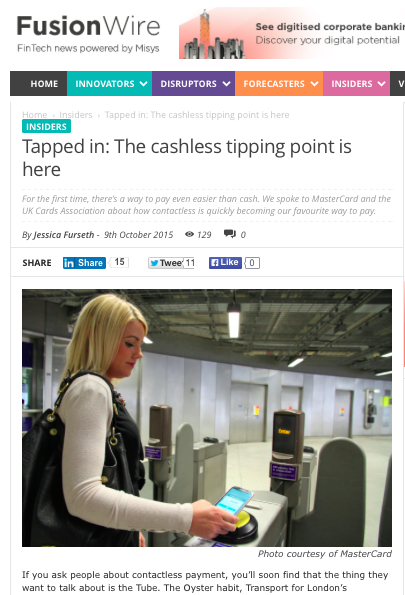
If you ask people about contactless payment, you’ll soon find that the thing they want to talk about is the Tube. The Oyster habit, Transport for London’s smartcard ticket that lets you tap in and out, has ensured a smooth transition to using our bank cards or mobile handsets in the same manner. Because getting people to change their behaviour isn’t just about making new technologies available to them – they have to want to use them.

“Contactless payments has been a slow burn for quite a few years in the UK, but in the last few years it’s really started to take off,” says Mike Cowen, European Head of Emerging Payments Products at MasterCard. The surge in contactless payments is far greater than can be explained just by more shops getting the kit to accept it, explains Cowen. This suggests the shift has just as much to do with culture: “We see a lot of people do their first contactless payment with Transport for London. It fits with the behaviours we’ve observed previously: there’s a barrier to overcome to do the first tap. But once they’ve done three or four, they tend to stick with it.”

Because if you’ve tapped in and out of the Tube, why not just tap to pay for a coffee on the way out of the station? It’s taken people a little while to realise how that little wave symbol on their card means they don’t have to use a PIN for small purchases, but there’s been a lot of noise around contactless lately. The arrival of Apple Pay has been particularly helpful, as people are now aware it’s possible to use a mobile handset to pay as well. “These things take on momentum,” says Cowen, explaining how you’ll always have the early adopters who jump in first. “But then you have a big chunk of the population, particularly around payment, who’re cautious around trying something new. But then they see other people doing it and that there’s no problem, and that builds their confidence.”

A method even easier than cash
By 2020, all end-of-sale payment terminals across the EU will be contactless-enabled, MasterCard has declared. This means we’re approaching an age when we may be able to say, for the first time, that there’s a payment method more convenient than cash: one single tap, and no need to make change or to get to an ATM. In the UK, we’re already taking to contactless with gusto: in the first half of the year, £2.5 billion was spent contactlessly – that’s more than we spent the whole of the year before, according to the UK Cards Association.

“The numbers reflect a growing awareness of the technology, and what it has to offer in terms of a really slick consumer experience,” says David Baker, head of the payment innovations unit at the UK Cards Association, the card payments industry trade body. “Contactless wins on speed and convenience, compared to other payment mechanics available at the point of sale.”

In September, the limit on contactless payments rose to £30 in the UK, meaning the spending volumes are likely to increase even more. Baker says the staggered increase in the limit has to do with caution as the industry learns: how the new technology works, and how it’s accepted by the consumer. Other countries, like the US and Australia, already allow higher contactless spending, suggesting we might see the UK limit rise again. Risk control has been another factor in the rollout of contactless, but so far, the system has proven reasonably robust, says Mike Cowen at MasterCard, pointing out that fraud on contactless is one of the lowest of any kinds of payment: “We’re always concerned about fraud, but at the moment, the industry is doing a pretty good job at managing it. That applies in particular to contactless.”

Towards the cashless society
While financial organisations have an economic incentive for driving more payments through electronic channels, there are arguably good reasons why this shift could be a positive factor for society at large. The cost of cash ranges from 0.5% to 1.5% percent of GDP, depending on the country, according to research from MasterCard. Cash-intensive economies are less productive per capita, MasterCard concluded in a 2012 paper, which found a correlation between countries with high cash use and problems like fraud and bribery, not to mention how people often favour cash when they don’t trust their governments.

But even in the UK, where most people use electronic payments, we’re still very fond of notes and coins. 48% of UK money transactions were cash-based last year, according to the Payments Council. (The organisation is now part of Payments UK.) This is the first time electronic payments via cards or transfers have overtaken cash in the UK. The Payments Council said it expects cash volumes to fall by 30% over the next 10 years, as increasing use of contactless and mobile payments are driving the trend.

“Cash has been around for thousands of years, and it’s ingrained in our society,” says David Baker at the UK Cards Association. “Just like the cheque is difficult to get rid of, cash will take a long, long time to disappear. Those over 50 are probably more wedded to cash, but my kids – the millennials – they’re not that bothered by cash, and make payments to their mobile phones quite naturally nowadays. But it’s going to be a generation or two, before we ever reach that truly cashless society.”

Innovations in cashless technology
Only 4.4% of people in the UK go so far to rarely use any cash at all, according to the Payments Council. One reason for this is probably because there are still lots of places that remain cash-only: small shops, certain pubs, car boot sales, the dog walker. The cost of implementing cashless technology can be a significant barrier: “Back when we implemented chip and PIN, there was an enormous cost of upgrading points-of-sale to accept chipped cards,” says Baker. But the move towards contactless has been a lot simpler: “With contactless, only a few years later, the technology was already there: essentially all you had to change was the reader.”

Spending a day without cash is becoming easier now that small retailers are increasingly accepting cards – in the past they’ve often held out due to cost. “There’s been a lot of innovation around that in recent years,” says Mike Cowen at MasterCard. mPOS (mobile point-of-sale) devices have become popular with small businesses; these are typically small, low cost payment terminals which don’t have communication capabilities built into the device itself, but instead connect to a mobile phone. “They tend to be inexpensive, and packaged in such a way that the point of entry is very affordable for small businesses,” says Cowen, explaining how the the cost of accepting card payments depends on the agreement between the retailer and their bank. “Extending the reach of card payment is probably the most critical thing for moving towards a cashless society.”

Both Cowen and Baker consider the rising number of choices when it comes to payment methods to be a good thing, as it increases awareness and boosts competition. “Payments is not a one-size-fits-all world. People have different preferences,” says Cowen. Baker is in shares this sentiment, but believes we’ll eventually see some consolidation: “We’ll probably start to see some of the mobile phone apps converge. As consumers, you don’t want eight different payment mechanics on your device. That’s confusing for you, and for the retailer. … But you need innovation to spark off interest, and get things moving.”

All change: How digital is changing the High Street bank branch

FusionWire, 2015.

Screen Shot 2015-10-22 at 12.36.57All change: How digital is changing the High Street bank branch

Digital banking probably won’t kill off physical bank branches – but the role of branches is certainly changing. We spoke with Nationwide and Handelsbanken about the future of the High Street branch.

Handelsbanken branches aren’t like the other UK High Street bank branches. This is immediately clear as I arrive to visit the bank’s Holborn location: 77 Kingsway has no exterior sign revealing what’s inside. Reassured by the receptionist, I sign the visitors’ log and make my way to the first floor, where branch manager Toni Virtanen comes to the door, alerted by the doorbell. Most customers make appointments before visiting the branch, Virtanen confirms, but they do get some walk-ins, and he’s always happy to show people around.

This branch, covering the area around London’s Holborn, is in a classic office building, but around the country you’ll get all sorts – some branches are even in Victorian houses. The otherness of Handelsbanken’s take on branches continues inside: there are no cashiers here, nor any queues; instead the Holborn branch is fully open-plan with bankers to the left, and a welcoming Scandinavian-style kitchen to the right. This is one of several nods to the Swedish mothership – Handelsbanken is a proud Swedish institution from 1871 – although the UK operations are run as a fully British bank.

If you’re not familiar with Handelsbanken, it’s possibly because they don’t advertise. But those who’ve heard of them will often know they’re lauded as one of the few UK retail banks currently opening branches, as opposed to closing them. Handelsbanken now has about 200 branches in the UK, after three years of having opened about 20 every year. Because as far as Handelsbanken is concerned, reports of the death of the physical bank branch have been greatly exaggerated:

“The industry seems to believe that customers either want digital, or they want physical banking. That, in my experience, isn’t the case at all,” says Virtanen. “People will want the convenience of a good digital offering, but that doesn’t mean customers don’t want to be able to speak to somebody who can make a decision.” In other words, the Handelsbanken app is for when you want to do things like make transfers, but if you lose your card, need a mortgage, get married, or someone has died, you have the branch: “That’s when you want to have a bank that knows you and that you can have a conversation with, as opposed to ending up in a call centre somewhere,” says Virtanen. “I don’t think the digital channel in any way takes away from the type of physical offering we have.”

Back to personal banking
The idea behind the Handelsbanken approach is that the bank branch is far from dying – but its function is changing. The fact that Handelsbanken doesn’t handle cash (they have arrangements with other banks for your occasional piggy bank pay-in needs) is a big hint: these branches are meant to be places for meeting bankers to talk about financial decisions. “Our branches tend to have experienced bankers with the ability to give advice if you want a mortgage, or if you’ve inherited some money and want to have a conversation about what to do with it,” says Virtanen. “The day-to-day payments, that’s very well taken care of by the digital channel. But when making the biggest financial decisions, people tend to want to have a conversation.”

Handelsbanken has carved out a niche for itself in the UK by offering something of a return to the old-school personal banking relationship. Each branch of Handelsbanken operates under the so-called Church Spire principle, meaning its manager has the autonomy to make lending decisions and set pricing, within a set framework. “We believe the manager closest to the customer is the one who best understands the risk. I don’t think somebody sitting in an ivory tower will understand my customer better than I do,” says Virtanen, who tries to meet and speak with all the branch’s customers personally.

“Part of what I love about our small patch is that I can walk across it in about half an hour,” says Virtanen. He points to the map on the wall, outlining the branch’s coverage area: east to west from Charing Cross Road to Farringdon Road, and then north to south from Euston Road to the Embankment. “We had a visitor from Sweden a few months ago. Normally when we have visitors we walk the patch, to show them the area we cover from the top of our Church Spire. That day we bumped into four customers on the way!” Because we might be in the middle of London, but for Handelsbanken, this is still genuinely local banking.

Nationwide’s digital branches
For Nationwide, knowing the face of each customer may be a stretch; as the second-largest provider of mortgages and savings products, the Building Society has a relationship with one in four adults in the UK. But the changing role of the bank branch is very much a hot topic, as Nationwide recently announced plans to invest £500 million into its 700-strong branch network over the next five years. This will mean better customer access through new locations and opening hours, more welcoming branch layout, plus new technology tools:

“We’ve looked at the services we traditionally provide and at how that’s evolving. Clearly, customers’ own technology is increasingly doing the heavy lifting of traditional transactions that were previously processed by people. Talking to both colleagues and customers, [we’ve found there’s] quite clearly a growing need for what we’re calling help, guidance and advice,” says Barnaby Davis, Divisional Director of Group Retail Strategy at Nationwide.

Branch transactions across all banks fell by 6% last year, according to the British Bankers’ Association, as the availability of digital tools mean people don’t walk into their High Street banks to make payments quite as often as they used to anymore. But what people very much still do, says Davis, is drop into branches and ask to speak to advisors about things like mortgages and investments. Often, though, advisors are busy and people are asked to make an appointment or come back later – this is the kind of thing Nationwide wants to fix in its new “help, guidance and advice” approach to branches:

“We’ve been investing heavily in video technology. We’re the first financial organisation to do this at scale, and we’ve just gone live at our 250th site,” says Davis. This means the customer who walks in without an appointment is increasingly likely to be able to speak to an advisor right away, via the high definition video link. The goal is to connect all the branches, so a customer in Barnstaple may speak to an available advisor in Brighton: “You’re fulfilling a need the customer has, which is to talk to somebody instantly.” Asked if this video connection could be made from home too, Davis says this is something they’re looking into, but the branches have better technology: “We want to make sure we create the highest quality experience. … If you’re providing high-quality and ease, the customer very quickly puts the fact that it’s video behind them and relaxes into the dialogue.”

The human element
Nationwide is also working on creating a more informal atmosphere for its in-person branch interactions: “Customers don’t always want to be in the office. They might find it claustrophobic, almost too private. They’re happy to have many of their discussions in a more casual way, on a settee or over a lunch table. It turns into a nice informality, from something that’s previously been very formal. We’re seeing a huge customer reaction to that.”

Because there’s a human element to banking that’s being ignored in the so-called death-of-the-branch dialogue, says Davis: “Nobody talks about the social and ritualistic side of banking. A lot of people equate borrowing money with seeing somebody face-to-face, for reassurance.” Davis cites himself as an example of this: he’s a prolific user of digital banking, but he also has a financial advisor and uses branch services. “Even the tech-savvy digital native often looks for face-to-face advice over important financial matters, and reassurance particularly around affordability and borrowing money.”

The conversation around the future of branches is often pegged as a competition between physical and digital space. But if Handelsbanken and Nationwide are to be believed, the future of the two are intrinsically linked, as each side compliments the other to provide a full service. Davis’ job description as Divisional Director of Group Retail Strategy is a nod to this fact: he’s charged with branch design and branch technology, as well as digital and mobile banking. This is a deliberate mo ve by Nationwide: “The development and transformation of the branch and digital go hand-in-hand. If you separate those [jobs] in two different people, you’re instantly going to get a disconnect,” asserts Davis. “By orchestrating the strategy, and having the ability to improve the development of both branch and digital, we can develop [both] services much more coherently.”

Anne Boden takes flight with Starling Bank

FusionWire, 2015.

Screen Shot 2015-10-22 at 12.36.43Anne Boden takes flight with Starling Bank

At the heart of the new mobile-only Starling Bank is Anne Boden, whose experience and conviction may just be the thing to create a brand new current account.

Anne Boden isn’t starting a bank – she’s starting a revolution. At least that’s how she’ll make you feel after spending an hour in her company, discussing the next-generation Starling Bank in her animated and energetic manner. This is a mobile-only bank, but there’s a lot more to it than that, and Boden will tell you all about it. Or more precisely, the CEO will ask you questions about your bank experience to make you realise that you’re not happy with it, not one bit – you just haven’t been able to articulate it before, because you didn’t realise it could be any other way.

We’re sitting in Starling’s offices, currently found in the duller parts of Clerkenwell behind a door with no sign. The bank is still in startup mode, says Boden, who started Starling in January 2014. They won’t provide details about funding, but right now they’re building their stack and getting a banking licence, with the launch set for next year. But before we get to that, I have to ask – why is Boden doing this? She’s had almost 30 years’ experience in banking, working herself up the ladder in a number of household names before becoming Chief Operating Officer at Allied Irish Bank. Life must have been pretty comfortable?

Boden looks at me for a moment before bursting into laughter, thrilled. “You’re the first to actually ask this!” She thinks for a bit. “Somebody said to me, ‘You’re trying to prove that the current model is broken and it’s possible to do something really different.’ A lot of people have this concept, but I have the execution capability,” asserts Boden. To put this in context she takes me back to the beginning, to after she’d graduated from computer science and chemistry at Swansea and joined Lloyd’s Bank in the early 1980s. “I was in a branch for a couple of months, doing my traineeship. Then I became one of the architects of the CHAPS system. I went to Standard Chartered and was Head of IT and Operations. I became a consultant, I did an MBA, I went front-of-office. I joined UBS and went to Zürich. I went into a big insurance company and started doing lots of work with boards. I went to work for ABN Amro Bank as head of transaction banking for EMEA, and joined RBS [when it] bought ABN Amro. Then the financial crisis happened.”

The reason Boden is telling me all this is partially to illustrate how she has a lot of experience in an industry that’s rich with rules and tradition. But the world changed after the financial crisis, and Boden realised this when she would go and give advice to RBS clients: “I was in a big corporation, running thousands of people and billions in budgets, but [here were these] start-ups, creating huge amounts of customer value for hundreds of thousands. This shocked me! I realised I was learning more from them than they were learning from me.”

New ways of thinking about banking
Boden spent a year talking to people all around the world about what they were doing post-crisis, and what was happening in technology. She joined Allied Irish Bank after their bailout and successfully applied several of the things she’d learned there. “But there were things I couldn’t do. I spent my summer holiday in 2013 going around the world, talking to big banks. And I came to the conclusion that everybody had the same problem: they were moving transactions from branches onto mobiles, but the technology wasn’t coping with how people were using it.” So once Christmas rolled around, Boden had made a decision: the only way to really fix things was to start from scratch. There were three factors making this possible, she says: the regulation for getting a banking licence had changed; people were ready to do much more banking on their phones; and the technology was there to enable it.

But, I ask, did she do this because she wanted to, or did she feel there was genuinely no other way? “All of a sudden, it was as if all these forces were coming together. There was nothing else I could do. I could see the problems big banks had, I could see that technology was enabling it, that the regulations had changed. And I could do it!” She laughs. Other people had the idea too, she adds, but it’s not a simple thing to do: “You have to be able to run a bank, to start a bank. You also need to be creative and have courage. So I thought to myself, ‘I want to do this’.”

Back in the present day, Starling Bank has finished its architecture, its big picture plans, and is working on the “detailed discussions” about functionality. The app exists, confirms Boden, but she hesitates when I ask if I can see it: “We haven’t really shown anybody our app!” She looks at me for a moment, before deciding to show me a little bit. She opens the app on her phone, talking me through the quick sign-up process. She lists a number of things the app can do, many of which are intriguing – but it’s still kept under wraps so let’s just say the app will have lots of links to other parts of your life, to help you plan and organise.

“You shouldn’t be asking people what they want from their banks, because it doesn’t get the right answers. So instead you ask, ‘Would you mind talking about the accounts you have and how you use them?’ […] People are trying to find ways around the system,” says Boden, explaining how people will do things like move cash around to avoid getting stung with fees. “What we’re trying to do, is solve people’s everyday problems with money.” Take how we’re used to being charged when direct debits bounce: “But Google doesn’t charge you when they reject spam. It’s a transaction, so why should you be charged?” She looks at me, clearly knowing what I’m thinking: that this comparison makes sense, yet it’s not at all how we’re used to thinking about banking.

The start-from-scratch advantage
While it’s clear that Starling wants to make technology work for people, rather than the other way around, I still can’t help but wonder: why can’t the existing banks do this? “Okay. You have all these things available in the rest of your life, so why don’t they exist in banks?” The problem, says Boden, is that standard banks are serving multiple customer groups, selling not just current accounts but also savings, loans and mortgages. All these systems are interconnected, and they’ve been consolidated over many years.” So the typical bank will have, say, 30-40,000 different systems,” says Boden, adding how one major bank has 60 systems just for payments.

Replacing all these systems is vastly expensive and time-consuming, explains Boden, with very few banks having taken the plunge. Because the risk is significant: “People expect a banking system to work 24/7, so there’s no tolerance for it not working.” Then there’s the fact that it’s taken half a dozen years for the few banks who’ve dared the transition. “So instead of replacing the system, they keep adding. And it gets worse and worse and worse.”

It’s certainly not impossible for a major bank to solve its technology problem, says Boden: “But it’s much easier to start fresh.” Having no customers to convert is the best as well as the worst thing about that, but Boden doesn’t seem too fazed by the looming task of having to convince people to change their current accounts: “We’re focusing on people who live their lives on their mobile and are focused on getting the best technology in all walks of life.” There’ll be a phone help line, plus an arrangement for that one time a year when you need to pay in a cheque, but Starling isn’t chasing people who want to spend a lot of time in branches. Not to mention that most people don’t go into branches to deal with their current account, says Boden – they do so to deal with other banking products like loans or mortgages. Starling won’t do any of that, partially because Boden doesn’t really think the cross-selling model is viable anymore: “We believe the majority of people are quite self-directed now. In the old model, you sold a current account and then you tried to sell lots of other products. But we think people are a little more sophisticated now, making up their own minds.”

That also means Starling has no need to own its customer data: “We believe the customer’s data is their own, and shouldn’t be used to cross-sell other products.” Bank data and how it should be used is a big topic right now: “But shouldn’t it be all about helping you manage your financial affairs?” This is an interesting point of view, especially as Starling’s app will let people link their bank account to lots of other personal information across the internet. “We’re working on how people can have the convenience of that linkage, but with the security of being a bank.”

Making Starling feel genuinely different is a key motivating force for Boden, who finds there’s no real difference between the existing High Street banks: “But if there was something really inspiring that was different, it would apply to a certain segment of the population. If you can focus on what people really want – that’s the difference.” You can see how this model could potentially become popular with people in the street, but what does her old industry colleagues think of her bold new venture? “Oh, what do they think?” Boden pauses for a moment. “I’d spent the last ten years trying to convince everybody that the current model is sustainable. That we could just carry on, go through the crisis and come out the other side and nothing would change. I came to the conclusion that wasn’t possible. People are changed! People are not tolerant of banks anymore. They’re angry.” Technology and regulation have changed too, she adds, so it’s time to change the banks: “You have to be highly relevant to your customers. Otherwise, you cease to exist.”

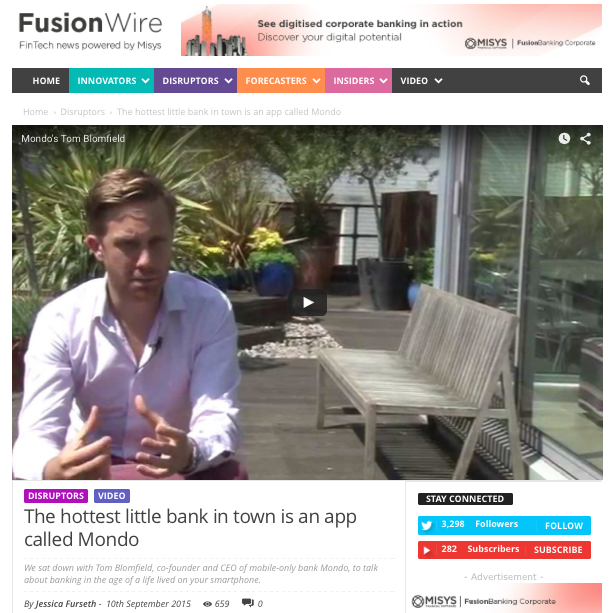
The hottest little bank in town is an app called Mondo

FusionWire, 2015.

Screen Shot 2015-10-22 at 12.36.36

The hottest little bank in town is an app called Mondo

We sat down with Tom Blomfield, co-founder and CEO of mobile-only bank Mondo, to talk about banking in the age of a life lived on your smartphone.

Mobile-only bank Mondo is a young company, even in startup terms: Tom Blomfield and his four co-founders have only been at it since February. Intrigued by a few tweets and blog posts hinting at what’s in the works, I asked Blomfield for an interview, and to my surprise he accepted. Because what can there really be to talk about this soon? Is it even possible to build a bank in five months?

The answer to this question is yes – the app is up and running, and the first Mondo debit cards have been issued. But the answer is also no, as Mondo is very much a work in progress: the app changes daily. “We’ve built a core banking system!” says Blomfield. “We have our own service and infrastructure, and the app runs on top.” This do-it-yourself approach means there’s plenty of freedom in building Mondo: this bank can go in any direction dreamt up by Blomfield and his team of merry coders.

The CEO and I are sitting on the roof of White Bear Yard, Passion Capital’s buzzy co-working space in Clerkenwell. Passion provided the “low millions” seed funding for Mondo in April, although Blomfield reckons it will take a couple of years and £15 million to get Mondo fully up and running. “We’re not even perfecting Mondo, we’re still very much building,” says Blomfield. “One thing we really believe in as a company, is being very transparent and close to our customers. We don’t want to go away and hide for two years before saying: ‘Here’s what we’ve built, does anyone like it?’ Instead we’re really open.”

It makes sense: a mobile-only current account bank for the smartphone generation begs an interactive process. “We’re trying to provide a bank account for the kind of people who live their life on their smartphones, and get angry when stuff takes more than five seconds. Like me, basically!” Blomfield laughs. But it’s right on trend: the people used to Uber rocking up within minutes, and same-day deliveries from Amazon, aren’t going to want to queue in a bank branch.

Blomfield opens the Mondo app on his iPhone. “My balance is 300-odd quid,” he says; for now, the Mondo debit cards have to be pre-loaded with cash. “You can see I bought my breakfast at Pret,” he says, as transactions are updated in real time. Blomfield taps it: there’s Pret on a map, and the tag #breakfast. “Or you can use the tag #expenses and then click ‘export’, immediately generating an expense report, with no work.”

There’s more: if you forget to touch out with your Oyster card, Mondo will invite you complete the journey on TfL’s website and avoid the fine. If your electricity bill is higher than usual, the app will invite you to investigate with a call to customer services. You can cash in your loyalty points right there in the app – the examples go on. “You start with all the basic data: what you spend, where, with which merchant. Then you move on to insights, some sort of learning. But the third step no one has got to, is action. Because we’re building a full bank, we can actually let people take action. That’s where the internet is really going.”

Blomfield’s enthusiasm for Mondo is infectious. I eye the app jealously: my bank’s app doesn’t do any of this stuff. A mobile-only bank was bound to be fun, with features like adding emoji to transaction fields, but this looks like it could actually be really useful. This bank would be less a walled garden, and more a financial hub with direct ties to the rest of your life. It turns out my reaction is pretty normal to seeing the app: “It’s often: ‘When can I have it!’” Blomfield laughs.

The banking community is starting to be won over too, now that Blomfield has a working app to show them: “Before we had the app, the reaction was very much things like: ‘Current account banking is just a commodity!’ ‘No one will switch accounts, it’s not interesting!’ And then we showed them the app and now the reaction is: ‘Oh s**t.’” Blomfield laughs again. But the reaction demonstrates the radical nature of the Mondo proposition, as a current account has always been a static place. “We’ve put a whole level of intelligence on top of it. And they say: ‘Oh my god. This is what people have been talking about for 15 years.’”

So if this idea has been knocking about for a decade, how come it’s not been done? This is a complicated issue, says Blomfield, whose team of co-founders include alumni from Allied Irish Bank and ABN Amro UK. There’s no shortage of innovation teams at the established financial groups, and they’ll come up with crazier things than Mondo: “But they are structurally unable to deliver it.” One reason is cultural: “[Established banks] don’t have a culture of regularly building and shipping features.” Then there’s the fact that many banks operate with off-the-shelf software, which, argues Blomfield, provides limited abilities for customisation. “Then there’s the old legacy banks out there who have decades of accumulated technical debt. Their systems are like Frankenstein’s Monster! … We’re different because we have a team of engineers sitting downstairs who actually write code, every day.”

Mondo is currently halfway through its banking licence application. The hope is to have a license with restrictions in about six months’ time, and a full launch sometime after that, probably in about a year. “But we have a working system, and we’re going to roll out debit cards to a few thousand people this summer. It will be based on our technology, but in the short term we’ll be partnering with another bank to provide the license.”

If all this sounds ambitious, it’s worth noting this isn’t Blomfield’s first time at the rodeo. The 29-year-old started and sold his first company, Boso, while reading law at Oxford. He then grew his second financial startup, GoCardless, to a company processing $200 million low-cost direct debit transactions annually. So what’s it like, doing this again with the added experience?

“It lets you be more ambitious,” says Blomfield, referring to how he worked with Passion Capital for several years at GoCardless. This meant his bold plans to launch a brand new bank were actually given the time of day: “Instead of saying: ‘Get the hell out!’, they said: ‘Okay, that’s interesting. Tell us more.’ … It feels like a step up in terms of ambition. It feels like this is the big one.”

He has a point: after starting a bank, how can you top that? “I can see myself spending a good proportion of my life on this, if it goes well. But it feels like this has been a long time coming: banking is so fundamentally broken. It hasn’t changed in 30, 40 years.” There are potential problems ahead for Mondo of course, but not the ones “traditional” bankers see: “The technology and licensing are serious undertakings, but they are pretty well known. Making something people really want is the biggest challenge, for any start-up,” says Blomfield. “You only really know by getting [the product] into their hands and seeing their reaction.” And Mondo won’t be for everyone: lots of people like having a branch. But this isn’t for them: “This is a bank for people who live their lives on their phones and hate waiting for anything. And if that means only addressing a third of the population, that’s fine: that a lot of people!”

That could actually end up proving a conservative target market for Mondo, judging from figures from the British Bankers’ Association: mobile banking has eclipsed not just branch-based banking, but also web banking, this year. Having said that, there’s no doubt that Blomfield is fully aware of the blue-sky potential for Mondo: “I think banks have an extinction event on their horizon. I want to be building the kind of company that replaces them!” He laughs again, but you can tell he’s serious. “I love technology. I love the way it can just make everyday life much, much better. … Sometimes it feels like we’re living in science fiction. It’s incredibly exciting.”

Ten top health tech innovations

BusinessLife, September 2015. Original article, p57-60.

Ten top health tech innovations 

BL1

Vital signs monitoring patch
One day, a little sticky patch for monitoring life signs may become standard for anyone who enters a hospital. That’s the hope for SensiumVitals from Toumaz Group, the British semiconductor company, which is currently undergoing clinical trials. “Our product is targeted not at intensive care, but at patients where monitoring is a manual process every 4-6 hours,” says Anthony Sethill, CEO of Toumaz. “We believe there are many clinical situations where continuous monitoring would be more effective clinically, and therefore economically.” For example, up to 30% of patients develop complications after gastrointestinal surgery. Being able to continuously monitor patients would not only mean catching problems quicker, but also that people could go home sooner and have vital signs transmitted remotely. Both these things are likely to increase patient comfort, and save money for the NHS.

Patient-controlled social networks
It’s not quite Facebook, but for people with Crohn’s Disease and other inflammatory bowel conditions, Crohnology.com is a lifesaver. Established in 2011, this network lets users trade information about symptoms and treatments. Crohnology.com is closely monitored by the medical estanlishment as an example of a patient-controlled social network, where people take charge of their own treatments. “This has very quickly become a global community of people sharing information about their conditions. They in turn talk to the clinicians treating them, and that has improved the dialogue globally,” says John Farenden, Director of EY’s ‘Let’s Get Digital’ initiative, which aims to support and accelerate the use of digital technologies in health and social care. “Using basic social media tools, this has made a huge impact on the lives of tens of thousands of people.”

BL2Cancer-detecting garments
Talk about a literal interpretation of wearable technology: Cyrcadia Health has developed a bra that can detect cancer. The garment is embedded with patches that track changing temperatures in the tissue, which can be indicative of tumour growth. Early trials showed a 87% success rate in detecting tumours, including in dense breast tissue where small lumps can go undetected. The idea behind the garment is not to wear it all the time, but to to provide simpler and more comfortable screening methods than some of today’s more invasive procedures.

Home dialysis
It’s the Nespresso of dialysis: Quanta Fluid Solutions is developing a compact, portable dialysis machine that people can use themselves. This could be a significant money-saver for the NHS, as people could have dialysis in the comfort of their home. “A percentage of patients are suited for home-dialysis, once they’ve been trained. We know that would save the NHS about £15,000 a year per patient,” says Martin Hunt, a Director at the NHS’s National Institute for Health Research (NIHR). Hunt heads the NIHR ‘Invention for Innovation’ programme, a translational funding scheme aimed at advancing healthcare technologies. The NIHR, whose funds only go to companies with proof of concept after robust screening, has funded Quanta twice: “Research teams need to take into account not just the medical impact, but also how new devices can provide value for money,” says Hunt. “If you get better patient outcomes, generally speaking, there should be some associated cost saving along the clinical pathway.”

Nanotechnology targeting treatments
Sending microscopic devices into the body to treat illness in a non-invasive manner is a science fiction dream that’s quickly becoming real. Earlier this year, researchers at the University of California successfully delivered treatment projectiles into the stomach of mice, in an effort to explore whether we can do this to treat stomach problems like ulcers or gastritis. A similar principle is behind antibody-drug conjugates, which are already being used to treat patients: a molecule-scale payload of cancer drugs is delivered directly to tumour sites, leaving the surrounding tissue undisturbed.

BL33D-printed body part replacements
Earlier this year, 3D printing technology from Stanmore Implants was used to create a replacement pelvis for a patient who’d lost his to cancer. The new part could be made more precisely with a 3D printer than standard methods. Another UK company using 3D printing to create body parts is Fripp Design and Research: their technology can create soft tissue organs like eyeballs, noses and ears, all based on scans from the patient. “3D printing now allow us to create new body parts, so the technology is actually no longer the problem,” says Farenden. “The challenge now is how we make best use of it and improve the outcome and experience for patients, as well keeping an eye on cost.” In an effort to make the product more commercially viable, Fripp has become the first company to use 3D technology to print directly in medical-grade silicone.

Lab-on-a-Chip
Imagine a USB stick which contains a whole laboratory – this is Christofer Toumazou’s Lab-on-a-Chip. It may sound impossible, but the tiny device provides quick results to medical tests, and can analyse DNA within minutes. Without the need of a laboratory, Lab-on-a-Chip can reveal how large a dose a patient needs of a particular medication, or whether they’re at risk for genetics-based diseases like diabetes or cancer. The technology, now being developed by DNA Electronics, could one day mean doctors looking into our future to treat us, not just our past. “Tying the genome to different risks associated with cancer is likely to become increasingly significant,” says Sethill at Toumaz. (Toumazou is the founder of Toumaz, but the company is not involved Lab-on-a-Chip.) “You could then use the collected data to understand which drugs give the best results, using millions of data points,” says Sethill, who predicts Big Data and analytics will become increasingly relevant in healthcare prevention.

Tissue repair wands
On Star Trek, they called it a medical tricorder: a device that heals skin and bone instantly. Here on earth, Mark Bass at the Department of Biomedical Science at the University of Sheffield has created a small handheld ultrasonic emitter that accelerates tissue repair. It’s not quite sci-fi, but the device can reduce healing times by up to 30%. That means the patient is more comfortable, and there is less chance of infection. The researchers have been able to reverse certain healing defects caused by diabetes, age and congenital disorders, and hope to soon be able to prevent the formation of chronic wounds.

BL4Video games for stroke rehabilitation
Therapy becomes play when necessary yet tedious exercises are made into a game. Looking to help stroke victims regain functionality in their arms and hands, Limbs Alive has created a Wii-style video game. Over 100,000 people in the UK suffer from strokes each year, and up to 80% never fully regain the use of their limbs. Therapeutic video games is a growing area for the NIHR, says Hunt: “We insist on patient involvement throughout the development process. It’s one thing to have a solution using a tablet computer, but for elderly patients with mobility issues, that may not work for them.” Effective video game therapies can mean reducing the cost of treatment, not to mention making a frustrating processing a little more fun, so the patient is less likely to give up.

Wearable pain relief devices
The relief of chronic pain is a big promise, but that’s what Quell does. This device from NeuroMetrix uses non-invasive nerve stimulation to tackle pain, kicking in within 15 minutes of putting on the device. A single charge provides 40 hours of relief, whether it’s back pain or nerve-related aches.. Quell was a hit at 2015’s CES, the consumer electronics tradeshow usually dominated by the newest phones, but there’s increasingly more crossover between mainstream gadgets and health, says Farenden: “Consumer technology businesses are pushing on with technologies to improve health, as we see with things like Apple Watch and Jawbone.” The jury’s out on whether the cost associated with these gadgets are actually translating to better outcomes: “But we will see people increasingly using those technologies to better understand their own health.”

BL cover