Robots in the future and artificial intelligence

Aquila kids’ magazine, January 2015.

ScanThe Singularity

What will robots look like in the future? We probably won’t see robots that look like people walking down the street any time soon, as much fun as that may sound. Robots will probably continue to look quite mechanical, but there’s good chance they will play an increasingly bigger part in daily life. Robots, or robotic devices, are already being used for a lot of things: cleaning floors, driving simple trains, making complex calculations. A computer brain has already won “Jeopardy!”, and smartphone users can ask questions to digital assistant “Siri”, who understands what they are saying.

So maybe the more interesting question is: Will robots ever be smarter than us? The answer to that is that yes, one day they probably will be. Robots don’t have to spend a long time to learn things, and they can remember a lot more than we can too, so machines may soon be able to use their bigger brains to work things out quicker.

The moment when machines become smarter than humans is called the “Singularity”. Scientists expect this to be a major moment in human history, possibly changing everything. There are plenty of films and books that speculate on what this may look like too. Many take a bleak view, where the smarter robots look at us the way we look at dogs: they’re cute, but also a bit stupid. Some scientists fear the robots could take over the world, but most take a more optimistic view: humans will benefit from robotic super-intelligence and do fantastic things. This could even mean copying the human brain and have it live on in a machine, creating some kind of eternal life.

“Everything that civilisation has to offer is a product of human intelligence,” scientist Stephen Hawking recently wrote in “The Independent”. He thinks it’s impossible to predict exactly what we’ll achieve once we create artificial intelligence, but it could mean ending war, disease, and poverty. In any case, it would change the world: “Success in creating artificial intelligence would be the biggest event in human history.”

Whether the Singularity sounds like it would be great, or just scary, chances are it won’t happen for a long time yet. We need to improve computers many times over first, both in terms of hardware and software, to make them run a lot faster and better. Another problem for the scientists working on creating clever robots is that it’s really tricky to teach a machine everything a person knows. Not only do you need to teach the robot millions of facts, but also lots of things we take for granted, such as how to lift our feet to walk. Then the robot has use all this programmed knowledge to come up with brand new ideas, something people do that all the time – but a machine can’t really do things it’s not programmed to do. And if a robot truly going to be smarter than us, it needs to learn about feelings and humour. That may be the hardest thing of all, as a joke is never funny once you’ve had to explain it.

So for now, scientists are working on making robots who can do things that humans either can’t do, or don’t want to do. Going into space is one thing robots could do instead of us, as they don’t need life support. Robots are already making good hospital assistants, distributing trays of food or fresh linens, freeing up the human nurses to do the more complicated things. While robots struggle to understand unpredictable human behaviour, like working on problems by testing out a guess, they are pretty good at working in laboratories and factories. This is because robots are great at doing very specific things over and over again, just the way they’ve been told, which is frankly something that can get a bit boring after a while. Maybe scientists will come up with a household robot to do the dishes and cut the grass soon? This day may not be too far away, as self-driving cars have already become reality: test cars have successfully driven thousands of miles without accident, relying on sensors to move safely in traffic. That’s one clever robot.

“My generation believed the world would be overrun by robots by the year 2014,” James Dyson, the British inventor who founded the Dyson company, told “BBC News”. Dyson is now investing £5 million in a robotics lab at Imperial College in London, hoping to develop robots that can understand more about what’s going on around them. “We now have the mechanical and electronic capabilities, but robots still lack understanding – seeing and thinking in the way we do,” said Dyson. “Mastering this will make our lives easier.” But first, robots need to learn how to deal with change, instead of just doing what they have been told. Until this happens, humans will remain the smarter ones, because being clever isn’t just about knowing things. What’s just as important is knowing how to use your knowledge, and being able to adapt when the world around you changes.

Screen Shot 2015-01-09 at 19.16.07

Body Talk

This Recording, December 2014. Archived link / Original article link.

Screen Shot 2014-12-01 at 12.35.41

In which we live outside of memory
Body talk
I never remember Decembers once they are gone. I walk through the days knowing I’ll forget them, that all the detail will fade, except for the feeling of stretching towards the light as it’s disappearing fast. This happens every year like clockwork, marking the seasons. My body is heavy with sleep and my brain is committing nothing to memory, like each day is a polaroid that gets thrown away.

It’s an odd feeling, being in the middle of a moment I know won’t stick. In the narrative of my life, it’s an anomaly: I’m living outside of my memory. I watched a TED talk once about the conflict between the self that experiences, and the self that remembers; how most of the time we choose things in service of our memories, even though the experiencing self may be having a different opinion in the moment. I’ve been thinking a lot about this lately, especially the question posed at the end: If you were going on a trip, would you choose differently if you knew you’d remember nothing afterwards?

Seasonal Affective Disorder is sometimes called winter depression, but I’m not actually unhappy. I used to be at this time of year, but getting older has fixed a lot. Now, the fog that sets in for the two darkest months is just a physical thing. Sometimes it feels like jetlag, or like having been woken up in the middle of the night. A sunlamp keeps me above water as I do the things I know to help: sleep at night, be awake during the day, go outside, eat properly, exercise. I don’t know what it says about me that I’m surprised: clean living seems to be the solution to almost everything.

People change all the time, I know that, but only if they really want to, or if something big happens. I don’t know which of the two are at work, but somehow the winter fog feels a little different this year. Card-carrying introvert that I am, I’m shocked to discover I’m becoming outgoing, all of a sudden drawn to people, to dinners, drinks, texting, even phone calls. I’ve always needed a lot of time by myself, becoming restless and unsettled if I didn’t get it, and normally, winter tends to bring out the worst elements in me. Still, this year, something is happening. It’s as dark as ever but somehow, change seems possible.

I keep waiting for my solitary nature to assert itself, but this isn’t about my head. Winter was has always been a whole-body experience, and this year it seems the body I live in wants to go out, talk to people, and get another drink on the rocks. Maybe my body is simply taking advantage of this moment outside of memory, realising this is a holiday I won’t remember after it’s over. This is just for the experience. But unless I remember it, is this really happening? A feeling is bubbling up, it’s small but it’s there, and I’m hoping maybe it will be stronger than the waking sleep. Maybe this is a momentary reprieve, or maybe it’s a fundamental change, I don’t know. All I know is that it feels so physical.

Fast Forward London: The Shoreditch tech startup hub

Screen Shot 2014-12-16 at 18.43.18

Source Magazine, autumn 2014. 

Original article. 
tech2

Fast Forward London: The Shoreditch tech startup hub

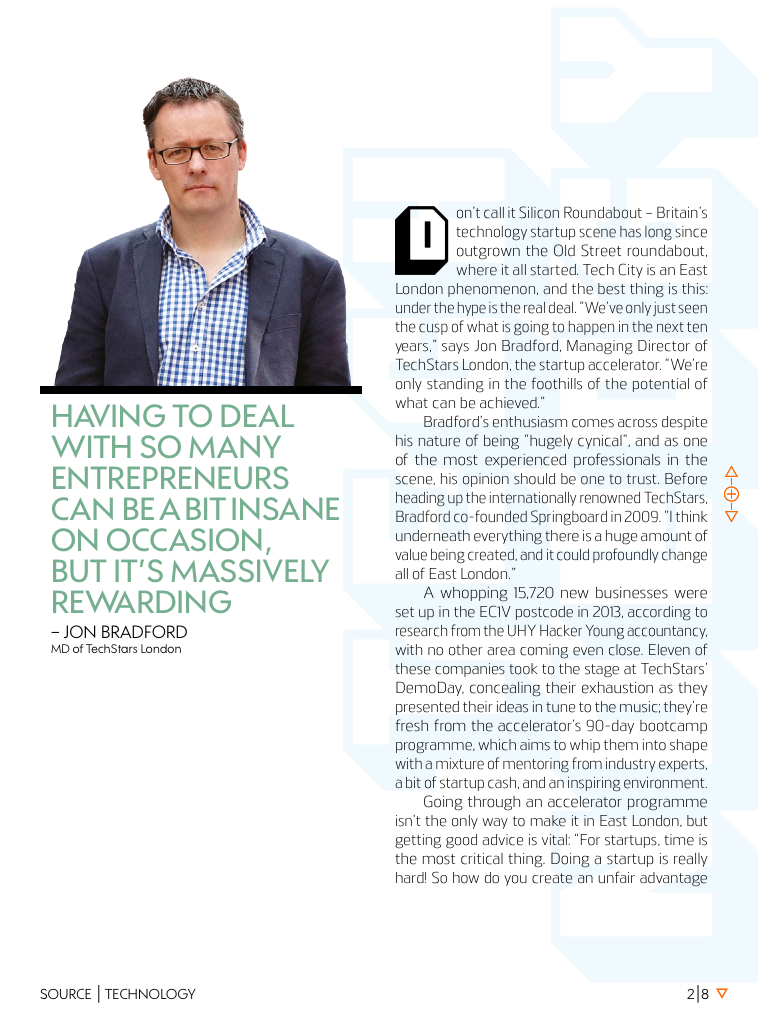
Don’t call it Silicon Roundabout – Britain’s technology startup scene has long since outgrown the Old Street roundabout, where it all started. Tech City is an East London phenomenon, and the best thing is this: under the hype is the real deal. “We’ve only just seen the cusp of what is going to happen in the next ten years,” says Jon Bradford, Managing Director of TechStars London, the startup accelerator. “We’re only standing in the foothills of the potential of what can be achieved.”

Bradford’s enthusiasm comes across despite his nature of being “hugely cynical”, and as one of the most experienced professionals in the scene, his opinion should be one to trust. Before heading up the internationally renowned TechStars, Bradford co-founded Springboard in 2009. “I think underneath everything there is a huge amount of value being created, and it could profoundly change all of East London.”

Because this is a Shoreditch thing: a whopping 15,720 new businesses were set up in the EC1V postcode last year, according to research from the UHY Hacker Young accountancy, with no other area coming even close. Eleven of these companies took to the stage at TechStars’ DemoDay, concealing their exhaustion as they presented their ideas in tune to the music; they’re fresh from the accelerator’s 90-day bootcamp programme, which aims to whip them into shape with a mixture of mentoring from industry experts, a bit of startup cash, and an inspiring environment. First on stage was Bradford, seemingly unencumbered by his crutches as he proudly presented his latest crop. The broken leg is a terribly boring story, he tells me later, involving no punishment such as sports or alcohol: “No, I just fell over!”

Going through an accelerator programme isn’t the only way to make it in East London, but getting good advice is vital: “For startups, time is the most critical thing. Doing a startup is really hard! So how do you create an unfair advantage to yourself?” Access to funding is one factor, says Bradford, but really, it’s all about the network. But is there a formula to building a startup?

“There are frameworks, but … “ Bradford stops himself. “The honest answer is that I don’t know. To do a successful startup is the exception to the rule. You’re constantly in the stage which I call, ‘How do you turn a zombie into a real live person?’” Of course, there are plenty of ways to support a company to increase its chances: “But there’s this latent potential you need to be entrepreneurial. … At such an early stage you’re really placing a bet on the team more than anything else.”

Technically you can start a tech company in any location, says Bradford, but London would probably be better: “I strongly believe you need critical mass in a single location to make a successful [startup] ecosystem. You need the institutional knowledge of people who’ve been and done it before. You need a system that is open enough and transparent enough.”

These factors have traditionally been what gave Silicon Valley such an edge, but as the London tech scene is growing up, this is starting to change: “A startup will ordinarily take seven years to go from start to end,” says Bradford, excitedly pointing out that London’s first seven-year cycle is coming around right now. “This is when life becomes really interesting, because you can encourage those [first founders] to come back and do it again.” Or, those first founders may choose to become investment angels: “There are more entrepreneurs now out there writing angel cheques,” says Bradford, often writing smaller cheques to more people, and sticking around to mentor.

Of course, Bradford refuses name favourites from the 11 teams who have just dazzled the DemoDay audience. He will however give an example of a company that ticks the boxes that indicate success: ShortCut, whose app enables people to buy food and drinks at sports and music venues without needing to queue. Bradford lists the factors: the founders have a track record in related industries, and there’s the right combination of sales and engineering skills. “Not to mention that when you speak to them they are just genuinely awesome. They are smart enough that if their first idea doesn’t work they can pivot – as much as I hate using that word – into other things inside that market.”

Spatch is another startup that tickled the imagination at DemoDay, as the company that wants to revolutionise email by making it an contextualised and intuitive tool for the future. “Spatch is gutsy! Is it a bit insane? Totally!” Bradford laughs. “But Mick [Hagen, co-founder] has any bit as much capacity to do this as anyone I’ve seen.” With such a lofty idea, it helps that they’re not 22 and have been around the block. “A less experienced team needs to do something else to prove they have the capacity to deliver,” says Bradford, pointing to Pubble, which is developing software to build customer inquiry databases: “They’re slightly less experienced, but they already have revenues.”

It’s clear Bradford gets a kick out of what he does, something he readily admits: “My favourite thing about my job is that I get to work with people who are smarter than me!” He laughs. “Having to deal with so many entrepreneurs can be a bit insane on occasion, but it’s massively rewarding.” And what’s the least fun part? “My least favourite thing is dealing with entrepreneurs.” He delivers it deadpan, and then cracks up. “They’re a lot like five year old children! You spend your time telling them what they should be doing, and then they bugger off and do something completely different! Then they come back when it didn’t work, beg forgiveness, and you pat them on the head and send them off again.”

Bradford pauses for a moment. “My motivation in everything I do is to help the wider ecosystem. I do TechStars which supports ten teams every nine months, and I have a bunch of people who come and support me supporting the teams. Even though during the programme, I shake my fist and swear at them a lot!” Because of course, part of the point of a startup is to find unpredictable ways of doing things: “You need people who don’t follow the normal cycle, who go and break the rules.”

***
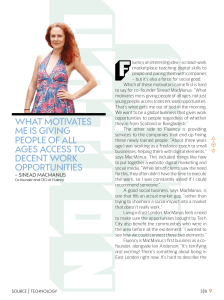
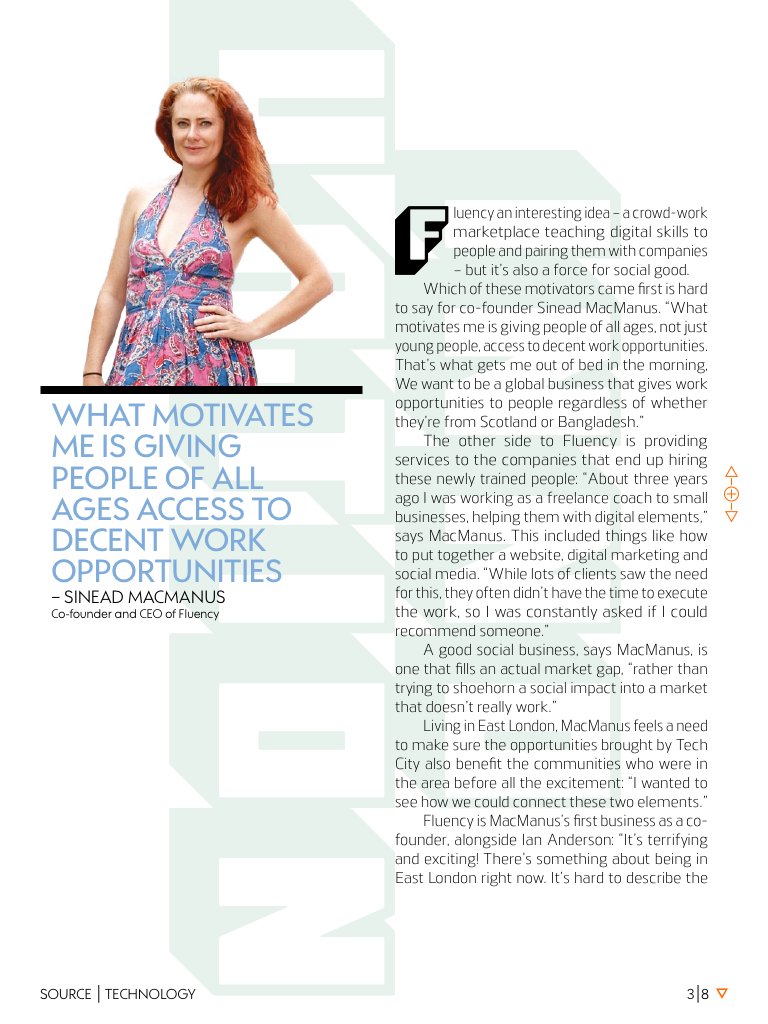
tech3Sinead Mac Manus, co-founder and CEO of Fluency
Not only is Fluency an interesting idea – a crowd-work marketplace teaching digital skills to people and pairing them with companies – but it’s also a force for social good. Which of these motivators came first is hard to say for co-founder Sinead Mac Manus.

“What motivates me is giving people of all ages, not just young people, access to decent work opportunities. That’s what gets me out of bed in the morning,” says Mac Manus. “We want to be a global business that gives work opportunities to people regardless of whether they’re from Scotland or Bangladesh.”

The other side to Fluency is providing services to the companies that end up hiring these newly trained people: “About three years ago I was working as a freelance coach to small businesses, helping them with digital elements,” says Mac Manus. This included things like how to put together a website, digital marketing and social media. “While lots of clients saw the need for this, they often didn’t have the time to execute the work, so I was constantly asked if I could recommend someone.”

The mark of a good social business, says Mac Manus, is one that fills an actual market gap, “rather than trying to shoehorn a social impact into a market that doesn’t really work”. Living in East London, Mac Manus feels a need to make sure the opportunities brought by Tech City also benefit the communities who were in the area before all the excitement: “I wanted to see how we could connect these two elements.”

Fluency is Mac Manus’s first business as a co-founder, alongside Ian Anderson: “It’s terrifying and exciting! … There’s something about being in East London right now. It’s hard to describe the energy here, it’s just amazing. There’s so much opportunity.”

There’s also the irony in the fact that Mac Manus, whose 2012 TEDxSquareMile talk is all about being a digital nomad, is now excitedly talking about moving into a new Shoreditch office: “If you’d asked me three years ago if I’d become a startup CEO with an office, I would have said you were insane,” she laughs; Mac Manus was living in Spain back then, working from her laptop. “I see this, in the medium term, as the role for me. But I have so many ideas about startups that I think can change the world.”

***
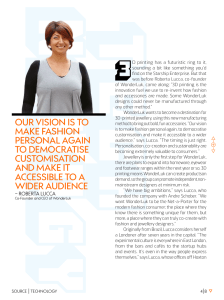
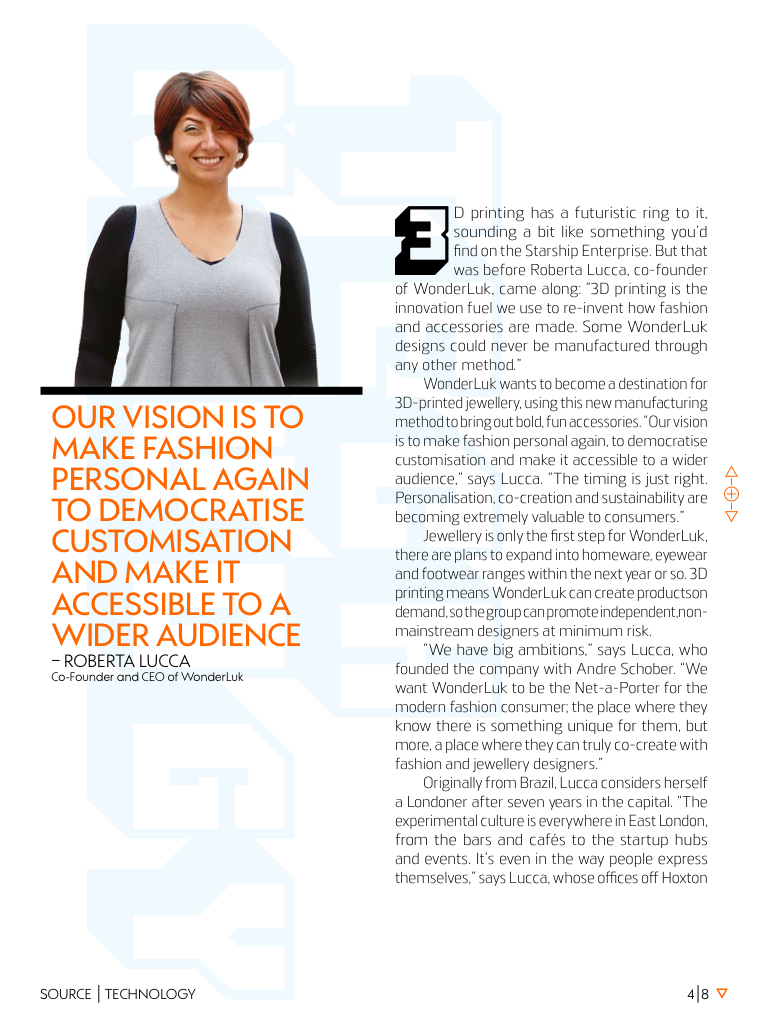
tech4Roberta Lucca, co-founder and CEO of WonderLuk
3D printing has a futuristic ring to it, sounding a bit like something you’d find on the Starship Enterprise. But that was before Roberta Lucca, co-founder of WonderLuk, came along: “3D printing is the innovation fuel we use to re-invent how fashion and accessories are made. Some WonderLuk designs could never be manufactured through any other method.”

WonderLuk wants to become a destination for 3D-printed jewellery, using this new manufacturing method to bring out bold, fun accessories. “Our vision is to make fashion personal again, to democratise customisation and make it accessible to a wider audience,” says Lucca. “The timing is just right. Personalisation, co-creation and sustainability are becoming extremely valuable to consumers.”

Jewellery is only the first step for WonderLuk, which launched in April, as there are plans to expand into homeware, eyewear and footwear ranges within the next year or so. 3D printing means WonderLuk can create products on demand, so the group can promote independent, non-mainstream designers at minimum risk. “We have big ambitions,” says Lucca, who founded the company with Andre Schober. “We want WonderLuk to be the Net-a-Porter for the modern fashion consumer; the place where they know there is something unique for them, but more, a place where they can truly co-create with fashion and jewellery designers.”

Originally from Brazil, Lucca considers herself a Londoner after seven years in the capital. “The experimental culture is everywhere in East London, from the bars and cafés to the startup hubs and events. It’s even in the way people express themselves,” says Lucca, whose offices off Hoxton Square include a creative lab. The space is now being transformed into a showroom, so customers can come and try out the pieces.

As WonderLuk collaborates with designers, developers and creatives across Europe to build not only the business but also a designer collaborative, it helps that this is Lucca’s second time around the startup merry-go-round: “Building my second startup has made me feel even more in-tune with what really fulfils me: to create something of value to the world. I’ve learned two big lessons: hire carefully, and pivot with no fear if what you set out to do isn’t working.” And above all, asserts Lucca, if you’re thinking of setting up your own company, remember what designer Charles Eames said: “Take your pleasure seriously.”

***
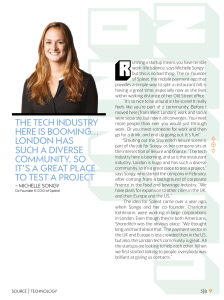
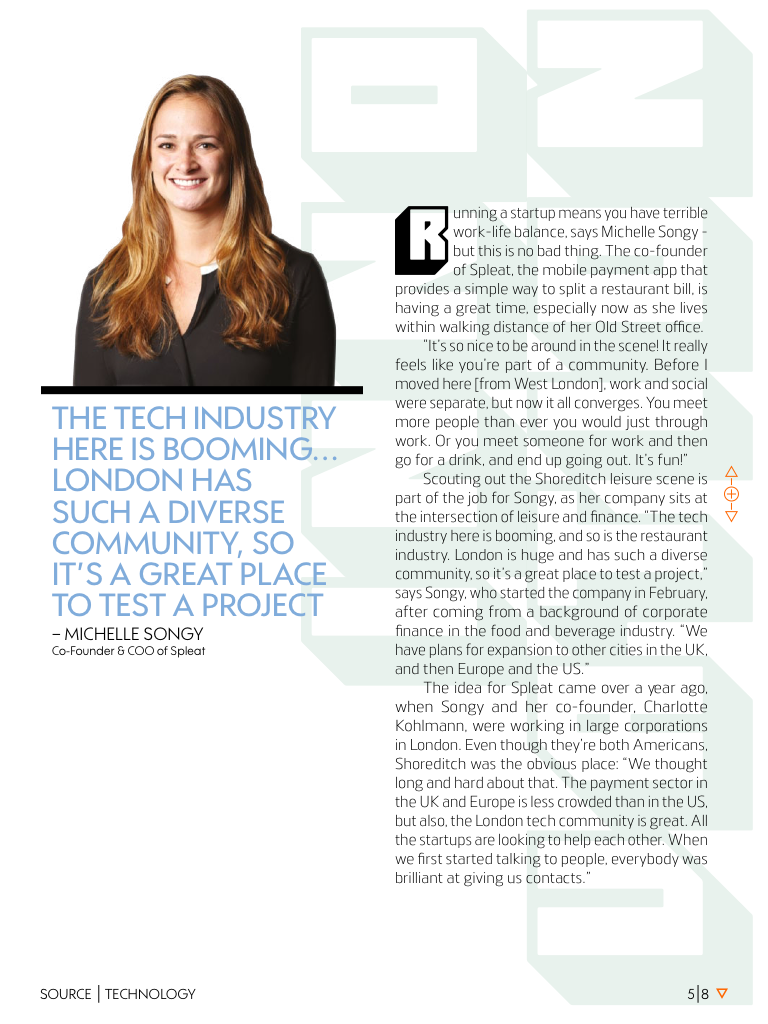
tech5Michelle Songy, co-founder and CEO of Spleat
Running a startup means you have terrible work-life balance, says Michelle Songy – but this is no bad thing. The co-founder of Spleat, the mobile payment app that provides a simple way to split a restaurant bill, is having a great time, especially now as she lives within walking distance of her Old Street office.

“It’s so nice to be around in the scene! It really feels like you’re part of a community. Before I moved here [from West London], work and social were separate, but now it all converges. … You meet more people than ever you would just through work. Or you meet someone for work and then go for a drink, and end up going out. It’s fun!”

Scouting out the Shoreditch leisure scene is part of the job for Songy, as her company sits at the intersection of leisure and finance. “The tech industry here is booming, and so is the restaurant industry. London is huge and has such a diverse community, so it’s a great place to test a project,” says Songy, who started the company in February. “We have plans for expansion to other cities in the UK, and then Europe and the US.”

The idea for Spleat came over a year ago, when Songy and her co-founder, Charlotte Kohlmann, were working in large corporations in London. Even though they’re both Americans, Shoreditch was the obvious place: “We thought long and hard about that. The payment sector in the UK and Europe is less crowded than in the US, but also, the London tech community is great. All the startups are looking to help each other. When we first started talking to people, everybody was brilliant at giving us contacts.”

Right now, Spleat operates from a co-working space: “Most of the other companies here are also early tech, so it’s like having a big focus group around! For where we’re at right now, this is perfect,” says Songy, whose motivations include a desire to create a working environment different to what’s common in large corporations. “We don’t want to have that stress on Sunday about going work on Monday, like so many people I know. We want to create a really good environment, where people enjoy the work and the work atmosphere.”

***
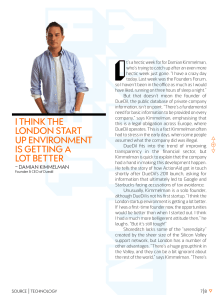
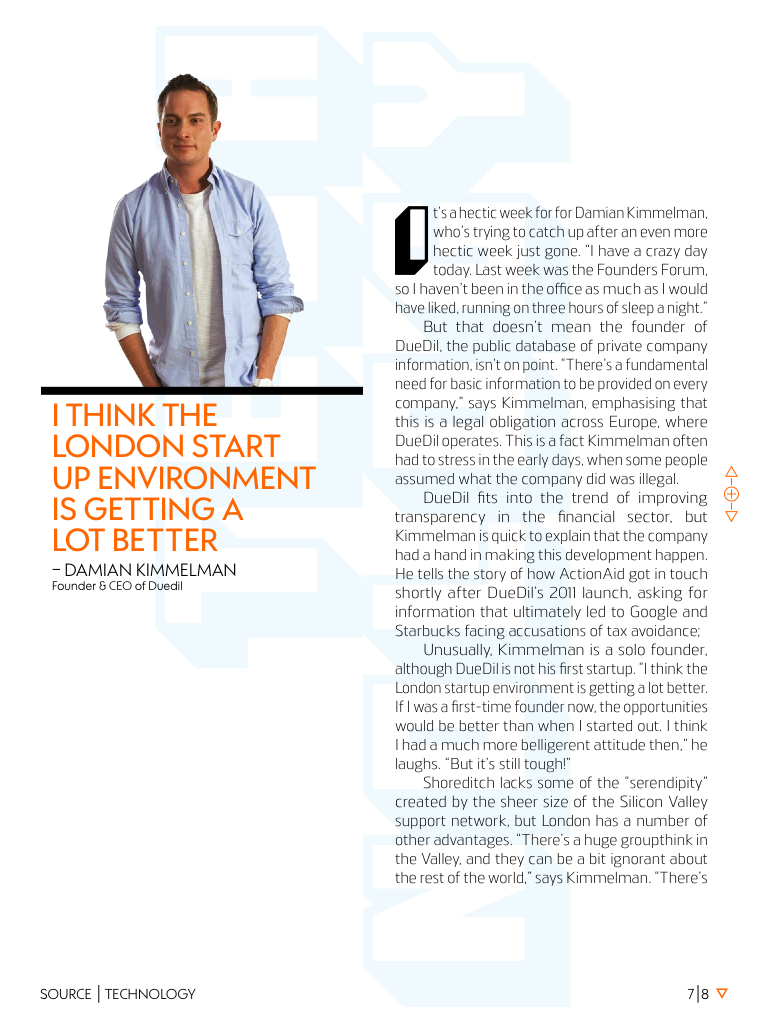
tech6Damian Kimmelman, founder and CEO of DueDil
It’s a hectic week for for Damian Kimmelman, who’s trying to catch up after an even more hectic week just gone. “I have a crazy day today. Last week was the Founders Forum, so I haven’t been in the office as much as I would have liked, running on three hours of sleep a night.”

But that doesn’t mean the founder of DueDil, the public database of private company information, isn’t on point. “There’s a fundamental need for basic information to be provided on every company,” says Kimmelman, emphasising that this is a legal obligation across Europe, where DueDil operates. This is a fact Kimmelman often had to stress in the early days, when some people assumed what the company did was illegal.

DueDil fits into the trend of improving transparency in the financial sector, but Kimmelman is quick to explain that the company had a hand in making this development happen. He tells the story of how ActionAid got in touch shortly after DueDil’s 2011 launch, asking for information that ultimately led to Google and Starbucks facing accusations of tax avoidance; “That really fuelled the fire under the Occupy movement.”

Unusually, Kimmelman is a solo founder, although DueDil is not his first startup. “I think the London startup environment is getting a lot better. If I were a first-time founder now, the opportunities would be better than when I started out. I think I had a much more belligerent attitude then,” he laughs. “But it’s still tough!”

Shoreditch lacks some of the “serendipity” created by the sheer size of the Silicon Valley support network, but London has a number of other advantages. “There’s a huge groupthink in the Valley, and they can be a bit ignorant about the rest of the world,” says Kimmelman. “There’s a huge amount of staff poaching over there, whereas one of the greatest things about being in London is all this incredible talent from across the UK and Europe.”

DueDil is in expansion mode, having just moved from a small office to a new 10,500 sq ft space, “where Shoreditch meets the City”. And as DueDil grow from a scrappy startup to a company with a three-digit employee number, Kimmelman is discovering new challenges: “We have to think about things like career progression, as there are a lot of ambitious people in the company and we need to do right by them.” He laughs: “As we’re scaling up, I seem to have a new job: HR!”

***
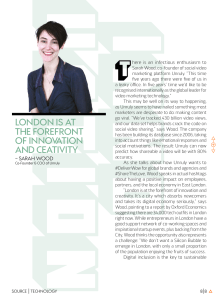
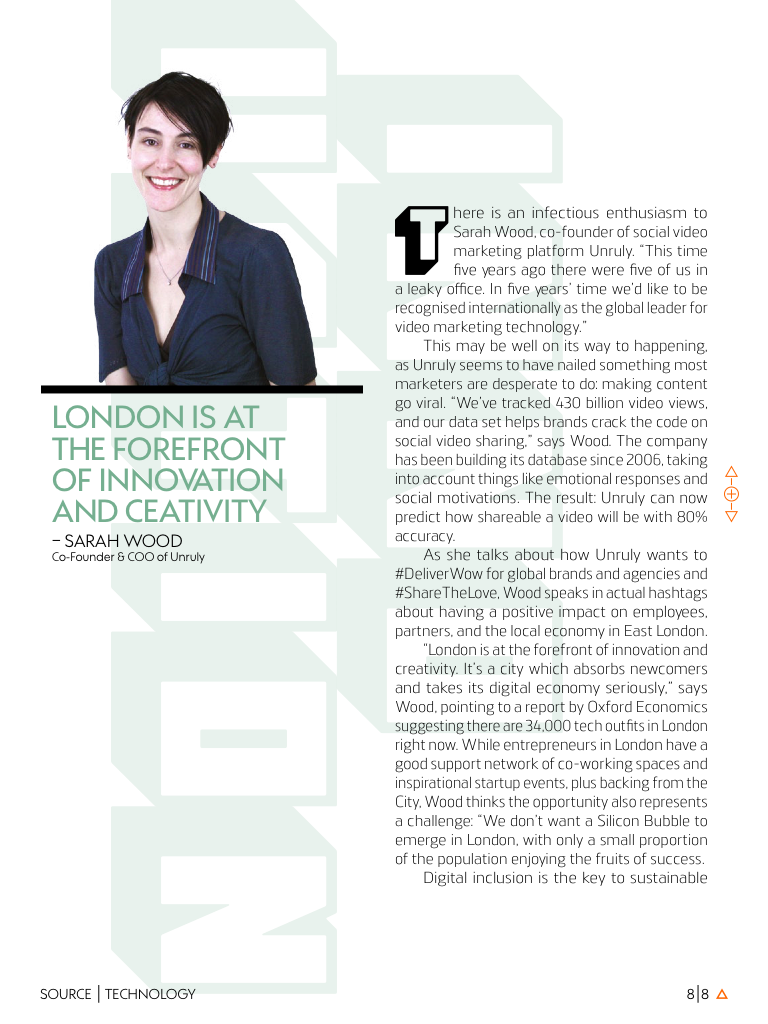
tech7Sarah Wood, co-founder and COO of Unruly
There is an infectious enthusiasm to Sarah Wood, co-founder of social video marketing platform Unruly. “This time five years ago there were five of us in a leaky office. In five years’ time we’d like to be recognised internationally as the global leader for video marketing technology.”

This may be well on its way to happening, as Unruly seems to have nailed something most marketers are desperate to do: making content go viral. “We’ve tracked 430 billion video views, and our data set helps brands crack the code on social video sharing,” says Wood. The company has been building its database since 2006, taking into account things like emotional responses and social motivations. The result: Unruly can now predict how shareable a video will be with 80% accuracy.

As she talks about how Unruly wants to #DeliverWow for global brands and agencies and #ShareTheLove, Wood speaks in actual hastags about having a positive impact on employees, partners, and the local economy in East London. “London is at the forefront of innovation and creativity. It’s a city which absorbs newcomers and takes its digital economy seriously,” says Wood, pointing to a report by Oxford Economics suggesting there are 34,000 tech outfits in London right now.

While entrepreneurs in London have a good support network of coworking spaces and inspirational startup events, plus backing from the City, Wood thinks the opportunity also represents a challenge: “We don’t want a Silicon Bubble to emerge in London, with only a small proportion of the population enjoying the fruits of success. Digital inclusion is key to the sustainable growth.”

At Unruly, the temptation may be to watch viral videos all day in the name of research, but Wood, with co-founders Matt Cooke and Scott Button, have clearly been busy building their empire. Unruly now has 12 offices across the world, employing 150 people. “It’s been an incredible experience: intense, insane and enormously rewarding. … Starting up a company is not dissimilar to setting up home and starting a family, and trust is the cornerstone of a strong co-founder relationship.”

Wood lives close the company’s offices, which are just off Brick Lane in a former toy factory. “We still spend a lot of time playing,” says Wood, adding how maintaining a strong culture is very important as the company grows. This means making time for things like #PingPongFightClub with their tecchie neighbours, as all the Unrulies still play: “Ping Pong is the skinny jeans of sport!”

***

Screen Shot 2014-12-16 at 18.42.12

Artists of vision: The Hackney and Haringey arts hub

Screen Shot 2014-12-16 at 18.40.29

Source Magazine, autumn 2014.

 Original article.

art2Artists of vision: The Hackney and Haringey arts hub 

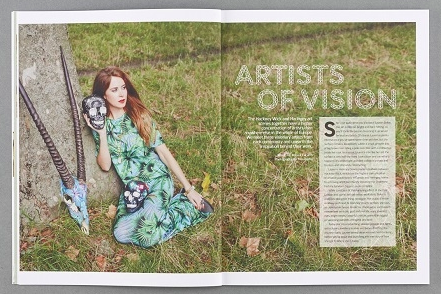
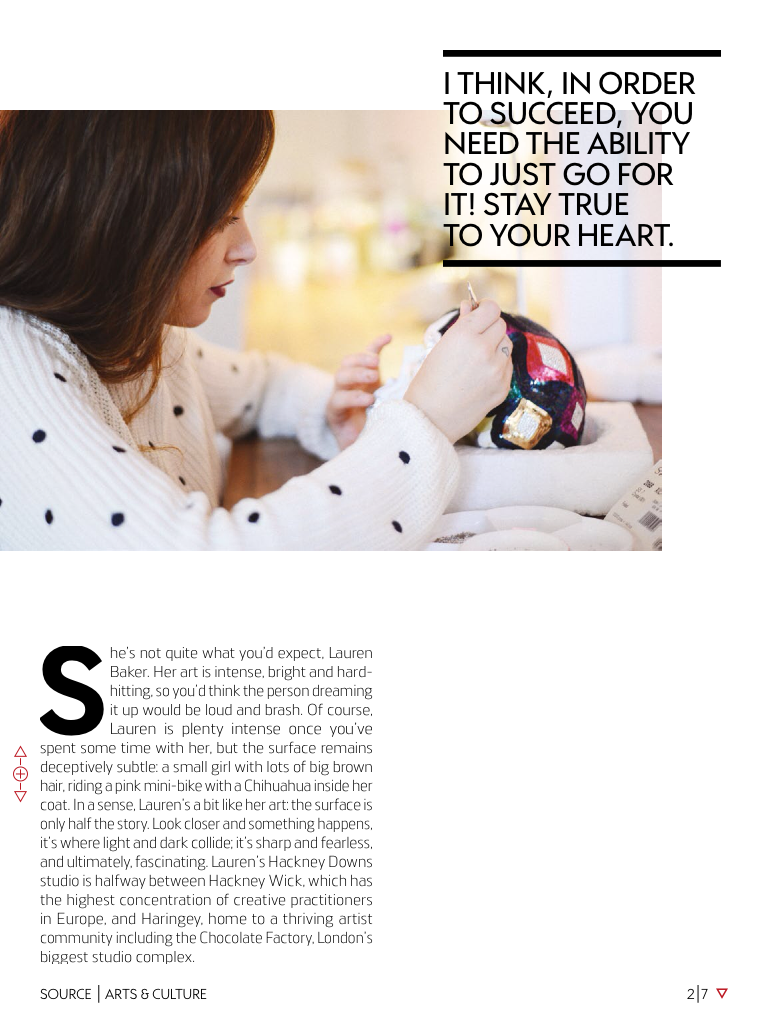
She’s not quite what you’d expect, Lauren Baker. Her art is intense, bright and hard-hitting, so you’d think the person dreaming it all up would be loud and brash. Of course, Baker is plenty intense once you’ve spent some time with her, but the surface remains deceptively subtle: a small girl with lots of big brown hair, riding a pink mini-bike with a chihuahua zipped inside her coat. In a sense, Baker’s a bit like her art: the surface is only half the story. Look closer and something happens, light and dark collide and it’s sharp and fearless, and ultimately, fascinating.

Take Baker’s favourite piece right now, a large, three-dimensional starburst covered in mirrors: “It’s symbolic of the portal to other dimensions.” Next to the portal sits a coffin, lined with light: “Like the light you see when you have a near-death experience.” And everywhere are the skulls: gold and metallic ones, jewelled eyes, bright neons, colourful crystals, painted in jagged or sweeping patterns, energetic and bold.

Baker’s Hackney Downs studio is halfway between Hackney Wick, which has the highest concentration of creative practitioners in Europe, and Haringey, home to a thriving artist community including the Chocolate Factory, London’s biggest studio complex. While conscious of the nurturing effect of the East London arts scene, self-admitted workaholic Baker is really just doing her thing, no biggie. Her studio is inside a railway arch next to Hackney Downs; perfect, she says, so close to her house. Today she’s in a loose, long-sleeved playsuit and tights, chunky jewellery in silver and bone offsetting the discrete outfit. She serves tea in mismatched crockery before sitting down, launching into the story of how she got to where she is today. Now 32, Baker’s only been an artist for three years: “I didn’t find my passion until I was 29. It’s moving really fast. Now that I’m finally on the right path, it’s just flowing.”

Baker credits her former life of working in events and marketing as part of the reason she’s managed to become a successful artist in such a short time; she knows how to attract attention to her work, and this is how the Tate Modern picked her up after her very first show. But it was necessary to make a change: “I quit my old job and went to South America. I was looking for an adventure, a spiritual path.” What she found was a mosaics artist in Brazil, who inspired Baker to go to Venice and learn the craft. But not before having an experience, deep in the Peruvian jungle, where she met a shaman and had a vision that she should become an artist. Having moved on from mosaics since, Baker now considers herself a multimedia artist: “I see my art practice as one big fun experiment. I don’t want to restrict myself.”

It’s sunny outside the cool railway arch, and Baker’s chihuahua, Dude, is keen to go outside. Baker releases the dog once we round the corner into Hackney Downs, and the tiny dog disappears immediately in the tall grass. Baker is unconcerned; Dude makes friends easily. “I love it here,” she says, as she waves to a woman passing on a bicycle; “That’s my neighbour. She’s a blacksmith.” I ask if Baker, who’s not a native Londoner, would ever leave the capital, but she looks at me like I’m mad: “Oh no! East London is my home. I could never leave!”

Even when she’s talking about her work, Baker is soft-spoken to the point where you still can’t quite believe all that powerful art comes from her. Then she talks about how, early in her career, she decided she wanted to decorate display windows, picked three places she fancied, and ended up with Harrods. She makes it sound easy, like it was nothing. The Harrods window led to a Selfridges window, and there were shows in New York, California, Ibiza. “I try to trust my instincts,” she says, in an effort to explain how she does it. “I think, in order to succeed, you need the ability to just go for it. Not letting yourself be led astray by what other people want you to do. Stay true to your heart.”

And, Baker is quick to add, you need to be a top-notch networker: “You really need to get yourself out there, go to exhibitions, art fairs, talk to lots of people and tell them what you’re doing.” Being part of Hackney Downs Studios makes this possible without going far; Baker’s complex is home to over 100 artists, designers, record labels, bookbinders and other creatives, even a brewery. Regular events and open studio days, plus a café, shop and gallery, ensure a nurturing community.

Baker doesn’t linger on the details when she talks, skimming over the studio that’s freezing in winter and the fingers that bleed after hours and days of placing crystals. Instead she talks about how much she loved it when the Tate Britain invited her to reinterpret one of their works; she chose ‘Ophelia’ by Millais, “the most beautiful death”. Baker created a forest inside the gallery, recreating Ophelia’s final moments surrounded by trees and flowers, and of course, skulls and bones. “I’m really driven to try and understand death, in a positive way. We’re not here forever.”

We’ve sat down on a bench on the Downs, and Dude has reappeared and wants attention. Baker has been talking about her work for Save Wild Tigers, and spending two and a half months placing 35,000 Swarovski crystals on a life-sized tiger’s head. This year she’s doing it again, only it’s bigger and will take four months. She readily admits the work can be maddening: each sequin is individually placed, and it has to be perfect. “But then I get into a meditative state doing it, and it’s really lovely.”

Baker’s in demand for commissions, but will still spend all her money on materials and push on with her passion projects. She’s just come back from her first vacation in three years. “The plan now is to have a work-life balance!” If that’s possible, that is: “I get into extremes with work. I got to bed at 3am last night. I basically have to leave London to stop working.” She seems to be having a lot of fun though. Is she? Baker looks up from Dude in her lap, and for a moment it’s like she’s surprised. Then she lets out a big, red-lipsticked laugh: “Yes! I’m having a really good time!” And you know it’s true.

***

art3Adam Doughty, illustrator in Hackney Wick
Adam Doughty draws what he sees: a pint, King’s Cross station, some cheese, what the weekend feels like. Of course, it’s all re-imagined, bringing a sense of magical, yet simple, realism to his work. “I liked the phrase ‘magical realism’, I felt it was a fitting term to describe my work.” says Doughty. “I focus on the everyday, but I like to play with aspects of the illustration, like manipulating scale, adding historical references, and using a varied colour palette.”

The result is day-to-day elements captured with a whimsical feel. Doughty likes to research the history of an area before drawing it: “It’s inspiring to discover the old use of a building, the people who worked there and what it stood for.” Like his workplace, the Bridget Riley Studios in the part of Hackney Wick known as Fish Island; the building used to be part of a peanut factory. “The Bridget Riley Studios has such an array of talent. At the last Hackney WickED open studios I talked with painters, glass cutters, sculptors, illustrators, web designers, architects, fashion designers – all in the same building.”

Doughty shares his studio with two women, one is a children’s illustrator and the other a freelance architect. “Our studio is quite spacious and we all get on really well. I love the fact that the space is hidden away, nestled in the corner of an artistic hub. If I leave my window open I’ll often get a cat visitor, who sits on my rocking chair until I’m done for the day,” says Doughty. “I’m proud to show visitors around the area. The graffiti, the quirky sculptures, canal boats, the giant stadium, and the creation of the neighbouring Queen Elizabeth Park. It all make for an interesting experience.”

Doughty lives ten minutes’ walk from his Fish Island workspace, in Bow. “I loved the feel of the place straight away, especially the vibrant arts scene in Hackney Wick. If you need support, it’s there for you.” Recently, Doughty has been experimenting with larger scale illustrations, but he always has a couple of Moleskine notebooks on the go: “I sketch and draw in these when I’m out and about. I draw on the bus, train, the doctor’s surgery, the beach, the Sikh Temple in Bow – anywhere that allows it.” He laughs. “The only place I’ve been told off for drawing was in the Tate Modern!”

***

art4Matt Small, painter in Haringey
“North London is one big village,” says Matt Small. He’s sitting on the fire escape of his flat in Camden right now, but his workspace, at Euroart Studios in Haringey, is just a skip, hop and jump away on the Overground. There are new studios opening up all the time, Small observes, with lots of open days and initiatives for support: “There’s a DIY mentality growing. I think us artists have realised it’s important to take control, and not wait on established organisations to provide support.”

As a full-time artist, Small knows that locking yourself away in your studio to focus on your craft probably won’t cut it: “You have to be savvy about promoting yourself. That’s a part of the job as well, and not something us artists have traditionally been so great at. So it’s good to have a network of individuals who are in the same boat as you.”

art5Primarily a painter, Small has a strong, compelling style, often choosing discarded objects like car bonnets or old signs instead of canvas for his work. “The theme of my work is young, dispossessed people: individuals who feel undervalued, who don’t have a voice, who get looked over.” Small explains how the urban debris he paints on becomes symbolic of the feeling of being without value: “I thought it’d be interesting to connect the two – that oven door, that shelving unit, that piece of trash to someone – I don’t see it like that, I see that it can be something beautiful and worthwhile. That’s how I see our young people too. Let’s look at their potential, at the hope that’s in all of them.”

Small has hosted workshops for socially marginalised people, driven in part by a desire to give them a voice, but also wanting to make art more approachable in general. “I think the art world is un-inclusive by design, but for me, making it understandable and connected to us mere mortals is what art is about. It’s about finding your own way of communicating what goes on in your mind. That’s the most powerful thing you can do as an individual: creatively express yourself, visually or through music or dance.” And of course, there’s the thrill of the challenge: “I’d feel as if I was cheating myself if I wasn’t pushing the boundaries of my own potential. Keep discovering, keeping finding, keep playing.” He laughs. “Having fun with it all. Yes, yes!”

***

art6Natalie Ryde, painter/printmaker in Hackney Wick
Delicate nets and intricate webs are in Natalie Ryde’s blood, it seems, as she was drawing these patterns for years before discovering her family’s 300-year history as framework knitters. “It’s so curious to me. I’d been drawing these nets and ferns almost intuitively,” says Ryde. The realisation came five years ago, when her family was invited to visit the factory where their ancestors had worked for generations. “My family knew, but they never mentioned it. They just took it for granted. So it’s definitely not from nurture!”

Studying nature, and close-up details, are key elements in Ryde’s work. Her nets create a “sub-lingual pattern” that tries to convey something: “It hints at things that are familiar but not quite discernible, like you can relate to them but you’re not quite sure what they are.” She laughs a bit, nervously, it’s hard to explain what she means. “I’m compelled to drawing things and making things in response to the world around me. I can remember being little and wanting to be really good at drawing. It’s so much a part of my life now, I can’t imagine it not being the thing I do every day.”

Originally from Scotland, Ryde works at Wallis Studios in Hackney Wick. “Why did I come here? Because this is where everyone is!” Previously living in London Fields, Ryde has since moved to Haringey. “I was thinking of getting a studio closer to home, but I quite like the commute. I cycle down, along the canal.” Not to mention the community in the Wick: “It’s exciting, there’s always lots of exhibitions and galleries. There’s always so much fun going on. People work hard here, it’s nice.” Ryde is part of a mentoring programme for artists in the area, and also works in arts education, in part for local children in nearby Queen Elizabeth Park.

And of course, there’s the net drawings. “I have worked in lots of different mediums but I’m focusing on the nets, as I feel that’s my visual language now,” says Ryde. “l get my ideas from being outside, but I’m not necessarily interested in the view. I’m more interested in the ground, or in things that are washed up on the beach. That’s how you’ll find those strange, alien-looking things, detached from their context, so it doesn’t quite make sense when you first see it.”

***

art7Richard Peacock, printmaker in Haringey
“The Chocolate Factory is really not bad,” says Richard Peacock, who’s been in his Haringey studio for 14 years now. “When I first qualified I had a studio in Dalston, where you had to scrape the ice off the windows. But here, we have heating!” He laughs. Peacock lives close to his studios too, although this is a happy accident; he originally came to Haringey because his sister lived there. “I didn’t do my art degree until my 30s. As a teenager in Essex I wanted to be an artist, but I didn’t get back into it until I started going to evening classes. Then slowly and surely it became the most important thing in my life.”

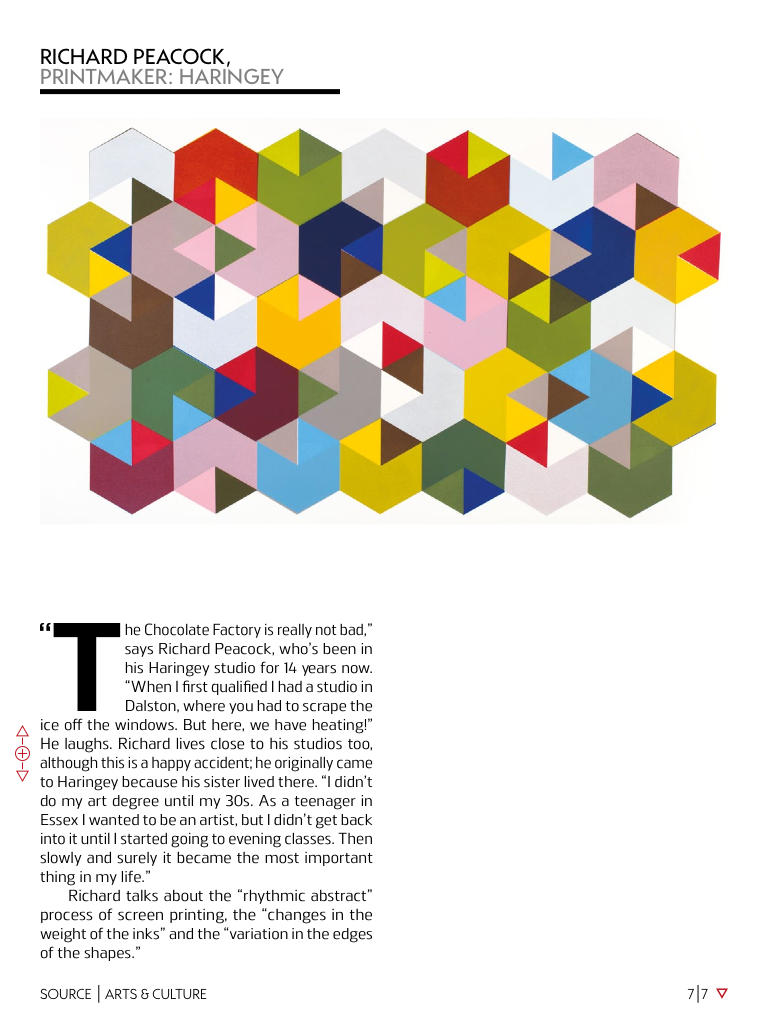
Peacock talks about the “rhythmic abstract” process of screen printing, the “changes in the weight of the inks” and the “variation in the edges of the shapes”. This is a physical experience, requiring 24 different processes for each print. It can be planned or intuitive, but regardless: “You have to respond to what’s happening. That should let you make something that’s better than what you can plan.”

The result is part abstract, part pop art, playfully exploring shapes and colours. “Every time a cardboard box comes into the house I take it apart and look at it,” says Peacock, who often ends up using the shape in his work. “I like things with holes and gaps in it, so you can see through it as you print layers. Someone once sent me this lovely waxed paper with lots of tiny holes, it had been used in a circuit factory.” Peacock used the paper to print strips, which began to resemble trees in the forest. The resulting piece, “Step from the path”, is his favourite. Sometimes he’ll includes words too, usually simple phrases, or maybe texts from spam emails or horoscopes; it’s cliche language that ultimately says something about how we live.

Haringey has seen a lot of new artist spaces pop up in the past few years, says Peacock. While still a very diverse borough, things are becoming more buzzy, especially around Tottenham with its open studios, and around Alexandra Park with its arts trails. “Then there’s the Chocolate Factory, which has its own community associated with it. There are lots of people here who are making things happen.”

***

art8Esther Ainsworth, mixed-media artist in Hackney Wick
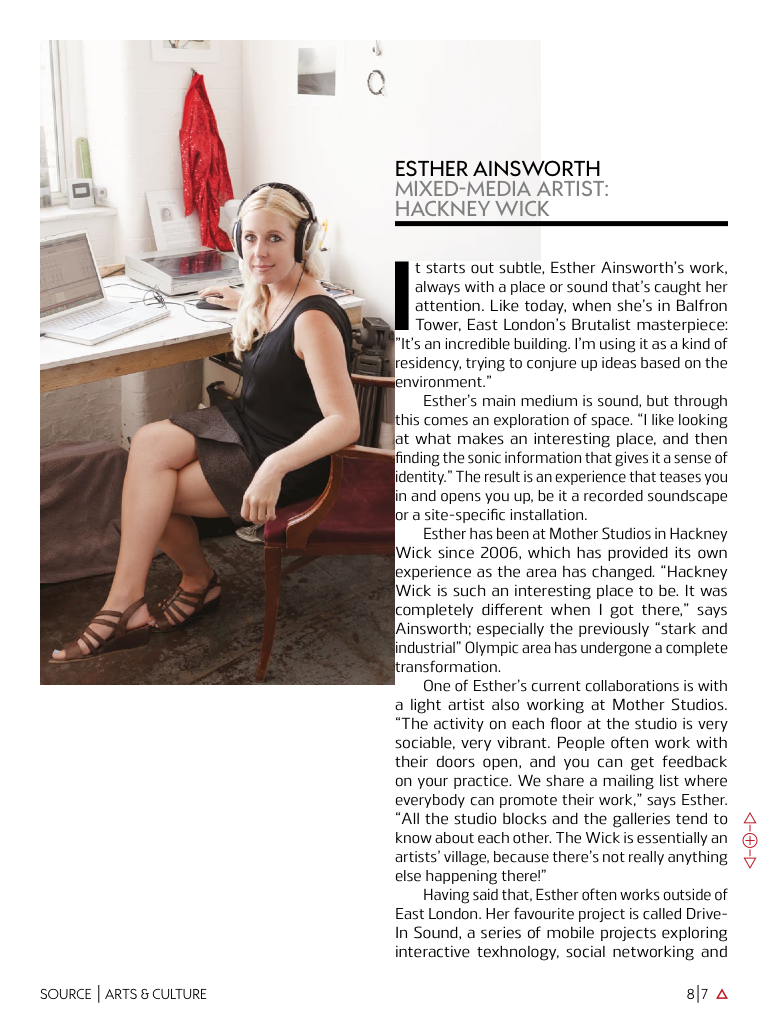
It starts out subtle, Esther Ainsworth’s work, always with a place or sound that’s caught her attention. Like today, when she’s in Balfron Tower, East London’s Brutalist masterpiece: ”It’s an incredible building. I’m using it as a kind of residency, trying to conjure up ideas based on the environment here.”

Ainsworth’s main medium is sound, but through this comes an exploration of space. “I like looking at what makes an interesting place, and then finding the sonic information that gives it a sense of identity.” The result is an experience that teases you in and opens you up, be it a recorded soundscape or a site-specific installation. Ainsworth has been at Mother Studios in Hackney Wick since 2006, which has provided its own experience as the area has changed. “Hackney Wick is such an interesting place to be. It was completely different when I got there,” says Ainsworth; especially the previously “stark and industrial” Olympic area has undergone a complete transformation.

One of Ainsworth’s current collaborations is with a light artist also working at Mother Studios. “The activity on each floor at the studio is very sociable, very vibrant. People often work with their doors open, and you can get feedback on your practice. We share a mailing list where everybody can promote their work,” says Ainsworth. “All the studio blocks and the galleries tend to know about each other. The Wick is essentially an artists’ village, because there’s not really anything else happening there!”

Having said that, Ainsworth often works outside of East London. Her favourite project is called Drive-In Sound; she’s done it three times so far, most recently on her way to a residency in Slovakia. “I love the idea of combining the freedom of a road trip with something that’s deeply enmeshed in the communities you visit. You can create new networks as you move around from place to place.”

This also goes to the core of why Ainsworth does her work: “It comes from trying to understand the world a little bit better. By finding interesting places, by hopefully connecting people between those places.” She thinks about it. “The idea of uniting and building bridges between communities and cultures is very exciting for me. I don’t think there’s an arrival point, but there’s a sense of journey. It drips through everything.”

***

Screen Shot 2014-12-16 at 18.42.12

Mirrorcity at the Hayward Gallery

Apollo Magazine, November 2014. Original article

Screen Shot 2016-07-03 at 15.34.07
Mirrorcity: Glimpsing the digital revolution

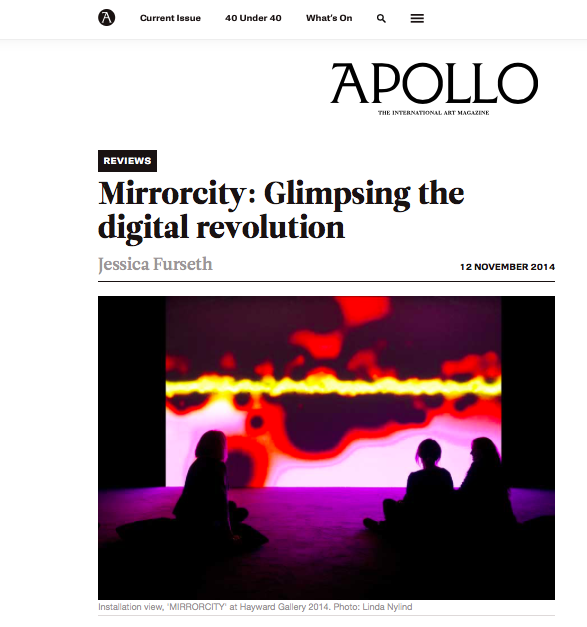
If mirrors were once considered to be portals into different realities, today’s mirror is the digital world. Almost everything has a digital component: scan a barcode or download an app to get information, wear a bracelet to track your health, use a hashtag to follow the conversation. As we live in a “digital mirror-city that echo our own”, Mirrorcity at the Hayward Gallery poses the question: “What is our current experience of reality?”

Mirrorcity is the second exhibition in London this year to look at the transition to a digital world is reflected in art. The summer’s Digital Revolution at the Barbican was a great examination of the emergence of digital imagery in the culture, from the blocky video games of the 70s, to today’s three-dimensional light beams that respond to touch. While Digital Revolution felt more like a walk through history than an art show, it illustrated perfectly how it has taken a very long time for digital tools to become a viable part of art practice.

Mirrorcity picks up where Digital Revolution left off, at least chronologically, as it focuses on how contemporary artists deal with the “challenges, conditions and consequences of living in a digital age”. While the show is decidedly mixed, one overall feeling remains: the digitisation of art is still in its infancy. The digital world, or the internet, is an augmentation of daily life now, and not an escapist place without consequences. But this development is still new, meaning heavy use of digital elements in art will easily feel gimmicky. Artists are working out how to use digital elements to enhance what they are trying to say, but the successful implementation of these new tools is a work in progress.

Because the best pieces in Mirrorcity are those with no obvious digital components whatsoever. Emma McNally’s large-scale drawings, presented so as to surround you as you walk into the room, are both overwhelming and subtle at the same time. They bring to mind nautical charts, the view from a plane through clouds, a map of stars, or maybe even a piece of music. McNally has described her work as a form of “visual thinking around questions of emergence”, intuitively creating a code that can be read with the right machine.

The feeling of a digital presence is even more clear in Katrina Palmer’s work. “Reality Flickers” is a plain metal box with a big hum, with two chairs inviting you to sit down and let it surround you. Hannah Sawtell’s also uses sound in her work, as well as software and devices such as tablet computers, as she works create a “dense digital situation”. Susan Hiller opts to immerse the audience in darkness, even offering cushions so we can lie back and forget the body as we take in her video piece, where colours and shapes overwhelm the senses as we are sucked into her world.

Mirrorcity explores interesting questions such as how we can navigate the space between the digital and the physical, but visitors emerge only slightly the wiser. Because as long as we are looking at a screen, the digital experience still happens outside of ourselves. Whether this is the fault of the show, or just the current point of technological development, is open to debate. At the moment, we walk around with the digital world in our pockets, as more immersive experiences, like so-called wearable technologies, are often considered too intrusive.

Last year’s Light Show, also at the Hayward Gallery, had a more modest mission statement, looking simply to thrill its audience with light-themed artworks. It’s very possible that digital tools were used to create some of the experiences in Light Show, but frankly, no one cared. We just wanted to jump between light strobes, and sink into bright rooms that made us lose perception of time and space. The digital mirror that echoes our lives has a similar ability to transport us, but Mirrorcity offers only a glimpse of what that may feel like. But maybe it is just too soon for art to truly reflect how the digital is changing our lives? After all, this is a revolution, and it’s all happening so fast. We don’t quite know what it means yet.

Creature of habit: A story of food, marriage, and ginger beer

The Toast, November 2014. Original article

Screen Shot 2016-07-01 at 15.37.50
Creature of habit: A story of food, marriage, and ginger beer

Having no one to help carry grocery bags home, that was the worst part of breaking up with my boyfriend of nearly five years. Or should I say, that was the worst part as far as I can remember it now, an eternity later. All the other stuff about breaking up with the first person I ever loved was pretty much as you’d expect, in all the shades of hellishness. But it’s not really the sleeping alone that gets you, because you are ready for that one. It’s that second it takes to remember that you can no longer just text them when something funny happens. It’s the first time at the grocery shop, when everything’s bagged up and you realise there’s no one there to help you carry.

I got the hang of solo grocery shopping eventually: buy what you need, but never more than two bags’ worth. Or if you don’t need that much, throw in a couple of non-perishables to fill up the bags, to save having to haul that weight later. Pasta and tomato sauce featured heavily for many years. There was that period of lots of hummus with bread, preferably white crust. There was one week where I lived mostly on prawn crackers, which ended sharply after they made me sick, literally. Lots of Chinese food, later Vietnamese, then Thai. All kinds of fruit, as it requires no preparation. I rarely cooked – nothing decent anyway, as I associated food preparation with couplehood: roasted meats, creamy curries, grilled fish with spicy rice. Still, I ate something at almost every meal, and my weight stayed within an average range without much fluctuation. Occasionally I’d wrap a salmon fillet in foil with some leek, pretending for a moment I was a grown up who ate proper meals. But I couldn’t fool myself for long, as I secretly wished for that three-course-meal chewing gum that Willy Wonka gave to Violet Beauregarde. I mean, it would be so much easier.

If this sounds sad, that’s not the way it felt. I was preoccupied with other things, and just didn’t think about food very much. Ok, that week of prawn crackers was a low point, I’ll admit. But most of the time my mind was simply elsewhere as I added pesto to my pasta and ate it hurriedly, while getting ready to go out. Food was fuel, or a layer to go under the alcohol, which I only drank in moderate amounts anyway. Except for that one year when I accidentally gave up booze altogether, something I never planned for but all of a sudden I looked back and realised it had been a teetotal year.

Instead, I developed a slight addiction to Maltesers that year. That’s the chocolate with the malt honeycomb centre, which popped so pleasingly in the mouth as the chocolate melted. I’d get a small packet every day, not trusting myself with the cheaper-by-the-pound bigger pack in the house. I only managed to break the addiction by going on a three-week trip to Portugal, which turned out to be a Maltesers-free space. Something similar happened a couple of years later with Maynards winegums, the release from which I owe to a month in Australia. I am, would seem, a creature of habit.

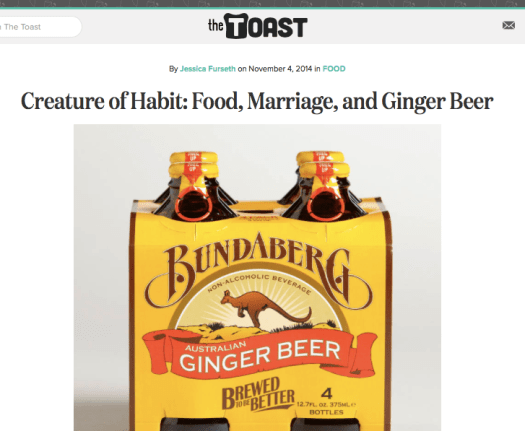
But there’s always some substance, some particular flavour or texture, that manages to slip through and take hold. My latest thing is this particular ginger beer, made by Bundaberg. The non-alcoholic drink is sold in a stubby brown bottle with a old-school pull-off cap, and while it’s not uncommon around my parts it can be tricky to find. It comes in packs of four at the big grocery shop near my house, but lately they haven’t had it in stock. I scour the aisle nervously every time I go there, hoping it will be there this time, but the ginger drought continues. Each time I check the label signalling its place on the shelf hasn’t been removed, but it seems that someone is playing a trick.

It was my birthday recently, and my husband me asked what I wanted to do. After thinking about it I realised that what I really wanted was to get in the car and go for a drive, to see if we could find some of that Bundaberg. It was sunny, as it always is on my birthday, and we drove with the windows open through back roads into leafy neighborhoods, the kinds that may appreciate a fancy bottle of ginger beer. Not that it was really about the ginger beer anymore. Still, we were rewarded with four packs; I’m drinking each bottle slowly, and once they’re gone I probably won’t buy any more. Not because they are too heavy to carry, or too hard to find, as marriage fixed those problems. Not marriage in itself, I should add, as it wouldn’t work with just anyone, but marriage to the right person, that fixed a lot.

Having a car to bring groceries home in, that’s one of the best things about getting married. Or should I say, that’s the best part out of the things I anticipated, especially as it’s so rare to meet someone who owns a car in this city. All the other stuff about getting married to someone you love more than anyone was pretty much as you’d expect, in all the shades of amazingness. Because it’s not sleeping in the same bed as someone else that gets you, as you are ready for that one. It’s the first time at the grocery shop, where you can get a trolley and not a basket, and you can get anything you want because you know that when everything’s bagged up, it’s not just you anymore. There’s someone there to cook with: tomato soups, peanut butter fudge, a whole grilled chicken. You no longer have to carry all the bags yourself.

Kids running their own business? Yes they can!

Aquila kids’ magazine, October 2014.

Screen Shot 2014-09-27 at 14.20.30

Kids running their own business? Yes they can!
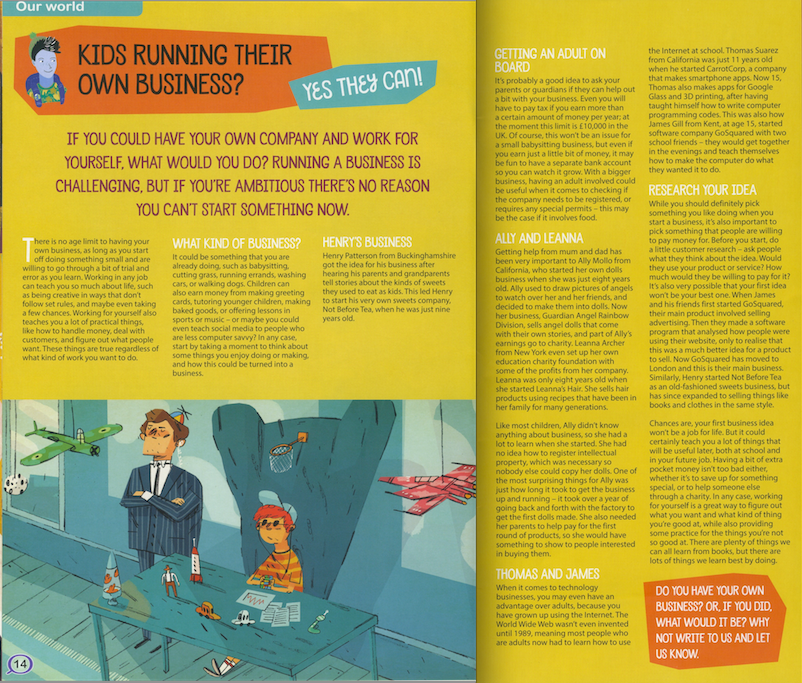
If you could have your own company and work for yourself, what would you do? Running a business is challenging, but if you’re ambitious there’s no reason you can’t start something now.

There is no age limit to having your own business, as long as you start small and are willing to go through a bit of trial and error as you learn. Working any job would teach you so much about life, such as being creative in ways that don’t follow set rules, and maybe even taking a few chances. Working for yourself also teaches you a lot of practical things, like how to handle money, dealing with customers, and figuring out what people want.

These things are true regardless of what kind of work you want to do – it could be babysitting, cutting grass, running errands, washing cars, or walking dogs. Kids can also earn money from make greeting cards, tutoring younger children, making baked goods, or offering lessons in sports or music – or maybe you could even teach social media to people who are less computer savvy? In any case, start by taking a moment to think about some things you enjoy doing or making, and how this could be turned into a business. Henry Patterson from Buckinghamshire got the idea for his business after hearing his parents and grandparents tell stories about the kinds of sweets they used to eat as kids. This led to Henry starting his own sweets company, “Not Before Tea”, when he was just nine years old.

It’s probably a good idea to ask your parents or guardians if they can help out a bit with your business. Even kids have to pay tax if they earn more than a certain amount of money per year: at the moment this limit is £10,000. Of course, this won’t be an issue for a small babysitting business, but even if you earn just a little bit of money, it may be fun to have a separate bank account where you can watch it grow. With a bigger business, having an adult involved could be useful when it comes to checking if the company needs to be registered or needs any special permits – this may be the case if it involves food.

Getting help from mum and dad has been very important to Ally Mollo from California, who started her own dolls business when she was just eight years old. Ally used to draw pictures of angels to watch over her and her friends, and decided to make them into dolls. Now her business, “Guardian Angel Rainbow Division”, sell angel dolls that come with their own stories. Part of Ally’s earnings go to charity, and Leanna Archer from New York even set up her own education charity foundation with some of the profits from her company. Leanna was only eight years old when she started “Leanna’s Hair”, where she sells hair products made from recipes that have been used in her family for many generations.

Like most kids, Ally didn’t know anything about business, so she had a lot to learn when she started. One thing was how to register intellectual property, which was necessary so nobody else could copy her dolls. One of the most surprising things for Ally was just how long it took to get the business up and running: it took over a year of going back and forth with the factory to get the first dolls made. She also needed her parents to help pay for the first round of products, so she would have something to show to people interested in buying them.

When it comes to technology businesses, kids may even have an advantage over adults: you grew up using the internet. The World Wide Web wasn’t even invented until 1989, meaning most people who are adults now had to learn how to use the internet, instead of it being something that’s always been around. Thomas Suarez from California was just 11 years old when he started “CarrotCorp”, a company that makes smartphone apps. Now 15, Thomas also makes apps for Google Glass and 3D printing, after having taught himself how to write computer programming code. This was also how James Gill from Kent started software company “GoSquared” at 15 with two school friends – they would get together in the evenings and teach themselves how to make the computer do what they wanted it to do.

While you should definitely pick something you like doing when you start a business, it’s also important to pick something that people are willing to pay money for. Before you start, do a little customer research: ask people what they think about the idea. Would they use your product or service? How much would they be willing to pay for it? It’s also very possible that your first idea won’t be your best one. When James and his friends first started GoSquared, their main product involved selling advertising. Then they made a software programme that analysed how people were using their website, only to realise that this was a much better idea for a product to sell. Now, as GoSquared has moved to London, this is their main business. Similarly, Henry started “Not Before Tea” as an old-fashioned sweets business, but has since expanded to selling things like books and clothes in the same style.

Chances are, your first business idea won’t be a job for life. But it could certainly teach you a lot of things that will be useful later, both at school and in your future job. Having a bit of extra pocket money isn’t too bad either, whether it’s to save up for something special, or to help someone else through a charity. In any case, working for yourself is a great way to figure out what you want, what kind of thing you’re good at, while also providing some practice for the things you’re not so good at. Because there are plenty of things we can learn from books, but there are lots of things we learn best by doing.

Scan 1

Radical Order: Geometry and the Utopian Impulse

Apollo Magazine, 2014. Original article.

Screen Shot 2016-07-03 at 15.34.26
Radical Order: Geometry and the Utopian Impulse

There’s something timeless about geometric art, with its clean lines and basic patterns appealing to an instinctive desire for order. All the works included in the Royal Academy of Arts (RA) show ‘Radical Geometry’ all date from the mid 20th century, but they still feel modern. The artists, from Brazil, Uruguay, Argentina and Venezuela, turned to this visual language, fresh and subversive at the time, to express optimism for the future. This fruitful 50-year period coincided with a turbulent and often repressive political climate, with a solid streak of radicalism running through everything. The future was close, and change felt possible.

The the overarching mood of radical optimism colours the experience of the RA show. The Uruguayan and Argentine sections starts us off with block colours, subdued towards a spectrum of dusty purple and muddy yellow, as the artists searched for an universal visual language. The boldness comes in the Brazilian section, where the colour choices turn to unapologetic black, white and red, in shapes that fit together in neatly ordered ways.

Lygia Pape is only represented with a couple of wood cuts, but her work was essential to the Brazilian artistic identity, championing art as a merging of aesthetic, ethical and the political. “Magnetised Space”, the 2012 Pape retrospective at the Serpentine Gallery, included an installation where Pape had strung gold threads from floor to ceiling; sometimes the threads seemed to disappear into nothing, but two steps to the side and they looked like rays of light. Closer inspection showed it is all perfectly logical in neat geometry, but the effect is magical.

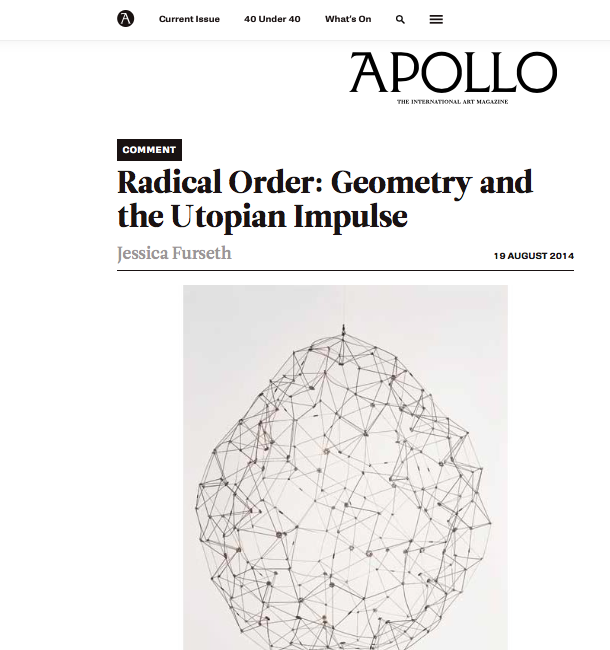
In “Radical Geometry”, the works of artist Gego (Gertrude Goldschmidt) provide a similar experience. Using wire and found objects, Gego joined her Venezuelan contemporaries in creating optical illusions, meaning the art changes depending on the viewer. “Sphere” seems to be floating in air, impossibly connected at each joint, so simple and yet so pleasing to look at. On the floor, the shadow is its own experience, unrecognisable yet inseparable from the original.

The sense of order and possibility in geometrical art comes in part from the mathematics at the core: the angles, the slots that fit. We are attracted to these shapes because they are natural to us: “Magnetised Space” showed how we have an instinct towards geometry through a still from Pape’s film, where a street performer dances in the middle of a crowd which has formed in a perfect circle around him. It is like the dancer is magnetic, attracting the crowd and repelling it at the same time, with geometry as a human impulse.

The link between radicalism and geometry was thoroughly examined in the “The Utopian Impulse”, the elegantly titled Buckminster Fuller retrospective at the San Francisco Museum of Modern Art in 2012. The futuristic designer called himself a radical idealist, dreaming up fantastic solutions to humanity’s problems. Prone to geometric designs, Fuller patented his solutions for energy-efficient housing and uniquely fuel-efficient cars, even lunar colonies, in his kooky style that left you feeling like anything was possible.

“The Utopian Impulse” included the 1969 “Earth Flag”, made by Norman La Liberte and John McConnell; it’s a grey and white planet on a blue background. Few artists today would present the idea of world unity in such a simple way as it feels distinctly nostalgic, like a throwback to simpler times. But considering how geometry, a fundamentally appealing visual language, keeps emerging in the artistic landscape, we still cannot help our impulse towards some kind of utopia. Looking at Gego’s hovering spheres, or Pape’s floating threads, we are swooning over the chance to create order in what we see.

We are islanders: Interview with Alicia Eggert

Lionheart Magazine, Home issue, 2014. Original article.

islanders1We are islanders: Interview with Alicia Eggert
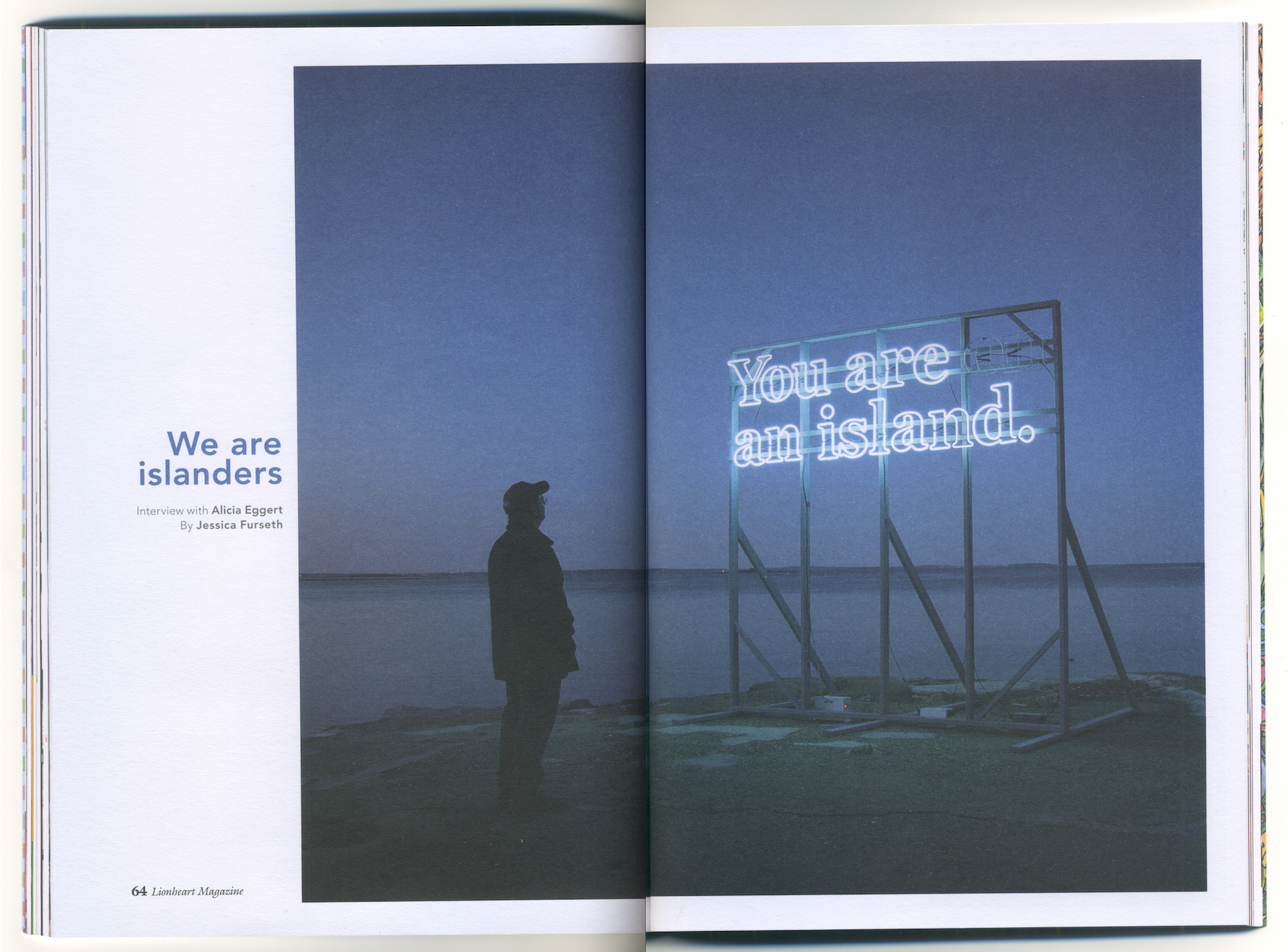
“You are on an island”, reads the sign, in bright white neon lights. Then it flashes, and suddenly the message is different: “You are an island.” It’s so simple, yet the philosophical implications are severe. And it’s not like Alicia Eggert hid this work away in some gallery. Instead she, along with co-conspirator Mike Fleming, rigged it onto a lorry and took it on tour, first in the US, then in Australia and the UK. Unsuspecting bystanders would get a dose of existentialism right in the face as the lorry drove up the High Street. Does Britain feel like an island? Or is it the the world that’s the island? The poet John Donne said it first: “No man is an island, entire of itself.” This is true, but don’t we each live alone inside our heads?

Light and language are repeating features for Alicia Eggert, who lives in Maine, USA. Time is another, as several of her works have a kinetic element: watch the rotating blocks and every so often they spell out a word: “NOW”. Then it’s gone, but it will be back. A drum is rigged to sound out the number of heartbeats of the average person, and we know the instrument will “die” when the timer runs down. A clock has 12 functioning hands, so it’s always all the time. Asign in the middle of a beautiful scenery that reads “Panorama”. All of it is so basic, on the surface. But just on the surface, though, because where do moments go once they’ve happened? Why do we forget that life isn’t a state but a motion? And what is time anyway? See, that’s what Alicia does: she gets you going.

Jessica: Your work is based on strong, clean ideas. Is it important to you that the viewer gets what you are trying to communicate?
Alicia: It has always been very important to me that my work can be understood by all people on at least some basic level. As a conceptual artist, my work always begins with an idea, and the materials I work with are chosen based on their ability to communicate a concept as clearly and concisely as possible. I think this is why text has become one of my primary sculptural materials. Words are like found objects – they are easily recognisable and accessible to anyone who speaks the same language and has the ability to read. But single words can have many definitions, so they also have the ability to possess great depth and complexity. One word can be both simple and profound. My art practice is founded on my own sense of wonder, and my personal goal is to create works of art that inspire a sense of wonder in others.

J: Time is a recurring topic for you. It feels like time passes at a different pace depending on the situation – I realise that’s impossible, but I’m not always convinced.
A: I think each one of us lives in our own little time universe. Some people live at a significantly slower or faster pace than the majority, usually without even realising it. Culture is definitely an influence, but I think it’s more individual than that. Time varies from person to person.

J: “You are (on) an island” – I love this. Do you think living on a massive continent like the US, as opposed to an island like Britain, makes people different characters? Or is being an islander a state of mind.
A: This work can be interpreted very literally when shown on geographical islands, but I think people can also live on metaphorical islands … ideological islands or political islands. I can never really know what it’s like to be an islander in the literal sense, since I was born and raised in the US. But what I love most about this sign is the way that it forces you to zoom out and consider the bigger picture. Even continents are islands on a planet whose surface is 70% water. And if you zoom out even further, our planet is an island in a vast universe. The sign highlights the sense of isolation we all sometimes feel as individuals, but it also emphasises how that feeling is something we all have in common.

J: Does working with the same ideas across several projects feel satisfying? Or is it frustrating because the questions are never fully answered.
A: It’s actually very satisfying. Because I’m not trying to answer any questions. I’m trying to figure out a better way to ask them.

http://www.aliciaeggert.com

lionheart6

A London Particular

This Recording, June 2014. Original article.

Screen Shot 2014-06-12 at 14.56.45A London Particular
I know what it’s like to live in a place where nothing ever happens, and West London is nothing like that. I know what it’s like to live in a place where you can’t choose your friends because there are only 300 souls in the village and no public transport, and this is certainly nothing like that. There’s a Tube station ten minutes up the road from my flat, and the world is just there. But it’s not East London.

The window in my old bedroom in Hackney, out East, would open onto the tiny, overgrown garden nestled in between the two rows of terrace houses. There were birds and chattering neighbours and the faraway hum of traffic; I’d lie on my bed, which was exactly the same height as the windowsill, with my head out the open window. The feeling was one of a secret patch of quiet. My current living room in Isleworth, out West, has a window wall with a door that opens out to a terrace, which would be nice if only there wasn’t so much traffic.

It takes me an hour to get to Soho now from the Isleworth flat, straight on the Piccadilly Line, crammed in with the crowds from the airport. The quickest way to get into Soho from my Hackney house was to walk down to Dalston Kingsland and get the Overground, and the city was there in half hour flat, via Highbury & Islington. My favourite route though, was to walk to the bus stop on Newington Green, which was about the same distance from the house but took you into a completely different part of the city. The leafy backroads were quiet, surrounded by houses made from that yellow brick you see all over East London. Always so much green, so many flowers.

I moved to West London for a good reason, for the only reason I’d ever have even considered it. The man I married has always lived this end of town, first for being a child here and second for working here. Before we really knew each other I expected the hour-and-a-half trek between our houses, between our London villages, to eventually become too big of an obstacle, but as it turned out, not his time. Marriage is different. Actually, let me rephrase that: marriage means that the relationship is different. It wouldn’t work with just anyone.

Because everything else about getting married has been great, but this West London thing … I thought I’d get over it, but I’m not. I’m really not, I know it’s bratty but I can’t help it. I remind myself that this really isn’t that bad, that none of the issues are actually problems, but still, I can’t shift the feeling that this is all wrong. West London is too slick; I miss the grit. This nostalgia is unusual for me, as I’ve lived in ten houses in London before this one and I’ve never felt homesick for any one of them. I even left a whole country once and never looked back: once I’ve left, that’s it. But as it turned out, not his time.

This is England, and nowhere else is this humid. It’s never more noticeable than when I get off an airplane, having spent time somewhere invariably drier; the humidity descends like a second skin the moment you step onto the jetway. The constant mugginess makes the city feel raw in the winter and sticky in the summer, exaggerating the natural direction of the temperatures. The icy fog seeps into your bones in the winter; it’s a London particular, rough and punishing. In the summer the damp heat does the same, but it’s mellow, reminding is why we love the city the way that we do.

East London is not that far away. And West London is really not that different. But home is a feeling.