Anne Boden takes flight with Starling Bank

FusionWire, 2015.

Screen Shot 2015-10-22 at 12.36.43Anne Boden takes flight with Starling Bank

At the heart of the new mobile-only Starling Bank is Anne Boden, whose experience and conviction may just be the thing to create a brand new current account.

Anne Boden isn’t starting a bank – she’s starting a revolution. At least that’s how she’ll make you feel after spending an hour in her company, discussing the next-generation Starling Bank in her animated and energetic manner. This is a mobile-only bank, but there’s a lot more to it than that, and Boden will tell you all about it. Or more precisely, the CEO will ask you questions about your bank experience to make you realise that you’re not happy with it, not one bit – you just haven’t been able to articulate it before, because you didn’t realise it could be any other way.

We’re sitting in Starling’s offices, currently found in the duller parts of Clerkenwell behind a door with no sign. The bank is still in startup mode, says Boden, who started Starling in January 2014. They won’t provide details about funding, but right now they’re building their stack and getting a banking licence, with the launch set for next year. But before we get to that, I have to ask – why is Boden doing this? She’s had almost 30 years’ experience in banking, working herself up the ladder in a number of household names before becoming Chief Operating Officer at Allied Irish Bank. Life must have been pretty comfortable?

Boden looks at me for a moment before bursting into laughter, thrilled. “You’re the first to actually ask this!” She thinks for a bit. “Somebody said to me, ‘You’re trying to prove that the current model is broken and it’s possible to do something really different.’ A lot of people have this concept, but I have the execution capability,” asserts Boden. To put this in context she takes me back to the beginning, to after she’d graduated from computer science and chemistry at Swansea and joined Lloyd’s Bank in the early 1980s. “I was in a branch for a couple of months, doing my traineeship. Then I became one of the architects of the CHAPS system. I went to Standard Chartered and was Head of IT and Operations. I became a consultant, I did an MBA, I went front-of-office. I joined UBS and went to Zürich. I went into a big insurance company and started doing lots of work with boards. I went to work for ABN Amro Bank as head of transaction banking for EMEA, and joined RBS [when it] bought ABN Amro. Then the financial crisis happened.”

The reason Boden is telling me all this is partially to illustrate how she has a lot of experience in an industry that’s rich with rules and tradition. But the world changed after the financial crisis, and Boden realised this when she would go and give advice to RBS clients: “I was in a big corporation, running thousands of people and billions in budgets, but [here were these] start-ups, creating huge amounts of customer value for hundreds of thousands. This shocked me! I realised I was learning more from them than they were learning from me.”

New ways of thinking about banking
Boden spent a year talking to people all around the world about what they were doing post-crisis, and what was happening in technology. She joined Allied Irish Bank after their bailout and successfully applied several of the things she’d learned there. “But there were things I couldn’t do. I spent my summer holiday in 2013 going around the world, talking to big banks. And I came to the conclusion that everybody had the same problem: they were moving transactions from branches onto mobiles, but the technology wasn’t coping with how people were using it.” So once Christmas rolled around, Boden had made a decision: the only way to really fix things was to start from scratch. There were three factors making this possible, she says: the regulation for getting a banking licence had changed; people were ready to do much more banking on their phones; and the technology was there to enable it.

But, I ask, did she do this because she wanted to, or did she feel there was genuinely no other way? “All of a sudden, it was as if all these forces were coming together. There was nothing else I could do. I could see the problems big banks had, I could see that technology was enabling it, that the regulations had changed. And I could do it!” She laughs. Other people had the idea too, she adds, but it’s not a simple thing to do: “You have to be able to run a bank, to start a bank. You also need to be creative and have courage. So I thought to myself, ‘I want to do this’.”

Back in the present day, Starling Bank has finished its architecture, its big picture plans, and is working on the “detailed discussions” about functionality. The app exists, confirms Boden, but she hesitates when I ask if I can see it: “We haven’t really shown anybody our app!” She looks at me for a moment, before deciding to show me a little bit. She opens the app on her phone, talking me through the quick sign-up process. She lists a number of things the app can do, many of which are intriguing – but it’s still kept under wraps so let’s just say the app will have lots of links to other parts of your life, to help you plan and organise.

“You shouldn’t be asking people what they want from their banks, because it doesn’t get the right answers. So instead you ask, ‘Would you mind talking about the accounts you have and how you use them?’ […] People are trying to find ways around the system,” says Boden, explaining how people will do things like move cash around to avoid getting stung with fees. “What we’re trying to do, is solve people’s everyday problems with money.” Take how we’re used to being charged when direct debits bounce: “But Google doesn’t charge you when they reject spam. It’s a transaction, so why should you be charged?” She looks at me, clearly knowing what I’m thinking: that this comparison makes sense, yet it’s not at all how we’re used to thinking about banking.

The start-from-scratch advantage
While it’s clear that Starling wants to make technology work for people, rather than the other way around, I still can’t help but wonder: why can’t the existing banks do this? “Okay. You have all these things available in the rest of your life, so why don’t they exist in banks?” The problem, says Boden, is that standard banks are serving multiple customer groups, selling not just current accounts but also savings, loans and mortgages. All these systems are interconnected, and they’ve been consolidated over many years.” So the typical bank will have, say, 30-40,000 different systems,” says Boden, adding how one major bank has 60 systems just for payments.

Replacing all these systems is vastly expensive and time-consuming, explains Boden, with very few banks having taken the plunge. Because the risk is significant: “People expect a banking system to work 24/7, so there’s no tolerance for it not working.” Then there’s the fact that it’s taken half a dozen years for the few banks who’ve dared the transition. “So instead of replacing the system, they keep adding. And it gets worse and worse and worse.”

It’s certainly not impossible for a major bank to solve its technology problem, says Boden: “But it’s much easier to start fresh.” Having no customers to convert is the best as well as the worst thing about that, but Boden doesn’t seem too fazed by the looming task of having to convince people to change their current accounts: “We’re focusing on people who live their lives on their mobile and are focused on getting the best technology in all walks of life.” There’ll be a phone help line, plus an arrangement for that one time a year when you need to pay in a cheque, but Starling isn’t chasing people who want to spend a lot of time in branches. Not to mention that most people don’t go into branches to deal with their current account, says Boden – they do so to deal with other banking products like loans or mortgages. Starling won’t do any of that, partially because Boden doesn’t really think the cross-selling model is viable anymore: “We believe the majority of people are quite self-directed now. In the old model, you sold a current account and then you tried to sell lots of other products. But we think people are a little more sophisticated now, making up their own minds.”

That also means Starling has no need to own its customer data: “We believe the customer’s data is their own, and shouldn’t be used to cross-sell other products.” Bank data and how it should be used is a big topic right now: “But shouldn’t it be all about helping you manage your financial affairs?” This is an interesting point of view, especially as Starling’s app will let people link their bank account to lots of other personal information across the internet. “We’re working on how people can have the convenience of that linkage, but with the security of being a bank.”

Making Starling feel genuinely different is a key motivating force for Boden, who finds there’s no real difference between the existing High Street banks: “But if there was something really inspiring that was different, it would apply to a certain segment of the population. If you can focus on what people really want – that’s the difference.” You can see how this model could potentially become popular with people in the street, but what does her old industry colleagues think of her bold new venture? “Oh, what do they think?” Boden pauses for a moment. “I’d spent the last ten years trying to convince everybody that the current model is sustainable. That we could just carry on, go through the crisis and come out the other side and nothing would change. I came to the conclusion that wasn’t possible. People are changed! People are not tolerant of banks anymore. They’re angry.” Technology and regulation have changed too, she adds, so it’s time to change the banks: “You have to be highly relevant to your customers. Otherwise, you cease to exist.”
The hottest little bank in town is an app called Mondo

FusionWire, 2015.

Screen Shot 2015-10-22 at 12.36.36

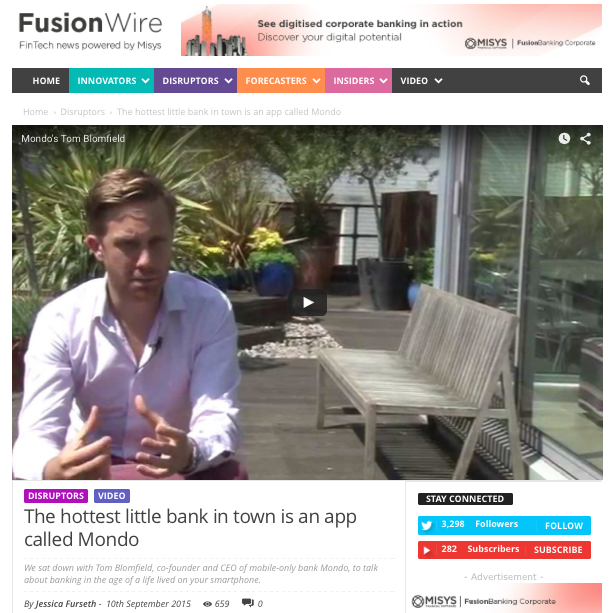
The hottest little bank in town is an app called Mondo

We sat down with Tom Blomfield, co-founder and CEO of mobile-only bank Mondo, to talk about banking in the age of a life lived on your smartphone.

Mobile-only bank Mondo is a young company, even in startup terms: Tom Blomfield and his four co-founders have only been at it since February. Intrigued by a few tweets and blog posts hinting at what’s in the works, I asked Blomfield for an interview, and to my surprise he accepted. Because what can there really be to talk about this soon? Is it even possible to build a bank in five months?

The answer to this question is yes – the app is up and running, and the first Mondo debit cards have been issued. But the answer is also no, as Mondo is very much a work in progress: the app changes daily. “We’ve built a core banking system!” says Blomfield. “We have our own service and infrastructure, and the app runs on top.” This do-it-yourself approach means there’s plenty of freedom in building Mondo: this bank can go in any direction dreamt up by Blomfield and his team of merry coders.

The CEO and I are sitting on the roof of White Bear Yard, Passion Capital’s buzzy co-working space in Clerkenwell. Passion provided the “low millions” seed funding for Mondo in April, although Blomfield reckons it will take a couple of years and £15 million to get Mondo fully up and running. “We’re not even perfecting Mondo, we’re still very much building,” says Blomfield. “One thing we really believe in as a company, is being very transparent and close to our customers. We don’t want to go away and hide for two years before saying: ‘Here’s what we’ve built, does anyone like it?’ Instead we’re really open.”

It makes sense: a mobile-only current account bank for the smartphone generation begs an interactive process. “We’re trying to provide a bank account for the kind of people who live their life on their smartphones, and get angry when stuff takes more than five seconds. Like me, basically!” Blomfield laughs. But it’s right on trend: the people used to Uber rocking up within minutes, and same-day deliveries from Amazon, aren’t going to want to queue in a bank branch.

Blomfield opens the Mondo app on his iPhone. “My balance is 300-odd quid,” he says; for now, the Mondo debit cards have to be pre-loaded with cash. “You can see I bought my breakfast at Pret,” he says, as transactions are updated in real time. Blomfield taps it: there’s Pret on a map, and the tag #breakfast. “Or you can use the tag #expenses and then click ‘export’, immediately generating an expense report, with no work.”

There’s more: if you forget to touch out with your Oyster card, Mondo will invite you complete the journey on TfL’s website and avoid the fine. If your electricity bill is higher than usual, the app will invite you to investigate with a call to customer services. You can cash in your loyalty points right there in the app – the examples go on. “You start with all the basic data: what you spend, where, with which merchant. Then you move on to insights, some sort of learning. But the third step no one has got to, is action. Because we’re building a full bank, we can actually let people take action. That’s where the internet is really going.”

Blomfield’s enthusiasm for Mondo is infectious. I eye the app jealously: my bank’s app doesn’t do any of this stuff. A mobile-only bank was bound to be fun, with features like adding emoji to transaction fields, but this looks like it could actually be really useful. This bank would be less a walled garden, and more a financial hub with direct ties to the rest of your life. It turns out my reaction is pretty normal to seeing the app: “It’s often: ‘When can I have it!’” Blomfield laughs.

The banking community is starting to be won over too, now that Blomfield has a working app to show them: “Before we had the app, the reaction was very much things like: ‘Current account banking is just a commodity!’ ‘No one will switch accounts, it’s not interesting!’ And then we showed them the app and now the reaction is: ‘Oh s**t.’” Blomfield laughs again. But the reaction demonstrates the radical nature of the Mondo proposition, as a current account has always been a static place. “We’ve put a whole level of intelligence on top of it. And they say: ‘Oh my god. This is what people have been talking about for 15 years.’”

So if this idea has been knocking about for a decade, how come it’s not been done? This is a complicated issue, says Blomfield, whose team of co-founders include alumni from Allied Irish Bank and ABN Amro UK. There’s no shortage of innovation teams at the established financial groups, and they’ll come up with crazier things than Mondo: “But they are structurally unable to deliver it.” One reason is cultural: “[Established banks] don’t have a culture of regularly building and shipping features.” Then there’s the fact that many banks operate with off-the-shelf software, which, argues Blomfield, provides limited abilities for customisation. “Then there’s the old legacy banks out there who have decades of accumulated technical debt. Their systems are like Frankenstein’s Monster! … We’re different because we have a team of engineers sitting downstairs who actually write code, every day.”

Mondo is currently halfway through its banking licence application. The hope is to have a license with restrictions in about six months’ time, and a full launch sometime after that, probably in about a year. “But we have a working system, and we’re going to roll out debit cards to a few thousand people this summer. It will be based on our technology, but in the short term we’ll be partnering with another bank to provide the license.”

If all this sounds ambitious, it’s worth noting this isn’t Blomfield’s first time at the rodeo. The 29-year-old started and sold his first company, Boso, while reading law at Oxford. He then grew his second financial startup, GoCardless, to a company processing $200 million low-cost direct debit transactions annually. So what’s it like, doing this again with the added experience?

“It lets you be more ambitious,” says Blomfield, referring to how he worked with Passion Capital for several years at GoCardless. This meant his bold plans to launch a brand new bank were actually given the time of day: “Instead of saying: ‘Get the hell out!’, they said: ‘Okay, that’s interesting. Tell us more.’ … It feels like a step up in terms of ambition. It feels like this is the big one.”

He has a point: after starting a bank, how can you top that? “I can see myself spending a good proportion of my life on this, if it goes well. But it feels like this has been a long time coming: banking is so fundamentally broken. It hasn’t changed in 30, 40 years.” There are potential problems ahead for Mondo of course, but not the ones “traditional” bankers see: “The technology and licensing are serious undertakings, but they are pretty well known. Making something people really want is the biggest challenge, for any start-up,” says Blomfield. “You only really know by getting [the product] into their hands and seeing their reaction.” And Mondo won’t be for everyone: lots of people like having a branch. But this isn’t for them: “This is a bank for people who live their lives on their phones and hate waiting for anything. And if that means only addressing a third of the population, that’s fine: that a lot of people!”

That could actually end up proving a conservative target market for Mondo, judging from figures from the British Bankers’ Association: mobile banking has eclipsed not just branch-based banking, but also web banking, this year. Having said that, there’s no doubt that Blomfield is fully aware of the blue-sky potential for Mondo: “I think banks have an extinction event on their horizon. I want to be building the kind of company that replaces them!” He laughs again, but you can tell he’s serious. “I love technology. I love the way it can just make everyday life much, much better. … Sometimes it feels like we’re living in science fiction. It’s incredibly exciting.”

Ten top health tech innovations

BusinessLife, September 2015. Original article, p57-60.

Ten top health tech innovations 

BL1

Vital signs monitoring patch
One day, a little sticky patch for monitoring life signs may become standard for anyone who enters a hospital. That’s the hope for SensiumVitals from Toumaz Group, the British semiconductor company, which is currently undergoing clinical trials. “Our product is targeted not at intensive care, but at patients where monitoring is a manual process every 4-6 hours,” says Anthony Sethill, CEO of Toumaz. “We believe there are many clinical situations where continuous monitoring would be more effective clinically, and therefore economically.” For example, up to 30% of patients develop complications after gastrointestinal surgery. Being able to continuously monitor patients would not only mean catching problems quicker, but also that people could go home sooner and have vital signs transmitted remotely. Both these things are likely to increase patient comfort, and save money for the NHS.

Patient-controlled social networks
It’s not quite Facebook, but for people with Crohn’s Disease and other inflammatory bowel conditions, Crohnology.com is a lifesaver. Established in 2011, this network lets users trade information about symptoms and treatments. Crohnology.com is closely monitored by the medical estanlishment as an example of a patient-controlled social network, where people take charge of their own treatments. “This has very quickly become a global community of people sharing information about their conditions. They in turn talk to the clinicians treating them, and that has improved the dialogue globally,” says John Farenden, Director of EY’s ‘Let’s Get Digital’ initiative, which aims to support and accelerate the use of digital technologies in health and social care. “Using basic social media tools, this has made a huge impact on the lives of tens of thousands of people.”

BL2Cancer-detecting garments
Talk about a literal interpretation of wearable technology: Cyrcadia Health has developed a bra that can detect cancer. The garment is embedded with patches that track changing temperatures in the tissue, which can be indicative of tumour growth. Early trials showed a 87% success rate in detecting tumours, including in dense breast tissue where small lumps can go undetected. The idea behind the garment is not to wear it all the time, but to to provide simpler and more comfortable screening methods than some of today’s more invasive procedures.

Home dialysis
It’s the Nespresso of dialysis: Quanta Fluid Solutions is developing a compact, portable dialysis machine that people can use themselves. This could be a significant money-saver for the NHS, as people could have dialysis in the comfort of their home. “A percentage of patients are suited for home-dialysis, once they’ve been trained. We know that would save the NHS about £15,000 a year per patient,” says Martin Hunt, a Director at the NHS’s National Institute for Health Research (NIHR). Hunt heads the NIHR ‘Invention for Innovation’ programme, a translational funding scheme aimed at advancing healthcare technologies. The NIHR, whose funds only go to companies with proof of concept after robust screening, has funded Quanta twice: “Research teams need to take into account not just the medical impact, but also how new devices can provide value for money,” says Hunt. “If you get better patient outcomes, generally speaking, there should be some associated cost saving along the clinical pathway.”

Nanotechnology targeting treatments
Sending microscopic devices into the body to treat illness in a non-invasive manner is a science fiction dream that’s quickly becoming real. Earlier this year, researchers at the University of California successfully delivered treatment projectiles into the stomach of mice, in an effort to explore whether we can do this to treat stomach problems like ulcers or gastritis. A similar principle is behind antibody-drug conjugates, which are already being used to treat patients: a molecule-scale payload of cancer drugs is delivered directly to tumour sites, leaving the surrounding tissue undisturbed.

BL33D-printed body part replacements
Earlier this year, 3D printing technology from Stanmore Implants was used to create a replacement pelvis for a patient who’d lost his to cancer. The new part could be made more precisely with a 3D printer than standard methods. Another UK company using 3D printing to create body parts is Fripp Design and Research: their technology can create soft tissue organs like eyeballs, noses and ears, all based on scans from the patient. “3D printing now allow us to create new body parts, so the technology is actually no longer the problem,” says Farenden. “The challenge now is how we make best use of it and improve the outcome and experience for patients, as well keeping an eye on cost.” In an effort to make the product more commercially viable, Fripp has become the first company to use 3D technology to print directly in medical-grade silicone.

Lab-on-a-Chip
Imagine a USB stick which contains a whole laboratory – this is Christofer Toumazou’s Lab-on-a-Chip. It may sound impossible, but the tiny device provides quick results to medical tests, and can analyse DNA within minutes. Without the need of a laboratory, Lab-on-a-Chip can reveal how large a dose a patient needs of a particular medication, or whether they’re at risk for genetics-based diseases like diabetes or cancer. The technology, now being developed by DNA Electronics, could one day mean doctors looking into our future to treat us, not just our past. “Tying the genome to different risks associated with cancer is likely to become increasingly significant,” says Sethill at Toumaz. (Toumazou is the founder of Toumaz, but the company is not involved Lab-on-a-Chip.) “You could then use the collected data to understand which drugs give the best results, using millions of data points,” says Sethill, who predicts Big Data and analytics will become increasingly relevant in healthcare prevention.

Tissue repair wands
On Star Trek, they called it a medical tricorder: a device that heals skin and bone instantly. Here on earth, Mark Bass at the Department of Biomedical Science at the University of Sheffield has created a small handheld ultrasonic emitter that accelerates tissue repair. It’s not quite sci-fi, but the device can reduce healing times by up to 30%. That means the patient is more comfortable, and there is less chance of infection. The researchers have been able to reverse certain healing defects caused by diabetes, age and congenital disorders, and hope to soon be able to prevent the formation of chronic wounds.

BL4Video games for stroke rehabilitation
Therapy becomes play when necessary yet tedious exercises are made into a game. Looking to help stroke victims regain functionality in their arms and hands, Limbs Alive has created a Wii-style video game. Over 100,000 people in the UK suffer from strokes each year, and up to 80% never fully regain the use of their limbs. Therapeutic video games is a growing area for the NIHR, says Hunt: “We insist on patient involvement throughout the development process. It’s one thing to have a solution using a tablet computer, but for elderly patients with mobility issues, that may not work for them.” Effective video game therapies can mean reducing the cost of treatment, not to mention making a frustrating processing a little more fun, so the patient is less likely to give up.

Wearable pain relief devices
The relief of chronic pain is a big promise, but that’s what Quell does. This device from NeuroMetrix uses non-invasive nerve stimulation to tackle pain, kicking in within 15 minutes of putting on the device. A single charge provides 40 hours of relief, whether it’s back pain or nerve-related aches.. Quell was a hit at 2015’s CES, the consumer electronics tradeshow usually dominated by the newest phones, but there’s increasingly more crossover between mainstream gadgets and health, says Farenden: “Consumer technology businesses are pushing on with technologies to improve health, as we see with things like Apple Watch and Jawbone.” The jury’s out on whether the cost associated with these gadgets are actually translating to better outcomes: “But we will see people increasingly using those technologies to better understand their own health.”

BL cover

Agnes Martin at Tate Modern

Apollo Magazine, July 2015. Original article

Screen Shot 2016-07-03 at 15.33.54

Agnes Martin and the singular obsession

What is Agnes Martin trying to say? If you really want to know you will have to go see for yourself, because rarely does art lose quite so much in a photograph. Even once you are there, it takes a moment to work out what is going on: the Tate Modern retrospective of the American artist demands a certain commitment. Because as Agnes Martin once said: “Beauty is the mystery of life. It is not just in the eye. It is in the mind.”

At first glance the surfaces are plain – beige, grey, muddy yellow – but take a moment to slow your breath and much will be revealed. Do not expect the titles to be much help though: “I love the whole world” is one, another is “Happy holiday”, and so it goes, as if she is mocking our instinct to look for clues. Agnes Martin is not a thought – she is a feeling. This is the softest geometry, and the mellowest company you will keep today.

The exhibition runs chronologically, from Martin’s initial shapes in muted colours to the signature grids, which she started in the 1960s and stuck to for the rest of her life. For a body of work that is so meditative, Martin’s art also has a distinctly obsessive streak: she used a ruler to create her lines and blocks, always trying to get it straighter, more exact. Many of the grid paintings have tiny repetitive patterns – it is as if you can feel her there, straining so hard to get it just the way she wants it.

Martin’s extreme desire for order on the canvas can possibly be traced back to her schizophrenia, which she suffered from throughout her adult life. Sometimes this contrast can be felt on the canvas: the picture is a wish, the painful flipside or reality. But other times the same process creates a result that is nothing short of magical; “Friendship” is a large-scale canvas covered in gold foil, laid out in bright and deliciously dirty rectangles. It is still subtle, like everything Martin does, but the effect is a shiver down the back. “A grey stone” is another wonderful experience: the closely detailed grey surface transforms gentleness into thrill.

More blocks of would-be dull colours follow in the next room, but by this point we are primed to love it: pale grey, pale beige, off-white; small rectangles, dots, tiny squares. Then a whole section of graphite grey, in what starts to feel like obsession – what is happening here? The answer comes in the next room, where obsession turns into worship with the series called “The Islands”. Now the canvases are all in white, over and over, surrounding you, and the effect is nothing short of elating. The paintings glow from the slightly darkened walls, and it feels like the problem Martin has been working so hard to solve has reached some sort of resolution. The answer, it feels like she is saying, is in the light.

Martin’s journey towards a single colour brings to mind another Tate Modern retrospective: Mark Rothko in 2008-09. But while Martin’s journey of simplification culminates in bright white, Rothko ventured in the opposite direction: he moved through colour towards a room of canvases in intense black. What both conclusions have in common is a feeling of reaching answers to inner turmoil; “We favor the simple expression of the complex thought. We are for the large shape because it has the impact of the unequivocal,” Rothko wrote in his New York Times manifesto, co-signed by Adolph Gottlieb. “We wish to reassert the picture plane. We are for flat forms because they destroy illusion and reveal truth.”

Rothko’s journey ended differently than Martin’s: he committed suicide at 66, while Martin kept painting into old age, passing of natural causes at 92. For both artists, their Tate Modern retrospectives present one more room after their singular colour experiences, and in both cases the final insight feels revealing. For Rothko, it was the reintroduction of light: subtle panes of silvery grey started creeping into his black canvases, insisting that maybe there is more than one answer. For Martin, it is the breaking with her strict geometry: bold blocks of purple, defiant lines of red, cheeky tips of acidic yellow. It is still precise and exact, but it feels less obsessed and more playful. It feels like the work of someone with nothing to prove and nothing to lose – it feels like a wink, is what it does.

Lynn Hershman Leeson: Origins of the Species (Part 2)

This Is Tomorrow, July 2015. 

Screen Shot 2015-07-01 at 16.05.09Lynn Hershman Leeson: Origins of the Species (Part 2)
Modern Art Oxford, 2015

What is technology, but another tool for shaping our identities? Lynn Hershman Leeson has been exploring the relationship between humans and technology for over 50 years, starting in a time before technology looked anything like it does today. Her multi-disciplinary approach remains pioneering, and if Hershman Leeson is a so-called digital artist, it’s is done with much subtlety. That’s also why it works: the digital element is here to enhance the idea, not an end in itself.

The retrospective at Modern Art Oxford shows a distinct thread running through Hershman Leeson’s work, from today’s interactive pieces all the way back to the earliest drawings. The show runs chronologically, easing you in with paintings of wired figures and their shadows, the first dated to 1962. The Breathing Machine makes subtle noises in response to people passing, a mechanism which was groundbreaking at the time and eerie still today. It feels like there’s someone here with me, and it’s possible that this someone is my own shadow: I’m the one who’s creating this presence.

The Roberta Breitmore archives stretch from 1974 to 1978, when Hershman Leeson created this fascinating alter ego, going great lengths to give this artificial character a complex inner life. From the photos, Roberta seems somewhat put on, with exaggerated make-up and what is obviously a wig – she’s a shadow that’s not quite right. “I saw her as a mirror of culture,” Hershman Leeson has said, but Roberta arguably became her own person. There are letters confirming her rental agreement, and Roberta’s notes to friends. Roberta left traces like a real person, but in retrospect, how can we tell what was real and what’s just a shadow?

All the while, the nearby Breathing Machine continues to make sounds. The idea of surveillance and monitoring takes on a more obvious shape in the Dante Hotel project, although the photographs from 1973 makes you wonder why we’re so muted in our outrage about surveillance today. We know we’re being monitored to a greater extent than ever before, in the street as well as in electronic communication. But for better or worse, it’s possible that privacy as a value in and of itself is fading.

Hershman Leeson’s early works take on new meaning as the visitor encounters Agent Ruby. Just like Hershman Leeson created Roberta Breitmore, we each have the opportunity to construct a digital persona in the manner of our choosing. Agent Ruby is a creature of artificial intelligence, and she invites you to talk to her via a keyboard. “Is the internet real life?” I ask, and she answers: “If it is, I’d be surprised.” We chat a little – she’s clever, and intriguingly philosophical. Sometimes she turns the question back at you, and I’m surprised how quickly I start to feel that Ruby is interested in me.

The third section of the show contains a film curated by Modern Art Oxford, where Hershman Leeson has interviewed Oxford-based scientists and researchers about genetic technology. The Infinity Engine is presented in an immersive space with photographs and paperwork pertaining to genetic discoveries. The scientifically grown ear in the picture – is it more or less real than Agent Ruby or Roberta? The microbiologist in the film is talking about evolution: “Biology can be very scary,” he says, explaining how we must take responsibility for what we create.

The Infinity Engine is ambitious in its attempt to explore a complex issues such as genetics, but it’s less approachable than the rest of the show and it takes a minute for a link to the previous works to suggest itself. But maybe anything can be a mirror of ourselves, from synthetic biology and Agent Ruby, all the way back to Roberta and the wired shadows in the earliest paintings. We create these representations and they can be whatever we make them, good or ugly. I get up from my seat after the film, and for a moment I can’t find the exit from the laboratory-like room. All I can see are the slightly warped walls, mirroring back to me numerous versions of my own twisted image.

Staycations in the London summer

The Billfold, June 2015. Original article

Screen Shot 2015-06-19 at 12.18.33Staycations in the London summer
I woke up by myself today in my little flat in Hackney. My husband is away for work, so I slept past 10 o’clock which I never do unless I’m alone. As much as I like company, I’m very good at being by myself, especially in London. Last weekend I meant to go to a neighbourhood book festival but ended up roaming around all day until it was dark, even though this is June, the lightest month.

Something like that might have happened again today, but my best friend K text me, wanting to meet for coffee. I said yes despite having to rush, because there’s never too much time to spend with K. I took the Overground to Whitechapel, which all of a sudden has plenty of good coffee, the calling card of an “up and coming” neighbourhood. K and I talked for an hour and I decide to walk home, taking the meandering route through the backstreets.

London is full of concrete, but I’ve never seen a major city that’s this green. There are trees and flowers everywhere, drooping over the brick walls and onto the pavements. This city is a very pretty boy right now. It’s been muggy lately but it’s warm, and before long you’re sweating under grey cloud. London is tough in the winter, but for six months over the summer, there’s nothing you can do to get me to leave the city. Right now, London is better than anything I can imagine.

*

“I’m an unrepentant Londoner, and the places that have chosen me – because I think it’s that way round: places choose you, rather than vice versa – have already done so. I think you only have room for two or three serious affairs of place in a lifetime, just as you only have emotional space for two or three serious love affairs,” said the writer Will Self.

I first read this a few years ago and I keep coming back to it. Familiarity isn’t enough to love a place, as I was familiar with the village I grew up in but it never felt anything like this. I’ve lived in London for 12 years now – it wasn’t love at first sight because this city is hard on newcomers, but if you stick it out, this place will reward you. I always say it takes two years to get on good terms with London, and it took me even longer to love it, maybe six years. That’s nothing like my experience of ever falling in love with a person, but make no mistake: London is it for me.

Most of the time it’s nice but nothing unusual, and then suddenly it’ll come over me: I’ll be walking along and I’ll look up and I realise that damn, I love this city. If I’m on a bus crossing the Thames, it’s bound to happen. Often though, it happens during the moments when London’s not so shiny, when I’m distracted or thrown off course. London has a knack for keeping you in that in-between space: a little hot, a little cold, leaving you guessing what’s coming.

Like the other night when I was out with my friend G. We just wanted to leave the house for beers, but suddenly we were wrists deep in barbecue sauce because that’s what Hackney is like now: cocktails and ribs. It was too cool to be wearing shorts down by the canal but we walked along anyway, shivering in the early London summer. Because isn’t this the best part? It’s so light, so much summer still to come.

*

I have a list in my head of things I want to do this summer, during the annual London staycation when I won’t leave the city. I want to go see Agnes Martin at the Tate Modern, and the summer exhibition at the Royal Academy of Art. I want go out to the Thames Barrier Park – this is the city’s flood barrier and a work of art. I haven’t been there in years as it’s a bit out of the way, but I want to go with my husband and a bottle of prosecco. I want to try this cocktail bar in Soho with my new friend R, and talk about work the whole time because sometimes that’s the best.

I saw a picture on Instagram from the Nunhead Reservoir recently, which apparently has amazing views of the city, a rare find in a shallow dish like London. I’ve never been to Nunhead. A few years ago, I went cycling up past the Hackney Marshes with the then-boyfriend who got me to finally buy a bicycle, and I’ve been wanting to go again ever since. There’s a grotty pub up the River Lea where you can get lunch, and even though the food won’t be great it won’t matter.

Sometimes though, the best way to go see the sights is having guests from out of town. When my mother visited recently we went to the London Transport Museum, which is brilliant: it chronicles the history of the Tube so it’s part trainset playground, but it’s also partially an archive of functional graphic design. Away from the rush hour, the Underground is a treat to explore, even after all these years – each line a different pattern of colours, each station a different style. I passed through Baker Street station the other day, on the platform that was part of the very first Tube line. The light wells are still streaming daylight down onto the platform.

I got out at Paddington, just onto the canal, which in West London is the same water that runs past my house in East London. It’s funny – I always tell people the key to London is to find your neighbourhood, that’s how the city will start making sense to you. I once spent three months not leaving Hackney, which would be easy to do again – like when I get Vietnamese on Kingsland Road with my friend C and we order the same things every time. There’s so much more to London than the patch where I live, but there’s a reason why I live here.

*

Last weekend I met up with K again, we walked along the canal up past London Fields, taking the long back around to my house. It’s quiet on the roads around here, away from the main stretch where the buses run. Heavy with green and flowers, and all the beautiful yellow-brick victorian terrace houses we can’t afford to live in. Then we came across this odd building made from corrugated iron plates, sticking out like a sore thumb in the row of pretty houses. It’s the Sight of Eternal Life church, said the internet, thought to be the oldest surviving “Tin Tabernacle” in the world. I took a photo and we walked on, but that’s the best part, I think: finding a piece of curiosity in a place I’ve lived for years, but somehow it’s something I’ve never noticed.

I took my mother on a long walk along the canal too when she was here, spending a whole day away from the London she knows from the pictures. Down past the canal locks and up through the market, into the park and down through the quiet back roads – I’ve walked this route so many times, and looked up to think, so many times, how much I love this city. Almost everything big that’s ever happened to me has happened in London. I know I keep saying things are the best, but there’s always something else about London that’s the best. Now how’s that for a love affair.

Physical thrill

This Recording, May 2015. Original article.

Screen Shot 2015-05-26 at 15.10.00In which we don’t believe in perfect
Physical thrill

There’s only a strip of canal visible across the courtyard, but that bit of canal is everything. I’m sitting at my new kitchen table with my laptop, looking up occasionally at the water: you can see the canal boats docked down there, and the ducks swimming by. Grown-up life is working out pretty well so far, I think, even though this flat that we bought is the tiniest thing. There’s no room for anything in here, meaning my husband and I are now committed to minimalism by default. But when we were looking for a place to live it soon became obvious: there’s no place like home. I wanted to go back to East London more than I wanted space, and when we found this tiny place in the perfect spot there was no turning back. Because who needs space when you’re living in the city? Everything you need is right there, outside.

I’ve been living in my new place for two weeks now, and I have to say it: I don’t think I’ve ever been this happy. Maybe when I got married, on a whim to a man I barely knew – I felt ecstatic then, the closest thing I’ve felt to a sober high. Maybe that time I went to San Francisco for a month by myself, when my jetlag would wake me early and I’d walk the streets for hours with a delirious craving for silence and forward motion I’ve never experienced before nor since. These thing stand out as the happiest I’ve been, and now this: living in my new place.

I didn’t expect to feel like this. I don’t really understand why it’s happening either – although I do know it’s not about nesting, and it’s not about ownership. I have no strong feelings about permanence. It may not even be about moving back to East London, I’m surprise to find. While the weeks dragged on as we waited to move, time slowing down until four whole months had gone by, then all I could think about was moving back across town. East London is where this city started making sense to me, it’s where my life started making sense, I guess. I left East London for good reasons, thinking it would become part of the past, like most things do once you leave. But not this time – I missed my old patch like a lost limb.

So I thought the excitement of moving would be all about coming back to my old neighbourhood, but it seems I was wrong. Because now that I’m in my new house, all I can think about is being alone. I love living with my husband, don’t get me wrong. It’s just that after staying with family for nearly four months while waiting to move into this place, being alone feels like a drug. My husband leaves for work and I sit down to work at the kitchen table, and hours go by when all I can do is revel in the aloneness. I’m drinking it in with a desperate thirst only an introvert can understand. I’m just sitting here, quietly, and it’s a physical thrill.

Being truly, gloriously alone doesn’t mean closing the door for a while – it means having no one else in the house with you. It means, at least for me, having no music playing, just the window open and the hum of the city in the distance. A plant needs watering. I get up from my chair and wander into the bedroom, over to the kitchen, over to the sofa, and back to the computer again. I work for a while. The afternoon sun crawls across the floor, filling up the room. A text message buzzes. My husband will be back soon, and we’ll have some dinner together. In the meantime it’s just me here, by myself, surrounded by the city. I don’t believe in perfect, but if I did, this would be it.

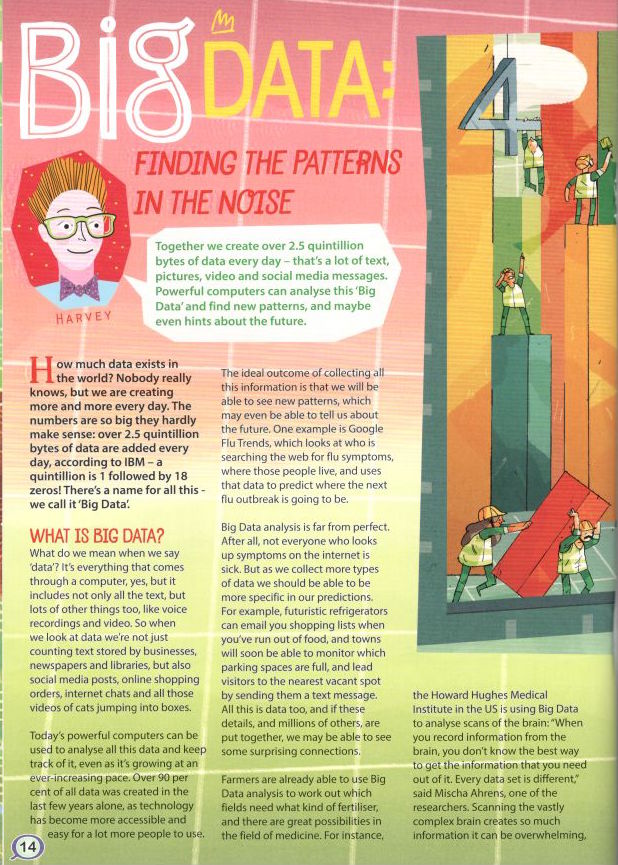
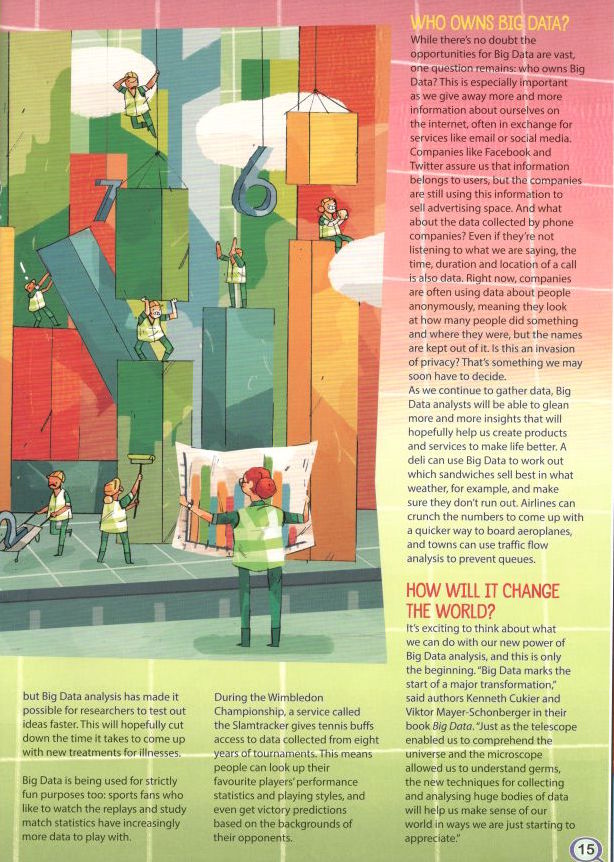
Big Data: Finding the patterns in the noise

Aquila Magazine (kids 8-12) – May 2015

Scan 3Big Data: Finding the patterns in the noise

We create over 2.5 quintillion bytes of data every day – that’s a lot of text, pictures, video and social media messages. Powerful computers can analyse this “Big Data” and find new patterns, and maybe even hints about the future.

How much data exists in the world? Nobody really knows, but we are creating more and more every day. The numbers are so big they hardly make sense: over 2.5 quintillion bytes of data is added every day, according to IBM – a quintillion is 1 followed by 18 zeros. There’s a name for all this – we call it “Big Data”.

So what do we mean when we say “data”? It’s everything that comes through a computer, yes, but it includes not only all the text, but lots of other things too like voice recordings and video. So when we look at data we’re not just counting text stored by businesses, newspapers and libraries, but also social media posts, online shopping orders, internet chats, and all those videos of cats jumping into boxes.

Today’s powerful computers can be used to analyse all this data and keep track of it, even as it’s growing at an ever-increasing pace. Over 90% of all data was created in the last few years alone, as technology has become more accessible and easy to use for a lot more people. The ideal outcome of collecting all this information is that we will be able to see new patterns, which may even be able to tell us about the future. One example is Google Flu Trends, which essentially looked at who was searching the web for flu symptoms, where those people lived, and used that data to predict where the next flu outbreak was going to be.

Big Data analysis is not perfect – after all, not everyone who looks up symptoms on the internet is sick. But as we collect more types of data we should be able to be more specific in our predictions. For example, futuristic refrigerators can email you shopping lists when you’ve run out of food, and a town will soon be able to monitor which parking lots are full and lead visitors to the nearest vacant spot by sending them a text message. All this is data too, and if these details, and millions of others, are put together, we may be able to see some surprising connections.

Farmers are already able to use Big Data analysis to work out which fields need what kind of fertiliser, and there are great possibilities in the field of medicine. For instance, the Howard Hughes Medical Institute in the US is using Big Data to analyse scans of the brain: “When you record information from the brain, you don’t know the best way to get the information that you need out of it. Every data set is different,” said Mischa Ahrens, one of the researchers. Scanning the vastly complex brain creates so much information it can be overwhelming, but Big Data analysis has made it possible for researchers to test out ideas faster. This will hopefully cut down the time it takes to come up with new treatments for illnesses.

Big Data is being used for strictly fun purposes too: sports fans who like to watch the replays and study the match statistics have increasingly more data to play with. During the Wimbledon Championship, a service called the Slamtracker gives tennis buffs access to data collected from eight years of tournaments. This means people can look up their favourite players’ performance statistics and playing styles, and even get victory predictions based on the backgrounds of their opponents.

While there’s no doubly the opportunities are vast, one question remains: who owns Big Data? This is especially important as we give away more and more information about ourselves on the internet, often in exchange for using services like email or social media without having to pay. Companies like Facebook and Twitter assure us information belongs to users, but the companies are still using this information to sell advertising. And what about the data collected by the phone company? Even if they’re not listening to what we are saying, the time, duration and location of a call is data too. Right now, companies are often using data about people anonymously, meaning they look at how many people did something and where they were, but the names are kept out of it.
As we continue to gather data, Big Data analysts will be able to glean more and more insights that will hopefully help us create products and services to make life better. A deli can use Big Data to work out which sandwiches sell best in what weather, for example, and make sure they don’t run out. Airlines can crunch the numbers to come up with a quicker way to board airplanes, and towns can use traffic flow analysis to prevent queues.

It’s exciting to think about what we can do with our new power of Big Data analysis, and this is only the beginning. “Big Data marks the start of a major transformation,” said authors Kenneth Cukier and Viktor Mayer-Schonberger in their book ‘Big Data’. “Just as the telescope enabled us to comprehend the universe and the microscope allowed us to understand germs, the new techniques for collecting and analysing huge bodies of data will help us make sense of our world in ways we are just starting to appreciate.”

Scan 4Scan 5


Who was Marie Antoinette?

Aquila Magazine for kids, March 2015.

Scan

Who was Marie Antoinette?
Marie Antoinette was executed in the French Revolution. But was the last Queen of France really as out of touch as people thought? And did she really say that people who couldn’t afford bread should just eat cake instead?

Marie Antoinette was born in 1755 in Vienna, as an Archduchess of the Austrian Empire. Baptised Maria Antonia Josepha Johanna, the girl was described as “small but completely healthy”, and had a happy childhood with her 15 brothers and sisters. Considering what was customary for a royal family at the time, Marie Antoinette had a pretty relaxed upbringing. The children were allowed privacy from the rest of the court, so they could dress more casually, learn from their teachers, and play in the gardens, often with regular kids.

In those days, royal marriages were tools for forging alliances between countries. For this reason, Marie Antoinette’s mother, the Duchess, decided her daughter should marry the boy set to become the next king of France. Marie Antoinette was only 15 when she was married to 16-year-old Louis, and the teenagers had never met when they were married in a ceremony where they weren’t even present. Before she left for France to start her new life, Marie Antoinette’s mother told her daughter to never forget she was Austrian, even when she was the Queen of France. But the French had other ideas, as young Marie Antoinette was made to get rid of all her Austrian belongings, even her clothes and her dog, replacing everything with French things.

Life for Marie Antoinette wasn’t easy once she arrived at the Palace of Versailles. As the Queen, she had to deal with everyone at court keeping an eye on her, gossiping about what she got up to. Her marriage to Louis was difficult, partially because the couple didn’t have children for eight years, something that caused a lot of speculation around the court. They eventually had four kids: Marie Thérèse, Louis Joseph, Louis Charles, and Marie Sophie, who the Queen was very close to as she took care of their upbringing and education herself.

But for all those years before her kids were born, Marie Antoinette had few royal duties, so she didn’t actually have all that much to do. As a young girl far from her family, the Queen spent much of her time socialising, and buying fancy clothes and jewellery. She liked to ride horses, but also enjoyed gambling on cards and horse races. At a time when France was struggling financially, stories about the Queen spending a lot of money were spread around, and criticised in the newspapers. The Queen and her friends, it was written at the time, “loved pleasure and hated restraint; laughed at everything, even the tattle about their own reputations; and recognised no law save the necessity of spending their lives in gaiety”.

As the first lady of the court, Marie Antoinette was supposed to set standards for fashion, so she’d buy a lot of new dresses, shoes, hats, perfume and makeup, sometimes even going into debt to pay for everything. At a time when many people were poor or starving, it looked bad that a woman who had so many luxuries would play dress-up with her friends, running around on a model farm dressed up as milkmaids and shepherdesses. This was considered insulting to real farmers, even though Marie Antoinette was probably just trying to fill her time, recreating the playful games of her childhood in Vienna.

While she did spend a lot of money, Marie Antoinette was certainly not to blame for all of France’s financial problems, as many people liked to say. The country was in debt mainly because of its involvement in the American Revolution, which cost far, far more than the Queen’s extravagant wardrobe. The royals’ money splurging did give the impression of being out of touch, but the social unrest in France was more based in the fact that ordinary people had to pay high taxes, while the richest people who owned the most land did not.

In the winter of 1788, the rising prices of bread led to a crisis in France, and Marie Antoinette was rumoured to have responded to the problem by saying: “Let them eat cake!” This wasn’t actually true, as Marie Antoinette gave a lot of money to charity and would have known better than to say something so silly. But people wanted someone to be angry with, and it was easy to blame the Queen had a reputation of spending too much money and not caring much about the people.

Once the French Revolution started in July 1789, the royal family quickly realised they were in danger and left the Palace of Versailles for Paris. Marie Antoinette tried to stay out of things and focus on her children, still hoping her son would become king of France one day. But as the revolution roared on, the monarchy was declared over and the royal family stripped of their titles. To make sure the King could never reclaim his power, the revolutionaries executed King Louis for treason, and as the Queen, Marie Antoinette suffered the same fate nine months later. She was 39 years old when she was executed by guillotine, after a rushed trial. Somehow, Marie Antoinette managed to get hold of a pristine white dress and bonnet for the occasion, determined to make a final impression of defiance. Her last words was to her executioner, after she accidentally stepped on his foot: “Pardon me Sir, I didn’t mean to do it.”

Scan 1
Scan 2


Michelangelo Pistoletto: The Mirror of Judgment

Whitehot Magazine, 2011. Original article.

Screen Shot 2015-02-16 at 12.08.11Michelangelo Pistoletto: The Mirror of Judgment

The Serpentine Gallery, London. 

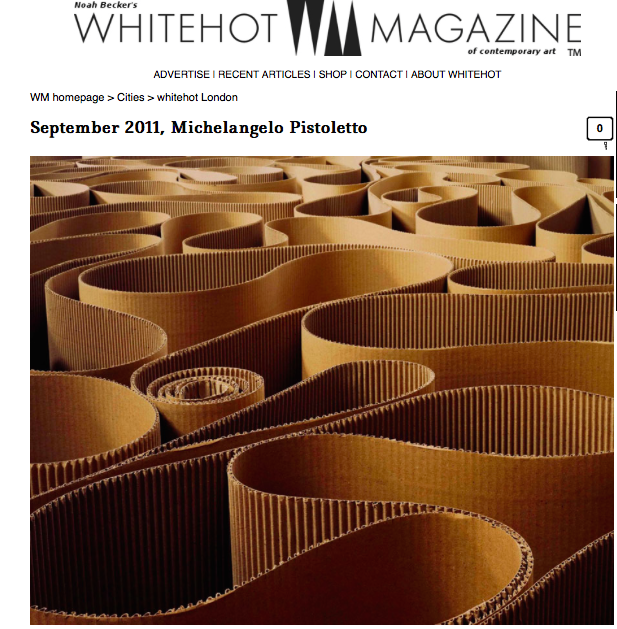
Michelangelo Pistoletto has got us all working for him. The artwork displayed at the Serpentine is only part of the equation; the rest is up to us visitors, moving slowly through the maze of swirling cardboard. The corrugated paper winds itself around the entire gallery, leading us on, every now and again depositing us in front of a massive mirror. There is no escaping Pistoletto’s mirrors; it is just you there, surrounded by white walls and cardboard, with no choice other than to look. Your eyes scan over your fellow audience, the walls and the ceiling, until like it or not, they come to rest on your own reflection.

Pistoletto, the Italian artist of worldwide renown, is no stranger to the themes of reflection and participation. It can seem as if there is a social experiment at work here, starting when visitors enter the gallery and search for instructions whether to go left or right. But there is no set order to the art, which is constantly changing anyway; it is all down to us. Standing in front of the big mirrors, several of the visitors seem uncomfortable having to look at themselves so blatantly, resorting to a quick adjustment of hair or clothing before scuffling on.  We are used to being provided with direction when looking at art, but Pistoletto does not seem to be all that interested in telling us what to think. Instead he sends us on our merry way through the labyrinth, possibly a metaphor for life, where around each corner we encounter a new version of ourselves.

Having said that, with an exhibition named The Mirror of Judgment it is clear Pistoletto is not devoid of motives. The four largest mirrors are adorned with iconography from one of four religions: a Buddha, an Islamic prayer mat, a Christian altar and the Jewish tablets. Pistoletto uses the word “judgment”, but there is something unifying about the way the cardboard maze ties it all together, creating a feeling it may in fact be about the opposite. Whether you stand by the prayer mat or the Buddha, the experience is the same: you, and your thoughts.

As the labyrinth leads us into the centre room of the Serpentine, we encounter Pistoletto’s mirror obelisk. Suspended from the ceiling are three large ovals, forming a symbol of infinity. The angles of the sculpture mean you get a different view each time you move, of the ovals, the obelisk and of the perpetually mirrored visitors. Then suddenly, only for a minute, I find myself alone in the room, with no reflection other than my own. With only white wall and brown paper behind me, I watch myself walk, conscious of the vanity but reluctant to look away. Pistoletto offers us no paintings to admire, no sculptures to study; just the maze, the mirrors and what we see when we look into them. I am not entirely sure what it means, but I believe the answer lies in the experience.