The innovation cycle: The agony and the ecstasy

Megabuyte, June 2012. Original article here (£).

innovation cycleLetter from the West Coast
The innovation cycle: The agony and the ecstasy

Instagram, the popular photo-sharing app, drew a $1bn price tag when Facebook came knocking back in April. It is a massive leap of faith to pay this much for a company lacking that pesky thing that is a revenue model, but equally, it is a powerful signal as to the importance of photos in the new social internet future. So then why is it that just four months earlier, the inventor of the hand-held camera filed for bankruptcy? It is not like people had lost interest in photography, the lifeblood of Kodak, in fact quite the opposite.

When it folded, Kodak was worth almost exactly as much in cash as Instagram was worth in dreams. Instagram was funded on just $500,000 back in October 2010, with a second round in February 2011 bringing onboard $7m from big-name investors. Of course we have the benefit of hindsight, but it would have been so easy for Kodak to make its own Instagram. So why did they not?

Small ideas in big companies
To be fair, Kodak had not exactly been sitting on its hands in the run-up to the bankruptcy; the 133-year-old company actually now draws 75% of its income from digital businesses. While change is constant, the current technological leap is bigger than usual: the coming of age of the internet means photography becomes digital, newspapers go online, music is available for immediate download, and books are read on e-paper. While Kodak had the money to try new things, it would seem that it did not quite have the courage to shake things up to the extent that was really necessary to survive.

Before Oliver Roup founded VigLink, the web-content monetisation software group in 2009, he was in charge of products for Microsoft’s media outfits such as XBox Live Video Marketplace and MSN Entertainment. At the time of our meeting in San Francisco, Roup’s idea had grown into a 22-people-strong operation. So why did he leave Microsoft to do this?

“The main reason I left was to get more autonomy. I wanted to build something of my own,” said Roup. When looking ahead at the kinds of projects he would be working with at a big company like Microsoft, he found they paled in comparison with the excitement of entrepreneurship. But from the point of view of his former employer, why were they not bending over backwards to give industrious employees a chance to develop new ideas in-house?

“The thing is that their interests and goals are different. I think a company like Microsoft, if they could create a business worth a $100m a year, that is not even worth it to them. The intellectual overhead of even thinking about it …” Roup shrugged, but quickly added that this is not a reflection of incompetence nor malevolence on part of a big organisation: “Priorities shift when you are already making $60bn in revenues. In order to move the needle and impress your investors you have to make strides that are material to that number, and that’s a very hard thing to do.” In other words: they are looking for guarantees, and with start-up adventures there is no such thing.

The acquisition challenge
76 year old Spirent, the technology testing group operating out of Silicon Valley, only needs to point to its age to demonstrate its skills as an innovator. Successful acquisitions have played an important part for the Crawley-born company: the 2002 acquisition of Caw Networks, which makes network performance testing appliances, gave the group a foothold in a growing niche, while the same is hoped to be the case for Mu Dynamics, a cloud- and app-testing specialist brought onboard earlier this year.

“But acquisitions are always challenging. You have a different culture and you have a product that is fairly typically early in its life cycle. You have to nurture the relationship, the culture and the product area, and they are not always successful,” CEO Bill Burns said as we met in his Sunnydale office. The challenge of being able to predict which trend will spark and catch fire is immense, and even if you get the trend right, the technology may be wrong.

Take Cisco’s acquisition of Flip, the little pocket camera, which came at a time when personal videos and YouTube were booming. Cisco was right about the trend, but it was the smartphone that would become people’s recording device of choice. Burns added: “You wonder if a Kodak could have done something around enhancing photo activity. Could they have sold the intellectual property around cameras in smartphones? Could they have turned themselves into a web service around photo processing?” Not knowing exactly which trend was going to be the winner, Kodak hesitated too long and ended up missing the boat.

Now Research In Motion seems to be where Kodak was a few years ago, instilling fear in the hearts of those of us still dedicated to the BlackBerry. “There are some things they excel in, such as battery life,” said Burns. “I think it is about the refinement of the product over time. They probably got too wedded to their keyboard.” RIM probably had numerous user surveys telling them never to do away with that keyboard, but then Apple, a beacon of innovation, came along with their touchpad, and lo and behold. As Steve Jobs once said: “People do not know what they want until you show it to them.”

The cannibalisation dilemma
Eric Kessler, co-president of cable TV channel HBO caused a stir last month when he said he thinks the move away from traditional TV to an internet-based model is just a “temporary phenomenon”. Consider then the fact the HBO series “Game of Thrones” is rapidly becoming the most pirated TV show of all times, with over 25 million downloads this spring as HBO refuses to let people pay for new episodes on Netflix, Hulu or iTunes.

VigLink’s Roup pointed out how the issue is difficult for HBO because the group gets most of their money from the network operators, and an online service would cannibalise this. Kessler is taking the conservative stance and sticking with what he knows, which makes sense. Added Roup: “If [at HBO] you throw out the Comcast business to go after that web business, maybe ten years from now someone else will be glad you did. But you will be out of a job, and that is what makes it hard.”

The fact that it is difficult for established companies to take chances is also part of what creates opportunities for start-ups. For young software companies, providing a pure Cloud offering from day one means they come across as modern and nimble, unencumbered by transitional issues. These remain a source of unending distractions for the incumbents as they try to keep everyone – new and old customers, as well as investors – happy, while they try and keep up with neverending change. But as a company grows and the management becomes invested in the status quo, is it possible to maintain that start-up spirit?

Staying ahead
“The start-up spirit was essential to us when we were tiny, we would not have survived without it. But it is hard to keep working at the pace and intensity of a start-up forever,” said Suranga Chandratillake, CEO of video search software outfit Blinkx. For large companies it is possible to throw money at the problem and buy what looks good from the upstart pool, and then strive to find the right balance between nurturing the growing company and leaving the entrepreneurs at the helm alone as much as possible lest they feel stifled and leave.

As Microsoft is looking to pay as much as $1bn for Yammer, it is hard not to be fearful: what if the tech giant starts stomping around at Yammer, imposing rules and processes and demanding ties instead of jeans. After meeting Adam Pisoni, co-founder and CTO at Yammer, it is hard to picture him being happy as a cog in the Microsoft machine.

“The thing that excites me [about running a start-up] first of all is the idea that we can build products that people want to use. I recognise that that is a bit vain, even,” said Pisoni. “The other part is feeling like you can build a better company. That you cannot only build a better product, but you can build a company that is sustainable, that is a better company than those who have done it before.” Before establishing Yammer just four years ago, Pisoni was software architect at Geni; he was instrumental in the systems architecture at Shopzilla; he co-founded web development consultancy, Cnation, which serviced big names such as CBS, Fox, Nissan and Honda.

And while the point about the jeans may sound superficial, Chandratillake argues that it is not: “It may sound silly, but things like this makes a big difference to the atmosphere at a small company.” This is also why Blinkx, whose market value has reached £150m, will regularly put engineers in start-up mode when working on new projects. “We pull people together from different teams, put them in a room together and give them crazy deadlines,” says Chandratillake. “Many of our employees find it empowering to work like that every now and again. It gives them a sense of ownership over the product. Keeping the start-up spirit alive is an important tool for staying ahead.”

A certain process

Lionheart Magazine, Warmth issue, 2012. Original article.

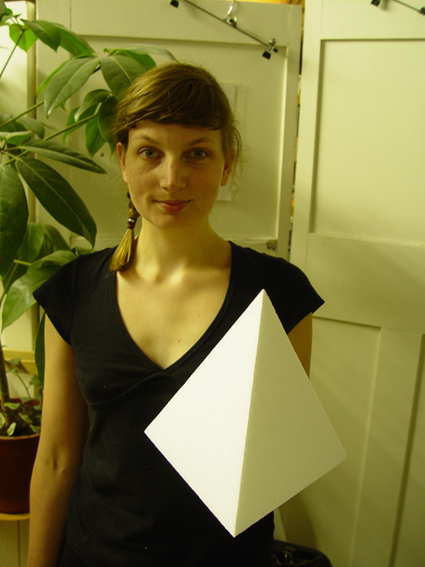
TetrahedronA certain process
Beauty isn’t really a part of the equation for product designer Bernadette Deddens, but somehow it happens anyway.

“I don’t care about pretty things,” says Bernadette Deddens, as I’ve just asked her about the clean look of her work. Her considered and specific processes create something elegant and beautiful, but what it is not, and do take this in the best way possible, is pretty.

The product designer is fresh-faced and cheerful in spite of the freeze gripping London the day we meet. Fellow café patrons are huddled over hot tea, but Bernadette seems unfazed by the sub-zero temperature; her means of transport is a bicycle, imported from her native Holland.

“The beauty lies in the practicality, in the usability,” she explains, taking off her self-made leather bangle. “People say they like this, so it must be pretty. But for me, it’s a 1.2 metre long piece of leather. I considered the thickness of the leather, how to roll it up … that’s where the beauty is for me. It’s almost mathematical. It’s a simple object.”

I’d hoped to meet Bernadette in her studio, which I’ve been told is cold and cramped and speaks volumes of how one suffers for art, but alas. Bernadette, who makes up half of Study O Portable alongside husband Tetsuo Mukai, is in the process of moving to a bigger space: “At the moment we have small versions of the tools we need. A small belt sander, small drills, a puzzle saw instead of a big saw.” This is dirty work; the result may be elegant, but the process is anything but.

Of course, Bernadette realises customers may be less concerned with the method. This will sometimes result in requests for matching pieces, such as earrings, but this is problematic: “This process doesn’t apply to earrings,” asserts Bernadette, explaining that the hollowness of the bangle can’t be replicated for earrings: “The process was developed for bangles, and I like to be specific.” She runs her fingers around the inside of the bracelet, her voice soft again now, self-conscious after having spoken so adamantly. But she is certain in her intentions, meaning the product catalogue will never feature earrings alongside the bangles. But would she do it on commission? She shrugs a yes, probably. This is where artistic ideas meet the reality of rent.

On that note, Bernadette works part time in a gallery and as a university art tutor. “Tetsuo and I have always had other jobs to fund our work. The other jobs pay for the job I love. I never envisioned it any differently, but it’s starting to pay off now, seven years later.” While she loves teaching, Bernadette is quick to point out that not everyone is suited to become artists: “You have to have a vision of what you want to do.” I ask her if she has a vision, and she makes a face. And then: “Yes, I am capable!” She bursts out laughing, shy again for speaking boldly, but I think she knows this is the truth. Bernadette’s teachers tried to talk her out of going to art school, and she is not entirely against this advice: “You have to be extremely driven. You have to subject yourself to vigorous experiments.”

Bernadette and Tetsuo’s dedication to experimentation runs through everything they create. Take the newest works, a series of quartz crystal mirrors. Crystals are integral to transferring energy in technological devices, and the mirrors are a play on the idea that we see ourselves through the objects we create. “We didn’t know anything about crystal when we started. But if you want to know, you find out.”

Peering over the photos of the mirrors, I cannot but point out how neat they would be as pendant. Bernadette’s eyes widen: “The mirrors won’t be pendants!” Their function would be compromised if they were that small, she explains, laughing. What if someone commissions one, I ask, and she nods, well yes, probably: “Is that a cop out?”

I think that’s a reality of London rents, I say as we gather our coats to brave the cold again. Has she considered moving Study O Portable to a less expensive city? “No, I think we need London. It has amazing free lectures, for one, all the galleries, the opportunities to meet people. Elsewhere would be cheaper, but we’d miss out on all this. I think we need this flux.”

For a designer whose work is all about experiments, transferrable ideas and methods, it makes sense to want to be in the middle of the noise and grime of a place like London. For an artist who sees beauty through process and practicality, it must be paradise.

The years shall run like rabbits

Lionheart Magazine, Warmth issue, 2012. Original article.

LionheartMagazineSpreadsThe years shall run like rabbits
‘Time flies’ – it’s an old person’s saying and I keep saying it. But instead of getting used to it, this racing of time, it just seems to scurry on more intensely. Time rushes along at an increasing pace, which doesn’t make any sense because there is more, not less, to do. Weekends come along thick and fast and all of a sudden it’s summer again when I could have sworn it was mid-winter only yesterday. When I was a kid, an hour was an age and winter seemed to never end. I walked home from school, one little foot in front of the other in seemingly infinite repetition, but I know now it was no more than fifteen minutes. I think time is supposed to be a constant element, but I’m really not all that convinced.

I keep getting distracted. I pick at the seam of my shirt, turning the hem upward to examine how the hastily assembled item is unravelling as I wear it. I feel my skin tingle and how my cardigan rests on my collarbone, my fingers wander up and slide into my hair. There they have work to keep busy for ages, twirling around the short, soft whisks underneath my ponytail, digging for rough strands near the crown and greedily feeling their coarseness when one is found. I look up and the sun has moved across the sky.

The dizziness of this new freedom is subsiding and I have more good days than bad days now; when it’s one of the latter the thoughts no longer feel like my own but as if there’s an intruder. Pragmatic as I am, I evoke my mother for the task at hand: ‘Don’t be so helpless,’ I hear her say inside my head, not unkindly. I get a broom and sweep the intruder away. I read back those last few sentences and realise how precious and melodramatic it sounds, to say things like that, but it’s the truth and don’t you think I wish it wasn’t. As I figure out what I want I can feel the world opening up but at the same time it’s getting narrower. I haven’t really changed anything but I am becoming determined and with it, ruthless; just a pinch.

And all of a sudden it’s the weekend again and we’re waiting for the green man so we can shuffle on in flimsy sandals, soles tapping against paving stones and there’s that feeling again: I want to be working. I’ve had the moment where I’ve realised that work is no longer something I’m trying to dodge – no more clock-watching for Jessie. There’s just me here, and all the things I’ve always wanted. And I’ve wanted them for a bloody long time too – so long that I was starting to wonder if waiting was all I could do.

Now that my time is my own I feel like it should be slowing down again, back to its leisurely, trusty ticking of the days before double-digit birthdays. ‘The day is long,’ my grandma used to say, as I stood in front of her wall-clock which counted the seconds so loudly they rattled through the whole house. Outside that living room, time runs like rabbits and I know it. So why isn’t all that dead-end inspiration of office afternoons here for me now, waiting like water in the tap? I spent so much time wanting to be ‘big’, for my time to be my own. Now both those wishes have come true, but there are other forces at play. Again I catch myself staring into the middle distance.

Letters from the West Coast

In the spring of 2012 I spent a month in San Francisco, speaking to technology entrepreneurs about trends and start-up culture. Letters from the West Coast is the article series I wrote about this for Megabuyte, the specialist technology newswire.

[The Early View is my follow-on series on technology start-up culture in the UK.]

* The magic in the Valley. What is it about Silicon Valley that makes it such a dynamic place to start a business? – read

* The innovation cycle: The agony and the ecstasy. The trouble with innovation and keeping the start-up spirit alive – read

* The social revolution. Interview with Yammer, plus how social tools are changing how businesses collaborate and create – read

* The mobile internet takes shape. Interview with HotelTonight, with notes on internet evolution from Spirent – read

* The dark art of content monetisation. Interview with VigLink, with notes on mobile advertising from Blinkx – read

* The view to Britain: How is Britain’s technology scene viewed from the West Coast? – read

The magic in the Valley

Megabuyte, June 2012. Original article here (£).

magic valleyLetter from the West Coast
The magic in the Valley

Silicon Valley sounds like it should be an airborne construction of glass and steel, with flying cars whizzing around as entrepreneurs test out their latest inventions. But instead, this capital of innovation is string of small suburban towns: San Jose, Santa Clara, Sunnyvale, Mountain View and Palo Alto, all nestled in the crook of the San Francisco peninsula. So what is it about Silicon Valley that makes it the world’s most dynamic place to be a technology startup company?

During the month I spent in the Bay Area I spoke to several entrepreneurs about what it is about the Valley, and the same thing happened every time: their eyes lit up, and they used the word “buzz”. The best people come here, they said, generating such a volume of ideas at such a rapid pace. Being constantly surrounded by this pushes you, it forces you to up your game.

Something in the water
“You can look at every metric of our company and see that it inflected when we moved here. This includes user growth. I cannot even explain that. There is this energy here,” said Adam Pisoni, CTO and co-founder of Yammer, the enterprise social network. I met Pisoni a few weeks before reports surfaced that Microsoft is prepared to pay over $1 billion for Yammer, which has come a very long way in only four years. The company scores highly on the “cool” factor with its San Francisco office, which is full of people in jeans, roaming dogs and discarded bikes, surrounded by framed praise from Forrester, BizSpark, the New York Times and the Wall Street Journal. Yammer spent its first year in Los Angeles, but access to “the best talent in the world” is first on Pisoni’s list of reasons to be on the West Coast: “Also, when you are here there are so many great companies, the bar you set for yourself is higher. You are comparing yourself to the greatest companies, the fastest moving companies in the world. So you start taking your goalposts and throwing them way out in front of you.”

Mountain View, home to Google and neighbour to Facebook, is just an hour south of San Francisco, courtesy of Caltrain. Walking down the street of this little town that intellectual property built I was surprised to find the innovator spirit is actually present in a very physical sense. On Castro Street, the main thoroughfare, you can hear people in Mozilla Firefox shirts talking shop, while the next killer app is being drafted on a napkin upstairs at Red Rock Cafe. It was here it all started, in 1956, when William Shockley left Bell Labs over his conviction that it was silicon, not germanium, that was the future of the transistor. Shockley Semiconductor Laboratory now has a plaque to mark this fact, but the real legacy is probably that of having nurtured employee Gordon Moore to go found Intel in 1968.

The kids are allright

Down the road in Sunnyvale, next door to Yahoo and Juniper Networks, is the operational headquarters of London-listed Spirent. Founded in the UK in 1936, the £1bn market cap is by no means an upstart, but the tester of telecoms and networking equipment still sees a presence in the Valley as vital. “Our operational headquarters are here is because our largest customers are here. If you look at the Bay Area in general, whether it is Cisco or Juniper or Extreme or Broadcom or Brocade or all the IP companies, the Googles, the Facebooks, the Yahoos … clearly it is the centre of tech,” said CEO Bill Burns. “Everybody who is anybody in technology has some kind of presence here.”

While Spirent is not fighting for its place in the sun in the same way as a company like Yammer, it does not take much revision of Valley history to remember that the world of technology innovation is ruthless. While Burns acknowledges that being “a young CEO with a ponytail” is fashionable, he points out that most companies are run by people who have grown up in the industry. Still, Burns thinks the constant influx is valuable also to the established businesses: “It is good for the industry to have smart and innovative new ideas, because it pushes all the rest of the companies to continue to do that. It really is about trying to transform your business over and over again, because if you do not keep up and do not make that transition, someone else will supercede you. […] Start-ups push bigger companies to be more innovative and make that change internally, or they go and acquire the new technology because the smaller company is further along with it.”

Friends of friends
Entrepreneurs keen on more urban settings in downtown San Francisco are mostly found in SoMa, an up-and-coming innercity area far from the chipper bells of the city’s ubiquitous cable cars. VigLink’s business is weblink monetisation, and founder and CEO Oliver Roup moved to San Francisco especially to set up the company in 2009, after leaving Microsoft.

“San Francisco is unmatched as far as the density of the people you want to reach. They are all right here, and many of our customers are a couple of blocks away. Every party you go to, every time you go to a bar you meet someone who is somehow related and helpful, and the ability to grow your network is amazing,” said Roup, as we met in his company’s warehouse office, where the birds on the walls reveal the former tenant’s identity as Twitter. In the Valley, Burns said similar things about the organic development of networks: “People meet at social or charity events, or while supporting local schools and universities. People are open and friendly and always willing to set up things. The introduction at an event is followed up with: ‘Hey, we met last week, we should go and have a coffee’.”

When asked why he decided to move to the city and not Palo Alto, Roup chalks this up to personal preference for an urban environment, and does not see the two as vitally different in terms of nurturing companies. The fundraising community, the venture capitalists, the banking resources, the law firms with the best technology knowledge for patents and M&A, all extend to cover the whole area. The same is also true on the flipside, however: the price of talent is steep. Every t-shirt wearing CEO I spoke to agreed that this is a place where the best engineers can wear what they want, come into work when they want (within reason) and collect good salaries before moving on to something new in a year or two. “But on balance, I think this the best place to start,” said Roup. “If you want to be an actor, you go to Hollywood; if you want to be in the money industry you go to New York;, if you want to be in start-ups you go to Silicon Valley. You can certainly do all those things in different cities, but you are not where the action is.”

Appetite for risk
Other cities could probably replicate many of Silicon Valley’s key characteristics to attract a startup community, but it would be hard to supercede the Valley’s size and history. The sheer tolerance for risk is a particular element that feels very alien from a UK perspective. Suranga Chandratillake, the San Francisco-based CEO of London-listed Blinkx, explained during our chat how the UK venture capital scene has many players from a finance or big company background, but you cannot use those criteria to assess a startup because they work completely differently.

“With a startup it is more about products, the market, and about what products will work for a market. It is about what kind of personalities you need to build a team,” said Chandratillake, who founded video search software specialist Blinkx in 2004 and spun it out from Autonomy in 2007. It is understandably hard for a venture capitalist to back an entrepreneur with nothing but a PowerPoint presentation and a big idea if he or she has no idea what that is like; this is an extreme example, but the West Coast is probably one of the very few places where that can happen. Part of the reason for this, said Chandratillake, is because the Valley now has an investor community that is established enough for former tech entrepreneurs to have gone full circle, meaning many are now part of the funding teams themselves.

And with tolerance for risk also comes a vastly more helpful and encouraging atmosphere. Sam Shank co-founded HotelTonight, a mobile app for same-day hotel bookings, in 2010. As we met in his SoMa offices, the CEO tells me how he found the Bay Area to provide a very different experience than other places in the US. “In Chicago, when I said I was starting a business, people said: ‘That’s so risky, I’d never do that.’ In Chicago, you get the five reasons why it is not going to work. In San Francisco, you get the five things you should do to be successful. You get, here is why you are going to succeed, and some introductions to help you succeed. Everyone wants you to succeed.”

Fail better
The fact that this hyper-optimism also allows for people to make mistakes is probably one of the key differences that makes Silicon Valley such a powerhouse. This attitude is instrumental to creating a nurturing space for feisty tech geeks to try out new ideas: you cannot make an omelette without breaking a few eggs. Of course, no one has forgot what it looks like when it goes wrong: the dot-com bust was only 12 years ago. And now, heat is again building in the sector, as seen with the values attached to the Facebook float and increasingly highly priced M&A activity with billion-dollar price tags for Instagram and Yammer.

Looking at the big picture, San Francisco is in many ways the ultimate boom-and-bust town, stretching all the way back to the Gold Rush in 1849. The same attitude that meant the city was rebuilt at a pace of 15 houses per day following the 1909 earthquake, which flattened the city, may be the very same reason the Bay Area has such an impressive track record for coming up with things that literally change our lives. There is of course the hope that the Valley has learned a thing or two from its previous failures, and will avoid busting quite so spectacularly again. Fingers crossed that 56 years of experience will count for something.

Mark Bradford

Published in Whitehot Magazine, 2012. Original article here.

bradfordMark Bradford at San Francisco Museum of Modern Art
San Francisco, California

Mark Bradford wants to overwhelm us. At least that is what it feels like, walking through the rooms of the San Francisco Museum of Modern Art (SFMOMA) dedicated to his ten-year retrospective. The canvases keep getting bigger and the patterns louder, more determined, and more confident in speaking their truth. It is the sort of exhibition that sends you scurrying for the leaflet, as there is a message here, the artist has something he wants to say. While it is entirely possible to walk through the 50-something piece show, which spans beyond the SFMOMA to the Yerba Buena Center for the Arts across the street, and just take in the expansiveness of it all, it would only be half the story.

Los Angeles-based Bradford brings a lot of his environment into his art. Working extensively with found objects, such as posters, billboards, maps, fliers, comics and magazines, the grit of the street translates excellently into the clean gallery space. Displayed chronologically, the first works are made from curling papers from his mother’s hair salon in South Central Los Angeles, resulting in beautifully textured and monochrome-ish canvases deeply rooted in what was going on around the young artist at the time. The style has since changed, but the connection to the surrounding world been maintained.

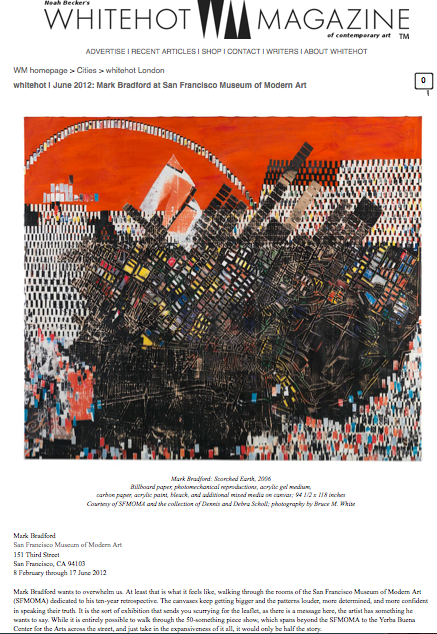
It is strangely difficult to describe Bradford’s work, though. ‘Juice’ from 2003 is made from mostly white squares, interspersed with black; ‘Strawberry’ from 2002 has white squares scattered over cheerful orange. But this tells you nothing about the works unless you see them, and unless you take your time in doing so, even that may not be enough. Sitting in front of one of Bradford’s pieces, especially the largest ones, gives you an idea of the work that has gone into it, with the pasting, scraping and painting, the sticky substances coating the artist’s hands at the end of the day. There is intensive labour behind these efforts to translate a world onto canvas. More than anything, Bradford’s works look like maps: of places, of feelings, of the troubles with the human condition. The effect is overwhelming, especially as the colours turn rich and dark, as the patterns grow harder to trace towards an intensity just on the right side of painful.

The massive ‘Black Venus’ from 2005 is compiled by smaller fragments in black and blue, cut into strips; there is an order to the chaos but it slips away from you. ‘Potable Water’ from 2005 is fraying, buckling off the wall. The blue streaks presumably represents water, and a look at the label reveals the work is a comment on California’s water issues throughout history. Several of the works carries references to social and political issues, along with a rich vein of pop culture. ‘Mississippi Gottam’ from 2007 concerns the destruction of New Orleans by Hurricane Katrina: silvery white, clay-like colours, patterned, etched, light playing on the surface like light on rippling water. “I am always looking for ways to activate a new kind of reality,” Bradford has said. “It is a very physical thing for me, more than an intellectual pursuit.” This comes across perhaps more than ever with ‘Mithra’, the life-size ark made from plywood and pasted papers, which Bradford displayed in New Orleans in a reference of the biblical levels of flooding and the government’s failure to protect the city’s inhabitants. The section on display is only a fraction of the whole, but gives an impression of how staggering the piece must have been in its entirety.

The exhibition includes a few of Bradford’s sound and video works as well, including ‘Pinocchio is on Fire’, where visitors are invited to lie down on bean bags in a room full of patterns and music. The experience is powerful, both visually and audibly, but Bradford does not need multimedia to do this; he manages just fine with just his canvases. Take ‘You’re nobody (til somebody kills you)’, where the cacophony comes together to a perfect hum, sort of like magic, as you sit still in front of the sprawling canvas. I kept tracing the patterns with my eyes, completely unable to describe what I was seeing, but something was happening. Almost like a 3D picture where you have to look at it before something pops out at you, the image felt alive; it seemed to hint at something bigger, like when you are looking a map of a city you know well. There is an energy in Bradford’s works, something that transcends the sum of their parts. I found myself reluctant to leave.

Fire in the heart

Published in Oh Comely, May 2012.

Screen Shot 2014-02-21 at 18.43.53

Fire in the heart

‘Junkhearts’ director Tinge Krishnan talks about writing stories in the playground, leaving medicine, and moving through darkness into light.

She is a believer in transformation and redemption, Tinge Krishnan. It is there in her own story, from her start as a medical doctor to becoming a film director, and it is the central theme in Junkhearts, her first feature film. The brief connection between Lynette, the young homeless girl, and Frank, the wrung-out soldier, triggers significant changes, but still the overarching feeling in Junkhearts is one of bleakness. At least that is what I say to Krishnan as we wait for our tea to arrive.

“It wasn’t intended to be bleak, does it feel bleak?” says Krishnan. This is awkward. The director has just told me how she’s always worried about letting the film down by saying silly things in interviews. And here I am, having possibly misread its intentions completely. But Krishnan seems genuinely interested in my interpretation of the film, asking several questions about which specific scenes I’m referring to. When Frank and Lynette meet they give something to each other, but then it all threatens to fall apart, I say to her. The film almost shows you that you shouldn’t trust people. Krishnan thinks about it for a moment.

“That does exist in Frank. His worldview is that people are not to be trusted, so he’s almost waiting for it to happen. All the little decisions he makes contribute to it. That is a pattern Frank has to shift, and in the end it’s proved, it was right to trust,” says Krishnan. “Frank couldn’t have continued to live the way he lived when he met Lynette. He had to go through a lot of pain, but there was a lot that shifted in that pain and it opened him up.”

Frank suffers from post-traumatic stress disorder (PTSD) from being a soldier in Northern Ireland, and this was a key point of connection for Krishnan. Krishnan was in Thailand during the 2004 tsunami, and being a doctor she helped in the aftermath of the crisis. This led to her developing PTSD.

“It was a very powerful experience,” says Krishnan, who received counselling after returning to the UK. “I wanted to make a piece that’s about that healing process. As a filmmaker I could find a way to creatively express those experiences in a way that could touch an audience and help them understand. I think it’s hard to understand PTSD when you haven’t experienced it yourself.”

Before becoming a filmmaker, Krishnan worked as an A&E doctor – not exactly a typical route for budding creative types. Krishnan can trace the idea of a ‘detour’ back to school: “All the way through school I’d write plays and stories, reading them out in the playground. I assumed I was going to become a writer, but my English teacher said I should go do and do something different first.”

While the path to filmmaking wasn’t a conscious choice, Krishnan has no regrets about hanging up her white coat: “That’s fine, because I learned so much from it, it’s amazing.” She pauses. “Aspects of being a doctor that I miss are relating that intimately with people, and finding solutions. That was always very interesting.”

It must have been great to have a job where you got to help people, I suggest, but Krishnan shakes her head: “Medicine isn’t all running around saving lives, sometimes it feels like its mainly banging your head against a bureaucratic wall!” She laughs. “I’m not sure to what degree doctors actually feel they’re making a difference.“

And as a filmmaker, does she feel like she’s making a difference now? Krishnan thinks about it for a moment: “I would hope so. It is my intention. Maybe not? I don’t know. All I can do is try.”

Krishnan spent a lot of time researching the themes of the film, talking to servicemen suffering from PTSD and alcohol problems, and spending time in drug rehab centres talking to former crack users. But when asked about which elements drew her to Junkhearts, the first thing she brings up is the father-daughter relationships; an intertwined storyline is that of Christine, the daughter Frank abandoned. “At the core it really is a relationship film. It’s about that funny relationship between daughters and fathers, or father figures. The interface between feminine and masculine energy can be quite tempestuous.”

The power of the feminine is emerging as a theme for Krishnan’s work, alongside redemption, tenderness and transformation of darkness into light. While also looking after her new baby, the director is currently busy working on her new script, for a thriller centred on a female anti-hero.

Krishnan still has dreams where she’s a doctor, but her heart belongs to film now. “It’s about that moment when we’re on set, and the actors are releasing powerful, in-the-moment performances. I can see it in the monitor and I can hear it in the headset and I can feel that electricity that means we’re getting something powerful. That’s the best feeling.” Krishnan pauses, she seems to have drifted off somewhere. “When making a film there will be a moment when there’s a commitment, you feel it coming from the crew and the cast when everyone knows they are working on something exciting. You really feel the moment when people start to walk through the fire.”

Cool kid Chloë

Lionheart Magazine, Warmth issue, 2012. Original article.

Cool kid Chloë
Swagger, talent and a thirst for exploration through acting is why Chloë Moretz is a star in the making. Jessica Furseth talks to the Hollywood actress about ambition, confidence and listening to your mother.

She has a lot of sass for a 14-year-old, that Chloë Moretz. She rocks up with buckets of smiles, a cocky-cute “how you doing” and she’s just so cool – there’s no other word for it. I meet the teenage actress in London during the promotions for Martin Scorsese’s film ‘Hugo’, where Chloë plays sheltered Paris girl Isabelle as she embarks on a much-longed-for adventure. But the Chloë sitting in front of me in the flash hotel suite looks much more grown up than the beret-wearing child on screen. An elegant hair bun is paired with dark-checked trousers and a grey blouse, with her silver nail polish perfectly offset against chunky heels in the same colour. She speaks with a broad American twang; earlier that day Martin Scorsese praised her for being a joy to direct, with an English accent so spot on he thought she was a native. The verdict is in: not just a pretty face, but good at her job too.

“It’s such an honour to have worked with Marty, he’s a living legend,” says Chloë, kicking back in her chair. She’s conscious of not seeming ungrateful for the chance to work with Scorsese, but then again, why wouldn’t she be chosen? After all, she’s good. “In acting there are so many people telling you ‘no’, but I look at them and think, well you say ‘no’ now, but next year I promise you are going to want me for your movie. And almost every time I’ve done that it’s come true: they have come back wanted me!”

Chloë laughs easily, drawing you in with the occasional geeky grimace. Listening to her describe Scorsese makes it clear she sees him more like an uncle than a hero: “He’s an amazing guy, he’s so funny! He makes everyone feel comfortable, everyone’s on the same playing field. I think that’s why he gets such a good vibe in his movies.” The role of Isabelle is probably the closest Chloë has come to playing a girl like herself, after previous experiences of playing a vampire in ‘Let Me In’ and a potty-mouthed superhero in ‘Kickass’. Tim Burton’s ‘Dark Shadows’ is due shortly, where Chloë plays a girl with a “dark secret”: “I look for something where I really connect with the character. If I can’t put down the script, if all I can think about for the next few days is how I want to play that character, that’s the kind of movie I’ll do.”

Chloë lives with her mother and four older brothers, and it’s clear that little sister’s career is a family project: “My brother Trevor and my mother read all the scripts that come in, and if they like them they send them to me. The we make a group decision on what’s not only the best decision for my career, but also for me as an actress.”

It’s easy to forget the young woman sitting in front of me is only 14 years old. Not that she tries to appear older, in fact she seems very aware of her youth. “I’ve seen [Scorsese’s] ‘Raging Bull’ and ‘Gangs of New York’ but my mum still keeps me from seeing ‘Taxi Driver’. Even though the others are also 18-rated, that’s over my head in a different way. It deals with things I can’t exactly grasp at 14. Which I don’t like to admit but I have to.”

Chloë has worked as an actress for half her life now, starting out by reciting monologues in the playground. “My mom would get calls from school asking, why is your daughter talking about killing someone?” She laughs. “That’s how I got into acting, and I begged my mom to let me do it. Of course I didn’t know what acting really was, just that it was fun.”

And it’s still fun: “I think the day it starts to feel like work is the day I will stop, but I’m nowhere near that. I still have an amazing time acting, when it’s huge and fantastical and I get to see through the eyes of the character. […] I love roles where I’m not like myself, because I’m Chloë every day. I’m happy with my life, so I like playing characters that aren’t so happy.” She pauses. “Those are the roles I can really space out in, you know, where I can really get into those dark crevices of the psyche. I love those weird and dark places you have to go to for those characters.”

Chloë is quick to concede she’s not exactly a regular 14-year-old, but her responses usually draw examples from her family, not from working with famous directors or going to Hollywood parties. Like when I ask if she feels older than she is: “My mom is the kind of mom where if you want a bowl of cereal, she’ll tell you to go get it yourself. She didn’t baby us to the point where we didn’t know what to do by the time we were 14. My family is … it’s sort of a sophisticated atmosphere, maybe. And also pretty crazy. But my mom’s always raised me to be a smart kid.”

It’s a bold statement, but Chloë definitely is a smart kid: “I think there’s a difference in acting older and feeling older, knowing older. When I was 13 I thought I was older, but now I’m 14 I realise I was a baby then. So when I’m 16 I’ll think I‘m a baby now.” She laughs. “And when I’m my mom’s age I’ll really think I was a baby!”

But make no mistake: Chloë has buckets of confidence. “Yes I do. But in any profession you have to be confident. I’m very competitive. I’ve always wanted to be the best.“ She shrugs, cocking her head to the side. “One of the first films I saw was ‘Breakfast at Tiffany’s’ and I fell in love with Audrey Hepburn. She makes you smile, you know? And that was one of the reasons I wanted to act, the way she makes you smile and transports you to that place, that’s what I want to do for people. I want to transport people to another place.”

And then our time is up, as the PR sweeps in and hustles Chloë out of her seat. She flashes a grin and thanks me for the chat before she’s off to charm someone else. In this she will succeed, I have no doubt.

Lucian Freud: Portraits

Published in Whitehot Magazine, 2012. Original article here.

FREUDLucian Freud: Portraits
National Portrait Gallery, London

For such a force of nature, Lucian Freud comes across as a man of basic needs. “I work from people that interest me and that I care about, in rooms that I live in and know,” the painter has said, and looking around the walls of the National Portrait Gallery, this is exactly what you see. The canvases are filled with people from all walks of life, posing in his London studio, each of them having spent countless hours being observed, penetrated even, by Freud’s steely gaze. Because the painter’s wants may be basic, but they are also beyond negotiation; this is Freud’s world, and those wanting in must conform: show up, pose, surrender.

The ‘Portraits’ exhibition at the National Portrait Gallery is an overwhelming experience. Representing a career spanning seven decades, over 130 paintings are displayed, including the canvas Freud was working on when he died last July, aged 88. The gallery has been packed with visitors every day, and the admiration is clear to see on everyone’s faces as we slowly move between the rooms: we are in the presence of greatness. The story of Freud himself is the stuff of legend: the grandson of Sigmund Freud who lived a bohemian life fathering at least fourteen children, hailed as an undisputed genius whose depictions made supermodel Kate Moss look plain and the Queen look weary.

At least that is what it may seem like at first. The faces and the often-naked bodies are scrutinised down to their most extreme detail, exaggerating every imperfection, but look at the paintings long enough and the raggedness is transcended. Freud would labour intensively over each brush stroke, requesting the sitter to arrive daily over several months; with that amount of time spent watching someone it is no wonder the surface becomes just the beginning. The result will “astonish, disturb, seduce, convince”, just as Freud wanted.

Take ‘Lying by the rags’, where a naked woman looks like she has rolled down off the bed along with the crumpled sheets. Her skin becomes kaleidoscopic in detail, but there is a sunlit patch of floor in front of her, lovingly rendered with as much care as the main subject. ‘And the bridegroom’ depicts a naked couple sleeping, limbs gratuitously sprawled across the large canvas. But in Freud’s world an appendage is the same whether it is a breast or the tail of a mouse; the process of observing goes far beyond simple titillation.

Freud’s earliest works are different from the style he is famous for, but still there are common threads. ‘Girl in a dark jacket’ shows a woman with striking eyes, where meticulous attention has been paid to her irises and frizzy strands of hair. The nudes from the same period are shockingly smooth in comparison to the laboured, mottled skin of the latter works; sure it is pleasant to look at, but is it as interesting? In ‘Pregnant girl’, painted during the 1960s mid-period, Freud has started using more texture, with blue veins poking through the skin and deep shadows cast from the collarbone. It may be more classically beautiful than what comes later, but aesthetics is not the goal: this is a process of discovery.

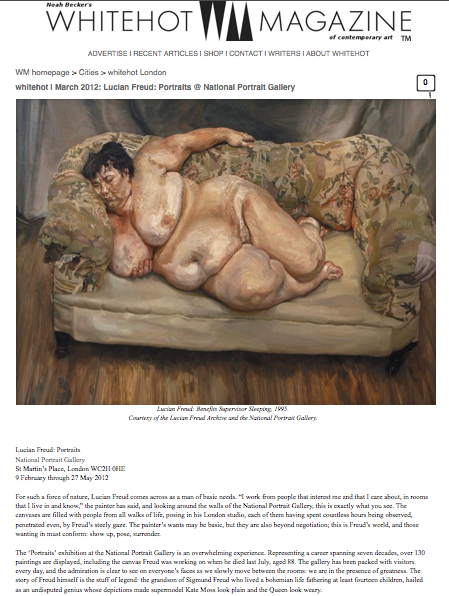
The final section of the exhibition focuses on Freud’s last 20 years, and contains arguably some of his finest work. There’s no sign of slowing down, quite the opposite, this is an artist in his prime. The ‘Benefits supervisor’ series is fascinating, where Freud has pained a large, nude woman in a celebration of abundant flesh. The pictures of Freud’s assistant David and Eli the whippet  show a strong, confident style and two subjects clearly at ease. In ‘Eli and David’ from 2005-6, David does the unusual thing for a Freud portrait and smiles, while Eli sleeps serenely. The result is a tender image, slightly softer in the brush strokes. Adding to the poignancy, these were also the subjects of the canvas sitting on Freud’s easel the day he died.

The departing feeling from the Lucian Freud exhibition is one of saturation, exhaustion and exhilaration. On the steps I overhear a fellow visitor’s comment to her friend that Freud seemed to care more for dogs than for people, and this is certainly possible. Take 2001’s ‘Naked portrait’, where the woman’s feet are cut off while careful attention has been given to the imprint left by her feet inside the shoes on the floor. It is all the same to Freud, he painted what he saw and that meant sometimes a hard-boiled egg or the back of a chair got centre stage. But every one of his canvases contain a person, who got to be observed by a genius with a single-minded obsession. I catch myself feeling more than a little envious of those who were chosen.

The mythology of Sir Ben Kingsley

Published in Idol Magazine, 2012. Original article here.

kingsleyThe mythology of Sir Ben Kingsley
Sir Ben Kingsley discovered a rich mythology in ‘Hugo’, Martin Scorsese’s playful 3D adventure. The veteran actor took us to the heart of the story, while Martin Scorsese dazzled us with us his passion for 3D as the next step in cinema history.

While ‘Hugo’ tells the dreamt-up story of a boy living in the clock tower of a Paris train station, the role played by Sir Ben Kingsley is plucked from reality. It is the life story of Georges Méliès which fascinates Kingsley, far more than the excitement over the film’s 3D format. As one of the world’s first filmmakers, Méliès made over 500 films, before a lack of money forced him into a life as a cranky toymaker at Gare Montparnasse.

“For an actor, to explore the light of Méliès in his glass studio, and then to experience the dark of the toyshop, the exile … to be Méliès at his most empowered, in order to appreciate that terrible loss when he can no longer function as a creative artist,” says Kingsley, as he fixes his eyes on you and pulls you into his narrative. “It was terrific to occupy the full sweep, the arc of the character. This was one of the greatest arcs I’ve ever been privileged to scale. Beautiful, perfect! The balance of it is perfect.”

Kingsley paints pictures with his words. The veteran actor is calm and focused as we meet in grand settings at London’s Dorchester Hotel. Dressed in a dark blazer and neat jeans, Kingsley speaks with consideration, whispering a bit here and there for emphasis. Sir Ben, as he is called by everyone around him, is 67 years old, but there is nothing to suggest the ‘Gandhi’-star is looking for any less demanding roles now that he is eligible for his free bus pass. For what would be the fun in that?

“I fear there is a desperate immaturity in me that means I will be stuck being a child for a long, long time,” laughs Kingsley.

Childish inspiration
Kingsley shares the spotlight in ‘Hugo’ with 14-year-olds Asa Butterfield and Chloë Moretz, playing the parts of Hugo and his friend Isabelle. While the film, based on Brian Selznick’s book ’The Invention of Hugo Cabret’, is suitable for children, it contains a wealth of detail which means it appeals also to a mature audience.

“There are many subtle metaphors in the film, like the heart with a key to unlock it,” says Kingsley; Hugo is trying to repair an automaton given to him by his father, but he is missing a heart-shaped key. “Méliès’ heart is closed, and the key to unlock is the most innocent of children. Also, Hugo has to recreate himself because of the loss of his parents. He is very brave living in the train station, winding the clocks, being the time keeper of the world.”

Kingsley is full of admiration for his young colleagues, to the extent that he claims they pushed him to do better job himself. “Asa and Chloë both bring to their work a purity. Their acting is unimpeded, it is uninterrupted by theory, it comes from the heart,” says Kingsley. “This then demands in me the same level of purity. It raises my game, which is for me very exciting.”

Classical myths

Children’s ability to inspire is a topic that Kingsley returns to several times during our meeting, both in terms of how it affects him as an actor, but also how it is the kids in ‘Hugo’ who inspire a change in filmmaker Méliès after he has given up.

“It is one of the ancient classic myths: the exiled man is drawn back into life by the hand of a child. I always look for the six-seven classical stories in the scripts that I am offered. If there’s a central myth that acts as a map to unlock a script and fill it with genuine life and feeling, that’s the script I will choose. I recognised that early on in Marty’s script: there it is, there’s the exiled man and the child! It’s perfect, perfect.”

His background from the Royal Shakespeare Company means Kingsley is more familiar with the classical myths than most. This influence remains clear even now: Kingsley’s words are akin to performance, uttered with a perfect grammatical structure usually found only on stage.

3D controversy
‘Hugo’ is the first 3D experience for both Kingsley and Martin Scorsese, and the format remains controversial. But the man who gave cinematic classics such as us ‘Taxi Driver’ and ‘Goodfellas’ has buckets of enthusiasm for the new frontier:

“I’ve always wanted to do something in 3D. Over the years I’ve been obsessed with it: the blue and red glasses, black and white 3D, I’m a fanatical about it all but I never thought we would be able to do it,” says Scorsese.

The technology has now caught up with the director’s inspiration, but the 3D experience in ‘Hugo’ is less gimmicky than we are used to. Still, the Hollywood legend does not necessarily agree that 3D has to add something to the story. “Everybody says 3D has to enhance the story, but you have to think of what that really means. Does colour enhance every damn film that’s ever made? No!” Scorsese becomes animated. “Does colour enhance the room right now? It is in colour! Guess what, it’s in 3D too!”

Constant reinvention
Listening to Scorsese is fascinating: he charges forward, he stops mid-sentence and jumps back and forth as he makes his point. But all the actors in ‘Hugo’ say the same thing: Scorsese is highly observant, and he makes everyone around him feel at ease.

“He doesn’t miss a thing, I’m not exaggerating,” says Kingsley. “Whenever you’re with Marty, in his lovely big glasses, you see that he’s always taking in everything: the world, the person with whom he’s speaking. And it’s that extraordinary appetite for life that allows him to entirely reinvent himself, and to be completely with the person in front of the camera.”

While Kingsley was not a fan of 3D before making ‘Hugo’, it seems the experience may have changed the Shakespearean’s view of the format. “You are asking me about 3D in the wake of a beautiful experience,” says Kingsley. “My first time with 3D was this little View-Master where you turned a disc to see things in 3D. As a child I loved it, I was inside another world. Until I saw Marty’s film I had never had a 3D experience with the same effect. Marty allows you to see things through your child’s eyes, and that’s an amazing achievement,” says Kingsley. “It’s a miracle, really.”