Staycations in the London summer

The Billfold, June 2015. Original article

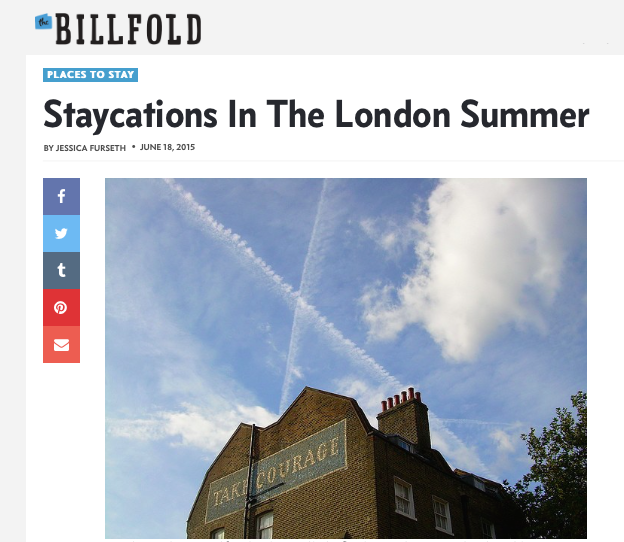
Screen Shot 2015-06-19 at 12.18.33Staycations in the London summer
I woke up by myself today in my little flat in Hackney. My husband is away for work, so I slept past 10 o’clock which I never do unless I’m alone. As much as I like company, I’m very good at being by myself, especially in London. Last weekend I meant to go to a neighbourhood book festival but ended up roaming around all day until it was dark, even though this is June, the lightest month.

Something like that might have happened again today, but my best friend K text me, wanting to meet for coffee. I said yes despite having to rush, because there’s never too much time to spend with K. I took the Overground to Whitechapel, which all of a sudden has plenty of good coffee, the calling card of an “up and coming” neighbourhood. K and I talked for an hour and I decide to walk home, taking the meandering route through the backstreets.

London is full of concrete, but I’ve never seen a major city that’s this green. There are trees and flowers everywhere, drooping over the brick walls and onto the pavements. This city is a very pretty boy right now. It’s been muggy lately but it’s warm, and before long you’re sweating under grey cloud. London is tough in the winter, but for six months over the summer, there’s nothing you can do to get me to leave the city. Right now, London is better than anything I can imagine.

*

“I’m an unrepentant Londoner, and the places that have chosen me – because I think it’s that way round: places choose you, rather than vice versa – have already done so. I think you only have room for two or three serious affairs of place in a lifetime, just as you only have emotional space for two or three serious love affairs,” said the writer Will Self.

I first read this a few years ago and I keep coming back to it. Familiarity isn’t enough to love a place, as I was familiar with the village I grew up in but it never felt anything like this. I’ve lived in London for 12 years now – it wasn’t love at first sight because this city is hard on newcomers, but if you stick it out, this place will reward you. I always say it takes two years to get on good terms with London, and it took me even longer to love it, maybe six years. That’s nothing like my experience of ever falling in love with a person, but make no mistake: London is it for me.

Most of the time it’s nice but nothing unusual, and then suddenly it’ll come over me: I’ll be walking along and I’ll look up and I realise that damn, I love this city. If I’m on a bus crossing the Thames, it’s bound to happen. Often though, it happens during the moments when London’s not so shiny, when I’m distracted or thrown off course. London has a knack for keeping you in that in-between space: a little hot, a little cold, leaving you guessing what’s coming.

Like the other night when I was out with my friend G. We just wanted to leave the house for beers, but suddenly we were wrists deep in barbecue sauce because that’s what Hackney is like now: cocktails and ribs. It was too cool to be wearing shorts down by the canal but we walked along anyway, shivering in the early London summer. Because isn’t this the best part? It’s so light, so much summer still to come.

*

I have a list in my head of things I want to do this summer, during the annual London staycation when I won’t leave the city. I want to go see Agnes Martin at the Tate Modern, and the summer exhibition at the Royal Academy of Art. I want go out to the Thames Barrier Park – this is the city’s flood barrier and a work of art. I haven’t been there in years as it’s a bit out of the way, but I want to go with my husband and a bottle of prosecco. I want to try this cocktail bar in Soho with my new friend R, and talk about work the whole time because sometimes that’s the best.

I saw a picture on Instagram from the Nunhead Reservoir recently, which apparently has amazing views of the city, a rare find in a shallow dish like London. I’ve never been to Nunhead. A few years ago, I went cycling up past the Hackney Marshes with the then-boyfriend who got me to finally buy a bicycle, and I’ve been wanting to go again ever since. There’s a grotty pub up the River Lea where you can get lunch, and even though the food won’t be great it won’t matter.

Sometimes though, the best way to go see the sights is having guests from out of town. When my mother visited recently we went to the London Transport Museum, which is brilliant: it chronicles the history of the Tube so it’s part trainset playground, but it’s also partially an archive of functional graphic design. Away from the rush hour, the Underground is a treat to explore, even after all these years – each line a different pattern of colours, each station a different style. I passed through Baker Street station the other day, on the platform that was part of the very first Tube line. The light wells are still streaming daylight down onto the platform.

I got out at Paddington, just onto the canal, which in West London is the same water that runs past my house in East London. It’s funny – I always tell people the key to London is to find your neighbourhood, that’s how the city will start making sense to you. I once spent three months not leaving Hackney, which would be easy to do again – like when I get Vietnamese on Kingsland Road with my friend C and we order the same things every time. There’s so much more to London than the patch where I live, but there’s a reason why I live here.

*

Last weekend I met up with K again, we walked along the canal up past London Fields, taking the long back around to my house. It’s quiet on the roads around here, away from the main stretch where the buses run. Heavy with green and flowers, and all the beautiful yellow-brick victorian terrace houses we can’t afford to live in. Then we came across this odd building made from corrugated iron plates, sticking out like a sore thumb in the row of pretty houses. It’s the Sight of Eternal Life church, said the internet, thought to be the oldest surviving “Tin Tabernacle” in the world. I took a photo and we walked on, but that’s the best part, I think: finding a piece of curiosity in a place I’ve lived for years, but somehow it’s something I’ve never noticed.

I took my mother on a long walk along the canal too when she was here, spending a whole day away from the London she knows from the pictures. Down past the canal locks and up through the market, into the park and down through the quiet back roads – I’ve walked this route so many times, and looked up to think, so many times, how much I love this city. Almost everything big that’s ever happened to me has happened in London. I know I keep saying things are the best, but there’s always something else about London that’s the best. Now how’s that for a love affair.

Physical thrill

This Recording, May 2015. Original article.

Screen Shot 2015-05-26 at 15.10.00In which we don’t believe in perfect
Physical thrill

There’s only a strip of canal visible across the courtyard, but that bit of canal is everything. I’m sitting at my new kitchen table with my laptop, looking up occasionally at the water: you can see the canal boats docked down there, and the ducks swimming by. Grown-up life is working out pretty well so far, I think, even though this flat that we bought is the tiniest thing. There’s no room for anything in here, meaning my husband and I are now committed to minimalism by default. But when we were looking for a place to live it soon became obvious: there’s no place like home. I wanted to go back to East London more than I wanted space, and when we found this tiny place in the perfect spot there was no turning back. Because who needs space when you’re living in the city? Everything you need is right there, outside.

I’ve been living in my new place for two weeks now, and I have to say it: I don’t think I’ve ever been this happy. Maybe when I got married, on a whim to a man I barely knew – I felt ecstatic then, the closest thing I’ve felt to a sober high. Maybe that time I went to San Francisco for a month by myself, when my jetlag would wake me early and I’d walk the streets for hours with a delirious craving for silence and forward motion I’ve never experienced before nor since. These thing stand out as the happiest I’ve been, and now this: living in my new place.

I didn’t expect to feel like this. I don’t really understand why it’s happening either – although I do know it’s not about nesting, and it’s not about ownership. I have no strong feelings about permanence. It may not even be about moving back to East London, I’m surprise to find. While the weeks dragged on as we waited to move, time slowing down until four whole months had gone by, then all I could think about was moving back across town. East London is where this city started making sense to me, it’s where my life started making sense, I guess. I left East London for good reasons, thinking it would become part of the past, like most things do once you leave. But not this time – I missed my old patch like a lost limb.

So I thought the excitement of moving would be all about coming back to my old neighbourhood, but it seems I was wrong. Because now that I’m in my new house, all I can think about is being alone. I love living with my husband, don’t get me wrong. It’s just that after staying with family for nearly four months while waiting to move into this place, being alone feels like a drug. My husband leaves for work and I sit down to work at the kitchen table, and hours go by when all I can do is revel in the aloneness. I’m drinking it in with a desperate thirst only an introvert can understand. I’m just sitting here, quietly, and it’s a physical thrill.

Being truly, gloriously alone doesn’t mean closing the door for a while – it means having no one else in the house with you. It means, at least for me, having no music playing, just the window open and the hum of the city in the distance. A plant needs watering. I get up from my chair and wander into the bedroom, over to the kitchen, over to the sofa, and back to the computer again. I work for a while. The afternoon sun crawls across the floor, filling up the room. A text message buzzes. My husband will be back soon, and we’ll have some dinner together. In the meantime it’s just me here, by myself, surrounded by the city. I don’t believe in perfect, but if I did, this would be it.

Big Data: Finding the patterns in the noise

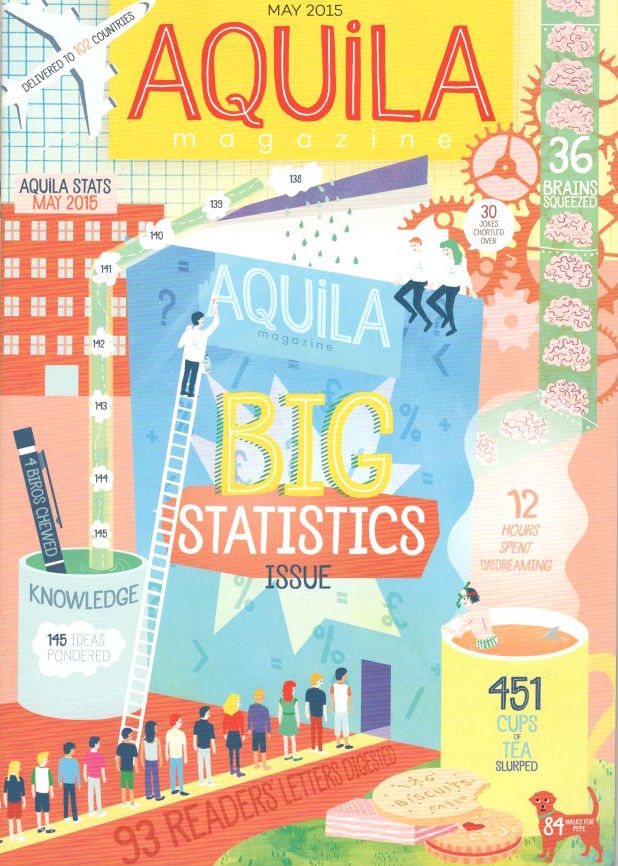
Aquila Magazine (kids 8-12) – May 2015

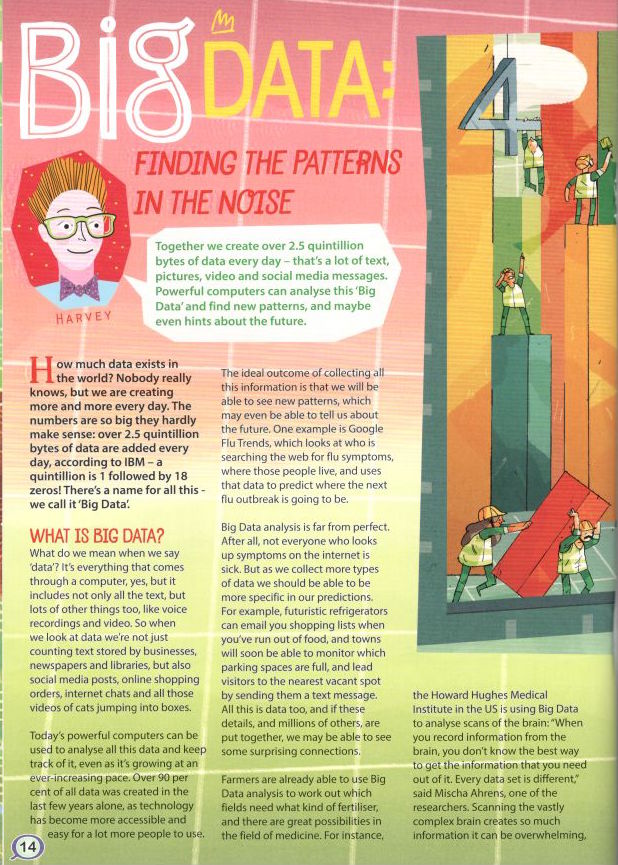
Scan 3Big Data: Finding the patterns in the noise

We create over 2.5 quintillion bytes of data every day – that’s a lot of text, pictures, video and social media messages. Powerful computers can analyse this “Big Data” and find new patterns, and maybe even hints about the future.

How much data exists in the world? Nobody really knows, but we are creating more and more every day. The numbers are so big they hardly make sense: over 2.5 quintillion bytes of data is added every day, according to IBM – a quintillion is 1 followed by 18 zeros. There’s a name for all this – we call it “Big Data”.

So what do we mean when we say “data”? It’s everything that comes through a computer, yes, but it includes not only all the text, but lots of other things too like voice recordings and video. So when we look at data we’re not just counting text stored by businesses, newspapers and libraries, but also social media posts, online shopping orders, internet chats, and all those videos of cats jumping into boxes.

Today’s powerful computers can be used to analyse all this data and keep track of it, even as it’s growing at an ever-increasing pace. Over 90% of all data was created in the last few years alone, as technology has become more accessible and easy to use for a lot more people. The ideal outcome of collecting all this information is that we will be able to see new patterns, which may even be able to tell us about the future. One example is Google Flu Trends, which essentially looked at who was searching the web for flu symptoms, where those people lived, and used that data to predict where the next flu outbreak was going to be.

Big Data analysis is not perfect – after all, not everyone who looks up symptoms on the internet is sick. But as we collect more types of data we should be able to be more specific in our predictions. For example, futuristic refrigerators can email you shopping lists when you’ve run out of food, and a town will soon be able to monitor which parking lots are full and lead visitors to the nearest vacant spot by sending them a text message. All this is data too, and if these details, and millions of others, are put together, we may be able to see some surprising connections.

Farmers are already able to use Big Data analysis to work out which fields need what kind of fertiliser, and there are great possibilities in the field of medicine. For instance, the Howard Hughes Medical Institute in the US is using Big Data to analyse scans of the brain: “When you record information from the brain, you don’t know the best way to get the information that you need out of it. Every data set is different,” said Mischa Ahrens, one of the researchers. Scanning the vastly complex brain creates so much information it can be overwhelming, but Big Data analysis has made it possible for researchers to test out ideas faster. This will hopefully cut down the time it takes to come up with new treatments for illnesses.

Big Data is being used for strictly fun purposes too: sports fans who like to watch the replays and study the match statistics have increasingly more data to play with. During the Wimbledon Championship, a service called the Slamtracker gives tennis buffs access to data collected from eight years of tournaments. This means people can look up their favourite players’ performance statistics and playing styles, and even get victory predictions based on the backgrounds of their opponents.

While there’s no doubly the opportunities are vast, one question remains: who owns Big Data? This is especially important as we give away more and more information about ourselves on the internet, often in exchange for using services like email or social media without having to pay. Companies like Facebook and Twitter assure us information belongs to users, but the companies are still using this information to sell advertising. And what about the data collected by the phone company? Even if they’re not listening to what we are saying, the time, duration and location of a call is data too. Right now, companies are often using data about people anonymously, meaning they look at how many people did something and where they were, but the names are kept out of it.
As we continue to gather data, Big Data analysts will be able to glean more and more insights that will hopefully help us create products and services to make life better. A deli can use Big Data to work out which sandwiches sell best in what weather, for example, and make sure they don’t run out. Airlines can crunch the numbers to come up with a quicker way to board airplanes, and towns can use traffic flow analysis to prevent queues.

It’s exciting to think about what we can do with our new power of Big Data analysis, and this is only the beginning. “Big Data marks the start of a major transformation,” said authors Kenneth Cukier and Viktor Mayer-Schonberger in their book ‘Big Data’. “Just as the telescope enabled us to comprehend the universe and the microscope allowed us to understand germs, the new techniques for collecting and analysing huge bodies of data will help us make sense of our world in ways we are just starting to appreciate.”

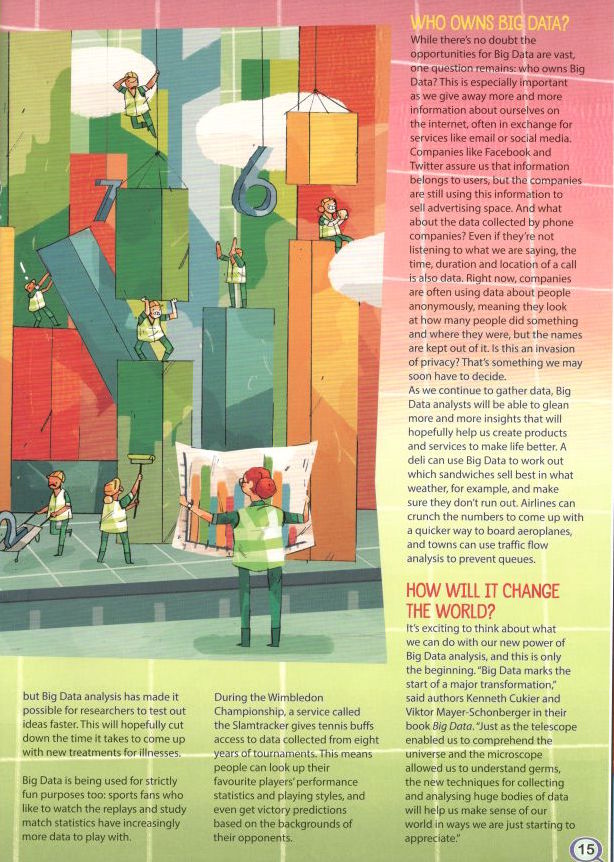
Scan 4Scan 5


Who was Marie Antoinette?

Aquila Magazine for kids, March 2015.

Scan

Who was Marie Antoinette?
Marie Antoinette was executed in the French Revolution. But was the last Queen of France really as out of touch as people thought? And did she really say that people who couldn’t afford bread should just eat cake instead?

Marie Antoinette was born in 1755 in Vienna, as an Archduchess of the Austrian Empire. Baptised Maria Antonia Josepha Johanna, the girl was described as “small but completely healthy”, and had a happy childhood with her 15 brothers and sisters. Considering what was customary for a royal family at the time, Marie Antoinette had a pretty relaxed upbringing. The children were allowed privacy from the rest of the court, so they could dress more casually, learn from their teachers, and play in the gardens, often with regular kids.

In those days, royal marriages were tools for forging alliances between countries. For this reason, Marie Antoinette’s mother, the Duchess, decided her daughter should marry the boy set to become the next king of France. Marie Antoinette was only 15 when she was married to 16-year-old Louis, and the teenagers had never met when they were married in a ceremony where they weren’t even present. Before she left for France to start her new life, Marie Antoinette’s mother told her daughter to never forget she was Austrian, even when she was the Queen of France. But the French had other ideas, as young Marie Antoinette was made to get rid of all her Austrian belongings, even her clothes and her dog, replacing everything with French things.

Life for Marie Antoinette wasn’t easy once she arrived at the Palace of Versailles. As the Queen, she had to deal with everyone at court keeping an eye on her, gossiping about what she got up to. Her marriage to Louis was difficult, partially because the couple didn’t have children for eight years, something that caused a lot of speculation around the court. They eventually had four kids: Marie Thérèse, Louis Joseph, Louis Charles, and Marie Sophie, who the Queen was very close to as she took care of their upbringing and education herself.

But for all those years before her kids were born, Marie Antoinette had few royal duties, so she didn’t actually have all that much to do. As a young girl far from her family, the Queen spent much of her time socialising, and buying fancy clothes and jewellery. She liked to ride horses, but also enjoyed gambling on cards and horse races. At a time when France was struggling financially, stories about the Queen spending a lot of money were spread around, and criticised in the newspapers. The Queen and her friends, it was written at the time, “loved pleasure and hated restraint; laughed at everything, even the tattle about their own reputations; and recognised no law save the necessity of spending their lives in gaiety”.

As the first lady of the court, Marie Antoinette was supposed to set standards for fashion, so she’d buy a lot of new dresses, shoes, hats, perfume and makeup, sometimes even going into debt to pay for everything. At a time when many people were poor or starving, it looked bad that a woman who had so many luxuries would play dress-up with her friends, running around on a model farm dressed up as milkmaids and shepherdesses. This was considered insulting to real farmers, even though Marie Antoinette was probably just trying to fill her time, recreating the playful games of her childhood in Vienna.

While she did spend a lot of money, Marie Antoinette was certainly not to blame for all of France’s financial problems, as many people liked to say. The country was in debt mainly because of its involvement in the American Revolution, which cost far, far more than the Queen’s extravagant wardrobe. The royals’ money splurging did give the impression of being out of touch, but the social unrest in France was more based in the fact that ordinary people had to pay high taxes, while the richest people who owned the most land did not.

In the winter of 1788, the rising prices of bread led to a crisis in France, and Marie Antoinette was rumoured to have responded to the problem by saying: “Let them eat cake!” This wasn’t actually true, as Marie Antoinette gave a lot of money to charity and would have known better than to say something so silly. But people wanted someone to be angry with, and it was easy to blame the Queen had a reputation of spending too much money and not caring much about the people.

Once the French Revolution started in July 1789, the royal family quickly realised they were in danger and left the Palace of Versailles for Paris. Marie Antoinette tried to stay out of things and focus on her children, still hoping her son would become king of France one day. But as the revolution roared on, the monarchy was declared over and the royal family stripped of their titles. To make sure the King could never reclaim his power, the revolutionaries executed King Louis for treason, and as the Queen, Marie Antoinette suffered the same fate nine months later. She was 39 years old when she was executed by guillotine, after a rushed trial. Somehow, Marie Antoinette managed to get hold of a pristine white dress and bonnet for the occasion, determined to make a final impression of defiance. Her last words was to her executioner, after she accidentally stepped on his foot: “Pardon me Sir, I didn’t mean to do it.”

Scan 1
Scan 2


Michelangelo Pistoletto: The Mirror of Judgment

Whitehot Magazine, 2011. Original article.

Screen Shot 2015-02-16 at 12.08.11Michelangelo Pistoletto: The Mirror of Judgment

The Serpentine Gallery, London. 

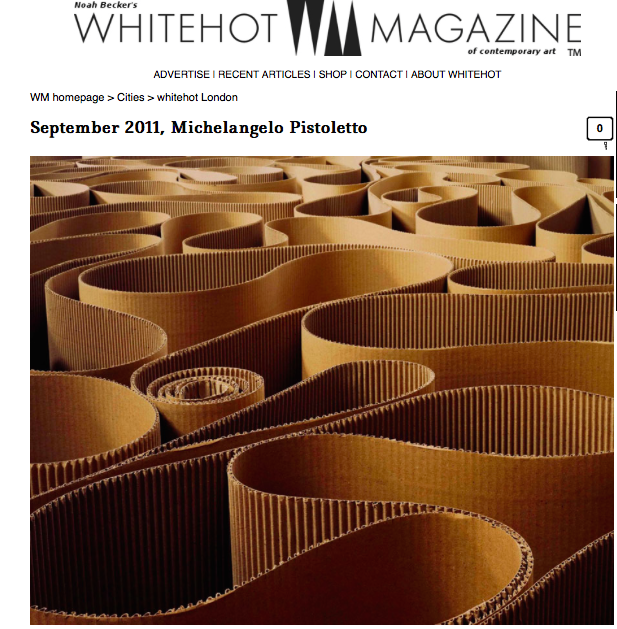
Michelangelo Pistoletto has got us all working for him. The artwork displayed at the Serpentine is only part of the equation; the rest is up to us visitors, moving slowly through the maze of swirling cardboard. The corrugated paper winds itself around the entire gallery, leading us on, every now and again depositing us in front of a massive mirror. There is no escaping Pistoletto’s mirrors; it is just you there, surrounded by white walls and cardboard, with no choice other than to look. Your eyes scan over your fellow audience, the walls and the ceiling, until like it or not, they come to rest on your own reflection.

Pistoletto, the Italian artist of worldwide renown, is no stranger to the themes of reflection and participation. It can seem as if there is a social experiment at work here, starting when visitors enter the gallery and search for instructions whether to go left or right. But there is no set order to the art, which is constantly changing anyway; it is all down to us. Standing in front of the big mirrors, several of the visitors seem uncomfortable having to look at themselves so blatantly, resorting to a quick adjustment of hair or clothing before scuffling on.  We are used to being provided with direction when looking at art, but Pistoletto does not seem to be all that interested in telling us what to think. Instead he sends us on our merry way through the labyrinth, possibly a metaphor for life, where around each corner we encounter a new version of ourselves.

Having said that, with an exhibition named The Mirror of Judgment it is clear Pistoletto is not devoid of motives. The four largest mirrors are adorned with iconography from one of four religions: a Buddha, an Islamic prayer mat, a Christian altar and the Jewish tablets. Pistoletto uses the word “judgment”, but there is something unifying about the way the cardboard maze ties it all together, creating a feeling it may in fact be about the opposite. Whether you stand by the prayer mat or the Buddha, the experience is the same: you, and your thoughts.

As the labyrinth leads us into the centre room of the Serpentine, we encounter Pistoletto’s mirror obelisk. Suspended from the ceiling are three large ovals, forming a symbol of infinity. The angles of the sculpture mean you get a different view each time you move, of the ovals, the obelisk and of the perpetually mirrored visitors. Then suddenly, only for a minute, I find myself alone in the room, with no reflection other than my own. With only white wall and brown paper behind me, I watch myself walk, conscious of the vanity but reluctant to look away. Pistoletto offers us no paintings to admire, no sculptures to study; just the maze, the mirrors and what we see when we look into them. I am not entirely sure what it means, but I believe the answer lies in the experience.

Bouvard and Pécuchet’s Compendious Quest for Beauty

This Is Tomorrow, 2012. Original article

Screen Shot 2015-02-16 at 11.51.46Bouvard and Pécuchet’s Compendious Quest for Beauty

David Roberts Art Foundation, London

It is a good thing the word “compendium” features so prominently even before you enter the gallery, as it makes a helpful prelude of what is to come. “Where is the rule?” is what Bouvard and Pécuchet used to say, the characters from Gustave Flaubert’s unfinished novel whose name has been given to this exhibition. The two Parisian gentlemen would meet to fuel each other’s curiosity about the world, studying a myriad of subject ranging from agriculture to medicine. After spending an hour at the David Roberts Art Foundation I am not sure if I am any the wiser about this elusive rule, but I do believe this show is not about a hunt for the red thread – but an exploration of that thing they call beauty. At least that is what followed my initial confusion about the volume of such diverse pieces, once I gave in and just focused on how good most of these works ultimately are.

34 artworks from as many artists make up this exhibition, including several famous names. Sometimes it feels like an education, while in other moments it is just luxurious to wander in a space where pieces were chosen because the curators liked them; the search for beauty has overwhelmed all other concerns. Still, says Pécuchet: “Beauty must be sought within a rule,” so the exhibition is divided into nine categories. But then Bouvard says: “Everybody knows that rules are not sufficient. Something else is needed: genius. And genius comes from sentiment, manifesting in expression.”

An urn by Grayson Perry is the first item comes first, representing the “Classic v expression” category. Photographed faces are contrasted against classical drawings around the pot, perfectly illustrating in a single work the points made by both Pécuchet and Bouvard about rules and their counterweight. “Memento mori” has Gerald Byrne’s large black and white photo of a newsstand, where an extra layer of meaning is derived from the juxtaposition of David Shrigley’s taxidermy kitten carrying a sign reading: “I’m dead”. The “Realism” segment has Thomas Demand’s large photograph of an empty office next to a perfectly crafted bin bag by Gavin Turk and a broom by Susan Collis, both easily mistakable for something left by the cleaners. Notes Bouvard: “The most banal things are liable to reveal new facets about the world. Modern life conceals within itself so much richness.”

‘Female beauty’ is the biggest single category in the show, with Valie Export’s “Body Sign Action 2” from 1970 being a standout piece. A big black and white image shows us a close-up of a woman’s hips; she has an intriguing tattoo on her thigh and her shadow plays up against the wall behind. Only then do you realise she is naked, a fact less subtle in the other images from this segment. One is a classic topless pose, another is a comical sex painting, the third is a man surveying a woman presented to him. Another excellent piece is Mario Pascual’s “Untitled” from 2010, where the photograph is gently folded in the middle so most of the woman disappears. Her head and shin sticks out, and somehow this is the most titillating of all.

Down the stairs, to “Abstraction”, we encounter Roy Lichtenstein’s six images of a cow. Each reworking looks less and less like an animal, illustrating Pécuchet’s point about abstraction being the final stand against art needing to represent anything at all: “One must reduce, purify.” Less obvious in its message but possibly even more intriguing is Bram Bogart’s “Blanc tombant”, where piled-on layers of paint are now hidden under a coat of white. Next, in the “Outsider beauty” category, is Douglas White’s “Mop print 1”: a large tea stain on a piece of paper, buckled from the moisture long since evaporated.

At the end of the exhibition we find “The sublime”: consisting of only one piece of art, by Graham Hudson. By this point, Bouvard and Pécuchet have run out of words to try and determine the difference between the beautiful and the sublime, and how to measure taste, because the rules have proved useless. Hudson’s rectangular box lined with lights spin slowly, and there is only one thing to say: how wonderful.


The little daylight

This Recording, February 2015. Original article.

Screen Shot 2015-02-05 at 14.33.50

The little daylight

I got on the plane – you always get on the plane in the end. I went to Norway thinking I could always go back to the city early if it got to be too much: the cold, the dark, the silence. I do that now, whenever I leave London: I tell myself I can go back early. Twelve years of living in the Big Smoke and it keeps getting better, or maybe I’m just getting greedier for it? For years my habit has been to always have a plane ticket waiting to take me somewhere, but lately the date of departure approaches and I don’t really want to go. London is gritty, demanding and thrilling, and the constant noise has been a backdrop to every significant thing in my life.

It’s been several days since I came to Norway now, I couldn’t really say; Scandinavian days are so short in winter. Sunset came at 3.45pm today, six and a half hours after the sunrise. Then, once the sun has disappeared, the sky seems to stay blue forever. It’s partially because it’s cold, minus 12°C today, rendering each intake of breath sharp and the air sparkling clear. I lived here for 18 years, but I don’t really remember much about winter. Until I got here a few days ago I’d forgot how the long, slow dark feels so dense once you’re in it, like being in a submarine at the bottom of the sea. The daylight is small, in length and in intensity, like there’s a light somewhere just around the bend but it doesn’t quite stretch far enough to fill up the sky.

As cold as Norway may get in the winter, I was never cold when I lived here. I’m not cold this time either, even after a week of relatively mild frost in London that nevertheless felt like a severe and personal form of punishment. The difference is that Norway expects the cold, so people accept it and prepare for it, not like the English style of remaining in denial while shivering in thin coats in drafty rooms, wondering what’s happened to the air. In Norway, you dress like a polar explorer, with double wool down the arms and legs and insulated shoes. The tricks for managing cold weather is slowly resurfacing from my subconscious, where it’s been buried all these years I’ve been away.

I don’t usually go to Norway in the winter anymore but I this year I’m between houses, so I figured my mother’s place in this small Norwegian town would be a nice place to be technically homeless. I was right: it’s peaceful and plentiful here, even in the cold. Everywhere you go is a warm room with ice on the windows. There are no distractions here, but somehow I’m still finding the hours slipping away, and suddenly the front door clicks open as my mother comes home from work. The town is sleepy under the snow covering the streets, the gardens and the porches. The roads are empty as people retreat to their wood-heated houses at night, red-cheeked from frost with hair static from wooly hats.

The night comes so early and I never quite get a grasp on the day before it slips away. The novelty of the dim light distracts me from the things I need to do, as I work in the warmth looking out at the cold, where the disappearing blue light is reflected by the snow. The whole world feels quiet here. I love London more than any place I’ve ever been, I adore the rush and the noise, and I keep thinking this silence will start to bore me soon. But for now I’m just wandering around, from the table to the tea kettle to the bed and back, revelling in the little daylight. Life feels simple here, in the way it always does when you spend time in a place that’s not your home. I was born here but it never felt quite right, in ways that had nothing to do with the light or the temperature.

Now that I’m a visitor it’s okay, it’s even a treat to spend a few days being someone I’m not. There’s a luxury in allowing myself to enjoy the dark and the cold, just for a little while. So I’m just going to sit here, watching the constant changes of the light, drinking in the silence with a thirst that won’t last for long, but right now it feels endless.

The weird, the wonderful and the WickED

Source Magazine, spring 2015. Original article.

Screen Shot 2015-06-02 at 13.09.16

The weird, the wonderful, the Hackney WickED
The Hackney WickED festival is a three-day explosion of the creativity of London’s most brilliant arts hub. But the community that’s the beating heart of Hackney Wick keeps the spirit alive all year round.

Hackney Wick doesn’t feel like the rest of London – actually it doesn’t even feel like the rest of Hackney. Coming off the Overground you immediately see the larger-than-life red letters on the wall: ‘HW’ they read, setting it in stone. And further along a more modest scrawl: ‘Welcome to the Wick’. This is a place by artists and for artists, but you’re welcome to come stay a while: linger in the galleries, study the artful graffiti, have a drink at The Hackney Pearl.

The biggest influx of visitors happens during the Hackney WickED festival. Last summer 35,000 people came for a peek behind the industrial facades as artists opened their studio doors. Not to mention all the gallery exhibitions, tours and workshops hosted during the festival, along with music, food and drink. “It’s amazing we’ve been able to run this festival for seven years with so little money,” says Anna Maloney, festival director at Hackney WickED. “We’re a volunteer-run arts organisation, so it’s based mostly on goodwill.”

The first studios opened in 2001 as artists came to the Wick in search of affordable spaces to work and live. The Hackney WickED festival came along in 2008 to celebrate and promote the art and community. “A main aim of Hackney WickED is to bring the artists together, to work together more closely and celebrate what we have here,” says Maloney, who estimates the Wick has near a thousand studios.

The feeling of community is the reason artists come and stay in the Wick: “I was looking for a large space where I could make noise and dust and be messy,” says Lee Borthwick, an artist at TM Studios. “I wanted to be in a more professional environment, and around people a bit further ahead in their practice so I could learn from them. The community in Hackney Wick has been far beyond my expectations.”

TM Studios is one of many who welcome visitors during the Hackney WickED festival. “You get people who’re interested in seeing the work and have a conversation with you,” says Borthwick. “People were buying work, which was lovely. That happened more the second year I opened, as people have to see you a few times to know you’re a professional, to get to know what you’re doing.”

Hackney WickED is currently working on become more of a sustainable, year-round presence in the Wick. “There’s so much change in the area” says Maloney, pointing to the concerns weighing heavy on the heart of every artist working in the Wick right now: several studios have been given notice to vacate, as the popularity of the area has led to increasing outside pressure. Hackney WickED was in part established to protect the artist community in the face of change, which has escalated since the Olympics. “First of all we’re an art organisation with an annual art festival, but we’re also a network of artists and a community working together. The festival wouldn’t happen without the participation of the people in the community,” says Maloney. “It’s a fine balance.”

Joanna Hughes, director at Mother Studios, believes Hackney WickED has been crucial to the success of the area: “The lasting legacy of Hackney WickED is how it’s pooled the community and made it stronger. […] Being an artist can be a solitary life, so you need your peers in the art world to help you on your way.” Hughes was among the first artists to come to the Wick, and feels strongly that the arts hub needs protection in order to continue thriving: “When I opened Mother Studios I had a waiting list immediately, and I’ve never lost it. There are twice as many artists as artist studios in London.”

Daisy Bentley, part of the Tunnel Studios artist collective, recently lost her studio space in the Wick. “I’m hoping I’ll find a new one in time for this summer’s Hackney WickED. If not, I’ll definitely be getting involved in events.” Working in the Wick for three years has done more for her art practice than a decade of arts education, says Bentley: “People tend to shut themselves away in their studios, so Hackney WickED is an invaluable opportunity for everyone to share and open up to potential collaborations.”

While she prefers to keep a closed door to get work done, Nina Fowler appreciates the opportunity to get to know her neighbours during Hackney WickED. “I usually decide near the time if I’ll open my door during the festival, as it depends on what I’m working on and how accommodating my studio is to guests,” says Fowler, who works at Wallis Studios. Last year, festivalgoers could take part in her ‘Polaroid Portrait’ photo booth. “The festival reminds us there’s a large and thriving creative community in the area, and this is something to be celebrated.”

It’s a long time since Hackney Wick was “a mudpatch in the middle of nowhere”, as Doctor Who said in 1976. Even so, during the first Hackney WickED festival in 2008 there were no bars or restaurants in the area, and the organisers would sell drinks out of a caravan. Today, people come to the Wick to shop and eat all year round, indulging in the smoked salmon at Forman’s or a microbrew at whatever pop-up bar is attracting crowds that week. Even though it’s still geographically isolated between a major road and the canal, the Overground has made the area much more accessible. All the while, artists are busy at work in the warehouses lining every street, building the creative energy that’s unique to the Wick and thoroughly infectious.

Screen Shot 2015-06-02 at 13.06.43

Buckminster Fuller

Whitehot Magazine, 2012. Original article.

Buckminster Fuller: The Utopian Impulse
San Francisco Museum of Modern Art, 31 March – 29 July 2012

Screen Shot 2015-01-28 at 12.26.39‘Radical idealism’ is what Buckminster Fuller called it. It was the 1960s, a time when everything people had taken for granted was up in the air and the future was a place with minimalist design, energy efficient housing and maybe even a colony on the moon. ‘The Utopian Impulse’ is not only an insight into Fuller’s ideas for the future, one where technology and sustainability stands at the centre, but also a picture of what the world could be like if was created through elegant design, inspired by nature and boldly executed with a mandate to make things better.

Or maybe it was too much to ask, because by the time the 1980s rolled around, boasting a very different brand of radicalism, people had stopped picturing this fantastical future. So where did the dreams go? At least this is what I am wondering after spending a couple of hours surrounded by the imagination of Buckminster, lovingly displayed at the San Francisco Museum of Modern Art. While Fuller (1895 – 1983) never lived in the Bay Area, he lectured here extensively, making this exhibition a perfect fit for an area with a unique magnetism for idealists, inventors, non-conformists and dreamers of various ilk.

The ‘Inventions’ series consists of 13 drawings patented by Fuller in his mission to create superior solutions. There is the teardrop-shaped car; a design for a rowing boat consisting of two beams and a seat; a base for septic fuel tanks. A photograph shows Fuller next to a dome-shaped building covered in round windows, the most energy-efficient form. Geometrical shapes are repeated everywhere, chosen for practicality and kept for being pleasing to the eye. This is not a coincidence, observed Fuller: “I only think about how to solve the problem. But when I have finished, if the solution is not beautiful, I know it is wrong.”

The stand-out piece is the ‘Dymaxion Air-Ocean World Map’, where Fuller has taken a globe and laid it out flat, in triangles. Looking at the world with the North Pole as the centre, you suddenly realise all the land masses link together. Fuller was a fan of the triangle, calling it the only shape that is “inherently stable”, as described in the ‘Synergistic Dictionary’. A selection of the 22,000 entries typed up on index cards are displayed, providing a glimpse into how this man saw the world. Take the entry for ‘Spiral’: “A triangle is a spiral, and is one energy event.” It may seem a little kooky, but there is evidence that Fuller was way ahead of his time, especially with his energy-efficient solutions. The teardrop-shaped car from 1933 had unprecedented fuel efficiency; the ‘4D House’ from 1928 is an hexagonal autonomous dwelling designed to be optimally resource efficient, as well as capable of mass production in factories for off-site assembly.

‘The Utopian Impulse’ also includes pieces by artists and designers whose works are in a similar vein to Fuller. The Ant Farm Collective was established in San Francisco in 1968, a group which expanded the role of architecture to include performance, film, installation and animation. On display is their ‘Convention City’ model from 1978, a dome-shaped suggestion for Texas. There are pamphlets from the Office of Appropriate Technology, established in California in 1976 with the task of assisting state agencies in developing and implementing less costly and energy-saving initiatives. Solar energy, farmers markets and bicycling programmes were among its efforts.

For an exhibition so firmly focused on the future, ‘The Utopian Impulse’ feels distinctly retro. This is probably a natural consequence of styles having changed since the 1960s, but the main element to this feeling is the sneaking awareness that these people, who made this work nearly 40 years ago, may have been more optimistic about the future than we are now. Maybe we know more now, about the limitations of power generation and the complexities of politics, and we are simply resigned to the fact that the future will take a little longer to get here than we had hoped. The ‘Earth Flag’, made in 1969 by Norman La Liberte and John McConnell’s, hangs on the wall; it has a grey and white planet on a blue background. It looks so simple.

Or maybe we just have different dreams now, ones which we can actually reach: fewer underwater colonies, just better waste recycling. And energy-neutral housing: amongst a handful of post-millennium works included in the exhibition is IwamotoScott’s ‘Jellyfish House’ from 2005, an intricate architectural model made from mesh, with soft curves like a sea creature. ‘Hydramax Port Machine’ from 2012, bulit by Future Cities Labs, looks like a plant with tentacles, moving softly under water. The building is designed to capture moisture and to store and re-circulate water inside the building. It is not quite “peace on earth” but it is distinctly in the tradition of Fuller, who sought the attention of the individual and not governments; he wanted us to each add our knowledge and resources to build a future we would feel a part of.

In 1965, Fuller initiated something he called the ‘World Game’ project. He described it as a data-visualisation system to facilitate global approaches in solving the world’s problems, wanting it to contribute to “mak[ing] the world work, for 100% of humanity, in the shortest possible time, through spontaneous cooperation, without ecological offense or the disadvantage of anyone”. Nowadays we call it the internet. Fuller believed greater access to information would generate more humanitarian problem-solving, and on a good day, that is what the internet does. There is a lot of work to do still, but l think Buckminster Fuller would be excited about what comes next.

Coffee houses of Melbourne

Escapism Magazine, February 2015. Original article (p64-68).

Screen Shot 2015-01-26 at 15.15.42Coffee houses of Melbourne, the caffeine addict’s paradise
To tell you the honest truth: you don’t need any help to get good coffee in Melbourne. Australia’s second city is a haven for caffeine addicts, as you’d be pretty unlucky to get a bad cup. As mayor Robert Doyle discovered when he dared suggest that “coffee is coffee; it’s not life or death” – Melburnians take their black brew very seriously. Lucky for them, and for everyone who visits, the overall quality of the city’s offering is nothing short of outstanding. But that doesn’t stop people from battling it out over who’s got the best beans in town.

Melbourne’s thing for coffee is a running theme in the cityscape, as you don’t have to walk far between watering holes. The grid that makes up the downtown area, the CBD (Central Business District), is a mixture of broad streets and tiny lanes, both equally busy as people are always popping out for a cup or three during the day. It’s not uncommon for a Melburnian to get up a little earlier just to have time to sit for a bit in a café, either for a slap-up breakfast or to just read the paper over a wake-up shot before work.

The local taste calls for a gunpowder strong brew: ask for a Short Black and get a tiny yet forceful shot of espresso that hits you at the back of the throat. A Long Black will give you the same, eased out with some hot water. Starbucks may be serving Flat Whites now but if you want a great one, Melbourne will sort you out: the Flat White is an Antipodean invention that’s been going strong since the 1980s. Speaking of coffee chains, you’ll find very few of them in Melbourne: Starbucks closed almost all of its Australian branches back in 2008, realising they were selling ice to Eskimos.

Screen Shot 2015-01-26 at 15.15.54While coffee was originally brought to Australia by the First Fleet of ships from England, Melbourne’s love affair with coffee started in earnest during the 1830s, during the Temperance movement. Italians, who remain the city’s second-largest ethnic group after the Anglo-Celtic, took it to the next level when they arrived after World War II, bringing with them the custom of espresso.

Today, this tradition has blossomed into a city that’s nothing short of obsessed with coffee, to the point where baristas become local celebrities and people proudly proclaim themselves to be coffee snobs. In addition to the usual fare, espresso menus often offer up things like single origin beans, cold brews, signature blends, or siphon drips, all created by expert hands who see their jobs as a calling.

Don’t worry, you can get decaf or soy milk in a Melbourne coffee house too – after all, what’s most important to a good barista is that customers enjoy themselves. Just don’t ask if they have any flavoured syrup.

   ***
Screen Shot 2015-01-26 at 15.16.04Market Lane Coffee, 163 Commercial Road (Prahran)
The proprietors of Market Lane Coffee run a single-minded operation, obsessively sourcing “memorable” coffees that can stand on their own without blending. Serving only beans that are in season, there is full transparency around the process too, meaning the barista will probably know who grew the beans and how they got from there to your cup. Located next to Prahran Market in an airy building that mixes glass and steel, Market Lane Coffee takes its role as educator very seriously, offering free tastings, or “cuppings”, every week. If that doesn’t inspire confidence, we don’t know what will.

Atomica Caffé, 269 Brunswick Street (Fitzroy)
It’s a bit rough around the edges, with the peeling paint and scruffy decor, but you’d expect that in Fitzroy. Atomica Caffé fits right in with the funky vintage and cool design shops on Brunswick Street, but don’t let that distract you from the fact that this place has a heck of a reputation for its beans. Roasting its custom mixes on site twice a week, Atomica’s style is to deliver the goods without fuss or frills, keeping flavour squarely in focus. Duck into the dark interior with the chequered floor, bring a book and hide from the world but not for long: in 20 minutes that caffeine will kick in.

The League of Honest Coffee, 8 Exploration Lane (CBD)
Coffee is a way of life for the proprietors at the League of Honest Coffee, who serve up single-origin or custom-mixed brews, roasted in small batches with the goal of “create a fulfilling flavour profile for every bean”. As hardcore as this may sound, rest assured the shop on Exploration Lane is just the opposite: a light and airy space where concrete floors meet wooden ceilings, with friendly baristas inviting you to sit and relax. Coffee snobs will appreciate the Slayer coffee machine, the ultimate reassurance that this place really is second to none.

Pellegrini’s, 66 Bourke Street (CBD)
Melbourne’s first espresso machine was delivered to this address in 1954 – at least that’s what the proprietors claim, and we have no reason to doubt them. Pellegrini’s is one of Melbourne’s oldest coffee houses, and a proud piece of Italy. Everyone come to Pellegrini’s: kids, office workers, Saturday shoppers, theatre-goers – everyone is encouraged to take a seat at the counter or communal table, and order a shot or two from a waiter in a white shirt. You could even have lunch – it’s not always listed on the board, but they often serve up some pretty decent lasagna or gnocchi.

St ALi, 15-18 Yarra Place (South Melbourne)
Walking through the eventless streets leading up to St ALi, you’d never think there’d be a world class coffee roastery hiding around the corner. The converted warehouse makes for a great place to linger, as the spacious café has plenty of rugged atmosphere with its mish-mash of chairs, plants and coffee sacks. If you have time, stay for lunch: the eggs are excellent. Though the main draw is the coffee, which is roasted “with care” and brewed “to exacting specifications”. In any case, you can’t go wrong with St ALi: come and hang out a while, bring your friends, and leave jittery. Remember what it says on the wall: “Decaf is like kissing your brother.”

Screen Shot 2015-01-26 at 15.12.53