On synchronicity

Published in Lionheart Magazine #8, the Pattern & Colour issue, September 2017.

On synchronicity

Reality has one advantage over fiction: real life events can be wildly improbable. When you’re making things up they have to be believable, but reality makes no such promises: anything can happen.

It was the author John Irving who said this, I think – I seem to remember reading it in a preface to one of my favourite novels, “The World According to Garp”. This is a book where magical things happen to ordinary people. Or more likely, where perfectly realistic things happen, because reality is full of wild coincidences.

Like this one. I met my friend Johanna in San Francisco 18 years ago, and while we’ve kept in touch we hadn’t seen each other in the past decade. But the other week we’d agreed to meet – and three days before we were supposed to see each other for the first time in all that time, we ran into each other on the street. It was around the corner from my house in London, although she didn’t know I lived there, and she lives in Vienna now. I was headed into a café, so had she walked up just a moment later we’d have missed each other.

I ran into my partner at Waterloo station a few days later. He was on his way home and I was on my way into Soho when our paths crossed by the ticket barriers. This is less freaky as we both go through that station all time time, but Waterloo is the busiest rail station in all of Britain and the place was rammed with people. I wasn’t supposed to be on that train but I’d missed the last one, and I wasn’t supposed to take a left at the gates but did it anyway as it was so crowded. And suddenly Luke was there, I saw him first and reached out to touch his arm, interrupting the flow of people to steal a moment out of time.

Coincidences come with a feeling that something has slipped through a crack somewhere, interrupting the normal workings of time and space. A person shows up in a place they’re not supposed to be in; a name or number repeats; two people have had the same experience; a song plays at the perfect moment. These are some of the most common coincidences, and they happen to all of us, all the time.

But it feels so profound when it happens, and a number of coincidences in a row can create a sense of luck. Maybe it feels like you’re being carried forward by an invisible force, or that things are being nudged along to make sure they’re going your way. Like when you’re travelling through traffic and all the lights turn green just as you approach, or you get what you need in an unexpected way, just at the right time. The psychologist Carl Jung called this “synchronicity” – meaningful coincidences. This relates to Jung’s idea of the “unus mundus” – the idea of “one world” with an underlying order and structure where everyone and everything is connected.

It’s a quick jump from the idea of a connected world to superstition. As pattern-seeking animals, it can be hard for us to experience coincidences and not be tempted to read any deeper meaning into them, especially if the experience feels like it borders on the supernatural. But there are seven billion people on the planet, and with such large numbers, outrageous coincidences actually start to become likely. It may feel unlikely to meet someone who shares your birthday, but mathematically, you only need 23 people in a room before there’s a 50/50 chance two of them will be born on the same day.

Still, none of this explains how it’s possible to be thinking about someone – maybe a friend you don’t speak to every week – and the moment you do, your phone buzzes with a text from them. This happens to me all the time. Once my partner used “oak” as a metaphor, and we rounded the corner to find the ground suddenly covered in oak leaves. I was in a taxi on my way to something I was dreading, and “Don’t bring me down” came on the radio – and the same song played again in the taxi on the way back. I start thinking I want to get some Birkenstocks and suddenly I see them on a million people every day. But this isn’t the universe speaking to us – this is what linguistics professor Arnold Zwicky calls the “frequency illusion”: you think about something and your brain becomes primed to focus on it. It’s not that these things are suddenly happening more often, it’s just that now, you’re paying attention.

If it makes you sad to think that coincidences are just a toss of a coin, don’t be. Just because there’s nothing magical about magic, it doesn’t make our experience of it any less meaningful to us. Although Carl Jung didn’t like the idea of reading coincidences as random: “This would result in a chaotic collection of curiosities, rather like those old natural-history cabinets where one finds, cheek by jowl with fossils and anatomical monsters in bottles, the horn of a unicorn, a mandragora manikin, and a dried mermaid.” He says this as if it’s a bad thing, but it sounds pretty great to me.

It’s such a big world, and it can feel so overwhelming. How amazing is it that we find the things that we end up loving: our people, our places, our songs, our random detours that become memories that stick in our brains for the rest of our lives? I’m sure my partner and I have passed each other at Waterloo station without seeing each other a dozen times, and I believe it was luck that we saw each other that day. But that didn’t make it any less wonderful. A face that I love appeared in the crowd, purely as a surprise, and we shared a moment that shouldn’t quite be happening.

London’s challenger banks are the envy of New York fintech

FusionWire, 2016. 

London’s challenger banks are the envy of New York fintech

New York has no shortage of impressive fintech startups, but when it comes to challenger banks, everyone is looking to London.  

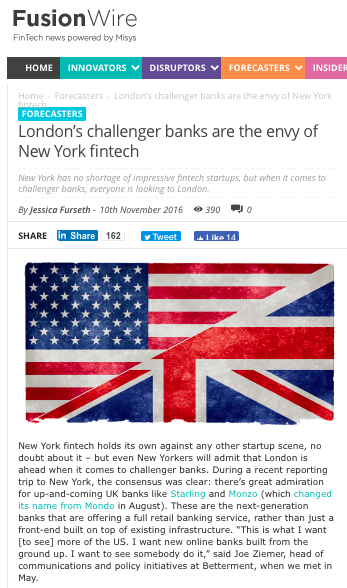
New York fintech holds its own against any other startup scene, no doubt about it – but even New Yorkers will admit that London is ahead when it comes to challenger banks. During a recent reporting trip to New York, the consensus was clear: there’s great admiration for up-and-coming UK banks like Mondo and Starling. These are the next-generation banks that are offering a full retail banking service, rather than just a front-end built on top of existing infrastructure. “This is what I want [to see] more of the US. I want new online banks built from the ground up. I want to see somebody do it,” said Joe Ziemer, head of communications and policy initiatives at Betterment, when we met in May.   

Starling and Mondo both secured UK banking licences this summer, joining the dozen-plus new banks that have received licences since 2013; that was when UK regulators changed the rules in an effort to encourage innovation in the retail banking sector. Goals are lofty and ambitious and there’s money available to pursue them: Starling raised $70m in January, while Mondo was valued at £30m following its £6m fundraising in February. In May, new name Tandem raised £1m on crowdfunding platform Seedrs in less than 20 minutes.

In New York, leading US robo adviser Betterment is an example of a fintech startup that provides a full service, rather than just repackaging products from traditional financial groups. There are two key benefits to this approach, says Ziemer: “One is the user experience. If you open a Betterment account you will open the entire thing in two minutes – the advisory relationship and the brokerage relationship. … If you fund your account tonight you’ll be fully invested tomorrow morning.” This is possible because Betterment handles everything in-house, and no outsourcing means no delays, no profit-sharing, and overall full control.

Building from scratch – like Betterment is doing as a US robo adviser, and Mondo is doing as a UK challenger bank – has drawbacks. For one, it takes much longer. It also requires more funding up front, as years can go by before the product can be launched and even then, it can take years to make money. But if successful, the payoff will be a company that’s central to the customer, rather than a nice-to-have. An example of this is how we may use a service like PayPal, but this is useless without a bank account: our central relationship is still with the bank. The overall goal of Betterment gets to the heart of this, says Ziemer: “We want to get to a place where we are the client’s central financial relationship.” For UK challenger banks, the goal is the same – this is what’s caught the admiration of the New York fintech scene.  

The regulation advantage

So if New York can nurture a full-service financial advisory startup like Betterment, why the dearth of groundbreaking challenger banks? Put simply, it’s the lack of supportive infrastructure or permissive regulation. “There’s certainly a number of connecting data points around challenger banks being more prominent in Europe and Asia rather than the States. It may have to do with the regulatory scheme here in the US: you don’t often see them popping as much,” said Jesse Podell, Managing Director of Startupbootcamp Fintech New York, when we spoke in May. “[In London] you have some proven leaders, like Mondo. Whereas here, it may feel a bit stalled.”

Podell says London has done a remarkable job at boosting its fintech scene, which unlike in the US, benefits from being focused primarily in one place. But the UK still lags behind when it comes to funding. In North America, VC-backed fintech companies raised $1.8 billion across 128 deals in the first quarter of 2016, according to KPMG and CB Insights, which concluded fintech deal activity in the region is on track to reach a new high this year. In Europe, funding numbers for the period came in at $0.3 billion, and half of this went to WorldRemit and LendInvest. “Fintech investment in Europe has certainly been less overheated than in other markets,” CB Insights CEO Anand Sanwal said when the numbers were published, adding that this has resulted in increasing interest from US and Asian investors. These number do however pre-date Brexit, which has created uncertainty; London’s ability to hire people from all over Europe has been a significant asset when it comes to competing with the US.

London benefits from having more fintech accelerators compared to New York, and Podell is impressed by the quality of the infrastructure set up to support fintech startups in London. “What I do really appreciate and like about London is the regulatory scheme. It seems to be more adept at working and experimenting with startups. It’s seen as quite adversarial here in the States.” Podell, who’s just overseen the first round of companies completing the Startupbootcamp Fintech New York accelerator programme, says this is something he would like to work towards improving in the US: “[In London] you have a regulatory sandbox that startups have enjoyed. That could be a big part of the reason why the UK has done well.”

Buckminster Fuller’s Spaceship Earth

Aquila Magazine for children, July/August 2017 (PDF)

Buckminster Fuller

Buckminster Fuller wanted to bring humanity closer to utopia – a perfect place where everyone has what they need – and he believed that technology was how we’d get there. Fuller’s dream was borderline crazy but “Bucky” got closer than most, in part because he didn’t just try to solve each problem individually but he looked at how every single thing in the world is connected.

Buckminster Fuller was a scientist, as well as a designer, architect, geometrist, engineer, and cartographer. Or you could simply say he was a genius – and a bit of a crackpot! He had wildly creative and beautiful ideas for how to solve humanity’s problems, and he was deeply interested in pretty much everything he came across.

As the root of technology is science, Fuller studied the basic patterns in nature in the hopes of reproducing them in his inventions. Fuller is probably best known for his Geodesic Domes – those half circles that look a bit like a football cut in half. This construction doesn’t need any supporting beams, and is stable enough to endure harsh weather. Standing inside a Bucky Dome shows you how this design isn’t just strong and light, but also elegant and graceful. Fuller said: “I never work with aesthetic considerations in mind. But I have a test: If something isn’t beautiful when I get finished with it, it’s no good.”

*

Richard Buckminster Fuller Junior (1895-1983) was born in Massachusetts, USA, to a family of strong individuals dedicated to activism and public service. Young Bucky was no different, and the work he went on to do inspires us to this day. Fuller was severely nearsighted as a child, but until he got glasses he refused to believe the world wasn’t blurry. Early inspiration came from family trips to Bear Island in Maine, where Fuller learned about nature and boat construction. Fuller was later thrown out of university for spending too much time with friends and missing his exams. He then went to work at a mill, which taught him about machinery. His time in the Navy meant learning about engineering – Fuller invented a winch for rescue boats that meant pulling planes out of the water in time to save pilots’ lives. This invention earned Fuller the opportunity to train with the US Naval Academy, before he went to work with his father-in-law where he invented a new way to strengthen concrete buildings.

After the construction company went under, Fuller found himself at a loose end. He withdrew, wondering how he could best contribute to humanity. “You do not belong to you. You belong to Universe,” he concluded after he emerged from two years in deep concentration. His goal was ambitious: “To make the world work for 100 percent of humanity in the shortest possible time, through spontaneous cooperation without ecological offense or the disadvantage of anyone.” Fuller wanted to find a way to solve all the problems in the world at the same time, because he believed it was all connected. Fuller called his particular brand of whole-system thinking “synergetics” – to look closely at the natural relationships between objects, and examine how we think about things.

Not everyone liked Fuller – his ideas were unusual and pretty out there – and even those who supported him found he could be exhausting at times. He would often start talking about one subject and before you knew it, hours had gone by and Fuller would have covered not only the original topic, but put it into context with everything else around it. In Fuller’s world the simplest thing, like ancient boat building, was a vital component of the biggest issue, like the development of modern science – and listeners would find themselves not only convinced, but also inspired. Concluded the New Yorker magazine concluded after interviewing Fuller in 1966: “As Fuller told it, the whole rousing saga sounded absolutely irrefutable.”

*

“More with less” was Fuller’s guiding principle as he worked on one of his key areas of interest: revolutionise construction in order to improve housing. He invented the Dymaxion House, a cheap, mass-produced module that could be airlifted into place. The name, a mix of the words “dynamic”, “maximum” and “tension”, became a calling card for Fuller, who went on to invent the Dymaxion Car – a vehicle that even today looks like something out of science fiction. This car had three wheels and aerodynamic rounded edges, was 20 feet long and could hold up to 11 people and it used very little fuel. The Dymaxion Car caused such a stir when Fuller drove it that he was asked that he kindly keep it off the streets during rush hour because it caused gridlock. Fuller also dreamt up underwater settlements where people could receive supplies via submarine, and floating communities where people could live in the clouds.

The Dymaxion Map shows the whole planet on a single flat sheet of paper, without any of the usual distortions that you get with maps – the idea was to encourage people to think about the planet in a more comprehensive way, instead of focusing on individual countries. Fuller also developed the World Game, which used the Dymaxion Map to help people better understand how to use the planet’s resources to the benefit of everybody. Fuller figured we were all in the same boat, so it would make more sense if we all pulled in the same direction: “I’ve often heard people say: ‘I wonder what it would feel like to be on board a spaceship,’ and the answer is very simple. What does it feel like? That’s all we have ever experienced. We are all astronauts on a little spaceship called Earth.”

Just talking about the weather

Lionheart Magazine, February 2017.

eliasson1

Just talking about the weather

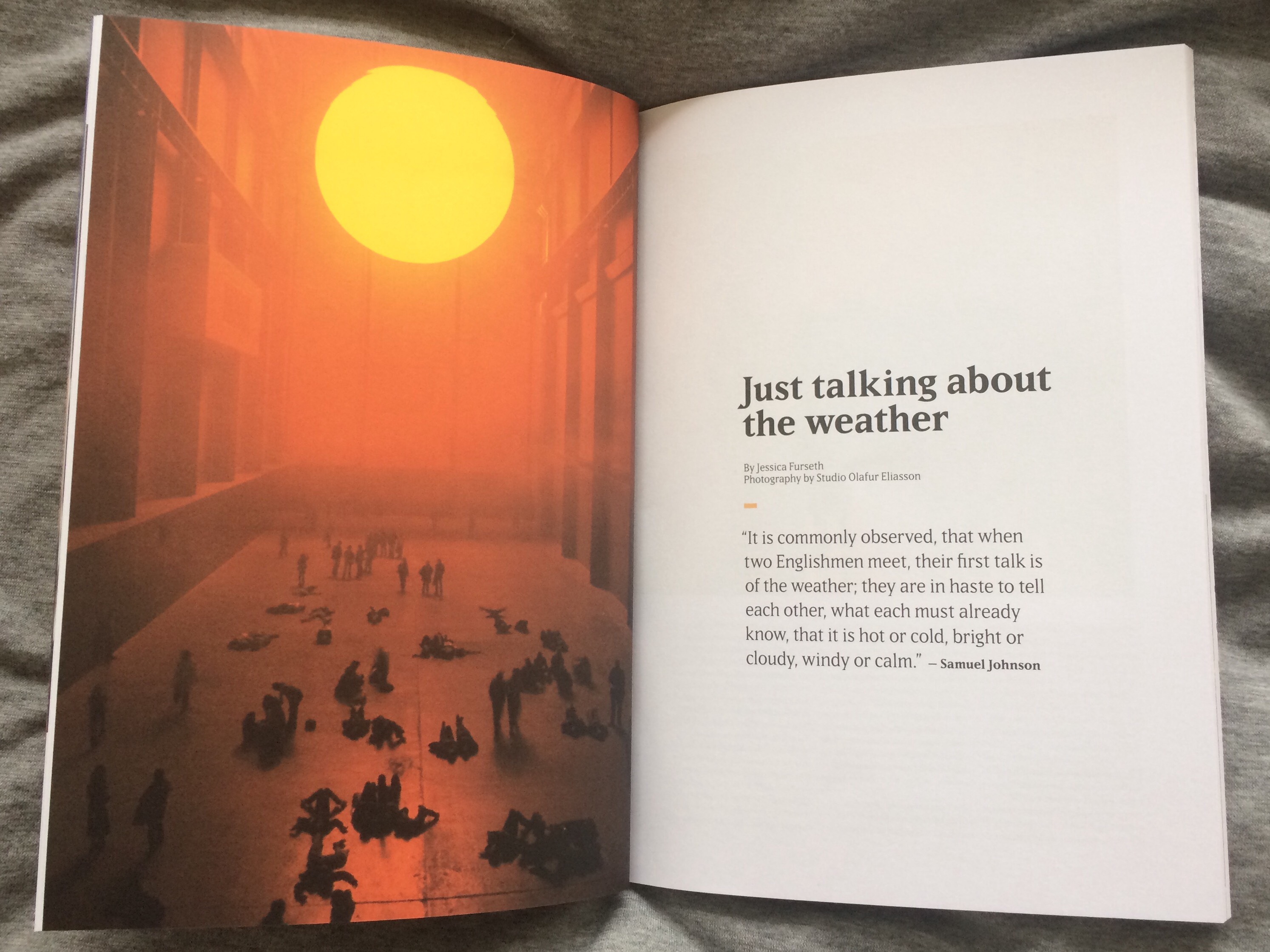
“It is commonly observed, that when two Englishmen meet, their first talk is of the weather; they are in haste to tell each other, what each must already know, that it is hot or cold, bright or cloudy, windy or calm.” (Samuel Johnson)

White sunshine is pouring down from a cold blue sky today, creating a rare moment of picture perfect autumn, the kind you see in postcards. The light hits the trees, covered in yellow and orange leaves – it’s so bright they’re glowing. I’m a summer child and the prospect of winter scares me, but right now the autumn is putting on a show, and it’s spectacular.

I feel bright today too, because the weather affects me far more than is reasonable. In the summer I’m happy, basking in the heat and the sun, grateful every day for the sweetness of it. In the winter it’s the opposite, although it’s not the cold that bothers me – it’s the absence of light. The grey January sun becomes a metaphor for my mood: not quite enough, stretched too thin. It’s always been like that for me, but in 2003 it was the worst: I’d just moved to London after finishing university and the city was too big, the rent was too high, the world was coming in too fast, and it was too damn dark outside. In winter, hibernation instinct takes over, and all you can do is wait.

eliasson2I don’t remember much from that winter, but there’s one thing that stands out. At the Tate Modern, in the central cavern that is the Turbine Hall, was an installation by the artist Olafur Eliasson. It was very simple: a sun-shape mounted on the wall, filling the gigantic space with yellow light and a fine mist. The mono-frequency lights, similar to those used in old-fashioned streetlights, meant you could see only three colours: yellow, black and white. The ceiling was covered in mirrors, which meant that when people walked into the space and looked around, very often they would lie down.

All through that winter I would go down to the Tate several times a week on my lunchbreak, just to sit in the sun. It might be gloomy as hell outside, but for half an hour it felt like the world was a place with light in it, and that I would find a way to make London agree with me. Now it’s 13 years later and my life is no longer something I feel the need to get away from, but I still think about that magical sunscape every single winter.

Apparently I’m not the only one. Olafur Eliasson’s Tate installation has been hailed as one of the most successful uses of the Turbine Hall to date. Eliasson called it ‘The Weather Project’, in recognition of how weather becomes our most immediate experience of nature in an urban landscape. “The weather has been so fundamental to shaping our society that one can argue that every aspect of life – economical, political, technical, cultural, emotional – is linked to or derived from it,” Eliasson wrote in the project catalogue. “Over the centuries, defending ourselves from the weather has proved even more important than protecting ourselves from each other in the form of war and violence. If you cannot withstand the weather, you cannot survive.”

Ahead of the exhibition, Eliasson asked people questions about the weather, including whether they thought the idea of the weather in society is based on nature or culture? 53% said nature – 47% said culture. As they teach you in meditation: there may be clouds in the sky, but the trick is to remember that above them is always a blue sky.

The light always comes back after the dead of winter and we survive it, every time. It can be difficult to remember in the depths of it, but in 2003 it was easy because there was summer on tap at the Tate. How amazing was that sun! How warm and reassuring. How it felt like a promise that things would change.

lionheart7-cover

Brixton Pound: How fintech boosts the local currency agenda

FusionWire, December 2016. 

screen-shot-2016-12-08-at-16-56-36

Brixton Pound: How fintech boosts the local currency agenda

The notes are eye-catching, but South London local currency Brixton Pound is most commonly traded in the form of text messages. We sat down with B£ Communications Manager Marta Owczarek to talk about how technology is furthering the local currency cause.

The Brixton Pound has just turned seven years old, making it one of the most successful local currencies in the world. Maybe you’ve seen the notes – the one with David Bowie is best known – you can get them from the B£ cash machine in Brixton Market, the first ATM of its kind. Or maybe you’ve been to the shop in South London – B£ has just moved to a new location on Atlantic Road, operating a pay-what-you-feel café and community space.  

Walking up to the café through the local market, seemingly every shop or restaurant has a B£ symbol in the window. This is a currency, yes, but more than that it’s a community interest project, says Marta Owczarek, Brixton Pound’s Communications Manager. As we’re sitting down on the hottest day of the summer, Owczarek gives me the breakdown: Brixton Pound is a non-profit organisation employing five people, running a local currency accepted by around 250 businesses. 200 of them also operate the B£ pay-by-text scheme, which has over 2000 registered users. This is what I want to talk to Owczarek about: how technology can help future-proof a local currency that ultimately depends on social goodwill to survive.

brixton-pound-pay-by-text

The technology behind the current B£ pay-by-text system is simple, and that may well be the key to its success, says Owczarek: “It’s a pay-by-text system that doesn’t need internet. You just need a phone that operates text messages.” She explains that the B£ notes have become a collector’s item, which is good PR but doesn’t actually help the local economy. Because of this, the electronic payment system has been an important tool for getting people to actually spend Brixton Pounds.

People can top up their B£ pay-by-text account at any time with a transfer from their bank accounts, or with cash at one of the dedicated outlets. “Lambeth Council has a payroll scheme for local employees, who can dedicate how many Brixton Pounds they want to receive as part of their salary every month,” says Owczarek. She takes out her phone to show me how the electronic payments work. It’s easy: just type out a text message with the amount and the name of the recipient (a shop or a person), and send it to the B£ phone number. Then each party gets a text message confirming the transaction – that’s it.

brixton-pound-david-bowie-born-in-brixton

The case for local currencies
Brixton Pound is tied to Pound Sterling, meaning this isn’t actually a separate currency – there incentive to use it isn’t financial. But there’s a strong community message attached – it’s a symbol of belonging to Brixton, and wanting to support the local community in an area where rapid gentrification is affecting local businesses’ ability to keep up with rising costs. This means B£ is mostly an independent business thing, but not exclusively; Honest Burgers and Franco Manca are both London restaurant chains that started in Brixton, so they accept B£ at their Brixton outlets as a signal of their dedication to the area.  

But while B£ has a strong social element, this is very much a financial enterprise: “Brixton Pound was set up by a group of local activists who wanted to do something in response to the financial crisis,” says Owczarek. “Many [local] currencies are about alternative banking, or alternative value systems.” Take the café we’re sitting in – people can pay however much they feel is appropriate. “When we at Brixton Pound started to ask questions about money, we were also asking what is value, or what is money in a wider sense,” says Owczarek. “Nobody is going to be using Brixton Pounds for profit. … [But] it really does start conversations. It means people are connected to each other, to their local community, and to their local business community.”

There are significant financial advantages to keeping money local. The New Economics Foundation concluded that spending money in local shops means that cash circulates in the local economy up to three times longer than if it had been spent in a national chain. The think tank also reported that £1 spent with a local shop is worth £1.76 to the local economy, while being worth just 36p if it is spent out of the area.

“We’re in touch with lots of other local currency worldwide and in the UK,” says Owczarek. “In the UK, we were the first to launch in an urban area. The ones that were operational before us, like Totnes, Stroud and Lewes – the initial idea was more about local supply chains, to be able to grow your own food and supply it locally.” Bristol Pounds has been a particularly successful addition to the local currency family, allowing individuals to pay council tax in Bristol Pounds. In comparison, Lambeth Council will accept Business Rate payments in Brixton Pounds, but individuals have to stick to Sterling.

brixton-pound-jeremy-deller-5y-anniversary-note-front

brixton-pound-jeremy-deller-back

Technology experimentation
Owczarek is eager to point out that local currency is only one aspect of the Brixton Pound. “That’s is how it started, but we’ve now developed other projects.” She tells me about the Brixton Bonus, a lottery with a monthly draw of B£1000 – individuals can’t cash out their B£ so it has to be spent. The surplus of the Brixton Bonus, as well as 1.5% from each pay-by-text transaction, go into the Brixton Fund. This is a micro-grant awarded to organisations whose work fulfils three criteria: it furthers Brixton communities; takes action for social justice; and increases local employment opportunities. “The [second round] was completed in June, and we gave grants to nine local organisations,” says Owczarek, adding she was surprised to get 60 applicants for a grant with such narrow criteria. “We’re trying to have a business focus and community focus at the same time.”

As electronic spending has taken over from cash as the most popular way to pay in Britain, I ask Owczarek if she thinks technology is key to future-proofing the Brixton Pound. The B£ cash machine empties out on a weekly basis, Owczarek points out, suggesting there may be a novelty factor drawing people to the paper money. But there’s no reluctance at Brixton Pound to go high-tech. Just over a year ago, Brixton Pound piloted a contactless payment scheme, but Owczarek says it was unsuccessful: “It was a pioneering scheme, and it didn’t quite … there wasn’t a lot of take-up. People were maybe interested, but not enough to make it work.” Owczarek adds there were some issues around hardware – traders already had one terminal, and weren’t so keen on adding another. “It’s interesting to follow these bigger trends, but what we observe on a smaller scale is often its own thing. Pay-by-text has been incredibly successful, and it really took our currency to another level. It’s the most hassle-free payment option.”

Brixton Pound has also experimented with a payment app, which was closer in function to the current pay-by-text system. This was scuppered by technical problems, preventing the app from working after B£ updated their systems. “We’re looking at developing another version of the app that would work with current system. But I think even with the app, most [electronic] payment was pay-by-text.” One reason for this could be that you don’t need a smartphone to use the old system. I ask Owczarek if she thinks the current pay-by-text system is actually working fine as it is – maybe less is more? But Owczarek won’t go that far – she says it would be very nice to have the money to build a great app that looks professional and runs smoothly. But the B£ motivation is clear: “Our priority isn’t to make Brixton Pound as technologically advanced as possible. Our ambition is to make it work for the local area, and for the local community.”  

brixton-pound-cafe-interior

Ada and Abbie: The Difference Engines

Aquila Magazine for children, November 2016. 

aquila-front

Ada and Abbie: The Difference Engines

Engineer Abbie Hutty’s job is to build a vehicle that will be sent into space to look for life on Mars. Things have changed a lot since Ada Lovelace became the first computer programmer 200 years ago, in a time when women weren’t supposed to study science.

Science can’t get very far without imagination – before we can create new things, we need to dream them up. But once we have the idea, we need scientists to actually create the fantastical devices from our imaginations. You can’t have one without the other.

Right now, a team of engineers is hard at work preparing to send a rocket to Mars – they have four years to get everything ready. Curiosity is what’s driving us: is there life on Mars? But what’s making it possible to actually go and find out is the work of scientists like Abbie Hutty. She’s a Senior Spacecraft Structures Engineer at Airbus, where she’s in charge of designing the body of the ExoMars rover. That’s the little car that will be sent on a nine month journey through space, before setting down on Mars to explore and look for life.

“I lead a team of specialist engineers, and together we design the structure, choose materials, do lots of testing, and make sure everything about the rover’s body will work perfectly on Mars,” says Abbie. When the rover gets to Mars there won’t be anyone to fix it if anything goes wrong, so it’s a very important job: “I have about 20 people working for me, and some of them are much older than me,” says Abbie, who’s just 29 years old – it’s unusual to be in charge of a team like this at her age.

Abbie’s position is even more unusual when you consider that most engineers are men. Out of all the people working in the STEM professions – that’s Science, Technology, Engineering and Mathematics – only 14 out of every 100 are women, according to the Office of National Statistics. But anyone can work in STEM: “I always liked making things,” says Abbie, when asked what kind of interests she had as a kid. “It didn’t really matter what it was, from biscuits to marble runs to knitting with my gran – I enjoyed the thrill of seeing an idea made into reality. I always liked science too: learning about nature, the world and the universe, and how it all works.”

Ada Lovelace, prophet of the computer age

ada-abbie-1Abbie got to where she is today by going to university: she has a degree in Mechanical Engineering. But things weren’t always so easy for women who were interested in the sciences. When Ada Lovelace was born in 1815, her mother decided she should learn about mathematics, which was an unusual thing to teach a girl at the time. Ada went on to become the world’s first computer programmer – that’s incredible when considering there weren’t actually any computers around. That meant Ada didn’t just have to come up with computer programmes, but she pretty much had to dream up the idea of a computer too.

When Abbie first became interested in engineering, some of her friends, and even some teachers, were confused. Why would a young girl want to become an engineer? Many people don’t actually know what engineers do, says Abbie: “A lot of them thought engineers were the same as mechanics, and thought I’d be fixing people’s cars! But I explained what I’d found out: engineering is all about designing new technology, and using creative and technical skills to make new things and solve global problems.”

That sounded great to Abbie, whose favourite subjects were art and design technology, plus she was good at maths and science.” She still remembers the moment when she saw on the news that British engineers were working on a mission to Mars, called Beagle 2: “I thought: ‘Wow! If engineers make cool things like missions to Mars, then I want to be an engineer!’”

200 years ago, girls would be told they were better off staying away from intellectual matters, but Ada didn’t listen. When she was 17, Ada met Charles Babbage, a professor of mathematics who’d invented a complex calculating machine called the Difference Engine. Fascinated, Ada wrote to Charles and asked him to be her mentor. This marked the beginning of a lifelong professional collaboration and friendship.

When Charles was working on a new calculating machine he called an Analytical Engine, he asked if Ada could translate a mathematical paper about it, from the original French. Ada took to the task with gusto, adding so many notes that the translation was four times as long as the original text. Ada’s proposed that the Analytical Engine could be used to read symbols, not just numbers, and that it could be programmed with code. Ada’s translation is now considered the world’s first algorithm for a machine, making her the world’s first computer programmer. Ada’s ideas were visionary: she understood that the machine could be more than just a fancy calculator – it could be an all-purpose computing device that could be used to solve all sorts of problems.

The poetry of science

ada-abbie-2Being good at maths isn’t enough to make a breakthrough like this – it requires a good dollop of creativity. Ada’s mother had been the one to insist she learn maths, but Ada had inherited an artistic temperament from the father she never met: Lord Byron, the famous, passionate poet. Ada herself called this powerful combination a “poetical science”.  

Working on the ExoMars rover, Abbie has also found she needs to be creative: she collaborates with people from all over the world as they work out exactly how to push humanity further out into space. “I love seeing something that was once just an idea in my head becoming real and taking shape. Then, knowing that one day it will land on a planet that no human has ever set foot on, is just incredible!,” says Abbie. There’s a shortage of engineers in the UK so we need to get more kids interested – both girls and boys: “We have lots of big challenges to solve, like climate change, green energy, getting clean water to the developing world, reaching new planets. We want people who have had lots of different experiences and learnt different things to come together to solve these problems,” says Abbie.

Abbie admires Ada Lovelace for being very smart, and she also has a lot of respect for Donna Shirley, the engineer who led the team that built the Sojourner Mars rover. That was the very first robotic rover to explore another planet 19 years ago. “It’s a real shame that a lot of women scientists and engineers historically have not been recognised or remembered in the same way as men,” says Abbie. Everyone who works in computer technology now knows that Ava was a true visionary, but she was largely ignored during her lifetime. Many women never get re-discovered like Ava was, and this is a shame, says Abbie: “Inspirational women are an inspiration to everyone – not just girls. All of us are missing out on knowing about half of the inspirational people from history.”

Asked what she wants to do after the ExoMars rover is finished, Abbie says she wants to keep working on groundbreaking projects: “Now that I’ve had a taste of working on a mission to another planet, I don’t want to give it up!” Maybe that means working on other Mars missions: “But there are also missions planned to go to other interesting planets and moons in our solar system. Like the icy moons of Jupiter – we think they might have life in the oceans.” That’s the imagination part done – now we need more engineers like Abbie to figure out how to get us there.

How to have better meetings: The case against brainstorming

BL Magazine, November 2016. Original article p76-78.

screen-shot-2016-10-31-at-13-26-56

How to have better meetings: The case against brainstorming

Everyone is prone to groupthink – even the boss. There are better ways for truly getting the best ideas out of people, because true innovation is often borne out of moments of quiet.

If you want your team to solve a problem, lock them in a room with a whiteboard and a pizza and don’t let them out until they have something – that’s the conventional wisdom. Brainstorming remains a go-to method for inspiring new thinking, and it sounds great: by creating a relaxed environment, people can throw ideas around and see what sticks. Except there’s a problem: brainstorming isn’t actually all that effective.

It’s a blow to companies that see themselves as dynamic operations where everyone’s always available, but there’s a myriad of research on this topic that argues for the opposite approach: give people some quiet! And only then, after some alone time, put them together to share their ideas. The problem with brainstorming is groupthink: people tend to fall into behavioural patterns in groups that have more to do with social dynamics than with innovation. It also doesn’t help that we’re drawn to people who sound confident, and there’s no evidence that the loudest person in the room is also the smartest.

*

The groupthink phenomenon can happen at any level of an organisation, including at the top where you may think people would know better than to fall in line without merit. “In terms of a company board, groupthink means the way disparate ideas are less forthcoming because people start to think of things in the same way,” says Richard Sheath, partner at Independent Audit, the specialist corporate governance consultancy focusing on the effectiveness of boards. “They see things through the same lens, and over time they start thinking in the same way – rather than what they should be doing, which is bringing their different experience and skills to the table.”

This conundrum holds a clue as to why brainstorming, or group decision-making, remains so popular: it makes people feel connected. In her excellent book ‘Quiet: The power of introverts in a world that can’t stop talking’, Susan Cain cites research studies where participants in brainstorming sessions often believe their group performed much better than it actually did. Writes Cain: “Group brainstorming makes people feel attached – a worthy goal as long as we understand that social glue, as opposed to creativity, is the principal benefit.”

Add to this the tendency of some people to do or most of the talking, while others sit quietly, and the appeal of brainstorming meetings to drive innovation starts to lose its lustre. Cain references studies that show how we perceive talkers as smarter than quiet types: “We see talkers as leaders. The more a person talks, the more other group members direct their attention to him, which means that he becomes increasingly powerful as the meeting goes on.”

*

screen-shot-2016-10-31-at-13-26-59In order to ensure no one railroads a meeting, you have to understand the dynamic of the group and be well prepared, says Ian Churchill, CEO of digital workflow software specialist BigHand. “When you get to know a group of people, you recognise their strengths and weaknesses. You have to make sure you engage the people who have a depth of knowledge, over those who just have a strong view.”

Churchill, who’s in charge of about 150 people, thinks large groups aren’t actually very efficient when it comes to solving problems: “I don’t particularly like big meetings. I think you get more done with four people than with eight.” Gathering a few people means they’ll be strongly motivated to solve a problem, says Churchill – that probably won’t be the case once the numbers grow. “Plus the bigger the group, the more challenges you have with strong personalities.”

Having good ideas is not solely reserved for those with the gift of the gab, so a key task for the person leading a meeting is to encourage participation from people who’re naturally more quiet. “There are some really smart people out there who’re quite shy, or who get intimidated by loud people,” says Mike Thorpe, now a director of the Janders Dean consultancy in Jersey after eight years with Ogier Fiduciary Services.

The most important person in the meeting is the one who’s leading it, says Thorpe, as he recalls how he recently saw ITV newscaster Alastair Stewart moderate an event at the Institute of Directors: “You could tell he has years of experience. He was very authoritative, knowing when to let people talk, and when to shut them up.” The smartest employees are sometimes the quietest ones, says Thorpe – they’re the people who just get on with their work: “Where companies have good moderators, or good leaders who allow them to speak, that’s when you get the most out of them.”

*

Richard Sheath concurs that effective chairing is key to getting the most out of a meeting. “You need an awareness of what each individual is able to contribute to the discussion, and give them space to do so. This can particularly apply in situations with different nationalities around the table,” says Sheath. He points out how some cultures value assertiveness more than others – the same can also be true for gender. But it’s important not to be dogmatic about how meetings are run, says Sheath: “With time constraints, and a sense of needing to give everyone an opportunity to comment, it can become a bit of a go-around-the-table. … It can become a collection of disconnected comments, rather than a discussion of a particular theme.”

As different personality types have varying approaches to discussions, leaders need to be aware in order to get the best out of people. “Extroverts think out loud and on their feet, they prefer talking to listening, rarely find themselves at a loss for words, and occasionally blurt out things they never meant to say,” writes Susan Cain. “Introverts, in contrast, … listen more than they talk, think before they speak, and often feel as if they express themselves better in writing than in conversation.” Each type bring different strengths: perhaps the best example of how powerful this combination can be is how it took extroverted Steve Jobs working with introverted Steve Wozniak to create Apple.

To maximise the chances of hearing also from the quieter members of staff, it helps to prepare them, says Mike Thorpe: “If you want to get something specific out of a meeting, and you know the person you need to [speak] is a quiet person, you give them a heads up. … Tell them, ‘I’m going to lead you into it.’” Thorpe emphasises the importance of setting an agenda for meetings: why are we doing this? That includes taking a moment to wrap up at the end, and make sure you got what you wanted out the meeting. This is the opposite of brainstorming sessions that end up with pizza-smeared post-its all over the walls, but the research backs it up: the best ideas come when everyone has a chance to contribute, not just the loudmouths.

Leading by example
What happens if the leader is a quiet type too? Ian Churchill is reluctant to describe himself as an introvert – the term is often misunderstood to mean shy, and that isn’t a positive trait for a CEO. But Churchill is more than happy to describe himself as someone who listens: “I recognise I have a set of skills that are different from the other members of the team. … To lead and make decisions you have to assimilate a selection of opinions, and then distill down what is the right way.” This is true for any leader regardless of their personality type, and Churchill thinks the stereotypical ideal of a larger-than-life CEO has started to disappear. “You have to engender respect to become a leader; you have to earn respect rather than demand it. But I don’t think you necessarily have to be charismatic to do so.”

screen-shot-2016-10-31-at-13-34-24

Secret tales of the cities

Qatar Happening, October 2016. Original article.

san-francisco-sign

Secret tales of the cities

If you look closely, cities are full of poetry. We went on a search for random and obscure poetic attractions and found plenty to love in New York, London, San Francisco – and also in Seattle, but only in the rain.

For a visitor, sights that only show up when they feel like it can be frustrating when you’re on a schedule. In New York, anyone can go look at the Statue of Liberty, but if you wanted to see the larger-than-life art of Jenny Holzer at the Guggenheim, you had to be there at the right moment in 2008. That’s when it was projected across the entire front of the museum: “More people and new offenses have sprung up beside the old ones – real, make-believe, short-lived.” For a moment, Holzer’s bold poetry prompted New Yorkers to stop in their tracks.

Temporary sights are often all the more magical: you’ve seen something that was only there for a brief moment. The permanent attractions are there for anyone, but these subtle, poetic installations are often the purview of locals. Created by artists, they’re placed not in galleries but where people might not expect to come across them, rendering them all the more powerful. Like four years ago, when visitors to London’s Shoreditch area could briefly spot the poetic art of Robert Montgomery out in the wild. You could be walking along the street, and suddenly be faced with giant posters with the artist’s poetic musings: “This city is wilder than you think, and kinder than you think. It is a valley and you are a horse in it. It is a house and you are a child in it. Safe and warm here, in the fire of each other.” Read on a giant billboard, it stayed with you all day.

xiq60la-imgur
Image courtesy of Rainworks

In part because we don’t expect to find it, street poetry will often feel hard-hitting. Last year, locals and visitors in Seattle were treated to what was literally a rainy day project: local magician Peregrine Church adorned the city’s pavements with words that can only be seen when it rains. “Rainworks” used biodegradable, water-repellent spray to stencil poems onto the concrete pavement, rendering the letters dry when it rained and hence readable. “Worry is a misuse of the imagination,” declared the wet pavement, cheerily. Each poem wears off after about six weeks, but “Rainworks” sells kits to anyone who wants to create their own rain poetry – meaning they could pop up everywhere.

The New York City subway has been treating its passengers with random moments of poetry since 1992, when the Metropolitan Transportation Authority launched “Poetry In Motion”. First off was an excerpt from the Walt Whitman poem “Crossing Brooklyn Ferry”: “Just as you feel when you look on the river and sky, so I felt / Just as any of you is one of a living crowd, I was one of a crowd.” London’s “Poetry on the Underground” scheme is 30 years old this year, initially launched to bring poetry to a wider audience. Shakespeare features frequently among London’s Tube poems, which may well be the perfect place to contemplate the meaning of sonnets written in Early Modern English: “Where the bee sucks, there suck I / In a cowslip’s bell I lie.”

new-york-subway-poetry

The marquee at the corner of Turk and Larkin streets in San Francisco’s Tenderloin has been called the world’s largest fortune cookie, because there’s always something new to see there. The sign, with its rotating selection of quotes, is managed by Bill Brinnon, who works at the tire shop next to the sign. It’s been going since the 1958, and it’s still changing every three to six weeks, depending on the feedback and current events. This winter, a David Bowie quote appeared a few days after his death: “The truth is of course that there is no journey. We are all arriving and departing all at the same time.”

In New York, there’s a fantastic piece of city poetry that you can still catch, if you’re quick. It’s painted across the entirety of a Brooklyn parking garage, courtesy of Steve Powers. “EUPHORIA IS YOU FOR ME,” the garage boldly declares, in what has become known as a love letter to the borough. Earlier this year, the garage’s owner announced it will be torn down, causing an outcry among people who’ve come to love the upbeat poetry that you can’t help but read every time you pass it. The black and white text wraps around the entire building, creating what the artist calls a “block-long poem”. The garage is still standing, but don’t wait too long: by the spring the building, and the poem too, will be rubble.

new-york-street-art

Richard Law, CEO of GB Group

The Megabuyte Interview: Richard Law

Screen Shot 2016-08-05 at 13.38.58Richard Law is calling from the back of a taxi, currently moving through the streets of London towards Euston station. Law is on his way home to Manchester: “The capital of the Northern Powerhouse, as it was.” Law may have announced his upcoming retirement, but the CEO of identity data specialist GB Group is still very much a busy man. But what’s it like to be in charge, while also having one foot out the door?

While the captain of the good ship GB Group is changing, the course has been set, asserts Law. “GBG has always had a five-year planning cycle. We started 12 months ago on what we call VOS 2020 – Vision, Objectives and Strategies to 2020. I don’t want to sound as though it’s inflexible, but it’s a process we go through. [It’s] a clear strategy to internationalise all our product lines, establish presence on all six continents, grow our business to £300m in revenue by the financial year March 2020, and have 1,500 people in the business helping us do that.”

It’s a good plan, says Law: ”The new leader will bring different skillsets and a different approach, which will enhance it.” So no, being on the final stretch hasn’t changed his approach to the job: “Not at all.” One element to Law’s confidence is making sure the plan lives within the company, as opposed to just in the boss’s head: “We’re probably working together a bit more closely than we would have done historically, but it’s amazingly seamless. … I’m not going anywhere until the handover is done. I’m pretty flexible on that.”

Law first joined GBG in 1995 as finance director, taking over as CEO in late 2001. Lauded as a key architect of his company’s success during 14 years at the helm, does he find himself thinking about that thing called legacy? “I’m very proud of what the business has achieved. Though I really believe that I may have been the conductor, but I wasn’t responsible for the concerto! I’ve always believed that you come up with a vision and you share it, and you encourage people to embrace that vision and have a very clear plan.” The VOS master plan has been around ever since Law took over, he says, and it’s based on his big picture ideas of how businesses would embrace the internet:

“The plan, which was literally on the back of a sheet of A4, was this: there will be huge amounts of data, and we need to negotiate access to all of that data. Then there will be a need for intelligence, which will be extracted by search-, match-, analyse- and score- algorithms and software programmes. That’s effectively what we’ve done, and that hasn’t changed in 14 years. The only thing that’s changed is the amount of data available, and the number of applications we’ve delivered.” This trend is only going to continue, asserts Law: “I think intelligence will be much more important in the future, but the bar is going to be set higher. We see that, and we understand that.”

The trust business
Everything Law says about how GBG is run is underscored by what he highlights as his key business lesson: teamwork really is key to success. “Lots of people talk about [harnessing the value of the team] and it’s almost flippant, but it’s very, very difficult to do. You have to have an absolute commitment to it.” For example, Law is the only person in the entire company who can approve a compromise agreement to someone leaving, and he’s only done this two or three times in 14 years:

“My observation is that a compromise agreement is the business equivalent of taking someone outside and shooting them. There’s no due process. … It’s always the wrong answer to take the easy option without understanding why you got the problem in the first place. Not always, but often, when when a manager says a person is disruptive or ineffective, it’s because the manager is ineffective.” Not cutting corners is key to building trust in a business, says Law – this is what it means to “build engagement through communicating”. GBG measures its success on this front every six months, using the Gallup Q12 employee engagement survey: “[Strong engagement] generates huge discretionary efforts, commitment and loyalty. … Those small things are really, really influential [to success].”

Not that every move Law’s ever made has been one harmonious melody. Law remembers when he’d just taken over as CEO, having inherited a loss-making company with a £5m market cap and a single product: “I had to convince the board to back me on a £3m investment, out of a total cash balance of £5m, to develop a totally new product based on the concept that companies were going to embrace the internet within the business environment.” This went against all the surveys: GBG’s customers said they were too concerned with security to be interested in such things. “But at some stage, if you’re going to disrupt things, you have to ignore what the crowd is telling you. That’s how you steal the march and make an impact.”

Law turned out to be right, although he says this was a very unpleasant time for him, “because I do believe everyone should be treated with respect”. The business was losing money and had to be rationalised before things could move forward, “but that was very difficult for me, personally.” So what was it that made him so sure that this was the right move for GBG? “It was an instinct, and some particular real life examples that convinced me. The first was Holly and Jessica, the Soham girls murdered by a janitor who should never have been working at the school.” Criminal records in the UK weren’t joined up back then, says Law – every police force had their own records. School was delayed that autumn as everyone across the country was re-checked, and GBG helped with some of that work. Law realised that data consolidation, and proper search engines, would be key to solving the problem of security verification. “Now, 14 years later, we can check criminal records of anyone in the United Kingdom. We can’t yet check the record of someone who’s come into the country from Poland – but we will.”

From the coalface
Law has arrived at Euston station, but we can keep talking, Law says over the train announcements. Law tells me how he grew up in Barnsley in Yorkshire, and left school to become a coal miner at age 17. “When my grandfather joined the industry there were 1.2 million coal miners. When my father joined there were half a million miners. When I joined there were 200,000, and now there are none. That’s the way things went,” Law says, matter-of-factly.

Though Law remembers the coalface experience fondly: “The reason the coal is there is because it was a forest, now a mile below ground. It was preserved more than 450 million years ago, and I’m the first person to stand where those living things were, all that time ago. I just fell in love with it.” Law won a scholarship from British Coal to study mining engineering at Imperial College, a fact he’s still proud of: “My dad talked about Imperial College and the Royal School of Mines as something he really wished he’d done. He spoke in awe about it, and it captured my imagination. … So I did my A levels at night school, and won the scholarship.”

Law went on to work in mining all over the world for eight years afterwards, but the mining recession in the 1980s made advancement difficult. So he decided to move sideways: “I joined Ernst & Young, as probably one of the oldest articled clerks they’ve had, and qualified as a chartered accountant.” After a stint in corporate finance, Law became finance director of his first tech company, Phonelink: “It had a very entrepreneurial Chief Executive, who I was really taken with. So I joined him.”

Law (56) is married to Ceris – they met at Ernst & Young, where she still works. They have two teenage boys, who’ll still come with their parents when they go on their many trips around the world – it’s all about picking the right activities, says Law: “We don’t go to just one place and stay there. … One [trip] was going ranching, and then riding across Wyoming, Montana, North and South Dakota.” Law was recently in Seville: “I love history, and understanding how things have ended up being as they are. We’re going through political upheaval at the moment, but when you look at Seville, which was Roman, Muslim, and Christian influence, what we’re going through is an infinitesimal blip on the radar of history.”

A busy retirement
Law’s retirement isn’t going to be about sticking pins in a world map, though. “My mum is quite ill at the moment. My sisters and I have all decided we’re giving up full-time work and spend quality time with mum.” That’s the principal reason for Law’s retirement, and it’s a hard-learned lesson: “I was made CEO of GBG in December 2001. My dad was diagnosed with cancer the following April and they thought he had about six months. He died in May. I saw him quite frequently but … I thought I had time.”

Law plans to work part time, assembling a portfolio of chairmanships and investments. He already has two businesses on his docket: car finance specialist Zuto, and consumer behaviour tech outfit RealityMind. “They’re both run by vibrant, young entrepreneurs, where the principal theme is using intelligence to automate and disrupt.”

As Law’s train is speeding north to Manchester, it’s fitting the conversation comes back round to the so-called Northern Powerhouse – the need for which Law believes is spot on: “Part of the reason we didn’t call the [Brexit] referendum correctly is that we don’t really understand what’s going on in Barnsley, Sheffield, Sunderland, Middlesbrough.” The last deep coal mine closed in January, Law points out – there’s a need for skilled jobs and wealth creation to fill the void. “I do think there’s a phenomenal opportunity for whoever runs the country in the future, irrespective of political persuasion, to get this rebalanced. We can only do it through technology. We’re not manufacturers anymore.” Manchester could well be the tech capital of not just the UK, but also of Europe, concludes Law: “I think that would keep me pretty busy too.”