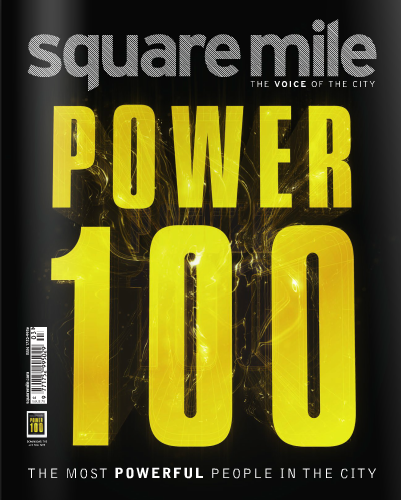
The most powerful man in the City

Square Mile Magazine, April 2013. Original article (p77).

Screen Shot 2014-02-21 at 19.02.04The 100 most powerful people in the City
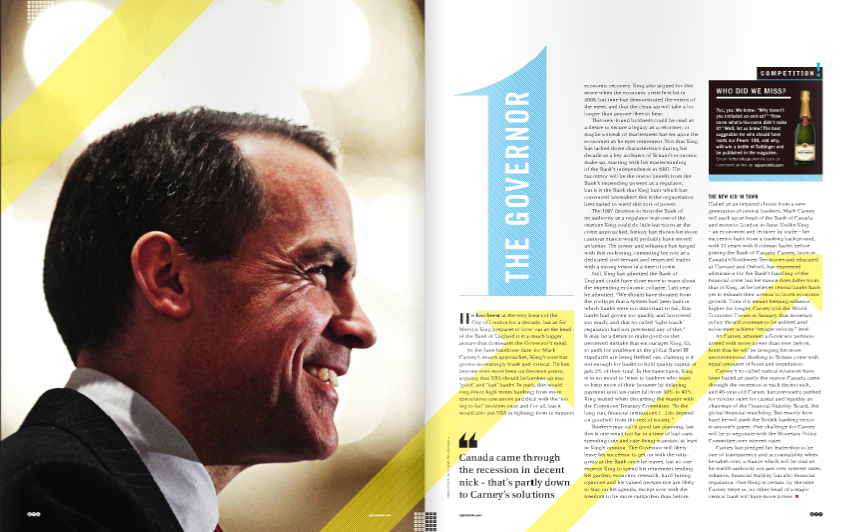
Number 1: The Governor
He is at the heart of the City of London, but as Sir Mervyn King prepares to bow out after a decade as the head of the Bank of England, it is a much bigger picture that dominates the Governor’s mind. As the June handover date for Mark Carney’s tenure approaches, King’s tone has grown increasingly frank and critical over the past few months. King is keen on decisive action, arguing that Royal Bank of Scotland should be broken up into a “good” and “bad” bank. In part this would ring-fence high-street banking from more speculative operations and deal with the ‘too big to fail’ problem once and for all, but it would also put RBS in fighting form to support economic recovery. King argued for this move also when the economic crisis first hit in 2008, but time has demonstrated the extent of the mess, and that the clean-up will take a lot longer than anyone likes to hear.

This newfound boldness could be read as a desire to secure a legacy as a reformer, or maybe a streak of fearlessness has set upon the economist as he eyes up retirement. The Bank of England was stripped of its regulatory powers in 1997, and hence could do little but scorn and tut as the crisis approached; still, King has admitted the Bank of England could have done more to warn about the impending economic collapse. Said King last year in a BBC Today Programme Lecture: “We should have shouted from the rooftops that a system had been built in which banks were too important to fail, that banks had grown too quickly and borrowed too much, and that so-called ‘light-touch’ regulation hadn’t prevented any of this.”

It may be a desire to make good on this perceived mistake that encourages King to push for prudence as the global ‘Basel III’ standards are being fleshed out, claiming it is not enough for banks to hold quality capital of at least 3% of their total. In the same spirit, King is in no mood to listen to bankers who want to keep more of their bonuses by delaying payment until tax rates fall from 50p to 45p. Stressed King when discussing the matter with the Commons Treasury Committee: “In the long run, financial institutions … do depend on goodwill from the rest of society.” Bankers may call it good tax planning, but this is one insult too far in a time of bail-outs, spending cuts and rate-fixing scandals, at least in King’s big picture.

Hailed as an inspired choice from a new generation of central bankers, Mark Carney will pack up as head of the Bank of Canada and move to London in June. King (64), born in Chesham Bois and educated at Cambridge, can look back at a career as an economist, lecturer and public servant at the Bank of England; his successor, however, hails from a banking background, with 13 years with Goldman Sachs before joining the Bank of Canada. Carney (48), born in Canada’s Northwest Territories and educated at Harvard and Oxford, has pledged his leadership to be one of transparency and accountability when he takes over the big seat at Threadneedle. While having expressed admiration for the Bank’s handling of the financial crisis, Carney’s stance does however differ from that of King as he believes central banks have yet to exhaust their arsenal to boost economic growth. Even if it means inflation stays higher, Carney told the World Economic Forum in Davos in January that monetary policy should continue to be utilised until economies achieved “escape velocity”.

Carney’s so-called radical solutions have been hailed as partly the reason Canada came through the recession in decent nick, and Carney has hinted he will be bringing his more unconventional thinking to Britain. As chairman of the Financial Stability Board, the global financial watchdog, Carney has previously pushed for stricter rules for capital and liquidity, but exactly how hard he will push the British banking sector is anyone’s guess. One challenge for Carney will be to negotiate with the Monetary Policy Committee over interest rates; in stark contrast to Britain, Canadian MPC members tend not to publicly disagree with their leader. New laws will give the Bank new authority over financial regulation, meaning that by the time Carney steps in, no other head of a major central bank will have more power.

Screen Shot 2014-06-01 at 22.36.49

Where the internet lives

Aquila Magazine (for children aged 7-12) – June 2014. Original article.

upintheair-0614u

Where does the internet live?
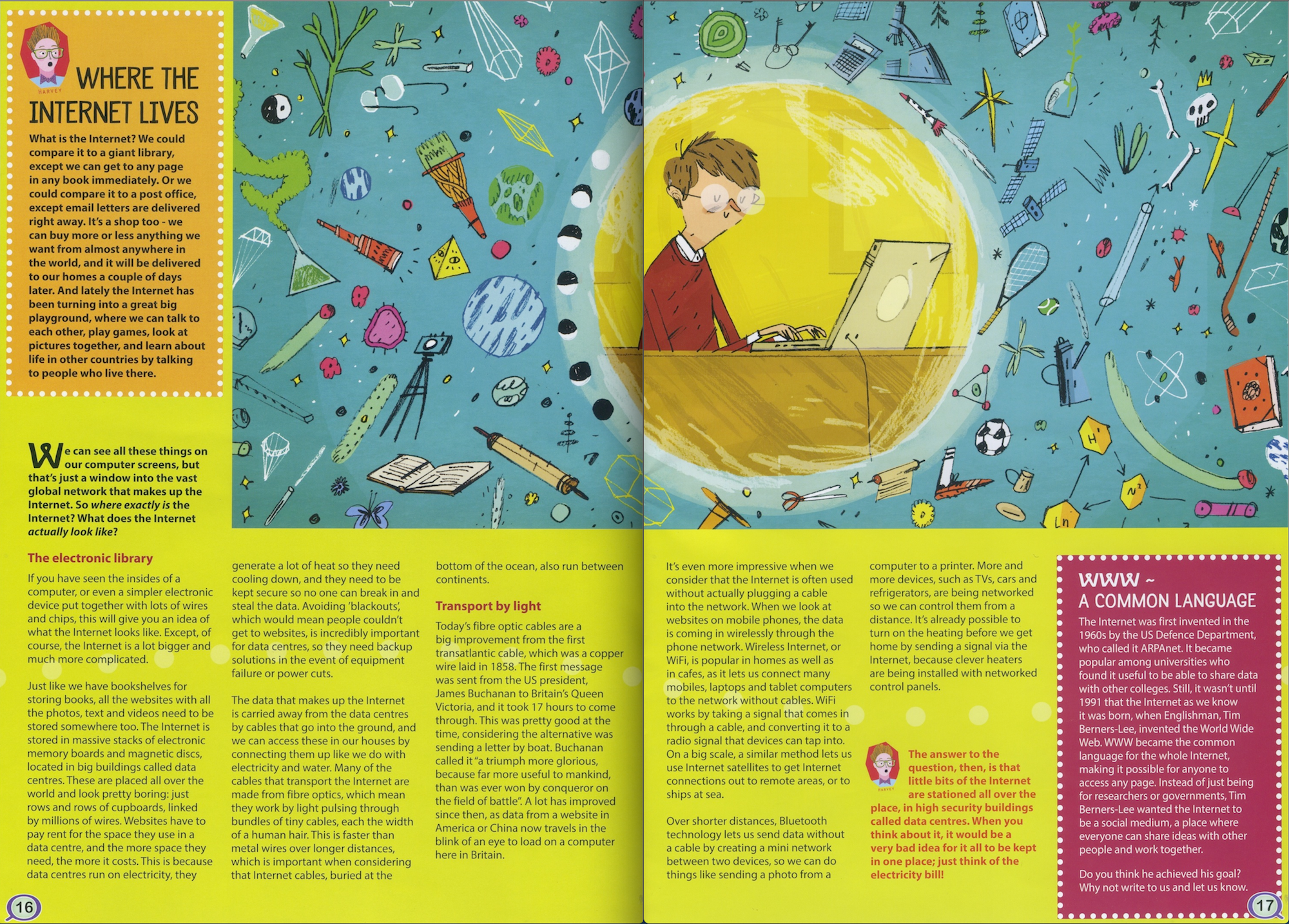
What is the internet? We could compare it to a giant library, except we can get to any page in any book immediately. Or we could compare it to a post office, except letters are delivered right away. It’s a shop too – we can buy pretty much anything we want from almost anywhere in the world, and it will be delivered to our homes a couple of days later. And lately the internet has been turning into a great big playground, where we can talk to each other, play games, look at pictures together, and learn about life in other countries by talking to people who live there.

We can see all these things on our computer screens, but that’s just a window into the vast global network that makes up the internet. So where exactly is the internet? What does the internet actually look like? If you have seen the insides of a computer, or even a simpler electronic device put together with lots of wires and chips, this will give you an idea what the internet looks like. Except, of course, the internet is a lot bigger and much more complicated.

The electronic library
Just like we have bookshelves for storing books, all the websites with all the photos, text and videos need to be stored somewhere too. The internet is stored in massive stacks of electronic memory boards and magnetic discs, located in big buildings called datacentres. These are placed all over the world and look pretty boring: just rows and rows of cupboards, linked by millions of wires. Websites have to pay rent for the space they use in a datacentre, and the more space they need the more it costs. This is because datacentres run on electricity, they generate a lot of heat so they need cooling down, and they need to be kept secure so no one can break in and steal the data. Avoiding “blackouts”, which would mean people can’t get to websites, is incredibly important for datacentres, so they need backup solutions in the event of equipment failure or power cuts.

The data that makes up the internet is led away from the datacentres by cables that go into the ground, and we can access these in our houses by hooking up them like we do with electricity and water. The cables that transport the internet are made from fibre-optics, which mean they work by light pulsing through bundles of many tiny cables, each the width of a human hair. This is faster than metal wires over longer distances, which is important when considering that internet cables also run between continents, buried at the bottom of the ocean.

Transport by light
Today’s fibre-optic cables are a big improvement from the first transatlantic cable, which was a copper wire laid in 1858. The first message was sent from the US president to Britain’s Queen Victoria, and it took 17 hours to come through. This was pretty good at the time, considering the alternative was sending a letter by boat. The US president called it “a triumph more glorious, because far more useful to mankind, than was ever won by conqueror on the field of battle”. A lot has improved since then, as data from a website in America or China now travels in the blink of an eye to load on a computer here in Britain.

It’s even more impressive when we consider that the internet is often used without actually plugging a cable into the network. When we look at websites on mobile phones, the data is coming in wirelessly through the phone network. Wireless internet, or WiFi, is popular in homes as well as cafes, as it lets us connect many mobiles, laptops and tablet computers to the network without cables. WiFi works by taking a signal that comes in through a cable, and converting it to a radio signal for devices can tap into. On a big scale, a similar method lets us use internet satellites to get internet connections out to remote areas, or to ships at sea.

Over shorter distances, Bluetooth technology lets us send data without a cable by creating a mini network between two devices, so we can do things like sending a photo from a computer to a printer. More and more devices are being networked so we can control them from a distance, such as TVs, cars and refrigerators. It’s already possible to turn on the heating before we get home by sending a signal via the internet, because heaters are being installed with networked control panels.

***

WWW: A common language
The internet was first invented in the 1960s by the US Defence Department, who called it ARPAnet. It became popular among universities who found it useful to be able to share data with other schools. Still, it wasn’t until 1991 that the internet as we know it now was born, when Englishman Tim Berners-Lee invented the World Wide Web. WWW became the common language for the whole internet, making it possible for anyone to access any page. Instead of just being for researchers or governments, Tim Berners-Lee wanted the internet to be a social medium, a place where everyone can share ideas with other people and work together.

internet lives


Things I’ve lost to exes, begrudgingly.

The Toast, April 2014. Original article.

Screen Shot 2016-07-01 at 15.36.58

Things I’ve lost to exes, begrudgingly.

Take it to the sea.

Endless loaves of bread
After too many mornings of waking up at his house and finding there was absolutely nothing to eat, I started bringing my own food over. The coffee and peanut butter stayed in the cupboard where I’d left them, but the bread would disappear immediately. At one point I was buying a loaf a week for my own house, and up to three loaves for his. Then he started complaining all that bread was making him put on weight.
* Lesson: Bring a man a loaf of bread and he eats for a day.

Fancy water bottle
My ex and I had the same water bottle: a red aluminium canister of the kind that will last a decade if you look after it. I’d been looking after mine. Then at some point during the relationship the bottles got swapped, but I didn’t become aware of this until we’d gone through the only breakup I’ve ever had where things got so ugly we no longer speak. And my ex had not been looking after his bottle. I don’t want to think the swap was deliberate, as that would have been petty. But then again, he’d been known to use the Twitter account belonging to the cat he’d shared with his ex to try and make her jealous, so.
* Lesson: Trust no one.

James Bond back catalogue
My ex was really into TV, and as a result we watched what amounted to, in my opinion, endless amounts of crap. Amateur cooking shows and kitchen sink dramas, urgh. So the Bond films were an attempt at coming up with stuff we both actually wanted to watch, as we’d exhausted Star Wars and Harry Potter. So I bought the DVDs and kept them at his house, and we chuckled our way through them. I mean, those films are comedies, right?
* Lesson: Opposites attract, then opposites bicker endlessly over what to watch while eating dinner. Romance is dead.

Favourite knickers
Do women actually leave used underpants at the houses of men they are dating, or is that a 1980s film cliche? In any case, these knickers were left behind in a clean state, in a moment of optimism that I’d be returning to wear them. I did not return to wear them. At the time I was too torn up about the guy to be upset about the pink lace number, but it goes without saying: I’ve never left a favourite piece of clothing at anyone’s house ever again.
* Twist in the story: About a year later I found myself back at the scene, briefly, and retrieved the lost knickers! I’ve never been able to wear them again though, so the loss stands.

Favourite yoga teacher
I once got asked out by a man who, like me, liked to do 90 minutes of Ashtanga yoga on Tuesday nights, overseen by a wonderful teacher named Kate. This man was attractive, as boys at yoga often are, but I’m fairly sure I’ve never met a person I have less in common with. Cue Mia Wallace in ‘Pulp Fiction’ making a square with her fingers. Fast forward a couple of weeks, to when his prettiness no longer compensated, and I saw no other choice: I begrudgingly gave him custody of Kate, and bought a bike instead.
* Lesson: Good men are hard to find, but not as hard to find as good yoga teachers.

Desert state

This Recording, 2014. Original article.

tumblr_n0uc8x47xs1qbeqkxo1_500

In which we sleep on crisp white sheets
Desert state


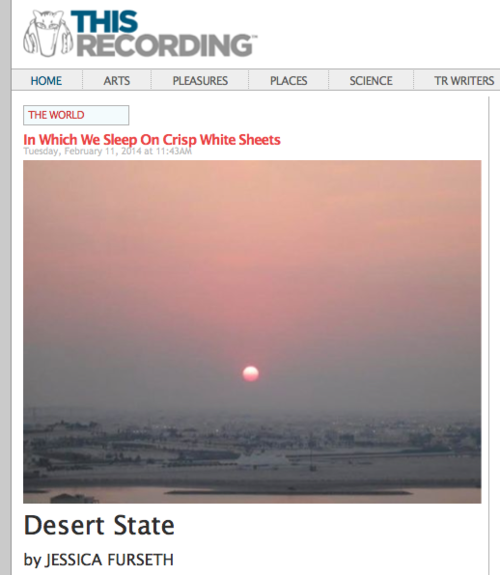
Every morning at 7am I climb over my sleeping husband, pulling the curtains open to let in a stream of dusty light. It’s pitch black until then, inside this hotel bubble without sound nor light, but I’m relieved to get up after yet another night of jetlag-ragged sleep. I tiptoe to the bathroom but nothing in this hotel makes any noise: carpet covers every surface, doors close slowly as so not to slam, furniture is heavy so it won’t topple over. The kettle takes so long to boil I have time not only to prepare the cafetiere, but also to brush my teeth for the full two minutes recommended by the dentist. I listen to the buzzing inside my head while outside, the sky is preparing for another day of pale sun in a violet sky. It’s the same as yesterday, and it will be the same tomorrow. We are in a desert state, in a brand new metropolis built on a sudden fortune, in a place where everything is shiny yet dull. It’s a city but it feels like a suburb, created from a drawing board. Every surface is kept clean yet it’s always dusty; the air is so dry that it only takes a moment.

I sit by the window drinking my coffee, inside a skyscraper hotel that’s part of a skyline that looks impressive from a distance. The bay is a few blocks away but I can see the the shore, because the buildings are just a little too far apart. I’ve never thought about that before: the distance between city buildings. But now, in this brand new environment that’s being built in front of our very eyes, it’s impossible not to look at it. In an old city, like the one I call home, the buildings push into each other, like the people on the street, and everywhere are cafes, shops, and even pavements. Here, each trip to the supermarket means manoeuvring a ledge next to a six-lane road, before scaling a sloped brick shoulder that takes you to the shopping mall parking lot. You’re not supposed to walk, is the thing, not when petrol is this cheap. Half the year it’s too hot to move around on foot anyway, with the searing sunshine leaving the outdoors just as inaccessible as if we were in a snowstorm.

In the bed, my husband has pulled the covers over his eyes, fighting against the light pouring in. He got here before me, so he’s adjusted to the local time. As much as the early mornings is a novelty for me, I envy his ability to stay up past 10pm. The sun is up and I’m awake, but my body is fighting me. I gain a little more ground every day, but I’m alarmed at how my heart pounds against my ribs, like a warning. It’s morning in the desert but my body thinks I’ve been up all night again, hankering back to in a place that’s much bolder and louder than this. I sip my coffee as I listen to the sounds trickling in, muffled through the double-glazing; the construction work has already started. For every building in this city there’s another one going up, and another road blocked to build a new lane. Inside their air-conditioned white cars, people are blasting the horns in frustration over the delays. Outside, the workers wears cloths around their heads to protect from the heat and dust.

Each day the hotel maid brings more bottled water, and provide all fresh towels even though the little card says the towels will only be changed if you put them on the floor. We may be in the desert, but there’s little concern for saving water. I wonder if they recycle all these empty water bottles. If I leave the cafetiere unwashed the maid will clean it; at first I felt I shouldn’t leave it as it’s not their job, but then I forgot a few times and now I think it’s really nice not to have to do it myself. I watch how people in restaurants ignore wait staff who bring them things, wondering how long I’d have to live here before I stopped saying thanks.

I stretch my body on the impossibly white sheets, thinking about what I’m going to do today. I have work but my head is full of cotton. I’m only here for the week anyway, having come to see my husband while he’s working. I’d never have come otherwise, as it’s not the sort of place you to visit. I was at the airport once for a stopover, just long enough to learn the name of the capital city and figure I’d probably never actually see it. But circumstances happen and now I’m here, in a padded hotel bubble, inside a not-quite-there skyline. Time feels like it’s standing still yet it’s slipping away, as before I know it it’s morning again and I’m opening the curtains, listening to the slow hiss of the kettle as the water heats up. In the desert, and in this city, there are no pavements, but people are creating sandy paths, through the construction sites. Every evening the sun sets, creating a bright spectacle in the sky, and for a moment it’s amazing before it’s gone and the sky is a dark, blank slate. Something is happening, but life is elsewhere.

My knight and I

Lionheart Magazine, Shapes issue, 2013. Original article.

lionheart4My knight and I
At night I curl up in the bed and twist my arms around my legs, one hand grabbing an ankle with a knee hiked to my forehead. The city is my nightlight, slipping past the curtain to make shapes on the floor. I listen to the rustle of distant traffic with closed eyes, and within moments I’m asleep. I’m a big girl now, even tangled up in the foetal position, and I no longer have wolves at the door.

When I was a kid, monsters would come when I turned the light off to sleep. Playful cartoon creatures would grow dark and menacing at night, looming in the corners. Fairytales my grandma told me, over the smell of familiar dishes in her warm kitchen, would turn on me at night. In the stories, trolls living under bridges were pushed into the water, and wicked fairy godmothers were split in halves by brave knights. But at night they came back to life, turning my blood to ice.

During the day the imaginary monsters slept. I would walk home from school, glancing over my shoulder in case the mean boys were around. They didn’t hit me very often. Mostly they would shout, but I could barely hear a word for the thud-thud-thud of my heart pounding inside my chest. I don’t remember much anymore, but if I close my eyes I can put myself in those little shoes and let the feeling rush in all over again.

Putting one small foot in front of the other I used to walk home, locking myself in the house until my parents came home from work. They would make dinner, and the three of us would eat together at the old, wooden kitchen table. Then later they would read me stories, where knights in shining armour made sure the witches met with their deserved end. But at night the creatures roamed free. I left the bedside light on and pulled the covers over my head, and lay there stiff and scared to breathe until sleep came.

This is a very long time ago now, and I hardly ever think about it anymore. Remembering used to make me feel helpless, but as I’ve grown up the sentiment has changed. When I dive into the memory now it’s less often as the girl – instead I’m the knight, having stepped out of the fairytale to put the world right. In my armour I slay the evil goblins and toss them into the river, watching as they thrash against the rocks, whispering: ‘Who’s ugly now?’

The birthmark I’ve always had on my thigh used to be exactly in the middle, but now it’s sitting three-quarters of the way up. I’m still in the same skin, but my bones have grown. For each thing that changes, it seems, there’s something that stays the same. The skin around my eyes shows my age, but I peer down at my feet and they look exactly the same as they always did: stubby toes, puffy on top. The little girl has found her knight in shining armour, and it turns out it was me all along.

knight


Ten houses in ten years in London: A story of hope over experience

The Billfold, 2013. Original article.

Ten houses in ten years in London: A story of hope over experience

Screen Shot 2014-03-01 at 15.18.15

1. Acton (1) – 6 months
The year is 2003, and two fresh graduates from Southampton roll into London to take it all on. Unfortunately they have no idea what they’re doing, which is why they’ve ended up in Acton, West London. Ten years later, this is still the worst location I’ve lived at in the capital, plus the rent there was more than what I pay now. The flat itself was very nice, but the area was thoroughly charmless and it was just ridiculous to pay £550 per month each. I cringe slightly at admitting that now, but we were new to London, a city that treats its newcomers in a way that makes you understand why it’s nicknamed ‘The Big Smoke’. My friend and I broke the contract early and have never really spoken about it since.

2. Acton (2) – 2 months
As a temporary arrangement, I moved in with my boyfriend and our other friend in their cream-carpeted semi-detached Victorian facing a very loud road. The rent here was the same as the first Acton flat, but as we split it threeways it was a very manageable £360. The bus stop outside meant you couldn’t watch TV with the windows open though, and everything was beyond walking distance. I was unemployed during these two months and thoroughly miserable; I don’t want to talk about it.

3. Chiswick – 15 months?
The Acton Three moved up in the world, to a nice flat just next to Turnham Green tube. It’s pretty pleasant there: there was a lovely chocolate shop that sold lavender truffles, and a coffee shop on the other side of the park. The rent was the same as the previous place, as I’d learned something vital about the London market by this point: living in a crappy area doesn’t necessarily mean you save on rent. London started to agree with me while I lived in this flat. The porter looking after the block, however, did not; he regularly left notes about drying laundry being visible through the window from the road. I still don’t know what that was about.

4. Dulwich – 1 month
Temporary dwellings after breaking up with my boyfriend of nearly five years. This marked the move to South London, with its other-side-of-the-river feeling and tricky transport links. I don’t remember much about this place, other than there being a ghost in the master bedroom. We all agreed on this when discussing it in retrospect, but were too fearful to acknowledge its presence while still living in the house.

5. Camberwell – 10 months?
A spider-infested but otherwise nice basement flat on what was allegedly one of the most burglarised streets in London. Top tip: if anyone you know move to such a location, please do leave them to their ignorance; we have the Daily Mail if we want to live in paranoia. I think the rent was around £450, which was a bit expensive but okay. Positives to this flat included oak floors and the neighbours’ cat, but the endless bus journeys to get to the tube is the overarching memory, not to mention a general reason never to move back south of the river ever again. Prejudiced, yes, but that’s my opinion.

6. Spitalfields – 10 months
This little flat marked the wise, wise move to East London. I could see Spitalfields Market from the living room window, a fantastic feature which was strongly reflected in the price, meaning my boyfriend and I were financially unable to take advantage of our new and fancy location. Having said that, paying £600 for this flat would be a steal today; the gentrification is complete and Urban Outfitters has since moved in across the road. I spent a lot of time wandering around buzzy Brick Lane late at night. Every few days I’d get a bag of fresh bagels, which at 15p a pop from Beigel Bake was budget food. It wasn’t bad at all.

7. Shoreditch – 18 months?
I found this flatshare in a grimy Shoreditch council estate on the internet while in a daze, brought on by looking for a new job and a new house while also contract-bound to co-exist with my ex in the tiniest flat ever. The fact the ensuing dark-side-of-Shoreditch life worked out as well as it did was a stroke of luck; at £550 the rent even included most bills. The estate kids threw water balloons, sure, but they never managed to hit me, and Shoreditch was the perfect place to live when I was single and needed a crowd on my street to walk through when coming home late at night.

8. Mile End – 10 months
Really nice flat, this, and the high-speed trains from Essex which brushed up against the wall every 15 minutes provided this interesting suction effect in the air. The rent was discounted because the recession had just hit, and at £450 it was a steal for such a spacious flat, close to both the tube and the park. I lived with a friend who was a cleaning nut, and he deemed my domestic efforts so insufficient that he preferred to do it all himself. It seemed like a good arrangement at first, until his control-freakery leaked into other aspects of our lives and it became absolutely necessary for me to leave. I’d go into detail, but I seem to have blocked out most of it. Safe to say, this is a cautionary tale.

9. Limehouse – 22 months
My longest stay at a London address to date. By this point I’d started to notice how a good flat would invariably reveal an issue to do with plumbing or the other humans and lead to short stays, while the shitty flats tended to result in long stays. This was no exception: the company was good, but the Poplar border-location was terrible and every single household appliance broke while we lived there – some more than once. A constant feature was how the shower would swing rapidly between hot and cold, meaning I can now wash like I’m Roadrunner. It was really cheap though, at just £420 a month, so we put up with it until the rent went up by 20% overnight and we left in shock. It was probably for the best.

10. Stoke Newington – 16 months and counting
My favourite house so far: it’s big, it’s full of nice people and touch wood, no major issues have yet to be identified. I mean, the mice moved on almost right away once we got the sonic repellers. If anyone’s curious, I’ve identified the key to houseshare happiness: a mixed group of three to five people, a cleaning rota and a working boiler. I moved to the Stokey-Dalston borderlands after a two-week stay at a friend’s to tide me over the search, which I actually conducted with some care this time. (In hindsight, this may have been the core problem leading to many of the previous duds.) The house is massive but the room is a shoebox; the rent reflects this and consequently I have money left to spend on airfare. I am very happy about this choice. This is also my first North London postcode, meaning I’ve done the circle. To my surprise, I absolutely love it up here. “I may never move again,” she said.

[Update: 13 houses in 15 years in London]

London hits me, it feels like a kiss

Litro Magazine, March 2014. Original article.

litroLondon hits me, it feels like a kiss
With swift, rehearsed motions I prop my bicycle onto my hip, swaying my body as a counterweight as I start the climb up the stairs. Music still blares in my left ear, too loud now there’s no traffic to drown it out, as I swing my wheels around corners, careful not to scrape the walls. At home I keep my bike in my hallway, as city dwellers do. The rustle of the traffic is still audible through thin walls and vibrating panes of glass, reminding us of the city that holds us. We love and hate the city, the London planet that’s our home.

I live out East, and while I can travel for hours I rarely make it out West. It’s a different life out there, one of steady living and picnic-dense parkland, not at all like the flowering decay of the East. Here, change happens so rapidly it’s almost tangible. You don’t discover the personalities of the city until you’ve been here a while, and by then you shrug at the irony of having moved to London to explore the multitude, only to find yourself ensconced in a small pocket of this giant metropolis. We sought variety but once we arrived, we discovered what we really wanted was to find our people and to make a home. We build walls around the East London village and scowl at strangers.

When visitors come from out of town we take them to the core of London, to the centre that all the London tribes share because no one actually live there. At least no real people do, only the Queen and her knights, but us mortals are allowed to walk in the streets and admire the tall, pale buildings. Old trees stretch up along the walls, making a good effort but it’s not the green that dominates the city. It’s not the stone and glass either, it’s about something else. The charm of the Big Smoke starts somewhere in the cracked pavements, continuing up the grimy streets and random alleyways, into the little squares with their cemented benches and unexpected moments of calm. We potter around the city, feeling like we’re a part of something. It’s vast, this city, enough so that it sometimes feels like this is the whole world. Pass the city limits and you will drop off the known universe.

It’s a demanding love, London, draining its people with long, dusty streets and cramped buses. This isn’t a place for flowers, it’s a place that tests the human spirit. If you want it badly you can have it, but you will wince slightly with the push of each step. Out East there are no grandiose monuments and our towers are run down council estates, carrying their concrete smell and graffiti-covered corners like badges of honour. The canal weaves through the neighbourhoods, with walkways on either side and flowers living among broken bottles under the benches. Keep going and the canal becomes a river, the parkland becomes a marsh and still you haven’t left London.

When it rains, London gets wetter than any other place in the world. Tourists are startled at the fervour with which the water splashes down, how it pummels the ground. On a good day it goes on for ten minutes and it’s gone, on a bad day it doesn’t stop and it keeps going for several more. My hallway is lined with damp shoes, one added per day of rain until I run out of dry footwear and have to circle back to the least wet pair. I scrunch up newspaper and stuff it into the shoes to soak up some of the water, looking over at my sandals and wonder when the weather was ever good enough for them to get worn down like that. When London rains, it’s hard to remember a time when the damp didn’t creep into your bones.

Then it stops raining, the pavements dry and the dust kicks up again like nothing ever happened. I walk across Waterloo Bridge and realise for the hundredth, for the thousandth time, how much I love this city. Late Sunday afternoons in Victoria Park and all you can hear is the rustling of the leaves and the nattering of the Eastenders, in their loafers and wayfarers next to their knocked-over fixie bikes. A year passes and I don’t move, but the city moves around me and change is constant. The universe circles around London and when I go away I can feel the pull of its gravity. As much as I love to travel, on the plane back to London there’s always a feeling of things righting themselves. Knowing a slow journey in a grimy train is ahead of me, I drag my bags across the carpeted arrivals halls of Gatwick airport, happy to be home. I’m grateful for London, she makes me what I am.

Thor Heyerdahl

In Aquila Children’s Magazine (ages 7-12), February 2014.

scandinavia-feb14u

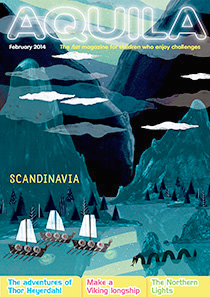
The adventures of Thor Heyerdahl
Norwegian explorer Thor Heyerdahl crossed the open ocean on wooden rafts, risking his life to prove that people in pre-historic times could have travelled the world.

When a young, unknown researcher named Thor Heyerdahl claimed people from South America had travelled to the islands in the Pacific Ocean, no one took him seriously. Most scientists were certain: the people who live on these islands, known as Polynesia, had come from Asia. This was because pre-historic South Americans didn’t have any boats which could have survived the long and dangerous journey.

Heyerdahl quickly understood there was only way to prove his theory: travel across the ocean himself. A crazy idea for sure, but Heyerdahl had a raft built, using the same materials and methods as the pre-historic South Americans would have used. With a crew of seven, Heyerdahl set out from Peru in April 1947, letting the sea currents and wind take them where it wanted. The Kon-Tiki raft travelled 7,964 kilometres before reaching Polynesia, 101 days later. Heyerdahl had proved he was right: pre-historic South Americans could have crossed the Pacific Ocean.

The young explorer
Thor Heyerdahl was born in Southern Norway in 1914, in the town of Larvik. It was his mother, Alison, who inspired him to become a researcher. She was a chairwoman of the city’s museum association, and a supporter of Charles Darwin’s theory of evolution. Thor created a small museum in the office of his father, a master brewer also called Thor. Young Thor decided to become an explorer when he was eight, and went to the University of Oslo to study biology and geography. There Thor met a collector who had travelled in Polynesia, a friendship which inspired Thor’s interest in the region. Soon after, he went to the island of Fatu-Hiva and lived there for one year.

Heyerdahl wanted to discover how Polynesia originally became filled with plants, trees and animals. He realised the winds and ocean currents were constantly coming from South America, and that this had consequences for plant life. But it was only when he found the same types of statutes on the islands as previously found in South America, that Heyerdahl started wondering: maybe the winds and currents brought more than just plants from South America to Polynesia? Maybe they brought people too?

Kon-Tiki
This was when Heyerdahl decided to prove this theory by setting sail on the Kon-Tiki. In the documentary he made about the trip he talks about how people doubted whether the crew would survive. After all, no one could save them once they headed out into the open sea on their simple raft, made from nine balsa tree logs with a small hut on top. “On calm days, we would float like a cork,” said Heyerdahl. “On smooth days, it felt like utopia.” But not every day was calm. Lorita, the seasick parrot who had come along from Peru, was lost in a storm. Swimming was dangerous because of the strong currents, not to mention the sharks which frequently followed the raft. The whales were dangerous too, as they sometimes topple small boats at sea. Heyerdahl admitted there were times he feared for his life on the Kon-Tiki, as he had been afraid of water as a child and never really learned how to swim.

Ra and Tigris
Heyerdahl became famous after the Kon-Tiki mission. While most scientists still disagreed with his theory that South Americans had travelled to Polynesia, at least it was clear it was possible. Heyerdahl was a big believer in the diffusionist theory: the idea that pre-historic civilisations had been in contact with each other. This could explain why groups who lived very far apart, like the Egyptians in Africa and the Mayans in South America, both built pyramids. But most scientists, both during Heyerdahl’s time and now, are separatists: they believe these similarities are coincidental, probably occurring because people all over the world have a lot in common.

Heyerdahl’s next sea voyage came in 1969, after he found pictures of reed boats during his archeological digs on Easter Island in Polynesia. Reed boats were also common among Mediterranean civilisations, meaning people could have travelled from there to South America, and then to Polynesia. Heyerdahl decided again to prove the skeptics wrong, and built a boat out of reeds and set sail from Morocco. Ra 1 had to be abandoned after 5,000 kilometres, but Heyerdahl was undeterred. Ten months later he tried again with Ra 2, which successfully reached South America.

Heyerdahl’s largest reed boat was built in 1977, this time with the ability to navigate instead of just drifting. The Tigris set out to prove it had been possible for people in the ancient civilisations of Mesopotamia, Egypt, and the Indus Valley to be in contact with each other. After five months at sea, the Tigris ended its voyage by the Red Sea, where Heyerdahl burned the proud ship in protest of the wars happening in the surrounding countries.

The biggest adventure
People describe Heyerdahl as a charismatic man with massive amounts of energy. But in video interviews he comes across as modest, almost shy, using formal language and always determined to make us understand: this is about science. For Heyerdahl, his voyages were also a message for people to work together. His crews on Ra and Tigris were all from different countries sailing under the United Nations flag, proving that people born to different places, habits and religions can work together. “Each of us were depending on the others’ friendship and help to survive. We knew if one of us was unwell, it would affect us all. That we all got along so well, that was the greatest part,” said Heyerdah, in an interview on Norwegian TV. “When you get to the bottom of it, to the big questions of life and death, people are so similar. We are all slices of the same loaf.”

During the Ra voyages, Heyerdahl became concerned with pollution of the world’s waters, as the crew found hardened clumps of tar floating in the water nearly every day of the 57-day-long trip. Heyerdahl’s reports were an important wake-up call for the international community about the dangers of pollution. “We seem to believe the ocean is endless. We use it like a sewer,” said Heyerdahl. Remaining a vocal advocate for the environment for the rest of his life, Heyerdahl was also a tireless supporter of international collaboration: “Borders – I have never seen one. But I have heard they exist in the minds of some people.”

Heyerdahl died in 2002 when he was 87 years old, living with his third wife Jacqueline in Italy. He had five children from two previous marriages: Bjørn, Thor Junior, Annette, Marian and Helene Elisabeth. While the theory of contact between pre-historic societies has now largely fallen out of favour, Heyerdahl continued his work until his death, convinced he was right. We may never know for sure, but last year research from the University of Oslo provided clues. Blood samples from the current inhabitants of Polynesia show they are mostly descended from Asia, but some of them have South American genes too. So it seems Heyerdahl was at least a little bit right.

photo(1)

Technology in times of crisis

In Aquila Children’s Magazine (ages 7-12), March 2014.

aquila2Technology in times of crisis
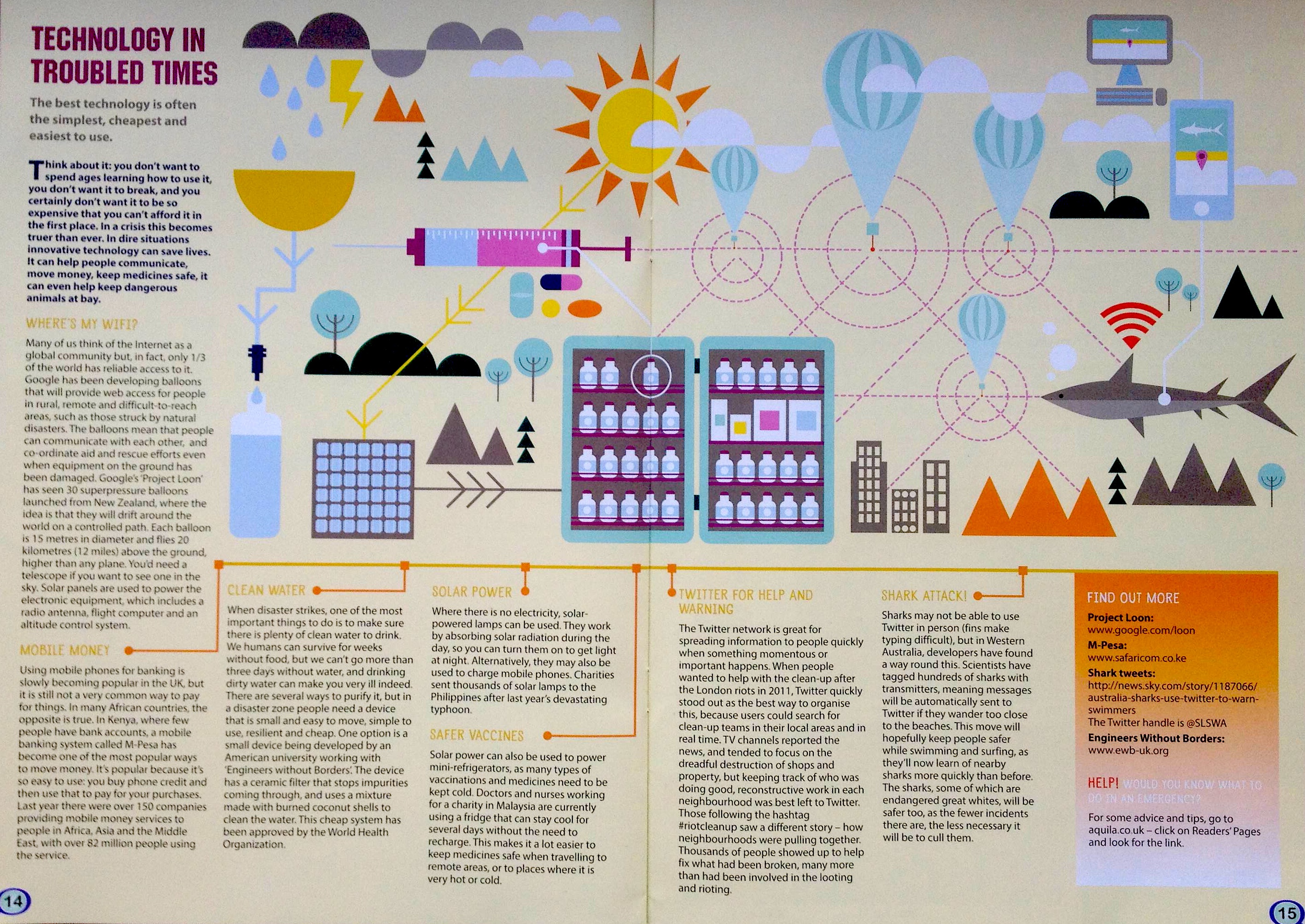
The best technology is often the one that’s the simplest, cheapest and easiest to use. Think about it: you don’t want it breaking, you don’t want to spend ages learning how to use it, and you certainly don’t want it to be so expensive you can’t afford it in the first place. In a crisis this is true more than ever, as good technology can be priceless by helping people talk to each other, move money, keep medicines safe, and even keep sharks at bay.

Balloon internet and mobile money
To bring the internet to remote areas, Google has been developing balloons that will provide web access for people on the ground below. This is a great idea for areas struck by natural disaster, as people can communicate with each other, and coordinate aid and rescue efforts when equipment on the ground has been damaged. Google’s ‘Project Loon’ has seen 30 superpressure balloons launched from New Zealand, where the idea is that they will drift around the world on a controlled path. Each balloon is 15 metres in diameter and fly 20 kilometres above ground, higher than any plane. Solar panels are used to power the electronic equipment, which includes a radio antenna, flight computer, and an altitude control system.

Using mobile phones for banking is slowly becoming popular in the United Kingdom, but it is still not a very common way to handle money. But in many African countries, the opposite is true. In Kenya, a mobile banking system called M-Pesa has become one of the most important tools to move money. The reason for its popularity is because it’s so easy to use: you buy phone credit, and then use that to pay for things on your phone. There is no need to have a debit card, which is another reason the system has become so widespread: most people in Kenya don’t have a bank account, but lots have mobile phones. Last year there were over 150 companies providing mobile money services to people in Africa, Asia and the Middle East, with over 82 million people using the service.

Clean water and safe vaccines
Making sure there is plenty of clean water to drink is probably the most important thing in a disaster. We can survive for weeks without food if we have to, but we can’t go more than three days without water. There are several ways to purify water, but in a disaster you need one that is small and easy to move, simple to use and not breaking too easily, and probably most importantly: cheap. One option is a small device being developed by an American university working with Engineers Without Borders. The device has a ceramic filter that stops contaminants from coming through, and uses a mixture with burned coconut shells to clean the water by stimulating an active-carbon process. The cheap system has been approved by the World Health Organisation.

When there is no electricity, solar-powered lamps can be used. They work by absorbing solar radiation during the day, so they can emit light at night. Alternatively, they can be used to charge mobile phones. Charities sent thousands of solar lamps to the Philippines after last year’s typhoon. Solar power can also be used to power mini-refrigerators, as many types of vaccinations need to be kept cold. Doctors and nurses working for a charity in Malaysia are currently using a fridge that can stay cool for several days without needing re-charging. This makes it a lot easier to keep medicines safe when travelling to remote areas, or to places with extreme temperatures.

Twitter for help and warning
The Twitter network is great for spreading information to people quickly when something happens. A good example of this is when people wanted to help with the clean-up after the London riots a couple of years ago. Twitter became the best way to organise this, because people could search for clean-up teams in their local area. TV would report the news, but keeping track of who was doing what in each neighbourhood was best left to Twitter. Another point is how the TV channels focused on the destruction, while those following the #riotcleanup hashtag on Twitter saw a different story: how neighbourhoods were pulling together, and thousands of people showed up to fix what had been broken.

Sharks may not have hands to type messages to send to Twitter, but in Western Australia, that is not a problem. Scientists have tagged hundreds of sharks with transmitters, meaning messages will automatically be sent to Twitter if they go too close to the beaches. This will hopefully keep people safer while swimming, as they now learn of nearby sharks a lot quicker than they used to. The sharks, many of them being great whites, are safer too, as beach security is an important issue in Australia. Fewer incidents with swimmers and surfers would make it easier to defend sharks from being culled.

emergencyaid-mar14u

Matthew Day Jackson

Published in This Is Tomorrow, 2011. Original article here.

JACKSONMatthew Day Jackson: Everything leads to another
Hauser & Wirth, London

Just as Monet’s paintings of waterlilies were originally presented in a long line, Matthew Day Jackson’s impressions of the surface of the moon stretch out across an entire wall of the Hauser & Wirth gallery. One panel follows another to cumulative effect, but as you stand in front of ‘Reflections of the Sky’, the enormity of the symbolism actually makes the piece feel almost on the small side. The subtle pattern is compelling to look at, to the degree that even as you are standing in front of it, you somehow want more.

Matthew Day Jackson has a knack for drawing in his audience. With ‘Everything Leads to Another’, the artist is interested in beauty that carries a counterpart, ‘so closely that it is difficult to delineate one from the other’. Works by the Brooklyn artist fill both galleries at the Savile Row space, with the North gallery dominated by large-scale pieces such as the moonscape and ‘Axis Mundi’, a manipulation of the cockpit of a B29 aircraft bomber. Positioned next to the moonscape, the polished cockpit segment evokes thoughts of space travel, an impression strengthened by an interior filled with strange, neon-coloured anthropological artefacts, as a nod to the undiscovered.

If the North gallery looks for the big picture through humanity’s push outwards, the South gallery takes the opposite approach and searches for answers by looking inward. With the notion of mortality running as a central theme, the artist has used his own body to examine what it is we are made from. Especially here is it tempting to touch Jackson’s sculptures, which are rich in texture and you suspect you may be missing out on a layer of the experience by being restrained to simply looking.

The central figure is a life-sized body, carved like a topographical map. The main body is made from a concoction of materials, including wood, wax and plastic, with carefully crafted internal organs sitting heavy in the middle. Four images surround the central figure, each presenting the body in different manners. The body made from meat set in jelly is the most uncomfortable to look at, to the extent that the depiction of the burning corpse is a relief. There is a discomfort that comes with being confronted with the messiness and the vulnerability of the body mechanism, but in Jackson’s world also this is a counterpart indistinguishable from the related beauty.

The exhibition concludes with a video piece, presented in a retro-style living room set. A documentary-style film, ‘In Search of … Ghosts’, plays surrounded by artwork, including Jackson’s ‘Life’ magazine covers with patches of embroidery. From the sofa in the artist’s fake living room, you are surrounded by references to space exploration and theories about the unknown; ‘who are we, and where do we come from,’ asks the video narrator, ‘what lies waiting in our future?’ But as the video continues to ponder the paranormal, it seems that whether we look into space or within our own bodies, the answers may well be the same. As Jackson points out, everything leads to another, and we can see our own reflection on every surface.