
Published in The Simple Things, January 2025.
Midwinter doesn’t really have many smells of its own. Beyond the invitingly acrid aroma of pine and the icy metallic scent of snow, this season’s smells are mostly memories of things that happened before nature went to sleep. Such as the baked goods spiced with ginger, cardamom and nutmeg, grown in summer and dried for later. Or the earthy whiff of wool jumpers that have become damp, bringing to mind sheep grazing in green fields. And as I grew up in a house with a woodstove, a classic winter scent for me is the sweet smoke of burning logs, with sap crusting around the twig holes as a reminder that inside every tree that’s currently bare, spring is waiting. So many good things of winter are the labour of warmer seasons, and our foresight to put away some of our good fortune so we can enjoy it later.
Except for citrus, that is – this is a delight that belongs solely to winter. Oranges are an unexpected flashy celebration of the coldest months, bursting in the door with unmistakable tang and cheeky brightness. January is peak season for citrus fruits of every persuasion – this is when oranges are at their most juicy and sweet. Or if you like them tart, this is the time for blood oranges, lemons and grapefruits, and let’s not forget the Seville orange, the queen of marmalade.
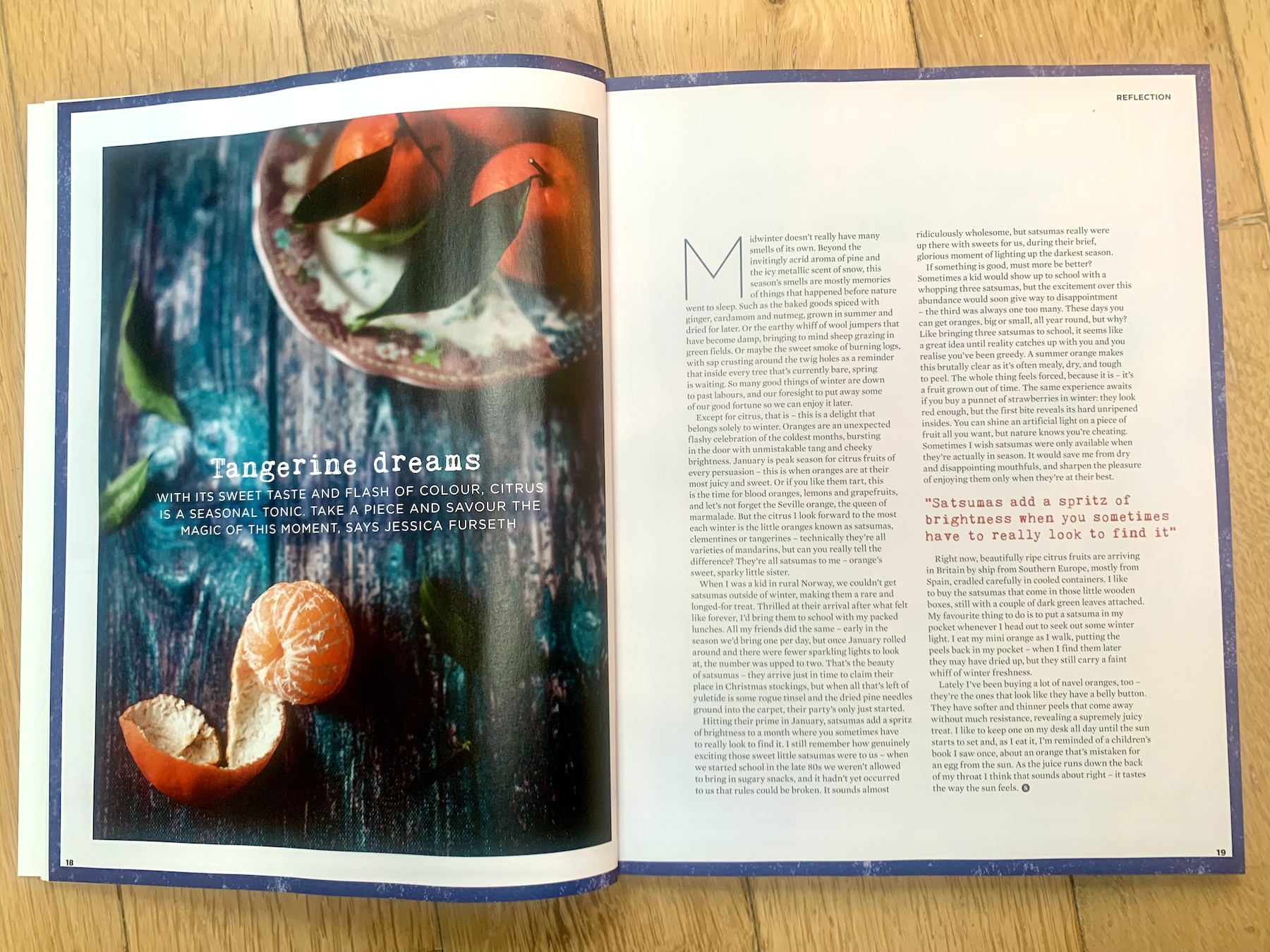
But for me, the citrus I look forward to the most each winter is the little oranges known as satsumas, clementines or tangerines – technically they’re all varieties of mandarins, but can you really tell the difference? They’re all satsumas to me – orange’s sweet, sparky little sister who’s here to just have fun.
When I was a kid in rural Norway, we couldn’t get satsumas outside of the winter season, making them a rare and longed-for treat. Thrilled at their arrival after what felt like forever, I’d bring them to school with my packed lunches. All my friends did the same – early in the season we’d bring one per day, but once January rolled around and there were fewer sparkling lights to look at, the number was upped to two. That’s the beauty of satsumas – they arrive just in time to claim their place in Christmas stockings, but when all that’s left of yuletide is some rogue tinsel and the dried-up pine needles ground into the carpet, their party has only just started.
Hitting their prime in January, satsumas add a spritz of brightness to a month where you sometimes have to really look to find it. I still remember how genuinely exciting those sweet little satsumas were to us – when we started school in the late 80s we weren’t allowed to bring in sugary treats, and it hadn’t yet occurred to us that rules could be broken. It sounds almost ridiculously wholesome now, but satsumas really were up there with sweets for us, during their brief, glorious moment of lighting up the darkest season.
If something is good, must more be better? Sometimes a kid would show up to school with a whopping three satsumas, but the excitement over this abundance would soon give way to disappointment – the third was always one too many. These days you can get oranges, big or small, all year round, but why? Like bringing three satsumas to school, it seems like a great idea until reality catches up with you and you realise you’ve been greedy. A summer orange makes this brutally clear as it’s often mealy, dry, and tough to peel. The whole thing just feels forced, because it is – it’s a fruit grown out of time. The same experience awaits if you buy a punnet of strawberries in winter: they look red enough, but the first bite reveals its hard unripened insides. You can shine an artificial light on a piece of fruit all you want, but nature knows you’re cheating. As someone who enjoys perusing a full range of nut milks at the supermarket it feels a little hypocritical to say this, but sometimes I wish satsumas were only available when they’re actually in season. It would save me from dry and disappointing mouthfuls, and sharpen the pleasure of enjoying them only when they’re at their best.
Right now, beautifully ripe citrus fruits are arriving in Britain by ship from Southern Europe, mostly from Spain, cradled carefully in cooled containers. I like to buy the satsumas that come in those little wooden boxes, still with a couple dark green leaves attached. My favourite thing to do is to put a satsuma in my pocket whenever I head out to seek out some winter light. I eat my mini orange as I walk, putting the peels back in my pocket – when I find them later they may have dried up, but they still carry a faint whiff of winter freshness.
Lately I’ve been buying a lot of navel oranges too – they’re the ones that look like they have a belly button. They have softer and thinner peels that come away without much resistance, revealing a supremely juicy treat. I like to keep one on my desk all day until the sun starts to set, and as I eat it I’m reminded of a children’s book I saw once, about an orange that’s mistaken for an egg from the sun. As the juice runs down the back of my throat I think that sounds about right – it tastes the way the sun feels.

 Jessica Furseth